
Everything you need to know about liposomal delivery
Learn when liposomal delivery improves supplement absorption, how to spot real liposomal products, and why NZ buyers should check claims closely.
Liposomal delivery sits at the intersection of supplement science and supplement marketing, which is exactly why it confuses so many buyers. In simple terms, it means packaging a nutrient inside tiny phospholipid bubbles called liposomes so it is better protected through digestion and more available for absorption. When that system is genuine and stable, it can change how much of a nutrient actually reaches your bloodstream.
What most people overlook is that liposomal delivery is not really about fancy packaging. It is about whether absorption is the limiting factor in the first place. A cheap standard supplement can be perfectly adequate for some people and some nutrients. For others, especially if you are older, dealing with gut issues, taking several supplements at once, or trying to correct a meaningful nutritional gap, delivery can matter more than the label dose.
In New Zealand, there is another layer to the decision. Liposomal claims are easy to make, hard for consumers to verify, and not pre-approved by regulators before products go on sale. That means you are not just deciding whether liposomal delivery works. You are deciding whether a product is truly liposomal, whether it stayed intact through shipping and storage, and whether higher absorption is actually useful - or potentially too much - for your situation.
This overview brings those threads together. You will see where liposomal delivery can genuinely improve value, who is most likely to benefit, what warning signs to look for, and how to make a more grounded buying decision instead of paying extra for a claim.
Why liposomal delivery changes the supplement value equation
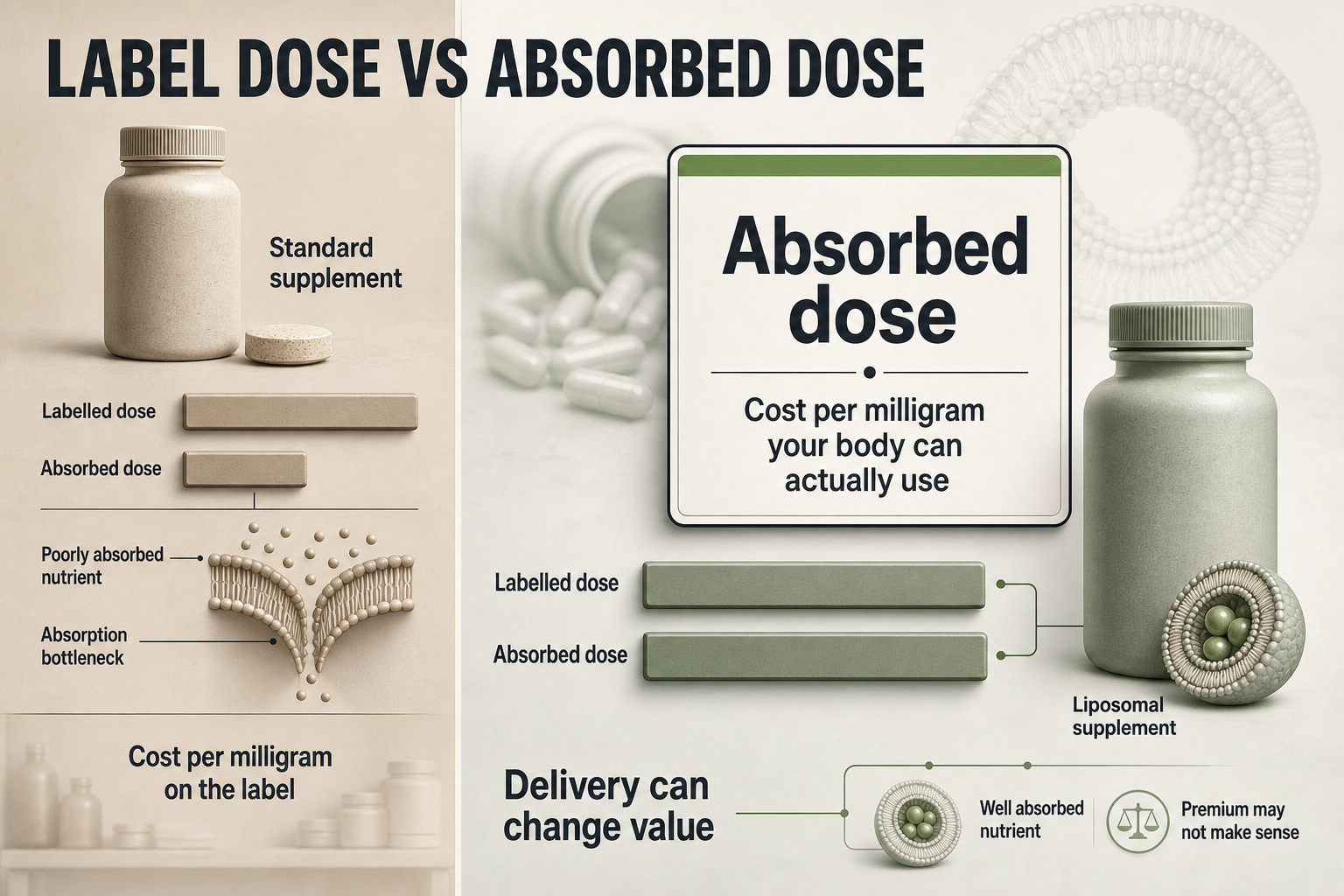
The core reason liposomal delivery matters is simple: labelled dose and absorbed dose are not the same thing. Most supplement shopping still revolves around milligrams per serving and price per bottle, but those numbers can be misleading if a nutrient is poorly absorbed in standard oral form. In that case, the true comparison is not cost per milligram on the label. It is cost per milligram your body can actually use.
That is the big idea behind Everything you need to know about liposomal delivery ›, which frames delivery as the hidden variable in supplement effectiveness. The Hidden Tax on Every Supplement You Buy › shows why poor bioavailability quietly inflates the real cost of standard supplements. Why Doubling Your Supplement Dose Is Not Doubling Your Results › adds an important nuance: for nutrients with transporter limits, taking more often means excreting more, not absorbing more. The Start-Stop Supplement Trap That Costs You Thousands › then connects weak delivery to a familiar real-world pattern - you take a supplement, feel little, stop, restart later, and repeat the cycle for years.
What buyers often misunderstand is that liposomal delivery is not automatically better because it sounds more advanced. It is better only when ordinary oral absorption is a real bottleneck. If the nutrient already absorbs well, or your needs are modest, the premium may not make sense. But when absorption is poor, comparing products without considering delivery is like comparing cars by fuel tank size while ignoring fuel efficiency.
Who is most likely to benefit from a higher-absorption format?
Liposomal delivery tends to matter most when you are not starting from an ideal baseline. That can mean your diet is leaving gaps, your digestive system is not absorbing efficiently, or your life stage has changed what your body can extract from ordinary supplements. In those situations, standard tablets can underdeliver even when the dose looks generous.
The Nutrient Gap Your Doctor Will Never Diagnose › explains the grey zone between obvious deficiency and true adequacy, where many people are not clinically deficient but still not optimally nourished. The Double Deficit Hiding in New Zealand's Clean, Green Food › adds a local NZ angle by highlighting soil-related shortfalls in selenium, zinc, and iodine. The Ageing Absorption Cliff: Why Your Supplements Stop Working After 50 › shows how age-related changes such as lower stomach acid, reduced digestive function, and common medication use can all reduce nutrient uptake. Your Gut Is Quietly Sabotaging Your Supplements › makes a similar case for people with reflux, IBS, inflammation, or other gut issues.
There is also a cumulative aspect. The Immune Debt You Are Building Every Winter › argues that underdelivered immune nutrients can chip away at resilience over time, especially with age. The pattern across these articles is clear: liposomal delivery is not mainly for people chasing novelty. It is most relevant for people whose absorption is already compromised, whose nutrient demands are higher, or whose consequences for underdelivery build slowly and quietly.
How do you tell a real liposomal product from a marketing claim?
This is where the topic becomes less about theory and more about buyer protection. Liposomal delivery only offers an advantage if the product contains real, functional liposomes. That sounds obvious, but the market does not make it easy. A product can use phospholipids, lecithin, or vague language about advanced absorption without proving that proper liposomal vesicles exist in the finished formulation.
Are You Paying Premium Prices for a Fake Liposomal Supplement? › is the clearest warning on this point. It explains that some products marketed as liposomal may be little more than lecithin mixed with the active ingredient, without verified vesicle formation or meaningful encapsulation efficiency. Are You Trusting Regulations That Do Not Actually Exist? › matters especially in New Zealand, where there is no pre-market approval process checking liposomal claims before sale. You Would Pay More for Supplements That Actually Work - So Why Can't You Find Any? › shows the market mismatch: plenty of buyers are willing to pay for clinically backed products, but transparent evidence is still patchy.
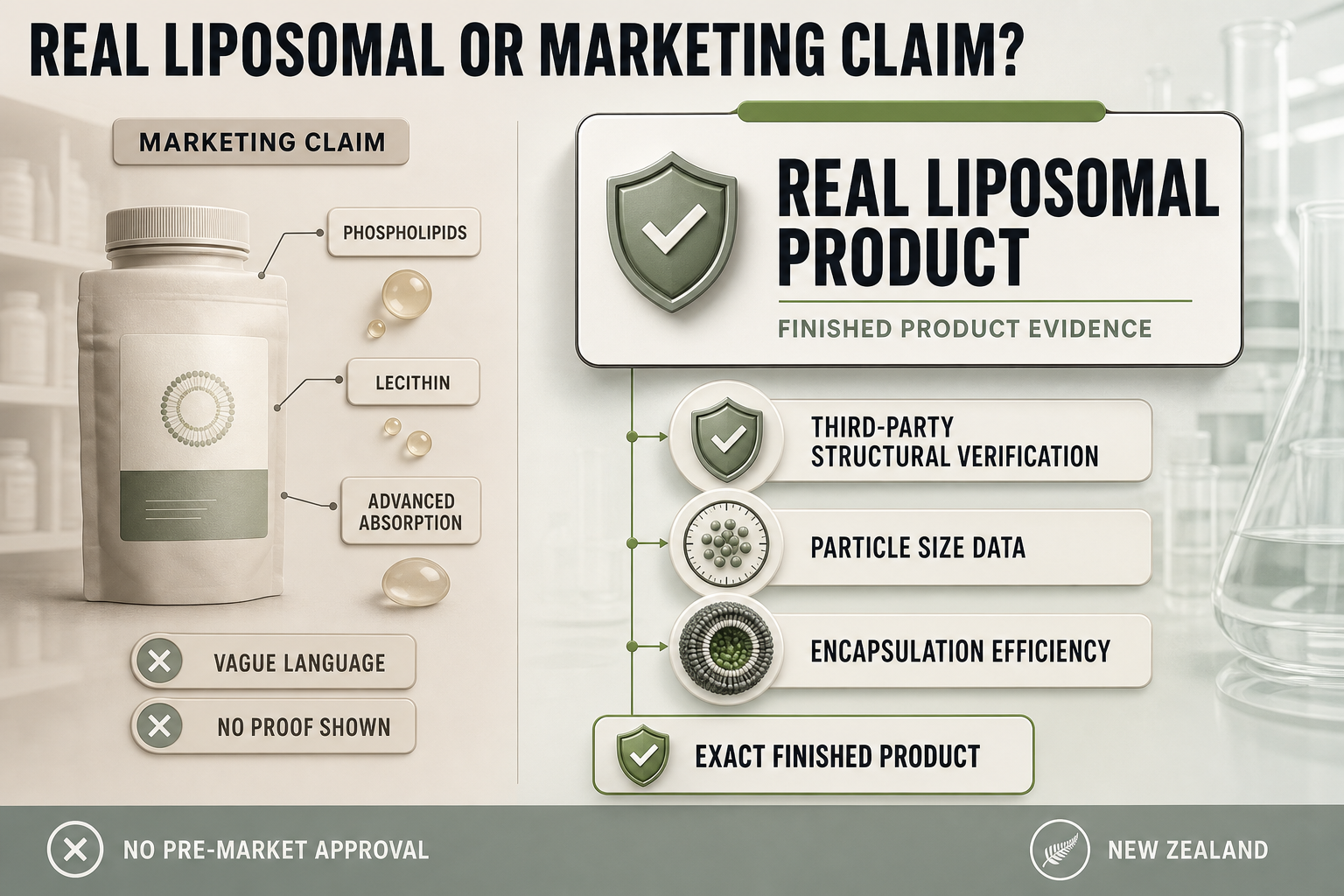
The common mistake is assuming the label has already been vetted by someone else. In this category, you need to think more like a sceptical buyer than a passive shopper. Useful questions include whether the brand provides third-party structural verification, particle size data, encapsulation efficiency, and evidence tied to the exact finished product rather than liposomes as a general concept. If a company cannot show how it knows the product is genuinely liposomal, then the claim is still just a claim.
Why storage, shipping, and handling are part of the product
Even a genuine liposomal supplement can lose much of its value if the structure degrades before you use it. This is one of the least obvious parts of the decision because many people treat supplements as shelf-stable by default. That assumption works reasonably well for tablets and capsules. It is much riskier for fragile liposomal liquids.
Is Your Liposomal Supplement Already Dead Before You Open the Bottle? › explains why liposomes are vulnerable to heat, light, oxygen, moisture, and time. In New Zealand, that matters because many products are imported and may travel long distances through supply chains that are not designed around delicate delivery systems. A formulation can be sound at manufacture and still arrive compromised after shipping, warehousing, and shelf time.
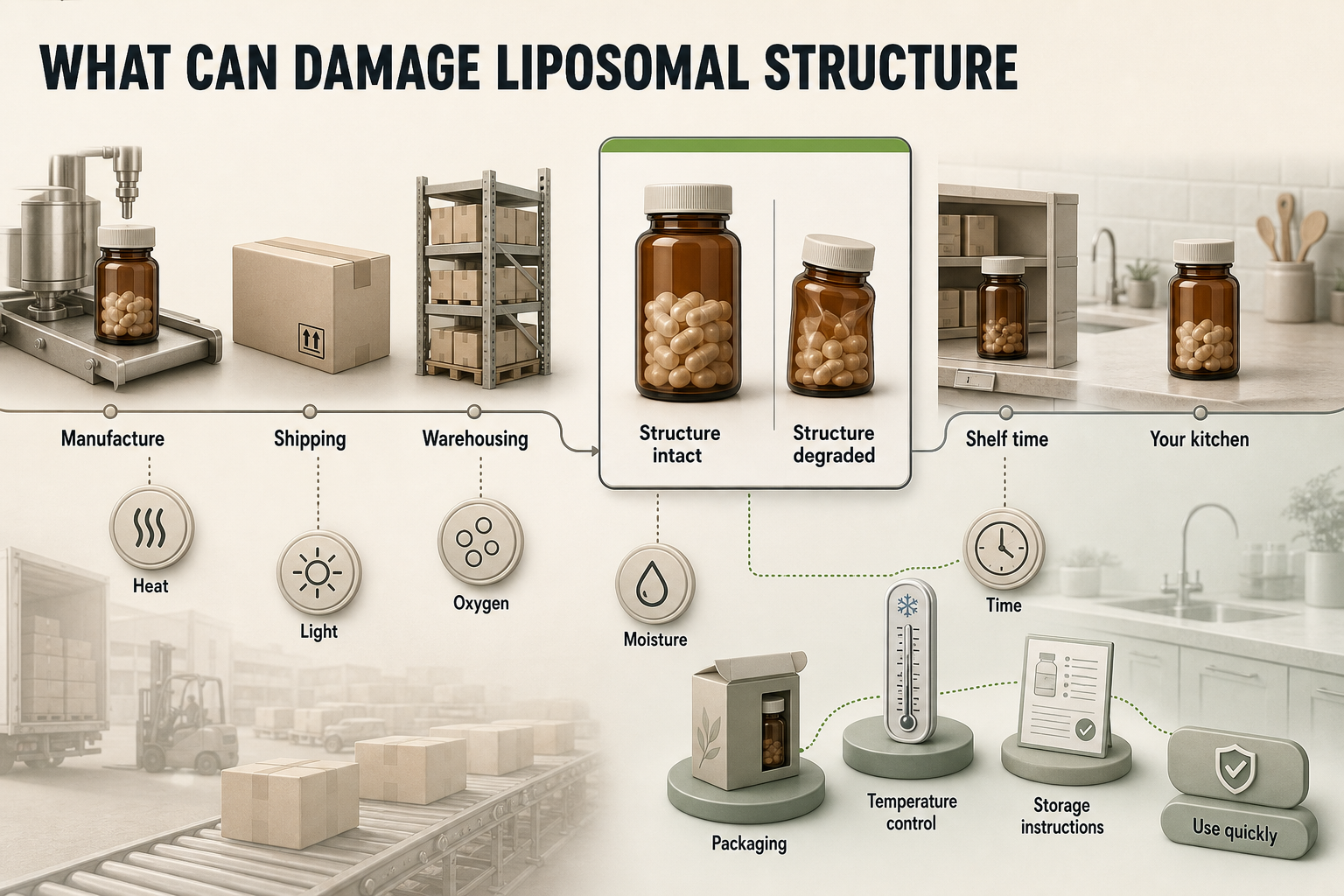
This changes what value means. You are not only buying a formulation on paper. You are buying the condition that formulation is in when it reaches your kitchen. Packaging, temperature control, storage instructions, and how quickly you use the product all become part of efficacy. That is easy to miss because degradation is often invisible. A product can look normal while delivering far less liposomal benefit than you paid for.
The practical takeaway is that liposomal delivery should make you more attentive to logistics, not less. A premium format only stays premium if the structure survives the journey.
Where liposomal delivery can make the biggest practical difference
Liposomal delivery is most compelling where poor absorption, poor tolerability, or poor adherence keep standard supplements from doing their job. In those situations, the benefit is not only higher blood levels on paper. It can also mean fewer abandoned bottles, fewer dose escalations, and a simpler routine you can actually maintain.
Why Taking More Supplements Is Making Each One Work Less › shows how multi-supplement routines create competition for absorption and practical pill fatigue. A more efficient delivery format can sometimes do more than simply adding another bottle. The Stomach Upset Tax You Pay on Every Bottle You Throw Away › highlights another overlooked advantage: for people who struggle with gastrointestinal side effects from standard iron or high-dose vitamin C, delivery format can improve tolerability and completion as much as absorption.
Some use cases are also more time-sensitive than they first appear. The Collagen Compound Clock: Why Your Vitamin C Isn't Keeping Up › argues that vitamin C delivery matters because collagen production depends on it and collagen loss compounds with age. The Bone Density Freefall Window: Why Menopause Makes Every Missed Dose Permanent › shows why menopause is a particularly unforgiving period, when bone loss is rapid and nutrient uptake may be less efficient. The Category Window: Why Waiting for Liposomal Supplements to Go Mainstream Costs You Twice › connects those ideas to timing by arguing that some biological losses are cumulative, so better delivery later is not always equivalent to better delivery now.
The shared lesson is that liposomal delivery matters most when underdelivery has a repeated cost - physical, financial, or behavioural.
When better absorption deserves more caution, not more enthusiasm
Higher absorption sounds like an uncomplicated win, but it is not always one. If more of a nutrient reaches your system, then dosing, accumulation, and interactions matter more too. This is especially important when people carry over habits from poorly absorbed standard supplements and assume the same dose logic still applies.
When Better Absorption Becomes a Risk You Did Not Plan For › makes this point clearly. Water-soluble nutrients such as vitamin C are generally lower risk because excess is excreted more readily. Fat-soluble vitamins such as A, D, E, and K are different because they can accumulate over time. Medication interactions can also become more important when delivery improves, particularly if you take anticoagulants or other medicines where small changes can matter.
This is a frequent blind spot because supplements are often treated as inherently gentle. But better delivery means a more meaningful effective dose. That is the whole reason to pay for it. If you are stacking products, combining a multinutrient with single nutrients, or using supplements alongside prescription medicines, you need to think beyond the label dose and consider the absorbed dose instead.
The sensible response is not fear. It is proportion. Better absorption should make you more deliberate, especially with fat-soluble vitamins, iron, and anything with plausible medication interactions.
How to decide whether liposomal delivery is worth it for you
A good buying decision starts with your actual problem, not the technology. Ask yourself what you are trying to solve. Are you dealing with a known nutrient gap, poor response to standard supplements, gut issues, ageing-related absorption changes, or a time-sensitive goal such as immune resilience or bone support? If yes, liposomal delivery deserves a closer look. If your needs are mild and your current supplement works well, the premium may be unnecessary.
Next, look at the nutrient itself. Some nutrients are far more likely to run into absorption limits, transporter saturation, tolerability issues, or competition with other supplements. In those cases, delivery format can matter more than a bigger dose. Then pressure-test the product. Can the company show evidence of real liposomes in the finished formulation, not just nice language on the box? Can it explain storage, shipping, and stability in a way that suggests the product will still be intact when you use it?
Finally, consider fit with your health context. If you are taking fat-soluble vitamins, prescription medicines, or multiple overlapping products, higher absorption may call for more caution and possibly lower dosing. If you are younger, healthy, and taking a single low-dose nutrient with decent ordinary absorption, standard formats may still be the rational choice.
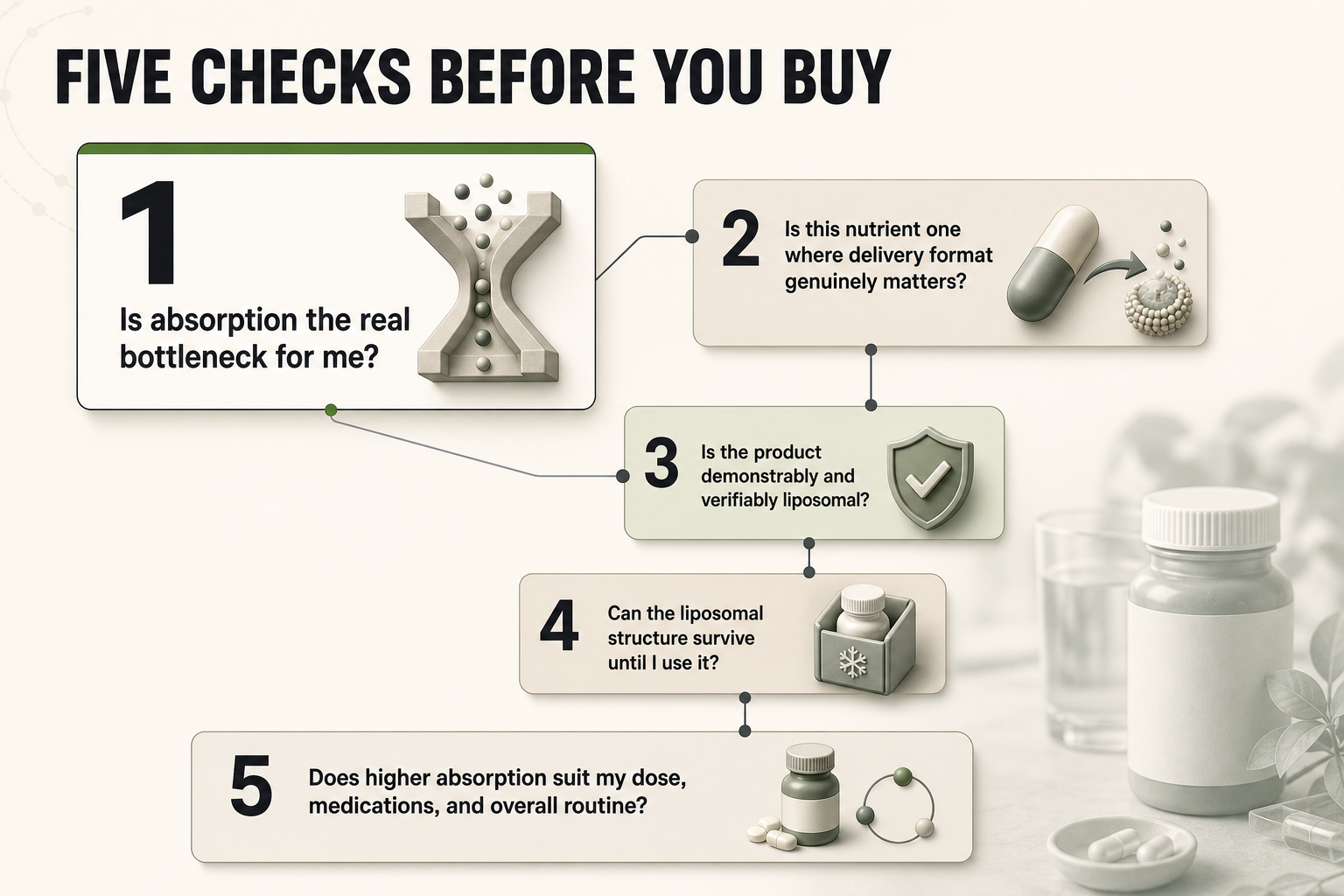
That gives you a workable framework:
- Is absorption the real bottleneck for me?
- Is this nutrient one where delivery format genuinely matters?
- Is the product demonstrably and verifiably liposomal?
- Can the liposomal structure survive until I use it?
- Does higher absorption suit my dose, medications, and overall routine?
Liposomal delivery is not a shortcut to perfect supplementation. It is a tool for solving a specific problem. Used in the right context, it can improve value, consistency, and outcomes. Used casually, it can become an expensive label with no meaningful advantage. If you want to go deeper, the linked articles above will help you test the part of the decision that matters most for your own situation.
Also written for
What the brands say
These brands have chosen to respond directly to this independent research. We publish brand responses unedited because we believe transparency builds trust - and that brands willing to engage openly with independent analysis deserve to be heard.
You may also be interested in these independent articles
Sources
- [1]Everything you need to know about liposomal delivery ›
- [2]The Hidden Tax on Every Supplement You Buy ›
- [3]Why Doubling Your Supplement Dose Is Not Doubling Your Results ›
- [4]The Start-Stop Supplement Trap That Costs You Thousands ›
- [5]The Nutrient Gap Your Doctor Will Never Diagnose ›
- [6]The Double Deficit Hiding in New Zealand's Clean, Green Food ›
- [7]The Ageing Absorption Cliff: Why Your Supplements Stop Working After 50 ›
- [8]Your Gut Is Quietly Sabotaging Your Supplements ›
- [9]The Immune Debt You Are Building Every Winter ›
- [10]Are You Paying Premium Prices for a Fake Liposomal Supplement? ›
- [11]Are You Trusting Regulations That Do Not Actually Exist? ›
- [12]You Would Pay More for Supplements That Actually Work - So Why Can't You Find Any? ›
- [13]Is Your Liposomal Supplement Already Dead Before You Open the Bottle? ›
- [14]Why Taking More Supplements Is Making Each One Work Less ›
- [15]The Stomach Upset Tax You Pay on Every Bottle You Throw Away ›
- [16]The Collagen Compound Clock: Why Your Vitamin C Isn't Keeping Up ›
- [17]The Bone Density Freefall Window: Why Menopause Makes Every Missed Dose Permanent ›
- [18]The Category Window: Why Waiting for Liposomal Supplements to Go Mainstream Costs You Twice ›
- [19]When Better Absorption Becomes a Risk You Did Not Plan For ›
- [21]Liposomal delivery enhances absorption of vitamin C into plasma and leukocytes: a double-blind, placebo-controlled, randomized trial
- [22]Do Liposomal Vitamin C Formulations Have Improved Bioavailability? A Scoping Review
- [23]Pharmacokinetic Analyses of Liposomal and Non-Liposomal Multivitamin/Mineral Formulations
- [24]Regulation of Dietary Supplements - Medsafe, New Zealand
- [25]Dietary Supplements Regulations 1985 - New Zealand Legislation
- [26]YourZooki Ltd ASA Ruling - UK Advertising Standards Authority
- [27]Liposomes as Carriers of Bioactive Compounds in Human Nutrition
- [28]Nutritional and lifestyle management of the aging journey
- [29]Priority nutrients to address malnutrition and diet-related diseases in Australia and New Zealand
- [30]Bone Mineral Density Changes during the Menopause Transition
- [31]Immunosenescence: How Aging Increases Susceptibility to Bacterial Infections
- [32]Vitamin D Toxicity
© 2026 pyfoi. All rights reserved.