
The Ageing Absorption Cliff After 50
After 50, your body absorbs less from every supplement you take. Learn why stomach acid loss, PPIs, and enzyme decline create a hidden nutrient gap.
If you are over 50 and diligently taking your daily vitamins, here is a fact that should stop you mid-swallow: between 10 and 30 percent of adults your age have a reduced ability to absorb vitamin B12 from standard supplements, regardless of how much they take [1]. The older you get, the wider that gap becomes. You are spending more on supplements while your body extracts less from each dose.
Why Your Supplement Dose Is Not the Problem
Most supplement shoppers compare brands by milligrams on the label. More is better, right? That logic works perfectly if your gut absorbs what you swallow. But after 50, your body starts quietly dismantling the machinery that makes absorption possible.
Think of it like pouring water into a bucket with a growing crack in the bottom. Doubling the water does not fix the crack. The real question is not "how much am I taking?" It is "how much am I actually absorbing?" And more pointedly: what is my gut environment doing to the supplement before it ever reaches my bloodstream? Is my medication interfering with nutrient uptake? And how would I even know if absorption has declined?
The Biology Working Against You
The decline is not subtle, and it is not optional. Multiple systems deteriorate simultaneously:
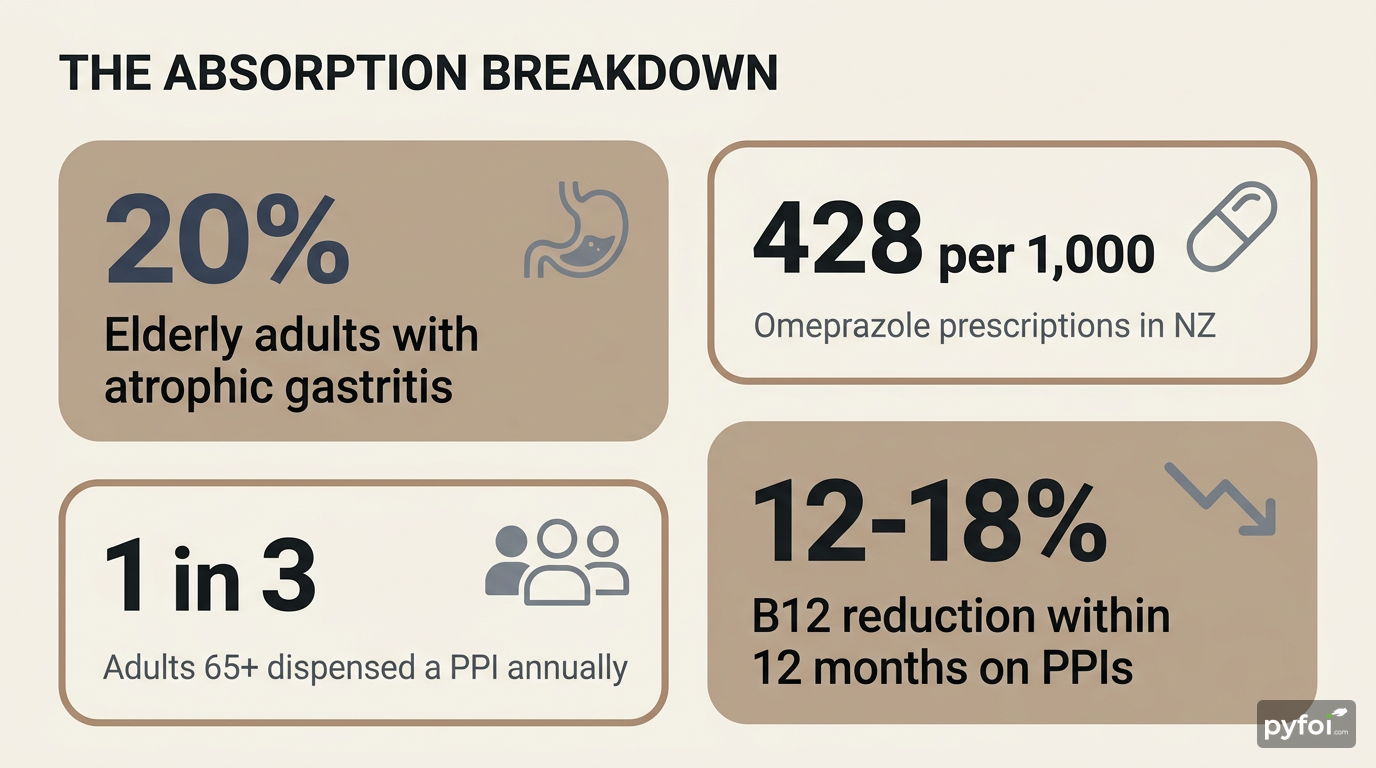
- Stomach acid production drops progressively with age. An estimated 20 percent of elderly adults develop atrophic gastritis, which destroys the acid-producing cells of the stomach lining entirely [1].
- Pancreatic enzyme and bile acid production weaken, directly impairing absorption of fat-soluble vitamins A, D, E, and K [1][2].
- Omeprazole, the third most prescribed medicine in New Zealand with 428 prescriptions per 1,000 registered patients, chemically suppresses the stomach acid that nutrients depend on [4].
- Over one-third of New Zealanders aged 65 and older are dispensed a proton pump inhibitor (PPI) annually [4].
- A 2025 systematic review confirmed PPIs cause a 12 to 18 percent reduction in serum vitamin B12 over just 12 months, alongside depletion of calcium, iron, magnesium, and folate [5][6].
This is not a single weak link. It is a cascade where each factor amplifies the others.
What Does This Actually Look Like?
Imagine two people, both 68, both taking the same daily multivitamin. One has healthy stomach acid and takes no PPIs. The other has mild atrophic gastritis and has been on omeprazole for three years.
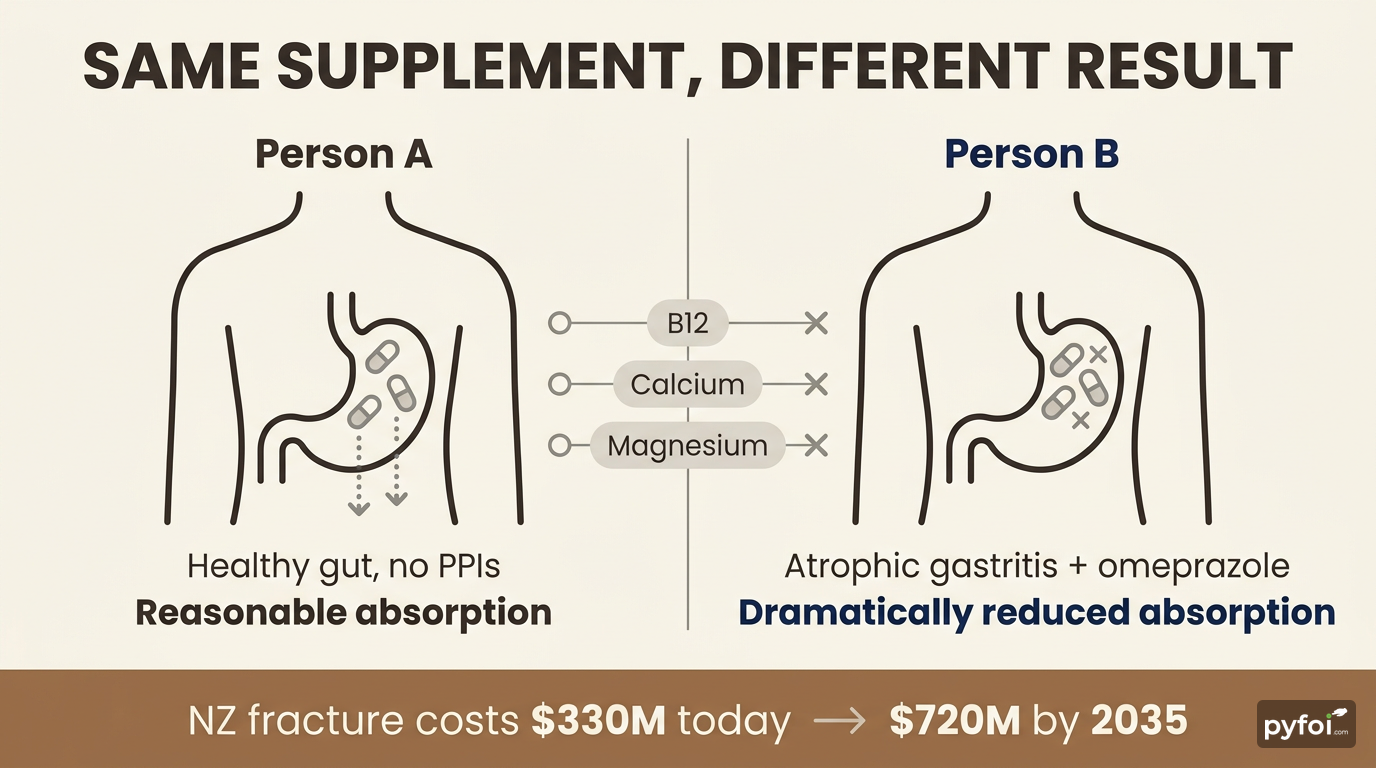
Person one absorbs a reasonable share of each nutrient. Person two absorbs dramatically less, particularly B12, calcium, and magnesium, but feels no different day to day. There is no sharp warning sign. The deficiency accumulates silently, showing up months or years later as unexplained fatigue, bone density loss, or cognitive fog that gets written off as "just ageing."
New Zealand's 65-plus population will reach one million by 2028 [10]. The direct cost of osteoporotic fractures already sits at $330 million annually, and ACC projects that figure will hit $720 million per year by 2035 [11][12]. A significant share of those fractures trace back to calcium and vitamin D absorption failures that started years earlier.
How Should You Actually Choose Supplements?
Stop evaluating supplements purely on dose and price. Instead, consider these factors:
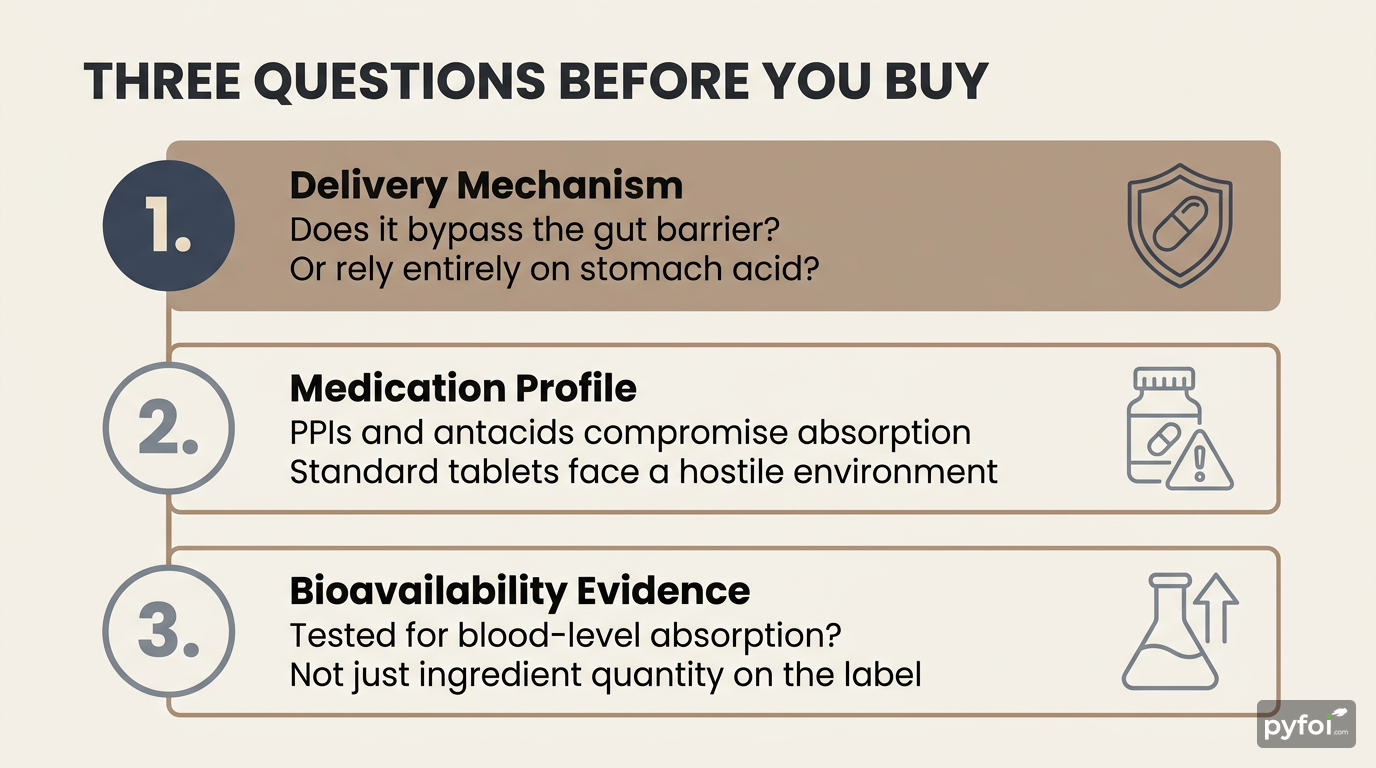
- Delivery mechanism: Does the supplement rely entirely on stomach acid for absorption, or does it use a delivery system that partially bypasses the gut barrier?
- Your medication profile: If you take a PPI or antacid regularly, standard tablets and capsules face a compromised absorption environment before they dissolve.
- Bioavailability evidence: Has the product been tested for actual blood-level absorption, not just ingredient quantity?
Putting This Into Practice
If you are over 50 and not on PPIs: Standard supplements may still work reasonably well for you, but absorption is declining. Pay attention to fatigue, brain fog, or muscle weakness as potential signals. Ask your GP for a B12 and vitamin D blood test as a baseline.
If you take omeprazole or another PPI: Your absorption environment is measurably compromised. A 2025 review found PPIs reduce B12 levels by 12 to 18 percent within a year [5]. Consider supplement formats that do not depend entirely on stomach acid for uptake. Liposomal delivery, which encapsulates nutrients in phospholipid layers, has shown significantly higher bioavailability in pharmacokinetic studies compared to standard forms [14][15].
If you are choosing supplements for an older parent: Do not assume the same brand that works for you will work for them. Their gut environment is likely very different from yours. Absorption-first formats matter more with every passing year.
On budget concerns: A cheaper supplement that your body cannot absorb is not a saving. Calculate the real cost per absorbed milligram, not per milligram on the label.
The shelf at the pharmacy is designed around a simple promise: take this, and your body gets what it needs. That promise holds for a 30-year-old with a healthy gut. For anyone over 50, particularly those on PPIs, it quietly breaks down. The gap between what you swallow and what your body actually uses grows every year, and no amount of extra milligrams will close it. The only fix is changing how those nutrients are delivered.
You may also be interested in these independent articles
Sources
- [1]Nutritional and lifestyle management of the aging journey - PMC, 2023
- [2]Underappreciated Problem analysis - File 02
- [3]Unrecognised Problem analysis - File 01
- [4]Proton pump inhibitors: When is enough, enough? - BPAC NZ, 2014
- [5]A Systematic Review of Long-Term Use of Proton Pump Inhibitors (PPIs) in Older Adults on Polypharmacy - Cureus, 2025
- [6]Proton pump inhibitors and risk of vitamin and mineral deficiency - PubMed, 2014
- [7]One million people aged 65+ by 2028 - Stats NZ
- [8]Current and future economic burden of osteoporosis in New Zealand - PubMed, 2011
- [9]Osteoporosis & fractures - Osteoporosis New Zealand
- [10]Targeted nanoliposomal nutrient delivery for human health - PMC, 2025
- [11]Pharmacokinetic Analyses of Liposomal and Non-Liposomal Multivitamin/Mineral Formulations - PMC, 2023
© 2026 pyfoi. All rights reserved.