

When Better Absorption Becomes a Risk You Did Not Plan For
Liposomal supplements boost absorption by 50 to 200 percent, but that same mechanism makes every dose pharmacologically larger than the label suggests. Fat-soluble vitamins accumulate, medication interactions scale up, and your old dosing habits may no longer be safe.
You wanted supplements that actually work - so what is the catch?
You switched to liposomal supplements because you were tired of paying for nutrients your body never used. The science backs it up: liposomal delivery can boost absorption by 50 to 200 percent compared to standard capsules [1]. More nutrient per dollar. Problem solved.
Except there is a consequence almost nobody mentions. If a liposomal format doubles your absorption, every dose is pharmacologically larger than the label suggests. For water-soluble vitamins like C, excess washes out through urine. But for fat-soluble vitamins - A, D, E, and K - the extra accumulates in your liver and fat tissue over weeks and months [2].
Could your "safe" dose actually be too much?
Most of us built our dosing habits with standard supplements - products where much of what you swallowed never made it past your gut wall. Poor absorption acted as a built-in safety buffer. Liposomal delivery removes it.
A dose that was safe at 30 percent absorption behaves very differently at 80 percent. Yet the label does not change, and your instinct tells you more is better.
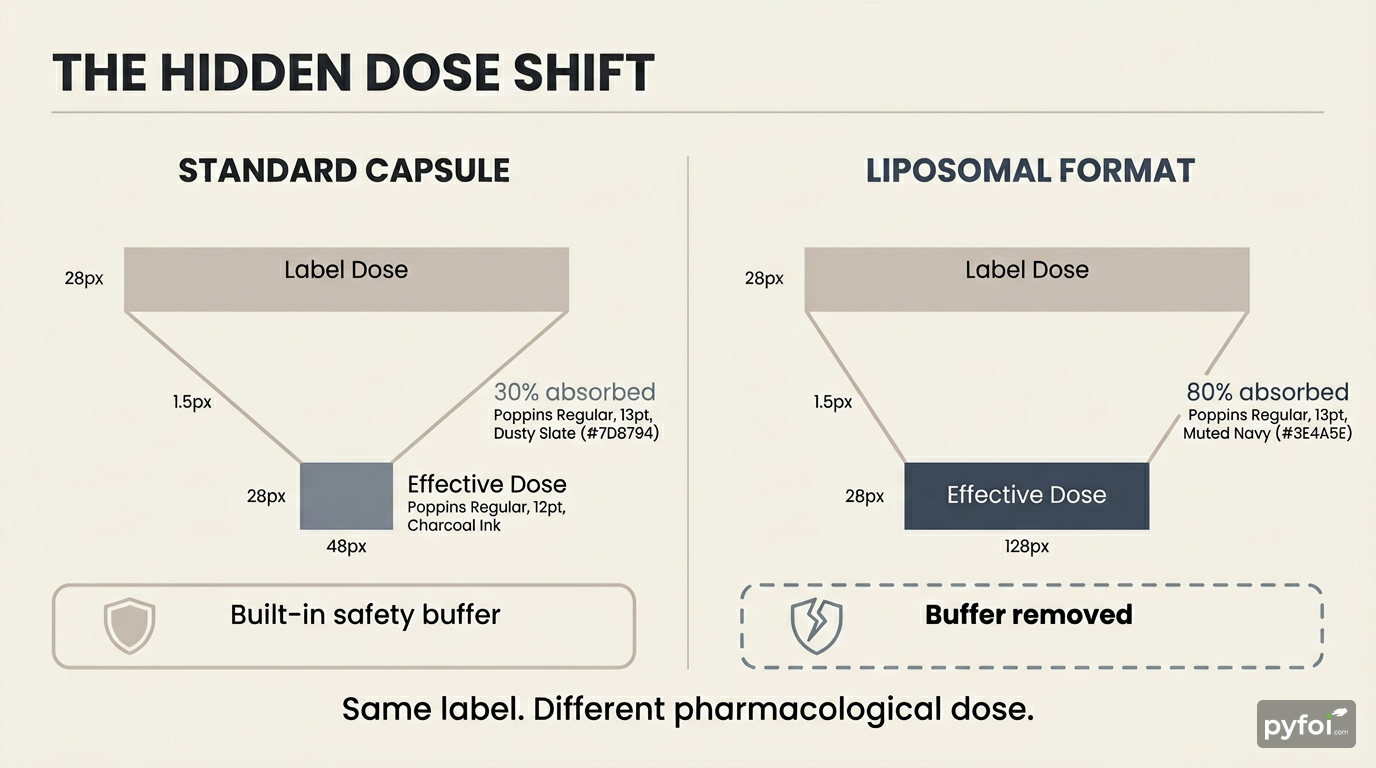
Think of it like upgrading from a garden hose to a fire hose but leaving the tap at the same setting. The pressure has changed, even if nothing on the handle looks different.
Instead of asking "am I taking enough?", the better questions are: does enhanced absorption change what counts as safe? Could my intake be accumulating? And what about interactions with medications I already take?
What the research actually shows
The accumulation risk for fat-soluble vitamins is well documented - and does not require extreme doses:
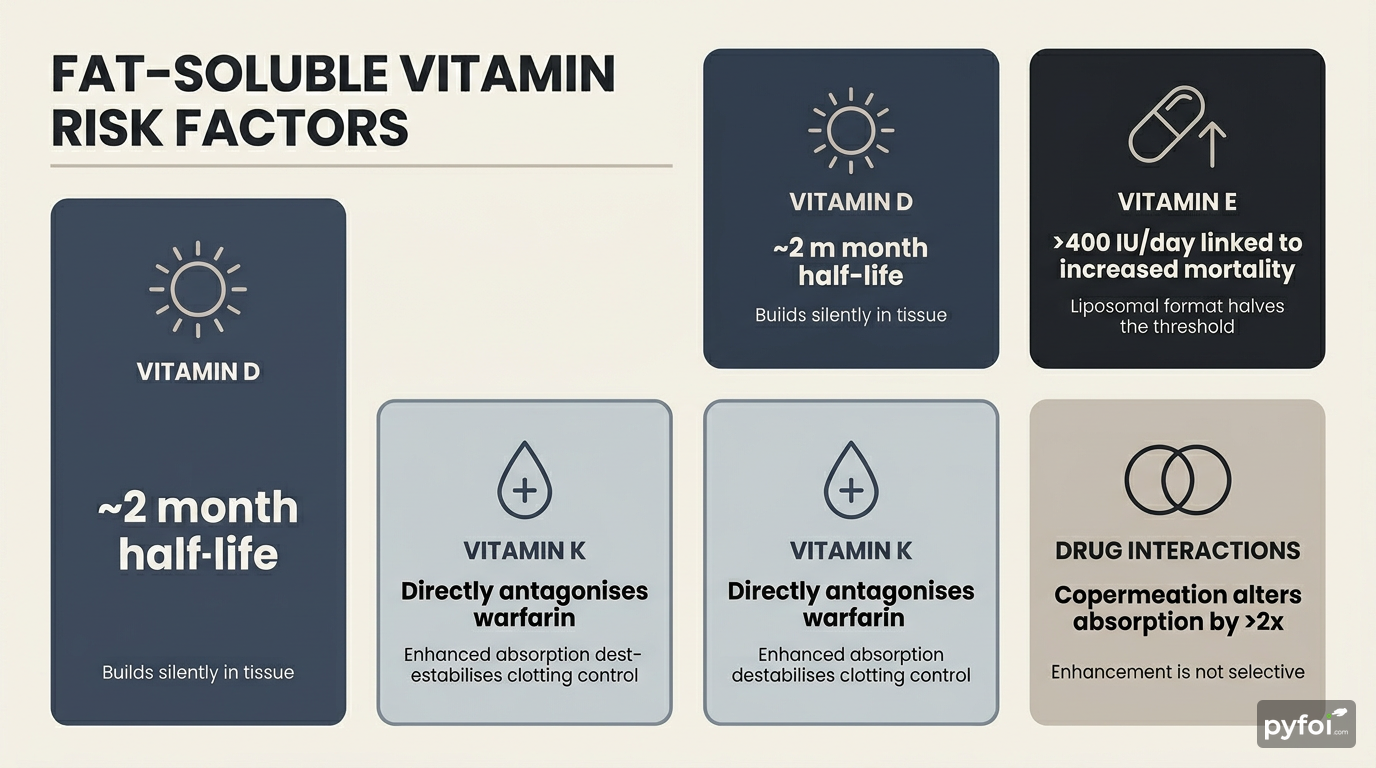
- Vitamin D has a half-life of approximately two months [2]. At enhanced absorption rates, daily supplementation builds tissue concentrations steadily without obvious warning signs until levels reach toxicity.
- Reported cases of vitamin D toxicity are increasing globally alongside rising supplement use [3]. Liposomal formats amplify this by delivering more per dose than consumers expect.
- High-dose vitamin E above 400 IU per day has been linked to increased all-cause mortality [4]. A liposomal format absorbing twice as efficiently could reach that threshold at half the labelled dose.
- Drug-nutrient interactions scale up too. A 2023 copermeation study found concurrent substances can alter permeation rates by more than twofold [5]. Liposomal delivery does not selectively enhance only the good stuff.
- Vitamin K directly antagonises warfarin, widely prescribed in New Zealand's over-65 population [2][6]. Enhanced K absorption could destabilise anticoagulation control without anyone realising the supplement changed.
- Liposomal vitamin C enhances iron absorption - beneficial for most, but a genuine risk for the approximately one in 200 with hereditary haemochromatosis [5].
What an unintended interaction actually looks like
Picture this: you are 62, on warfarin after a cardiac event, and your daughter recommended a liposomal multivitamin. It contains vitamins D, E, and K. You take the suggested dose daily - it is just vitamins, after all.
Over eight weeks, enhanced vitamin K absorption subtly shifts your clotting balance. Your next INR test comes back unexpectedly low. Your doctor adjusts warfarin upward, not knowing a supplement changed the equation. You are now managing a medication interaction that neither you nor your GP planned for.
This is not dramatic. It is exactly the kind of quiet, incremental risk that slips through - especially when nobody told you that "better absorbed" also means "different dose required."
How should you think about dosing liposomal supplements?
If you are using or considering liposomal supplements, these filters help you dose safely:
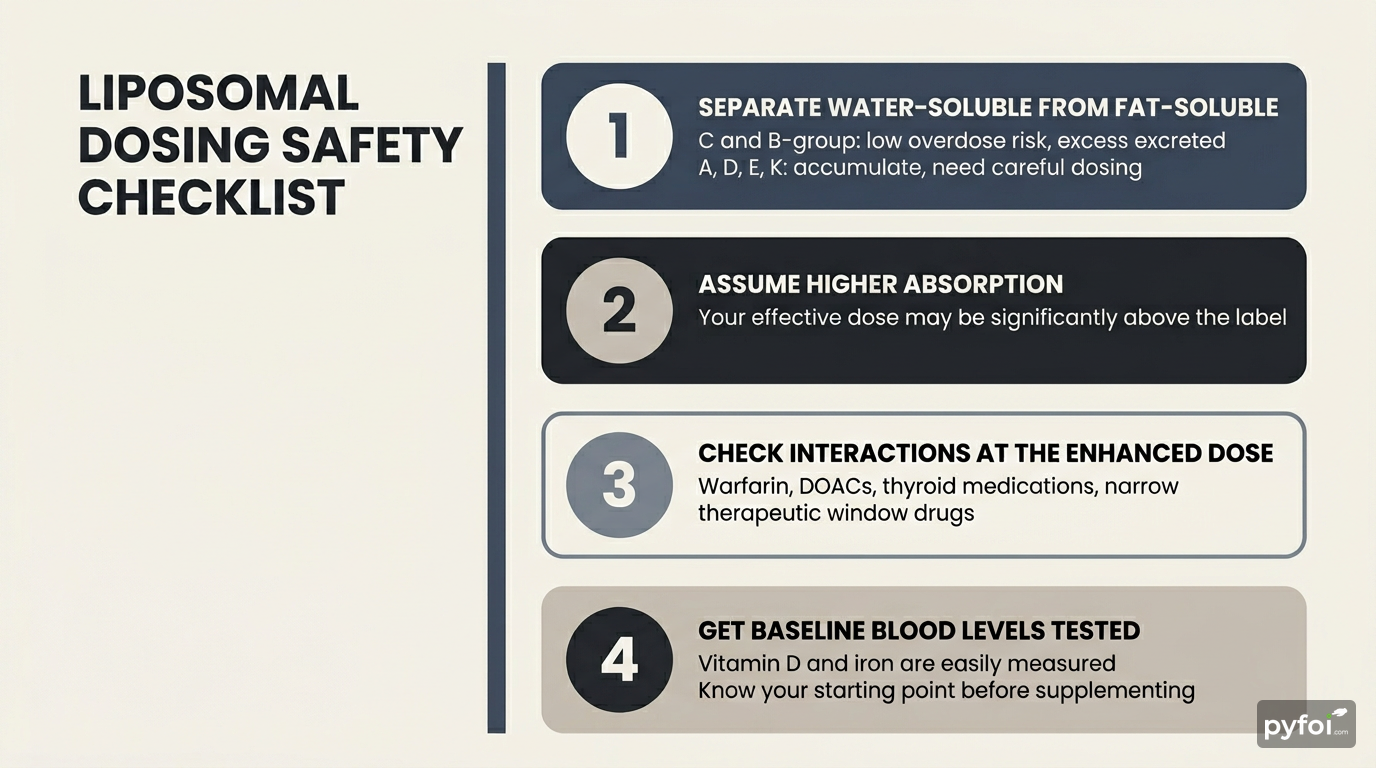
- Separate water-soluble from fat-soluble. Water-soluble vitamins (C, B-group) carry low overdose risk because excess is excreted. Fat-soluble vitamins (A, D, E, K) accumulate and need more careful dosing.
- Assume you are absorbing more than you used to. Your effective dose may be significantly higher than the label implies.
- Check medication interactions at the enhanced dose, not the labelled dose. This matters most for warfarin, DOACs, thyroid medications, and any drug with a narrow therapeutic window.
- Get baseline blood levels tested. Vitamin D and iron are easily measured. Knowing your starting point prevents blind accumulation.
Practical steps to stay in the safe zone
Review fat-soluble vitamins in your liposomal products. If they contain A, D, E, or K, treat the effective dose as higher than the label states. Consider starting at half the suggested dose and testing blood levels after six to eight weeks.
Tell your GP and pharmacist the format, not just the ingredient. "Liposomal vitamin D" is pharmacologically different from "standard vitamin D" at the same milligram count. Your prescriber needs this information to manage medications safely.
Watch for stacking. If you take a liposomal multivitamin and a separate liposomal vitamin D, the combined effective dose may far exceed what either label suggests alone.
If you are on blood thinners, treat vitamin K as a medication interaction, not a nutrition choice. Discuss any supplement containing vitamin K with your prescriber before starting.
Better absorption is genuinely valuable - it is why liposomal formats exist. But absorption is not a one-way benefit. The same mechanism that makes your supplement work harder also demands that you dose smarter. The label tells you what went into the capsule. Your body decides what that number actually means.
You may also be interested in these independent articles
Sources
- [1]Pharmacokinetic Analyses of Liposomal and Non-Liposomal Multivitamins - PMC, 2023
- [2]Vitamin D Toxicity - StatPearls, NCBI Bookshelf
- [3]Hypervitaminosis D Due to Overdose: A Case Series - Indian Journal of Pain, 2024
- [4]Fat-Soluble Vitamins in Food Supplements: Do the Labels Follow the Recommended Doses? - PMC, 2021
- [5]Liposomal Copermeation Assay Reveals Unexpected Membrane Interactions - Molecular Pharmaceutics, 2023
- [6]Hypervitaminosis: A Global Concern - US Pharmacist
© 2026 pyfoi. All rights reserved.