

You Would Pay More for Supplements That Actually Work - So Why Can't You Find Any?
More than 70% of supplement shoppers will pay a premium for clinical proof, but most New Zealand shelves offer neither trials nor branded ingredients. The premiumisation gap is costing consumers both money and health outcomes.
Are younger shoppers really the budget-conscious ones?
There is a persistent assumption in the supplement aisle: younger buyers want the cheapest option. The data says otherwise.
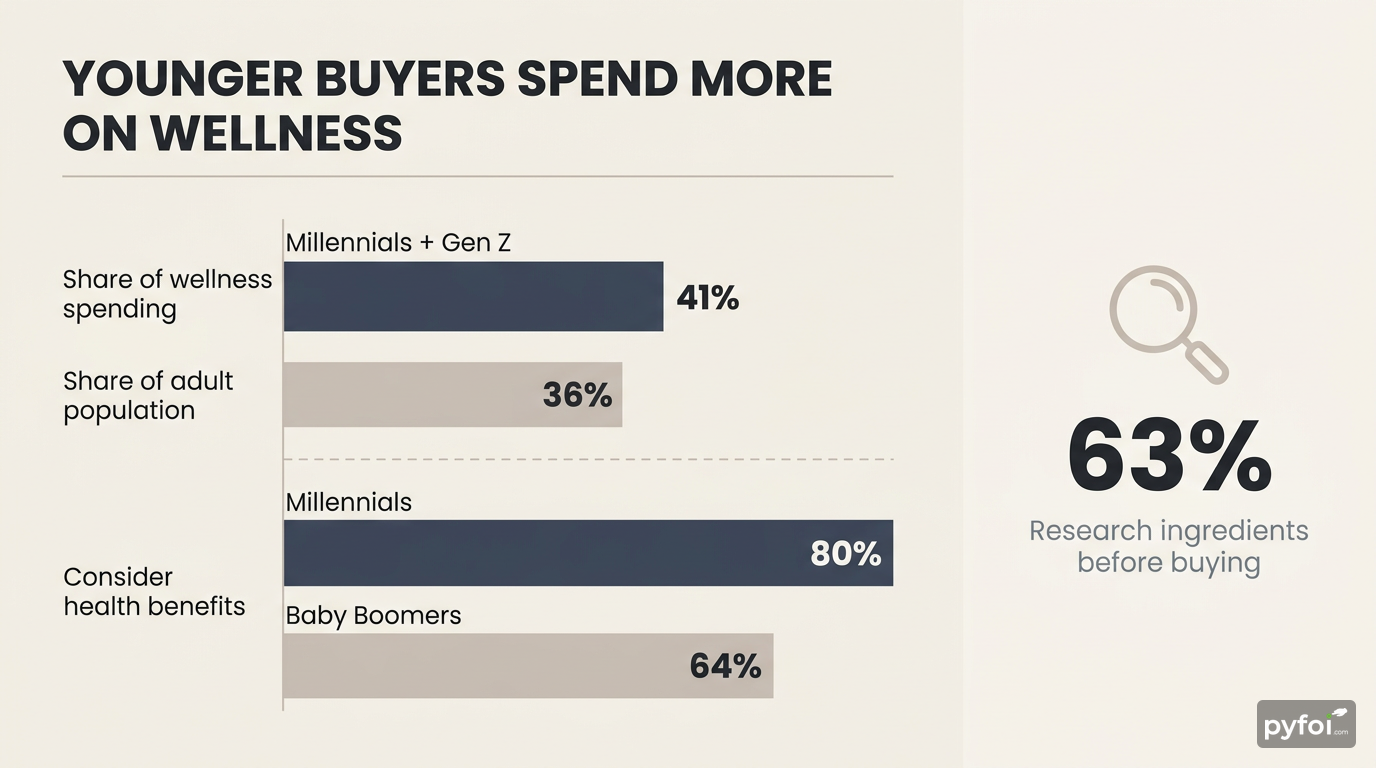
Millennials and Gen Z drive 41% of wellness spending despite representing 36% of the adult population [1]. Eighty percent of millennials consider health benefits when selecting food products, compared to 64% of baby boomers [1]. And 63% of supplement consumers report "always" or "often" researching ingredients before purchase [4]. This is not impulse buying. It is informed, intentional, and quality-first.
What if the problem is not what you are willing to spend, but what is available to spend it on?
By growth numbers, the local market looks healthy. The Australia and New Zealand dietary supplements market is expanding at 10.6% CAGR, projected to reach USD 6.55 billion by 2030 [5]. NZ health and beauty e-commerce grew 9% in value and 21% in transactions in Q1 2025 [7].
But growth does not equal quality. Walk into most pharmacies and you will find rows of commodity-grade products with no bioavailability data, no clinical backing, and no absorption claims. The market is growing because more people are buying - not because what they are buying has improved.
Think of it like a wine region that sells more bottles every year but never develops anything above house pour. Volume goes up. Quality stays flat.
The questions worth asking are not "should I take supplements?" but: does this product have clinical evidence? Can the manufacturer show me absorption data? And am I paying a premium for the ingredient or just the packaging?
The gap between what shoppers want and what they get
When you look at the mismatch between consumer expectations and market supply, the scale is striking:
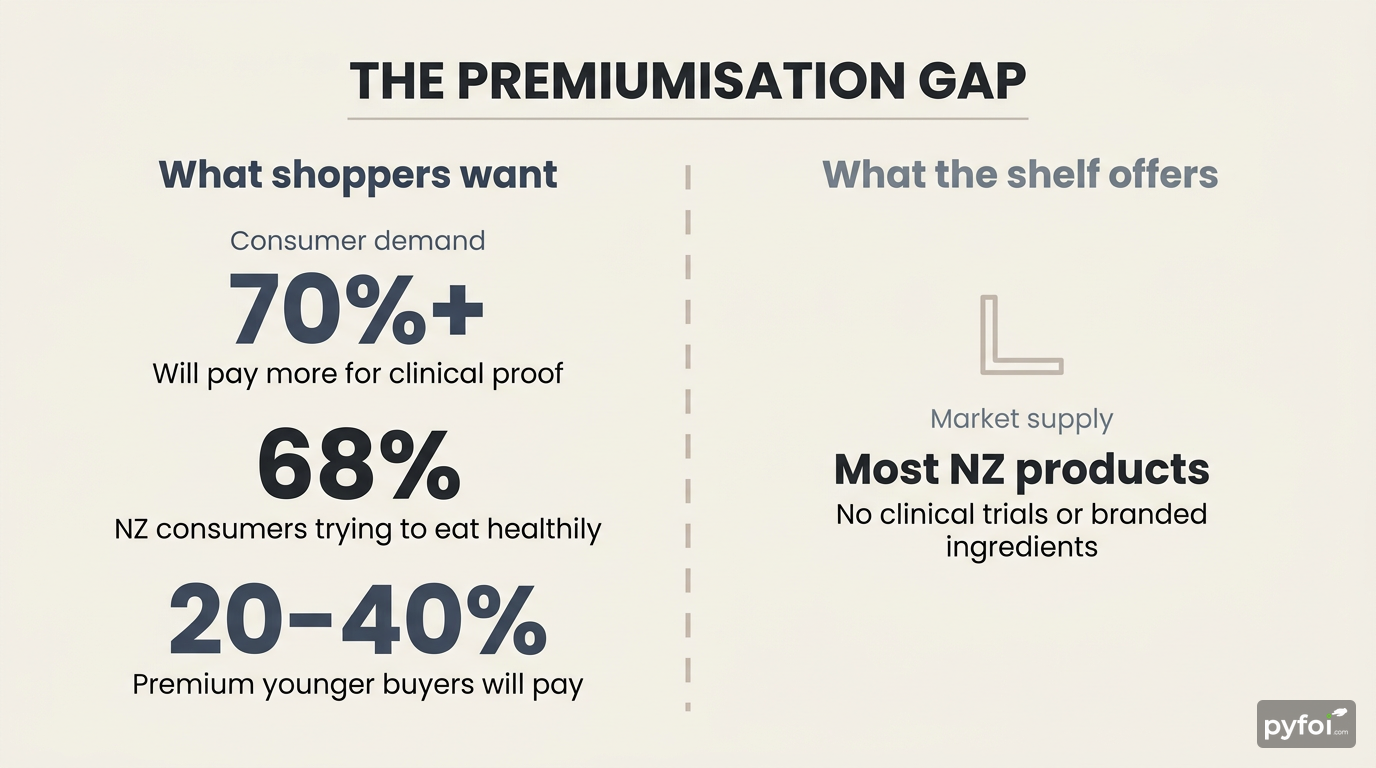
- More than 70% of global supplement shoppers willingly pay a premium for branded, clinically proven ingredients [2]. Yet most products on New Zealand shelves carry neither clinical trials nor branded ingredient certifications.
- The phrase "clinically proven" measurably increases both purchase intention and willingness to pay [3]. Brands that can substantiate the claim have a clear advantage - but few in the local market bother.
- 68% of New Zealand consumers report trying to eat healthily [8], signalling a population primed to invest in quality supplementation if the right products existed.
- Younger consumers prioritise quality over price as their number-one buying factor and are willing to pay 20-40% premiums for clinically proven, transparently sourced products [2][3]. The demand is already there. The supply is not.
What does this gap actually cost you?
Imagine you are 34, dealing with low energy and patchy skin. You have read that liposomal vitamin C delivers significantly more to your bloodstream than standard tablets. You are ready to pay more for a product with real clinical evidence.
You search online. You check your local pharmacy. Every liposomal product you find makes vague claims - "superior absorption," "advanced delivery" - but none links to a published trial. None lists a branded, tested ingredient. You cannot tell which product is genuinely premium and which is a standard supplement in fancier packaging.
So you either buy something unverified and hope for the best, or give up and grab the cheapest option. Either way, you are not getting what you were prepared to pay for. A market leaving both money and health outcomes on the table.
How should you evaluate a premium supplement?
Before paying more for any product, run it through these filters:
- Clinical evidence. Does the product or its key ingredient have published, peer-reviewed trials? "Clinically proven" on the label means nothing without a study you can find and read.
- Absorption data. Can the manufacturer show how much active ingredient reaches your bloodstream? If not, the premium is cosmetic.
- Transparent sourcing. Does the product use a branded, traceable ingredient with quality certification, or a generic powder from an undisclosed supplier?
- Third-party testing. Has an independent lab verified what is on the label matches what is in the product?
Finding real value in a market that has not caught up yet
Do not assume a higher price means higher quality. Many premium-priced supplements in New Zealand use the same commodity ingredients as budget options. The packaging changes. The powder inside does not.
Search for clinical backing, not marketing language. Look for specific study references, named ingredient brands, and measurable absorption claims. If the product page reads like advertising copy with no data, treat it accordingly.
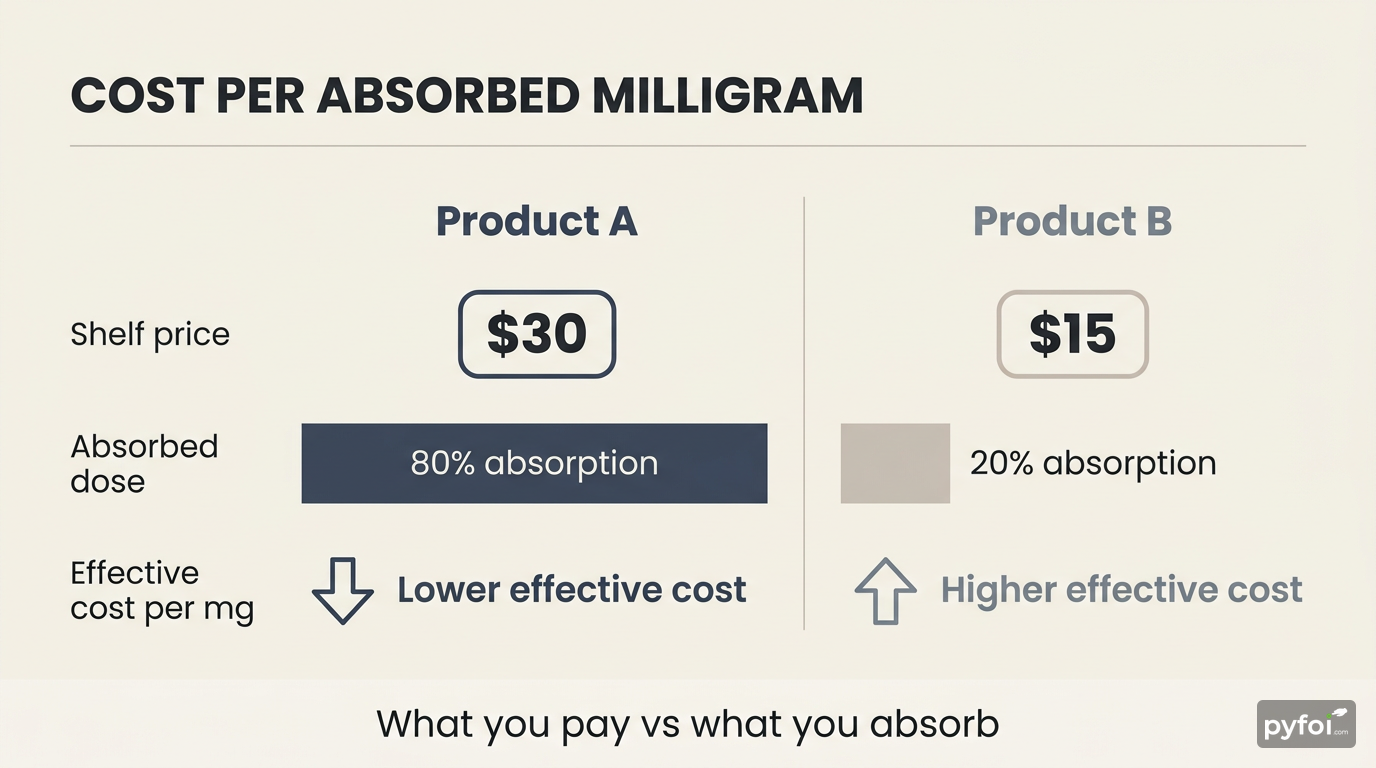
Consider the effective cost, not the shelf price. A $30 product that delivers 80% of its active ingredient to your bloodstream is better value than a $15 product that delivers 20%. Work out the cost per absorbed milligram, not just the cost per bottle.
Ask your pharmacist directly. Request products with published bioavailability data. If they cannot point you to one, that tells you something about the current market - and about where it needs to go.
The willingness to pay for quality supplements is not the problem. Sixty-three percent of consumers are already researching before they buy [4]. More than 70% will pay a premium for clinical proof [2]. The gap is not in consumer readiness - it is in a market that has not yet built products worthy of the demand.
You may also be interested in these independent articles
Sources
- [1]The $2 trillion global wellness market gets a millennial and Gen Z glow-up - McKinsey
- [2]Premium Supplement Ingredients 2025-2026: Top Consumer Trends - Champion Bio, 2025
- [3]Clinically proven: the power phrase reshaping consumer purchasing - SupplySide, 2025
- [4]Supplement Buyer Insights 2025 - Champion Bio, 2025
- [5]Australia and New Zealand Dietary Supplements Market Report, 2030 - Grand View Research
- [6]New Zealand eCommerce Trends Q1 2025 - iShipping
- [7]Health Conscious Consumer Statistics (2026) - Market.us
© 2026 pyfoi. All rights reserved.