
Retailers: Does Liposomal Delivery Earn Shelf Space in Your Store?
Learn when liposomal delivery improves supplement absorption, how to spot real liposomal products, and why NZ buyers should check claims closely.
Liposomal supplements are the fastest-growing format shoppers ask about by name - and the hardest for a buyer to evaluate before committing shelf space. The category sits at the intersection of supplement science and supplement marketing, which makes stocking decisions unusually risky. In simple terms, liposomal delivery means packaging a nutrient inside tiny phospholipid bubbles called liposomes so it is better protected through digestion and more available for absorption. When the system is genuine and stable, it can change how much of a nutrient actually reaches the bloodstream.
The commercial question is whether that science translates into a defensible range addition. Liposomal claims are easy to make, hard for consumers to verify, and not pre-approved by New Zealand regulators before products go on sale. That means a retail buyer is not just deciding whether liposomal delivery works. The decision includes whether a supplier's product is truly liposomal, whether it survived shipping and storage intact, and whether the margin and turn-rate justify displacing a proven SKU.
This overview provides the category knowledge needed to make that call - where genuine value exists, which customer segments drive repeat purchase, what supplier red flags to watch for, and how to protect the credibility of the range.
The metric that changes the category comparison
Labelled dose and absorbed dose are not the same thing. Most supplement ranging still revolves around milligrams per serving and landed cost per unit, but those numbers mislead when a nutrient is poorly absorbed in standard oral form. The true comparison is cost per milligram the customer's body can actually use.
That reframe matters commercially because it is exactly the conversation educated shoppers are already having. For nutrients with transporter limits, taking more means excreting more, not absorbing more. Customers who discover this - through social media, practitioners, or their own trial and error - stop buying on dose and start buying on delivery. A store that ranges only on label milligrams and price per bottle is optimising for a metric its best customers have already abandoned. It is like comparing cars by fuel tank size while ignoring fuel efficiency.
The customer segments driving demand
Liposomal delivery matters most to customers who are not starting from an ideal absorption baseline. That includes older shoppers whose stomach acid and digestive function have declined, customers managing gut issues such as reflux or IBS, and anyone correcting a meaningful nutritional gap rather than topping up casually.
New Zealand adds a local demand driver: soil-related shortfalls in selenium, zinc, and iodine create nutrient gaps that many shoppers are actively trying to close. Age-related absorption decline is well documented - lower stomach acid, reduced digestive function, and common medication use all reduce nutrient uptake. Immune-support shoppers represent another segment; underdelivered immune nutrients chip away at resilience over time, especially with age. The pattern is clear: the customers most likely to seek out liposomal formats are also the customers with the highest lifetime value - older, health-literate, repeat buyers with genuine needs, not trend-chasers.
How to separate a credible supplier from a label claim
This is where the stocking decision becomes a quality-control exercise. Liposomal delivery only offers an advantage if the product contains real, functional liposomes. Some products marketed as liposomal may be little more than lecithin mixed with the active ingredient, without verified vesicle formation or meaningful encapsulation efficiency. In New Zealand, there is no pre-market approval process checking liposomal claims before sale.
Ranging an unverified product creates two risks: margin erosion when the product underperforms and customers do not repurchase, and reputational damage if a savvy shopper or practitioner calls out the claim. Useful supplier questions include whether the brand provides third-party structural verification, particle size data, encapsulation efficiency, and evidence tied to the exact finished product rather than liposomes as a general concept. If a supplier cannot show how it knows the product is genuinely liposomal, the claim is still just a claim - and the shelf-space risk sits with the retailer.
The hidden cost of stocking a degraded product
Even a genuine liposomal supplement can lose much of its value if the structure degrades before the customer opens it. Liposomes are vulnerable to heat, light, oxygen, moisture, and time. In New Zealand, many products are imported and travel long distances through supply chains not designed around delicate delivery systems. A formulation can be sound at manufacture and arrive compromised after shipping, warehousing, and shelf time.
Degradation is invisible - a product looks normal while delivering far less benefit than the customer paid for. The commercial consequence is a quiet death: no complaint, no return, just a customer who never repurchases and never refers. A premium format only stays premium if the structure survives the journey. Buyers should evaluate supplier logistics - packaging, temperature control, shelf-life data, and recommended storage - as part of the ranging decision.
Where liposomal earns its margin
Liposomal delivery is most defensible where poor absorption, poor tolerability, or poor adherence keep standard supplements from performing. For customers who struggle with gastrointestinal side effects from standard iron or high-dose vitamin C, delivery format can improve tolerability and completion as much as absorption - translating directly into fewer abandoned bottles and stronger repurchase rates.
Some use cases are also time-sensitive. Vitamin C delivery matters because collagen production depends on it and collagen loss compounds with age. Menopause is a particularly unforgiving window, when bone loss is rapid and nutrient uptake may be less efficient. Customers in these segments are motivated, informed, and willing to pay a premium - but only if the product delivers. The shared lesson is that liposomal delivery matters most when underdelivery has a repeated cost, which is precisely the dynamic that drives repeat purchase.
Higher absorption also introduces a responsibility worth noting on the shop floor: fat-soluble vitamins such as A, D, E, and K can accumulate over time, and medication interactions become more important when delivery improves. Staff who can communicate this nuance build trust and protect the store from returns or complaints.
Building the business case for a liposomal range
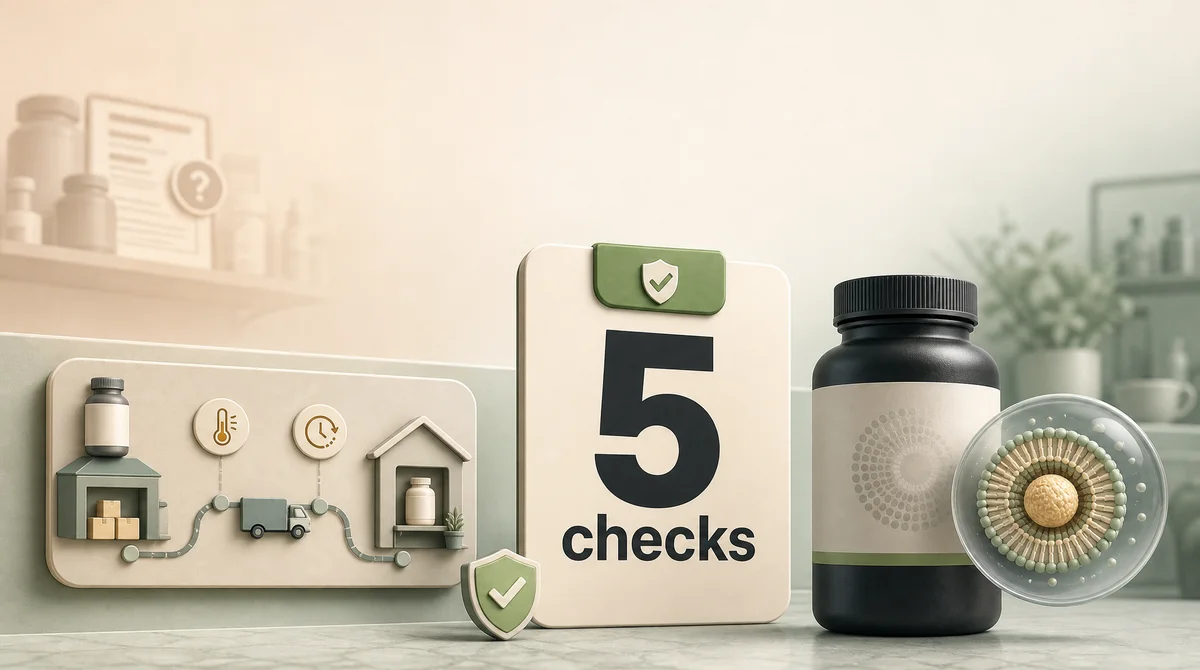
Five questions determine whether a liposomal SKU earns its place: Is absorption a real bottleneck for the target nutrient? Is the product demonstrably and verifiably liposomal? Can the liposomal structure survive the supply chain to the shelf? Does the supplier provide logistics, storage guidance, and third-party evidence? And does the margin and turn-rate justify the space over a standard alternative?
The commercial opportunity is a range gap most NZ retailers have not yet filled credibly. Shoppers are already searching for liposomal formats; practitioners are recommending them. Stocking a verified, well-supported liposomal line captures premium spend that currently leaks to online DTC brands or overseas purchases. The risk sits not in the category itself but in ranging unverified products that erode trust.
To evaluate category fit, request a wholesale quote and supplier evidence pack. A credible supplier will welcome the scrutiny - and provide margin structures, stability data, and merchandising support that make the stocking decision straightforward. Talk to your account manager or open a trade account to start the conversation.
Sources
- [1]Liposomal delivery enhances absorption of vitamin C into plasma and leukocytes: a double-blind, placebo-controlled, randomized trial
- [2]Do Liposomal Vitamin C Formulations Have Improved Bioavailability? A Scoping Review
- [3]Pharmacokinetic Analyses of Liposomal and Non-Liposomal Multivitamin/Mineral Formulations
- [4]Regulation of Dietary Supplements - Medsafe, New Zealand
- [5]Dietary Supplements Regulations 1985 - New Zealand Legislation
- [6]YourZooki Ltd ASA Ruling - UK Advertising Standards Authority
- [7]Liposomes as Carriers of Bioactive Compounds in Human Nutrition
- [8]Nutritional and lifestyle management of the aging journey
- [9]Priority nutrients to address malnutrition and diet-related diseases in Australia and New Zealand
- [10]Bone Mineral Density Changes during the Menopause Transition
- [11]Immunosenescence: How Aging Increases Susceptibility to Bacterial Infections
- [12]Vitamin D Toxicity
© 2026 pyfoi. All rights reserved.