
Is That Liposomal Supplement Actually Worth Your Money?
Learn when liposomal delivery improves supplement absorption, how to spot real liposomal products, and why NZ buyers should check claims closely.
You are standing in the supplement aisle - or scrolling through an online store - and two bottles of vitamin C sit side by side. One costs $15, the other $45 and says "liposomal" on the label. You want to make a smart choice, but the price gap feels hard to justify when you cannot see or taste the difference. That moment of hesitation is completely reasonable, because liposomal delivery sits right at the intersection of real science and aggressive marketing.
In simple terms, liposomal means a nutrient is packaged inside tiny phospholipid bubbles so it is better protected through digestion and more available for absorption. When the system is genuine and stable, it can change how much of a nutrient actually reaches your bloodstream. But in New Zealand, liposomal claims are easy to make, hard for you to verify, and not pre-approved by regulators before products go on sale. So you are not just deciding whether the technology works. You are deciding whether a specific bottle on the shelf is the real thing.
The price tag you are actually comparing
Here is what most shoppers miss: the milligrams on the label and the milligrams your body absorbs are not the same number. Most supplement shopping still revolves around dose per serving and price per bottle, but those numbers can be misleading if a nutrient is poorly absorbed in standard oral form. The true comparison is not cost per milligram on the label - it is cost per milligram your body can actually use.
Think of it like buying firewood. Two bags weigh the same, but one is damp. You pay the same price per kilogram, yet the damp bag gives you far less heat. Poor bioavailability is the dampness in your supplement routine. For nutrients with transporter limits, taking more often means excreting more, not absorbing more. That is why doubling the dose rarely doubles the result, and why many people end up in a start-stop cycle - taking a supplement, feeling little, quitting, restarting months later, and repeating for years.
Liposomal delivery is not automatically better because it sounds advanced. It is better only when ordinary oral absorption is the real bottleneck. If the nutrient already absorbs well or your needs are modest, the premium may not make sense.
When absorption is already working against you
Liposomal delivery tends to matter most when you are not starting from an ideal baseline. Many people sit in a grey zone between obvious deficiency and true adequacy - not clinically deficient, but not optimally nourished either. In New Zealand specifically, soil-related shortfalls in selenium, zinc, and iodine can add to the gap even if your diet looks healthy.
Age compounds the problem. Lower stomach acid, reduced digestive function, and common medication use can all reduce nutrient uptake after 50. Gut issues such as reflux, IBS, or inflammation do the same at any age. And underdelivered immune nutrients can chip away at resilience over time, especially through winter. The pattern is clear: liposomal delivery is most relevant for people whose absorption is already compromised, whose nutrient demands are higher, or whose consequences for underdelivery build slowly and quietly.
The real cost of guessing wrong
Picture buying that $45 bottle, trusting the label, and taking it faithfully for months - only to learn the product was little more than lecithin mixed with the active ingredient, without verified liposomal vesicles. Some products marketed as liposomal may contain no real encapsulation at all. In New Zealand, there is no pre-market approval process checking these claims before sale. That means no one vetted the label for you.
This is not just a waste of money. It is a waste of the months you spent believing you were covering a gap. For time-sensitive situations - bone density loss during menopause, collagen decline with age, or building immune resilience before winter - those months matter. Some biological losses are cumulative, so better delivery later is not always equivalent to better delivery now.
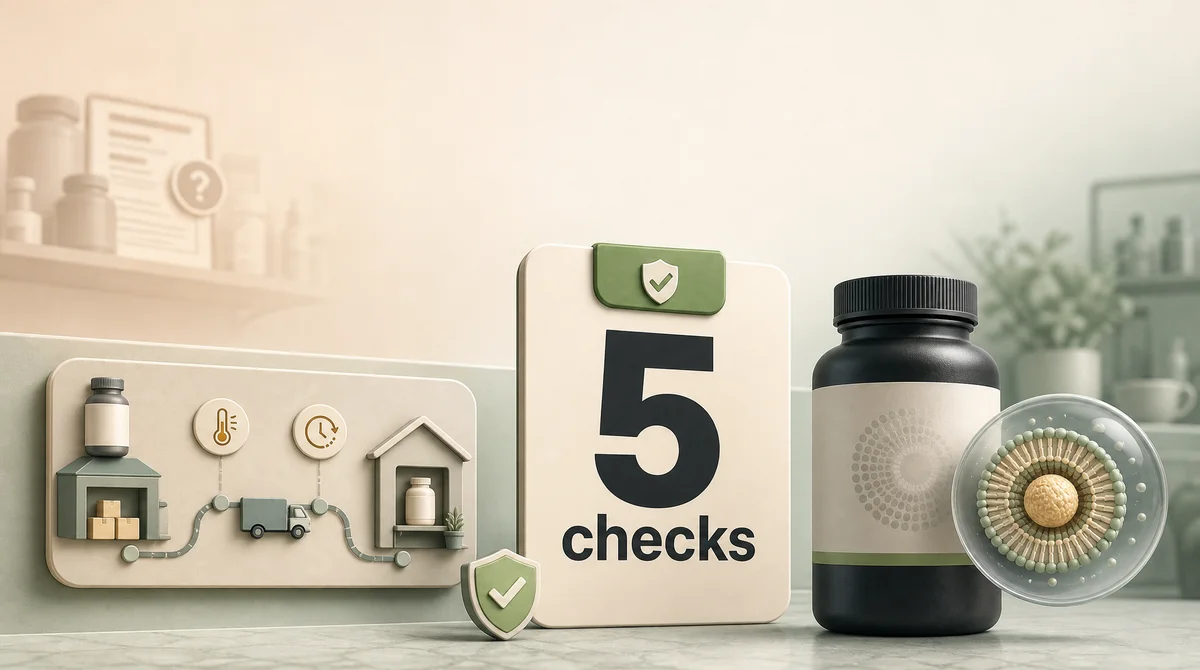
Five questions that protect your purchase
Instead of trusting labels at face value, treat yourself as a sceptical buyer. A genuine liposomal product should be able to answer these questions:
- Third-party structural verification - Can the brand show that real liposomal vesicles exist in the finished product?
- Particle size and encapsulation data - Not just claims about liposomes in general, but evidence tied to the exact formulation you are buying.
- Storage and shipping transparency - Liposomes are vulnerable to heat, light, oxygen, and time. A product can be sound at manufacture and arrive compromised after long-distance shipping and shelf time. Packaging, temperature control, and use-by guidance all matter.
- Appropriate dosing guidance - Higher absorption means a more meaningful effective dose. Fat-soluble vitamins such as A, D, E, and K can accumulate, and medication interactions can become more important when delivery improves.
- Honest positioning - A trustworthy brand will tell you when liposomal format is unnecessary for a given nutrient or situation, not push the premium on everything.
How to decide if liposomal is right for you
Start with your actual problem, not the technology. Ask yourself: Am I dealing with a known nutrient gap, poor response to standard supplements, gut issues, age-related absorption changes, or a time-sensitive health goal? If yes, liposomal delivery deserves a closer look. If your needs are mild and your current supplement works well, the premium may be unnecessary.
Next, look at the nutrient itself. Some nutrients hit absorption limits, transporter saturation, tolerability issues, or competition with other supplements far more than others. For people who struggle with stomach upset from standard iron or high-dose vitamin C, a liposomal format can improve tolerability and help you actually finish the bottle.
Then pressure-test the product using the five questions above. If a company cannot explain how it knows its product is genuinely liposomal, the claim is still just a claim.
Finally, consider fit with your health context. If you take fat-soluble vitamins, prescription medicines, or multiple overlapping products, higher absorption may call for more caution and possibly lower dosing. If you are younger, healthy, and taking a single low-dose nutrient with decent ordinary absorption, standard formats may still be the rational choice.
Liposomal delivery is not a shortcut to perfect supplementation. It is a tool for solving a specific problem. Used in the right context, it can improve value, consistency, and outcomes. Used casually, it can become an expensive label with no real advantage. Compare products on PYFOI to find liposomal supplements that meet these standards - and skip the ones that cannot back up their claims.
Sources
- [1]Liposomal delivery enhances absorption of vitamin C into plasma and leukocytes: a double-blind, placebo-controlled, randomized trial
- [2]Do Liposomal Vitamin C Formulations Have Improved Bioavailability? A Scoping Review
- [3]Pharmacokinetic Analyses of Liposomal and Non-Liposomal Multivitamin/Mineral Formulations
- [4]Regulation of Dietary Supplements - Medsafe, New Zealand
- [5]Dietary Supplements Regulations 1985 - New Zealand Legislation
- [6]YourZooki Ltd ASA Ruling - UK Advertising Standards Authority
- [7]Liposomes as Carriers of Bioactive Compounds in Human Nutrition
- [8]Nutritional and lifestyle management of the aging journey
- [9]Priority nutrients to address malnutrition and diet-related diseases in Australia and New Zealand
- [10]Bone Mineral Density Changes during the Menopause Transition
- [11]Immunosenescence: How Aging Increases Susceptibility to Bacterial Infections
- [12]Vitamin D Toxicity
© 2026 pyfoi. All rights reserved.