

The Category Window: Why Waiting for Liposomal Supplements to Go Mainstream Costs You Twice
The liposomal supplements market is heading mainstream, but collagen, bone density, and immune capacity decline on fixed biological clocks. Waiting to switch costs more than money.
Are you waiting for everyone else to catch on first?
You have probably seen liposomal supplements appearing in health stores and online. Maybe you considered trying one and thought: "I will wait until they are more established." It is a reasonable instinct. Nobody wants to pay a premium for a trend that fizzles out.
But here is what that wait-and-see approach actually costs you. The global liposomal supplements market is valued at USD 377 million in 2025, growing at 7.85% CAGR toward USD 745 million by 2034 [1]. The ANZ dietary supplements market is expanding faster still, at 10.6% CAGR, projected to reach USD 6.55 billion by 2030 [2]. These growth curves signal that liposomal products will shift from specialist shelves to mainstream pharmacy aisles within two to three years.
What if the cost of waiting is not just financial?
Most consumers think of supplement decisions as a matter of preference - try it now or try it later, same result either way. But biology does not pause while you comparison-shop.
Your body is running on a clock that does not reset. After age 30, you lose roughly 1-1.5% of your collagen every year [3][4]. During perimenopause, bone density drops at 1.8-3.3% annually [5][6]. Infection hospitalisation rates triple between ages 40-44 and 65-69 [7]. These processes are cumulative and largely irreversible.
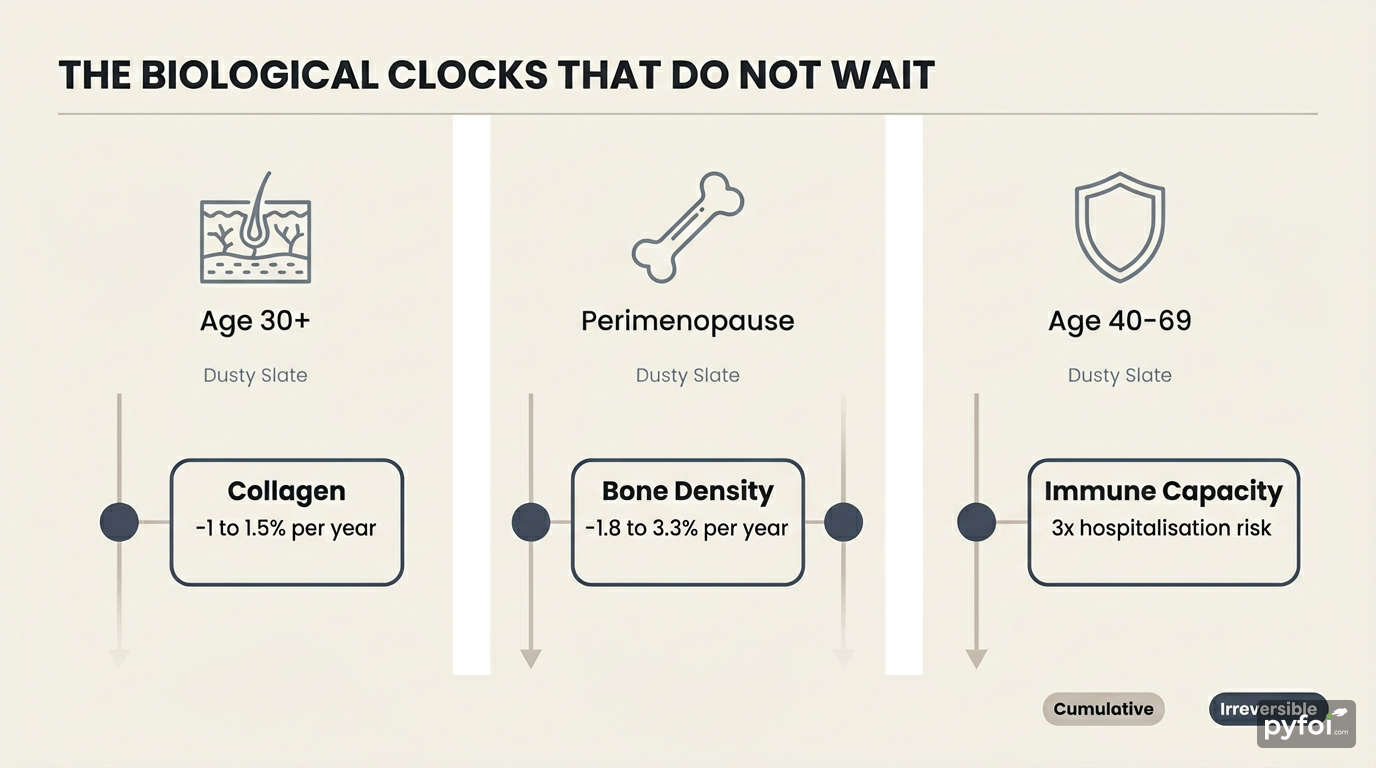
The real questions are not "should I try liposomal supplements eventually?" but: what is the biological cost of each year I delay? And does waiting for mainstream adoption actually protect me, or just feel safer?
What does the delay actually cost in concrete terms?
When you map the cost of waiting against the biological clock, the numbers are uncomfortable:
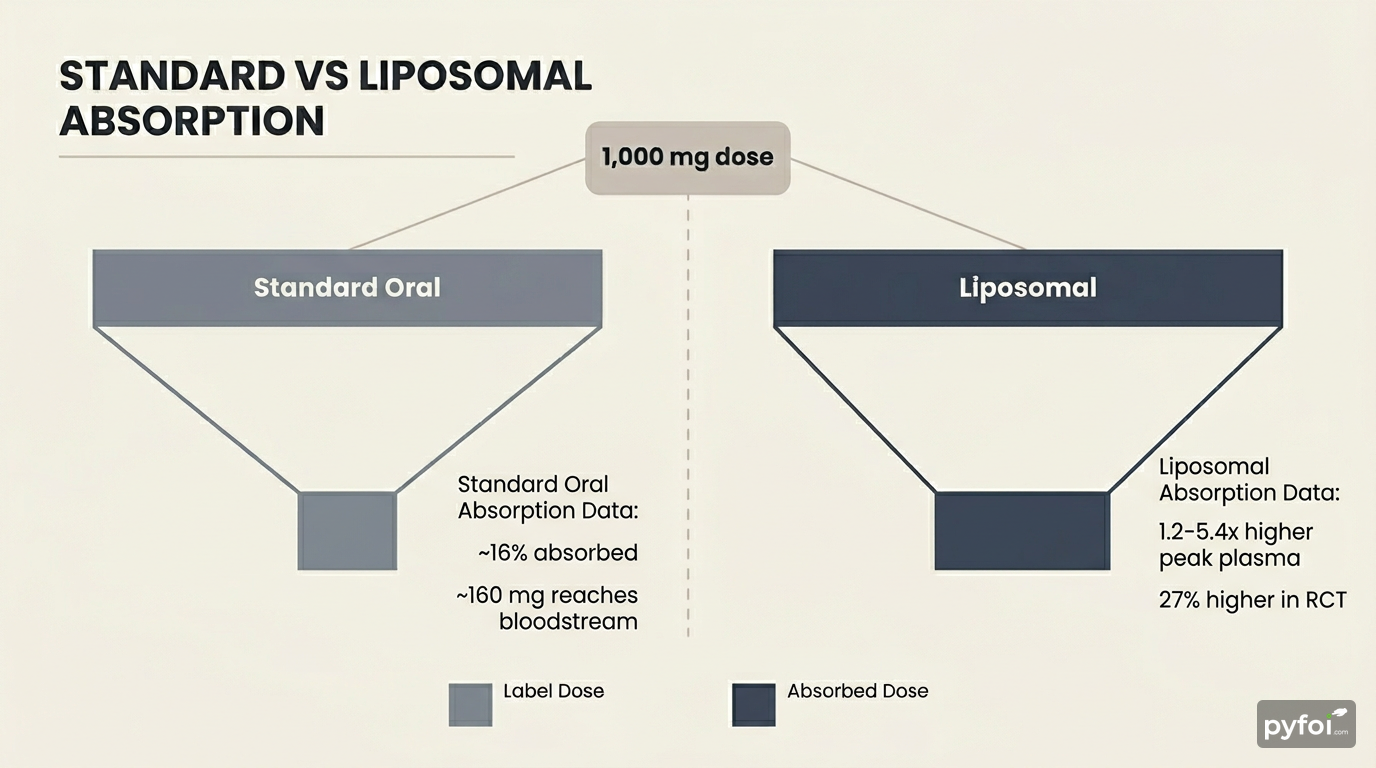
- Standard oral supplement bioavailability averages approximately 16% [8]. For every 1,000 mg on the label, your bloodstream may see around 160 mg.
- Liposomal vitamin C delivers 1.2-5.4 times higher peak plasma concentrations [9]. A double-blind RCT found 27% higher peak plasma levels at the same dose [10].
- Every year of suboptimal absorption compounds collagen decline, bone density loss, and immune reserve depletion - deficits that become progressively harder to reverse [3][4][5][6][7].
The supplement you take in three years will be the same formulation. Your biology will not be.
What does a two-year delay look like in practice?
Imagine two people, both 48, both taking daily vitamin C. One switches to a liposomal format now. The other decides to wait until the products are cheaper and more widely available - say, two years from now.
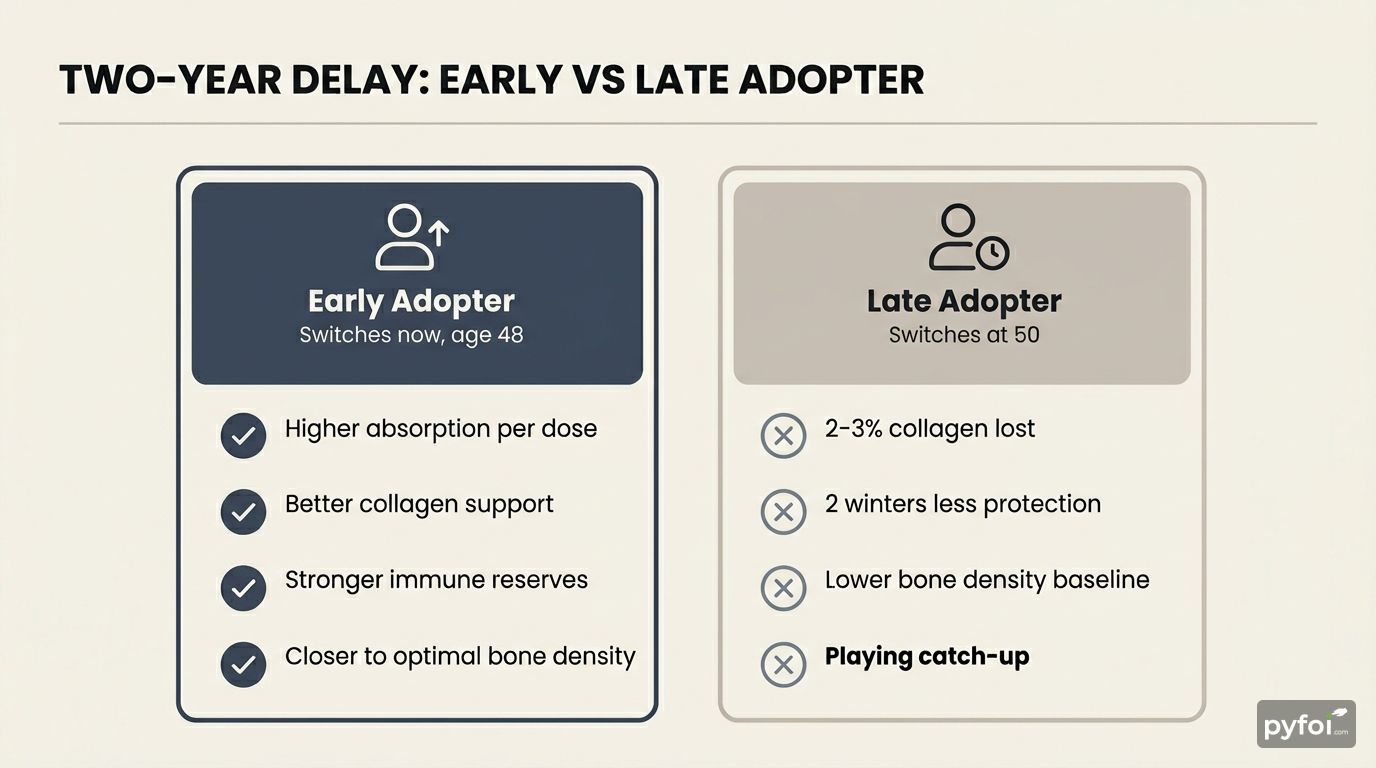
During those two years, the early adopter absorbs meaningfully more vitamin C per dose. Their collagen-building cells get more raw material. Their immune reserves are better maintained through two winters. Their bone-protective nutrient status stays closer to optimal through early perimenopause.
The person who waited eventually buys the same product at a slightly lower price. But they start from a lower baseline - two years of collagen loss at 1-1.5% per year, two winters of depleted immune reserves, bone density that continued its quiet decline. They are playing catch-up on a deficit that did not need to exist.
How should you evaluate the timing decision?
Before deciding to wait, weigh these factors against your own circumstances:
- Your age and life stage. Over 40, approaching menopause, or noticing slower recovery? The biological cost of delay is steeper. The window where better absorption makes the most difference is now.
- Your current absorption reality. At 16% bioavailability, you are paying for six times more than you receive. A format delivering several times higher blood levels changes the equation immediately.
- The compounding nature of the loss. Collagen, bone density, and immune capacity do not wait for prices to drop. Each month of suboptimal delivery adds to a deficit that becomes harder to close.
- Cost per absorbed milligram versus cost per bottle. A higher-priced product delivering three to five times more nutrient to your bloodstream may cost less per usable milligram than the cheaper option.
What should you actually do?
Stop treating this as a trend to watch. The clinical evidence already exists. Liposomal delivery achieves higher blood concentrations at the same dose [9][10]. The market trajectory confirms these products are heading mainstream [1][2]. The only question is whether you benefit now or later.
Assess your current supplement by results. If you are taking standard vitamin C and have never checked your blood levels, you do not know what you are actually absorbing. Ask your GP for a plasma vitamin C test. If levels are low despite supplementing, your delivery format is the problem.
Match urgency to your biology. Under 35 with no health concerns? You have more margin. Over 45, post-menopausal, or managing gut health issues? The absorption gap widens every year, and the cost of delay is steepest when your reserves are already declining.
Have the conversation with your pharmacist now. Ask about liposomal options for the nutrients you already take. Start with the nutrient where absorption matters most for your situation.
The products will go mainstream. The prices will likely come down. But your collagen, bone density, and immune reserves are not waiting for the market to catch up. Biological time, once lost, does not come back on sale.
You may also be interested in these independent articles
Sources
- [1]Liposomal Supplements Market Size to Hit USD 745.02 Million by 2034 - Precedence Research
- [2]Australia & New Zealand Dietary Supplements Market Report, 2030 - Grand View Research
- [3]Decreased Collagen Production in Chronologically Aged Skin - Varani et al., 2006
- [4]The 1% Problem: What You Should Know About Collagen Loss After 30 - Parallel Health, 2024
- [5]Bone Mineral Density Changes during the Menopause Transition - Finkelstein et al., 2008
- [6]Menopause and Bone Loss - Endocrine Society
- [7]Immunosenescence: How Aging Increases Susceptibility - PMC, 2024
- [8]What is the absorption rate of supplements? - Ask The Scientists
- [9]Do Liposomal Vitamin C Formulations Have Improved Bioavailability? - Carr, 2025
- [10]Liposomal delivery enhances absorption of vitamin C - PMC, 2024
© 2026 pyfoi. All rights reserved.