
Everything You Need to Know About Why Chinese Brands Are No Longer a Fringe Story
Chinese car brands in New Zealand now compete on ANCAP safety, warranty, EV running costs and support. See what buyers still miss in 2026.
If you are shopping for a new car in New Zealand, especially an SUV or electrified model, Chinese brands are no longer something happening at the edges of the market. They are already in driveways, on dealer forecourts, and in used listings. More importantly, they are now showing up in the parts of the decision that matter most to you - safety ratings, running costs, warranty cover, family practicality, and service support.
What many buyers still get wrong is assuming this is mainly a price story. It is not. Lower pricing may have helped some brands get attention, but the real shift is that several Chinese manufacturers now compete on the same evidence buyers use to justify any serious purchase. In some cases, they are also forcing a rethink of what "safe", "proven", or "sensible" really means. A familiar badge can still be the right choice. It is just no longer the only one that deserves a fair hearing.
That means your job as a buyer has changed. Instead of asking whether Chinese brands are legitimate in some broad, abstract sense, you are better off asking model-specific questions. Is this exact vehicle safe by current standards? Does it suit your weekly driving? Who carries the repair risk if something expensive fails? Is the support network good enough for where you live? And if you keep delaying the comparison, what is that caution actually costing you?
The articles below unpack those questions from different angles. Together, they show why this category has moved from fringe curiosity to mainstream shortlist material.
Has the safety conversation already moved on?
For many buyers, safety is still where the old assumptions linger most. There is a mental shortcut that says familiar Japanese or Korean badge equals safe, while Chinese badge equals uncertain. That shortcut once reflected reality more closely than it does now. Today, it is too blunt to be useful.
Several current Chinese-brand SUVs sold in New Zealand now hold five-star ANCAP ratings under modern protocols, including models from BYD, MG, GWM and Chery. That does not mean every model deserves trust by default. It means you need to judge the exact vehicle, variant, and build date rather than relying on country of origin as a proxy. The same discipline that includes strong Chinese entries also excludes weak ones, such as unrated or specification-compromised models.
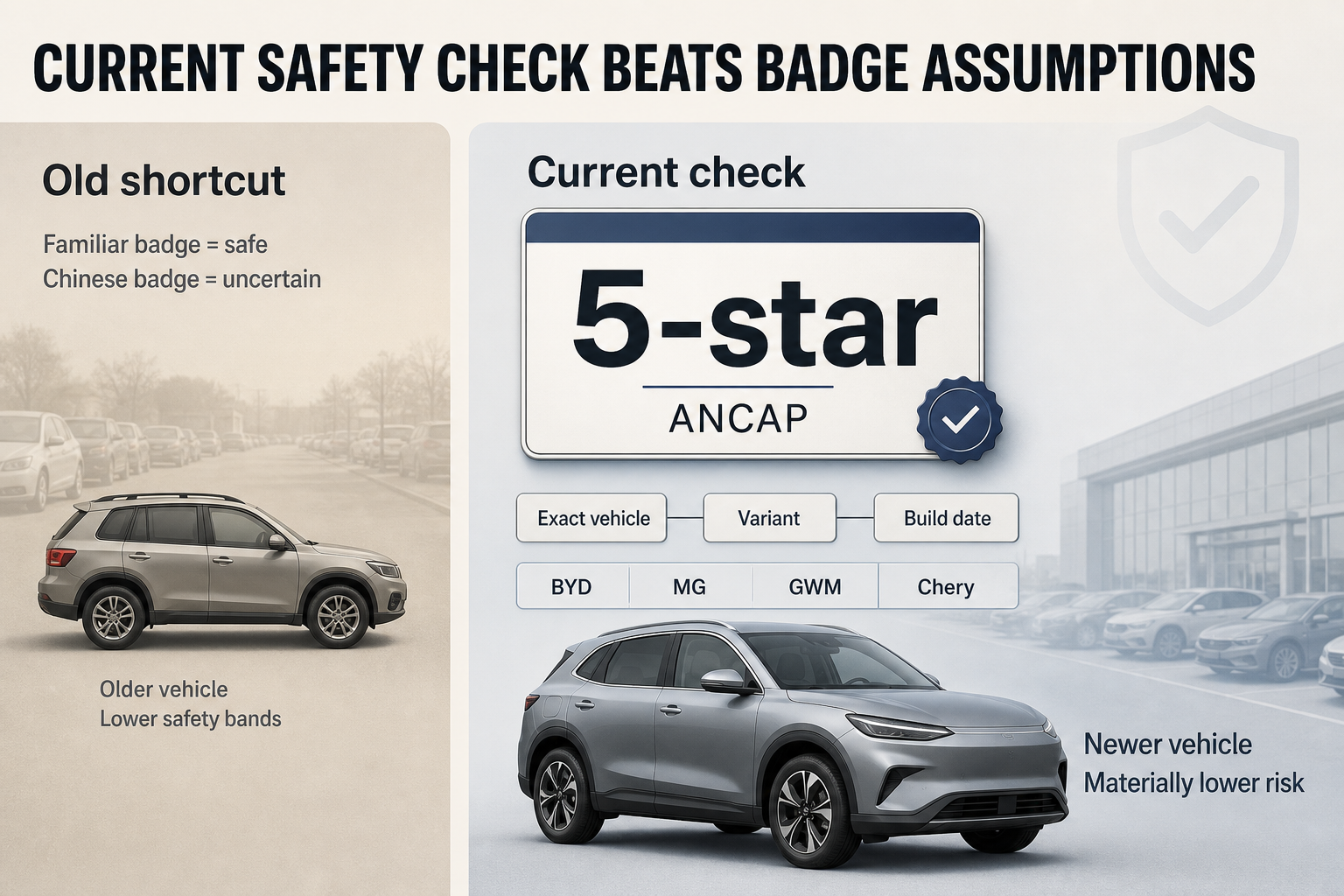
This matters because the benchmark should not be an idealised memory of a trusted brand. It should be the car in your driveway right now. NZTA data shows a large share of the local fleet still sits in lower safety bands, and newer vehicles materially reduce the risk of death or serious injury compared with older ones. If your current SUV is ageing, the real comparison is often between a lower-rated existing vehicle and a current five-star replacement, not between two abstract brand reputations.
If you want to go deeper on how delay affects family safety, start with What's one more month really costing you? › and What happens if you keep putting off the comparison? ›.
Is "wait and see" quietly costing you more than you think?
A lot of buyers tell themselves they are being prudent by waiting another six months or another year before taking newer Chinese brands seriously. The problem is that delay is not neutral. It can carry a monthly cost, and not just in the purchase price you have not paid yet.
The first cost is staying longer in an older vehicle with weaker crash protection or fewer active safety features. The second is continuing to pay petrol running costs when an EV or plug-in hybrid might already fit your routine. Public NZ guidance from Gen Less and EECA shows a typical home-charged EV can cost meaningfully less per 100 km to run than a comparable petrol vehicle, even after road user charges. Over a year, that can add up to a noticeable household expense. The third cost is strategic: if you rule out a growing slice of the market before test-driving anything, you shrink your shortlist and weaken your negotiating position.
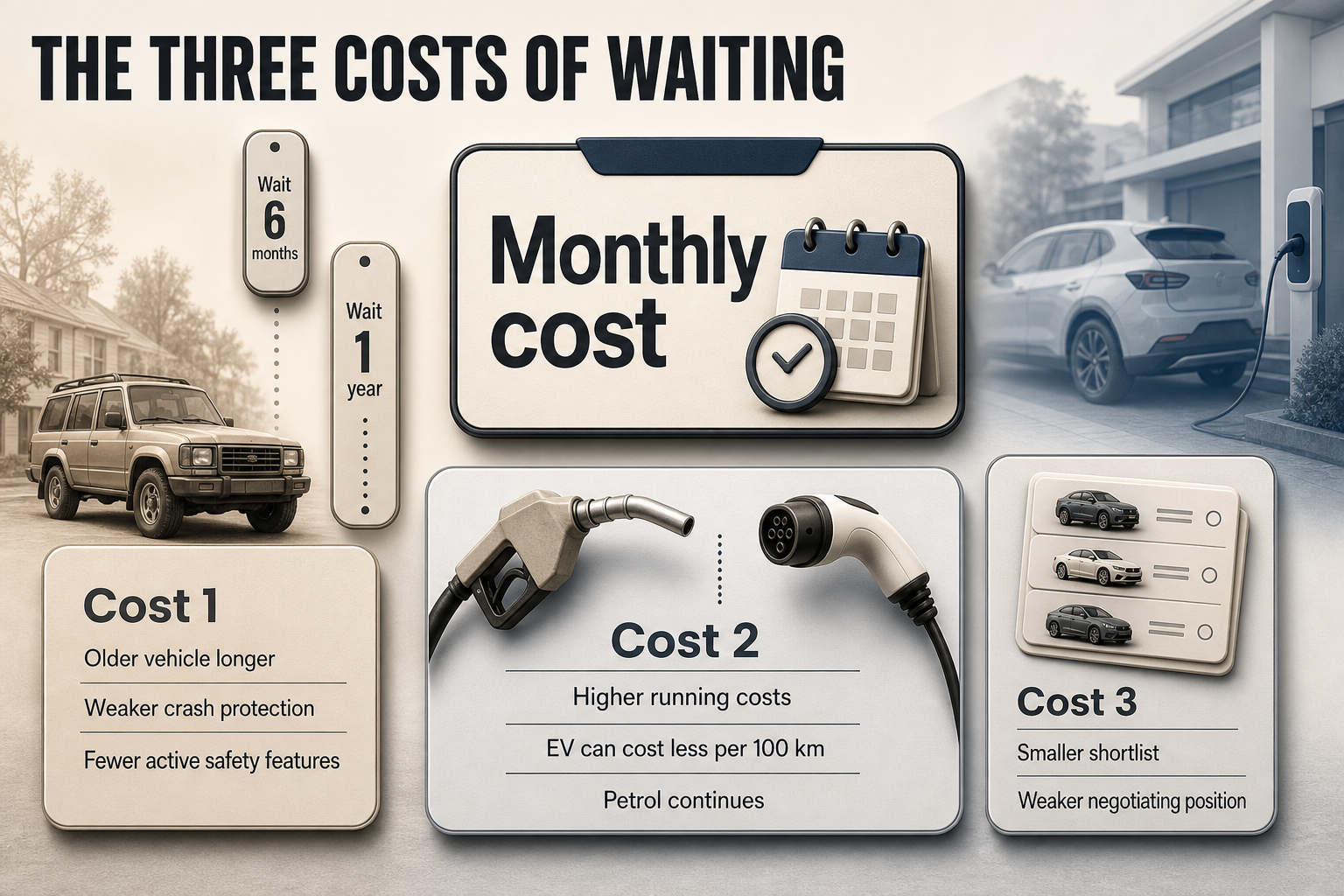
That is the hidden trap in the "I will revisit it later" mindset. It feels like risk management, but often it is just inherited caution operating on outdated information. By the time a warning light appears on your old car, or the next WoF turns expensive, you may be shopping under pressure and leaning even harder on familiarity.
If you want to understand the cost of postponing the comparison, read What's one more month really costing you? ›, What happens if you keep putting off the comparison? ›, and What if the "safe" choice is actually the expensive one? ›.
Are warranty and battery cover the new trust signals?
One of the biggest shifts in this market is that trust is becoming easier to compare in writing. Instead of relying on brand heritage as a stand-in for reliability, you can now look at published warranty terms, battery cover, roadside assistance, and servicing conditions.
That is especially important with electrified vehicles, where the battery and drive unit are often the components buyers worry about most. Several Chinese brands in New Zealand now publish long battery warranties alongside whole-vehicle cover. Those terms do not prove a car will never have problems. What they do is show who is prepared to carry the financial downside if a major component fails within the covered period.
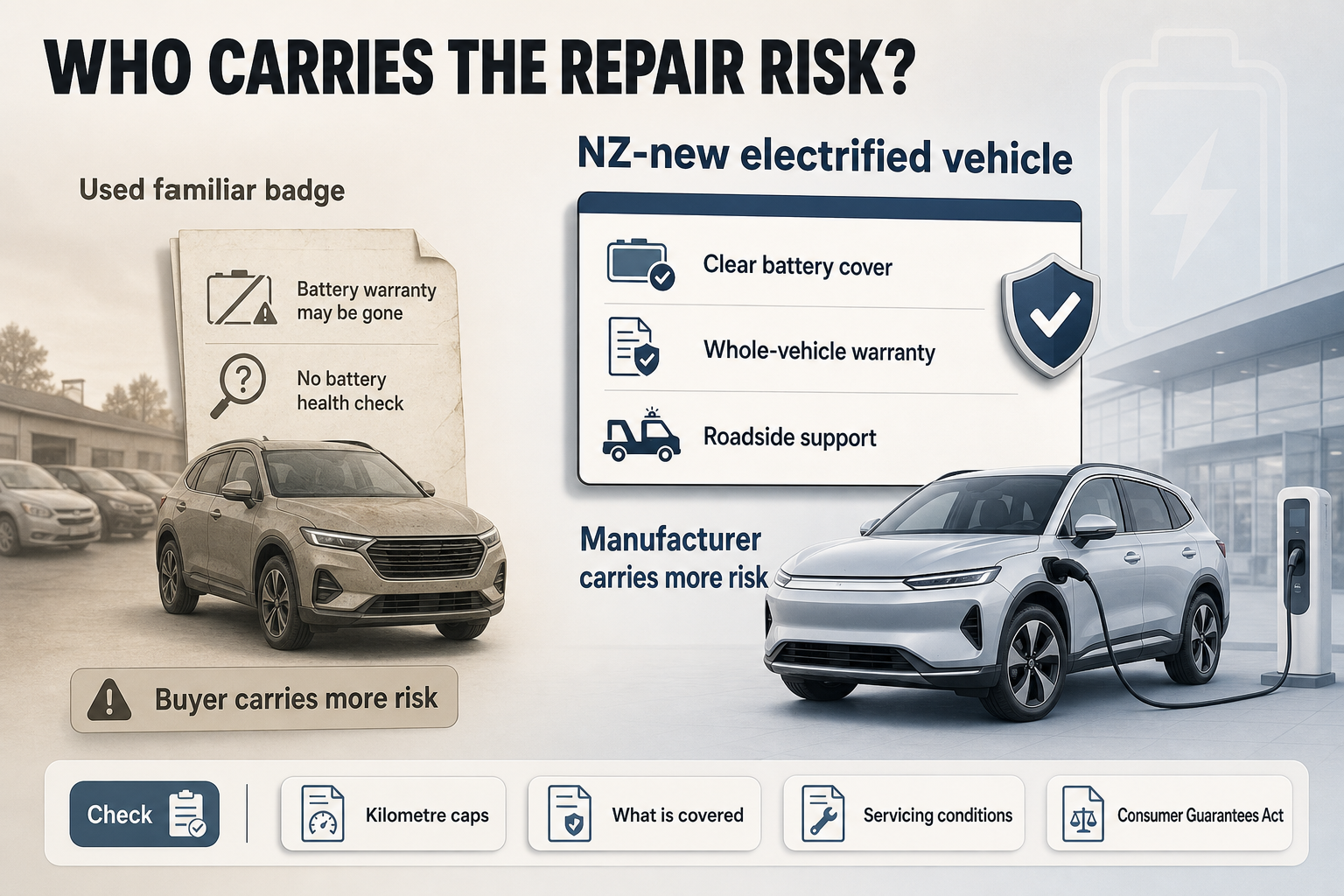
This is also where used versus new can get counter-intuitive. A used hybrid or EV from a familiar badge may feel safer because the brand is known, but if no meaningful battery warranty remains and no battery health check was done, you may be carrying the biggest risk yourself. By contrast, a NZ-new electrified vehicle with clear battery cover shifts that risk back to the manufacturer. That does not automatically make new better than used for every buyer, but it changes the comparison in a very practical way.
So when you assess ownership risk, look beyond the headline years. Check kilometre caps, what is specifically covered, whether roadside support is included, and what servicing conditions apply. Also remember that warranty sits on top of your rights under the Consumer Guarantees Act, rather than replacing them.
For more on this, see What happens if you wait another year to check? ›, What if you chose the "safe" used option this weekend? ›, and What if the "safe" choice is actually the expensive one? ›.
Is support in New Zealand still a real concern?
Aftersales support is one of the most reasonable concerns buyers have about newer or less familiar brands. A car can look compelling on paper, but if servicing is awkward, parts are slow, or roadside help is thin, ownership can become frustrating. The key point is that this question now needs a more precise answer than "Chinese brands have no support".
Several Chinese brands now operate formal dealer, service, showroom, and roadside networks across New Zealand. There are authorised locations, dealer locators, and growing stocks of NZ-new used vehicles appearing on Trade Me. That does not mean every support footprint is equal, or that every brand is equally suitable for every region. It means the issue has shifted from existence to adequacy.
For a metro or provincial household, a network may already be more than sufficient for normal family use. For a rural buyer, someone towing regularly, or a household that cannot tolerate downtime, the threshold is higher. In that case, you should map the actual distance to your nearest authorised service point, ask about parts pathways and turnaround times, and think honestly about how much disruption you could absorb if something goes wrong.
This is a much better filter than simply excluding unfamiliar badges. You are not asking whether the brand feels established. You are asking whether its NZ support is good enough for your geography and usage.
To explore that angle, read Would you rule out a suburb before checking if it has a supermarket? › and What happens if you wait another year to check? ›.
Could the vehicle you dismissed actually fit your life better?
The strongest reason Chinese brands are no longer a fringe story is not just that they are present. It is that some of them now compete well on the everyday jobs your vehicle actually needs to do.
For family buyers, that means practical packaging, boot space, child-seat access, efficiency, towing, electrified range, and standard safety tech. A vehicle that handles school drop-offs, the weekly shop, sports gear, holiday drives, and occasional towing with less friction is doing something more important than signalling brand familiarity. It is fitting your real life.
This is where shortlist habits can work against you. If you start with the badge and only later think about household tasks, you can miss models that deliver a stronger all-round bundle for the same money. Some current Chinese SUVs combine useful boot space, hybrid or plug-in capability, solid efficiency, and family-friendly packaging in ways that make them very relevant to New Zealand buyers. The point is not that one specific model will suit everyone. It is that the comparison deserves to happen on practical outcomes, not old assumptions.
A simple way to reset the process is to write down the top three jobs your next vehicle must do well. Then compare candidates against those jobs first. How easy is child-seat loading? How much of your weekly driving could happen on electricity? Do you need towing? What is the real running cost per 100 km? Once you do that, the badge often matters less than you expected.
For a deeper look at family-use practicality and value, read What if the SUV you dismissed actually does your family's jobs better? › and What if the "safe" choice is actually the expensive one? ›.
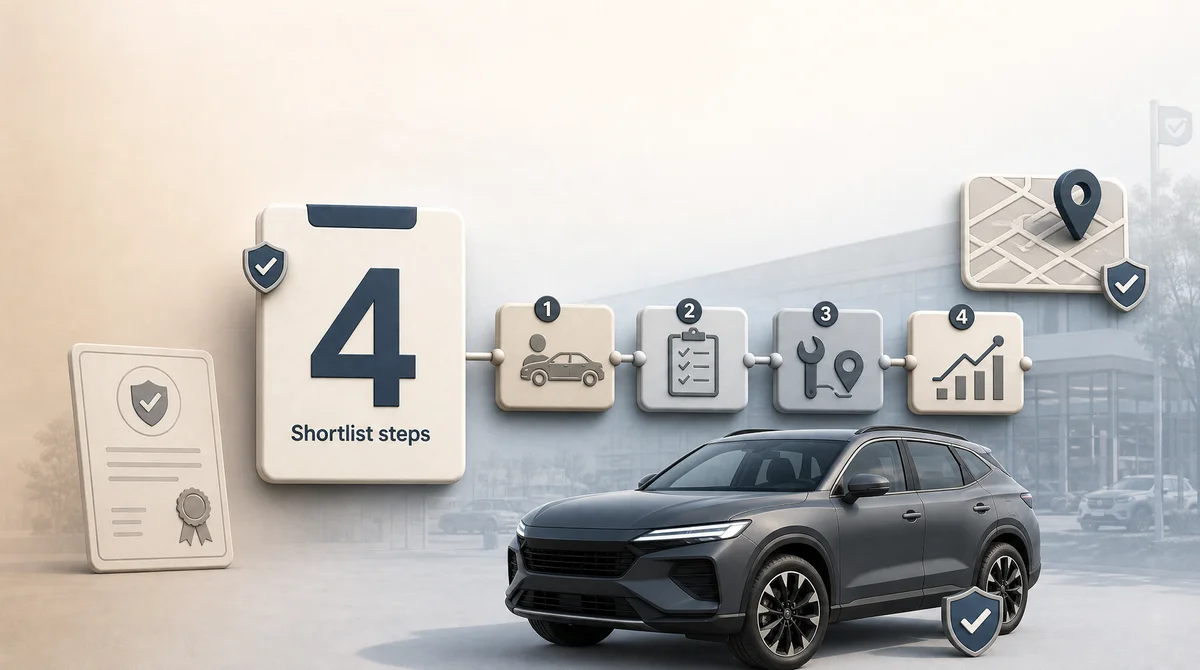
How should you decide whether a Chinese brand belongs on your shortlist?
A good decision here is less about embracing or rejecting a category, and more about using the right sequence. Start with your use case, then test the evidence, then price the trade-offs honestly.
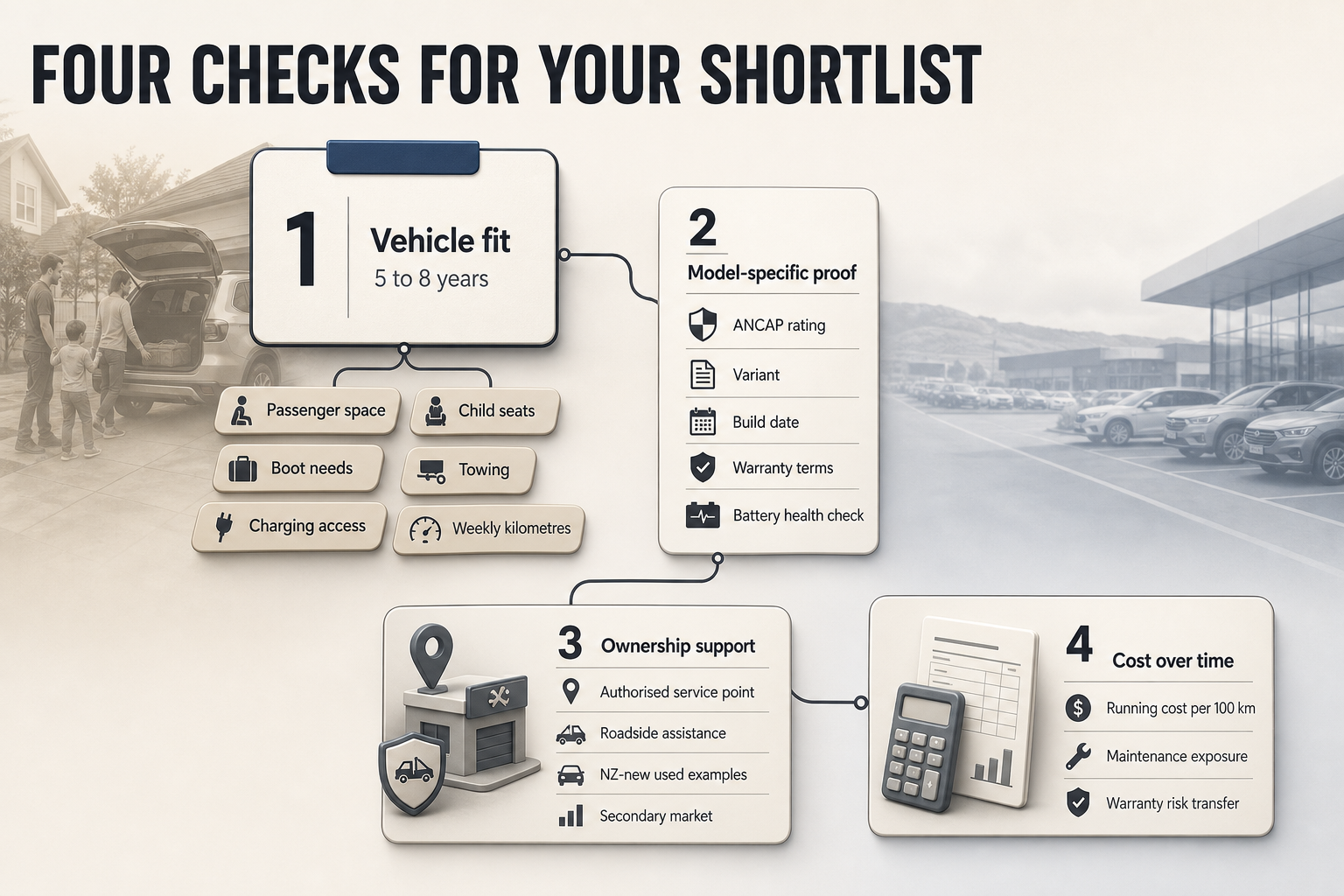
First, check vehicle fit. What does your household actually need over the next five to eight years? Think about passenger space, child seats, boot needs, towing, charging access, and weekly kilometres. If electrification could suit your routine, do not exclude it before you have run the maths.
Second, check model-specific proof. Look up the exact ANCAP rating and confirm it applies to the variant and build date you are considering. Read the actual warranty terms, especially for the battery if the vehicle is electrified. If you are considering used hybrids or EVs, ask for a high-voltage battery health check rather than assuming a standard inspection covers it.
Third, check ownership support. How far is the nearest authorised service point? What roadside assistance is included? Are there NZ-new used examples already circulating, suggesting a growing installed base and a forming secondary market?
Fourth, check cost over time, not just purchase price. Compare running costs per 100 km, likely maintenance exposure, and the value of written risk transfer through warranty. Sometimes the "safe" choice is only safe because it feels familiar. On paper, it may cost more to run, leave you with shorter cover, or fit your family less well.
The final takeaway is simple. Chinese brands in New Zealand no longer deserve either blanket trust or blanket dismissal. They deserve the same disciplined, model-by-model comparison you would apply to any serious purchase. If a vehicle clears your safety, support, practicality, and ownership-risk tests, it belongs on the shortlist. If it does not, rule it out for those reasons - not because of where the badge comes from. That is how you make a current decision in a market that has already changed.
What the brands say
These brands have chosen to respond directly to this independent research. We publish brand responses unedited because we believe transparency builds trust - and that brands willing to engage openly with independent analysis deserve to be heard.
You may also be interested in these independent articles
Sources
- [1]What's one more month really costing you? ›
- [2]What happens if you keep putting off the comparison? ›
- [3]What if the "safe" choice is actually the expensive one? ›
- [4]What happens if you wait another year to check? ›
- [5]What if you chose the "safe" used option this weekend? ›
- [6]Would you rule out a suburb before checking if it has a supermarket? ›
- [7]What if the SUV you dismissed actually does your family's jobs better? ›
- [9]NZ Transport Agency Waka Kotahi - Vehicle safety
- [10]ANCAP - BYD SEALION 7 Safety Rating and Report
- [11]ANCAP - GWM Haval H6 Safety Rating and Report
- [12]ANCAP - MG HS and electric Omoda E5 prove their safety credentials
- [13]Gen Less - Why buy an EV: benefits, costs and charging
- [14]EECA - Benefits of electric vehicles for your home
- [15]BYD Auto New Zealand - Warranty and Service Book
- [16]GWM New Zealand - Warranty Program
- [17]Consumer Protection New Zealand - Warranties
- [18]AA New Zealand - Pre Purchase Inspection Terms and Conditions
- [19]Consumer NZ - What to know before buying a secondhand EV
- [20]MG Motor New Zealand - Locate a Dealer
- [21]BYD Auto NZ - Roadside Assistance
- [22]MoneyHub - Top-Selling Cars in New Zealand 2025, 2026
- [23]BYD Auto NZ - BYD Sealion 6 vehicle page
© 2026 pyfoi. All rights reserved.