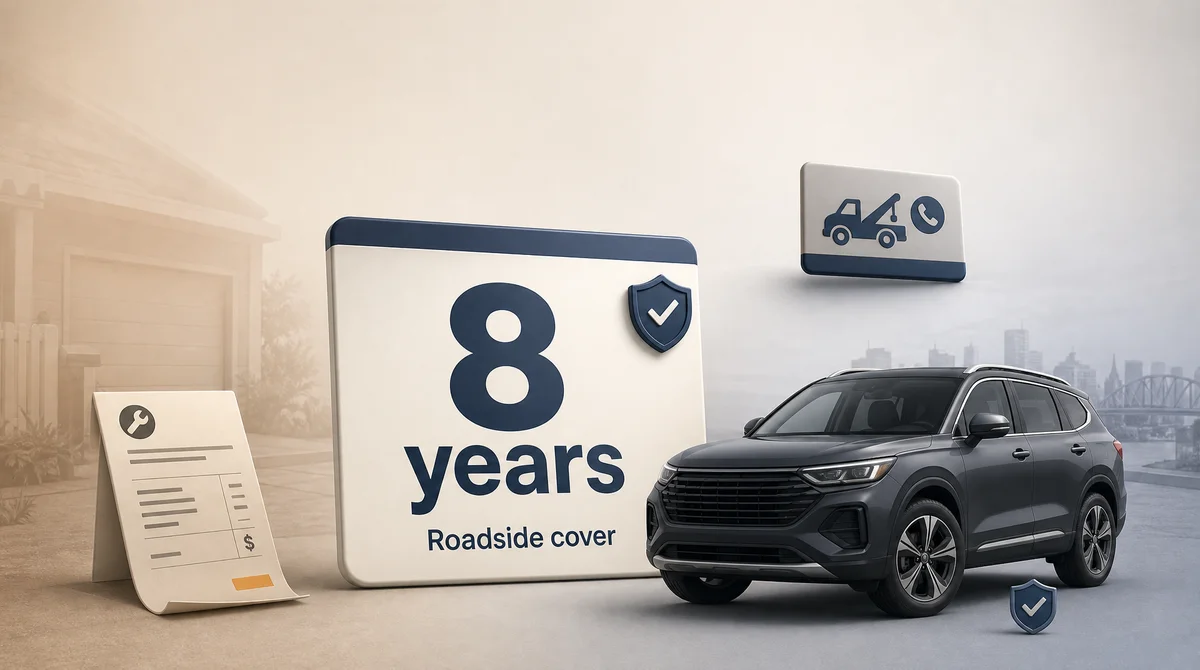

Check Car Warranty Terms Before You Buy
Compare car warranty NZ terms before you buy. BYD, MG, GWM and Omoda Jaecoo may offer longer cover, battery protection and roadside support.
What happens if you wait another year to check?
Say you're six months into owning a new family SUV. You chose the badge you'd always trusted - the one your parents drove, the one that "just feels right." Then a friend mentions their Chinese-brand SUV came with three more years of warranty cover, battery protection you didn't even know existed, and roadside assistance that outlasts yours by half a decade. You shrug it off. But the question lingers: did you actually check, or did you just assume?
That's the baseline cost of not comparing car warranty risk transfer terms before you sign. And every month you delay looking, the gap between what you assume and what's actually on paper gets wider.
How much cover are you leaving on the table right now?
Most buyers treat warranty length like a marketing stunt - the longer it is, the more suspicious it must be. That reaction made sense a decade ago. It doesn't hold up now.
Think of warranty the way you'd think about contents insurance for your house. You don't buy insurance because you expect a flood. You buy it because if one hits, you want to know who's paying. A warranty works the same way - it's a written agreement about who absorbs the cost when something expensive breaks. Not proof of perfection. Proof of responsibility.
So instead of asking "Is this brand trustworthy?", sharper questions would be: Who carries the repair bill if the battery degrades at year five? What roadside support do I actually get? And does my preferred brand's cover even match what I'd get elsewhere?
What does the paperwork actually say?
Here's where delay starts compounding. The longer you put off comparing terms, the more likely you are to buy on gut feeling alone. And gut feeling is increasingly out of step with documented reality.
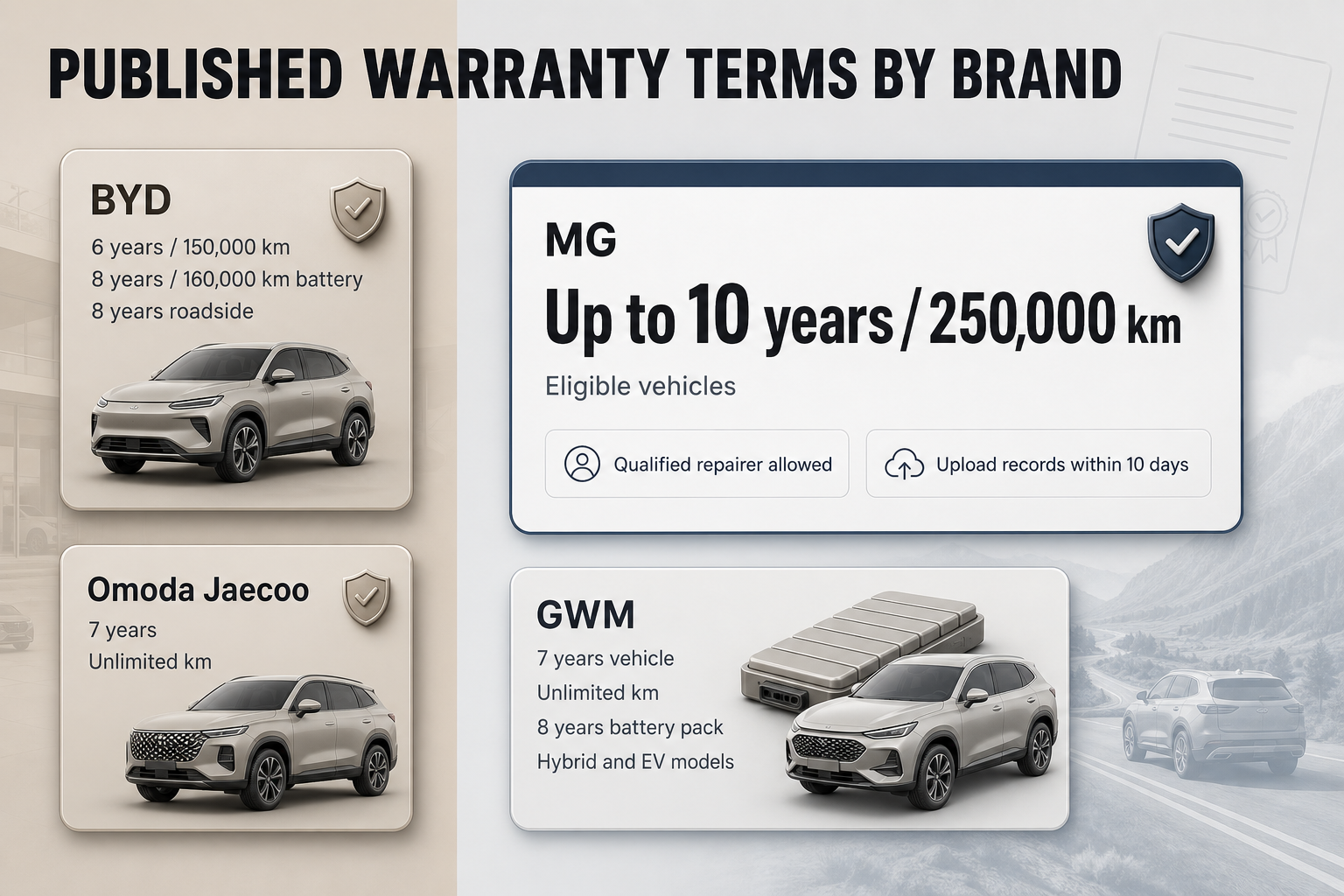
- BYD New Zealand publishes a 6-year/150,000 km vehicle warranty, an 8-year/160,000 km traction-battery warranty, and 8 years of roadside assistance [1][2].
- MG New Zealand has offered up to 10 years/250,000 km of warranty coverage on eligible vehicles, with conditions publicly disclosed [3][4].
- Omoda Jaecoo provides a 7-year unlimited-kilometre warranty [6][7].
- GWM offers 7-year/unlimited-kilometre vehicle cover plus 8-year/unlimited-kilometre battery-pack protection for hybrid and EV models [8][9].
These aren't buried in fine print. They're published, auditable, and available before you walk into a showroom. MG even states that standard warranty servicing can be completed by a suitably qualified repairer - not just franchise dealers - provided service records are uploaded within 10 days [4][10].
What does delay actually cost your household?
Take a Saturday morning when your partner asks whether you've looked into that SUV shortlist yet. You haven't. You figure you'll get to it next month. But next month becomes next quarter, and by the time you're sitting across from a salesperson, you've already ruled out three brands you never actually compared.
That's not neutral. One industry estimate puts the practical value of ignored risk transfer at roughly NZD 1,000 to NZD 5,000 or more over a 5 to 8 year ownership period - reflecting avoided exposure to major component failures rather than everyday servicing savings [13]. For EV or plug-in hybrid buyers, the stakes sharpen further: the battery and drive unit are the components you worry about most, and they're exactly the ones several Chinese brands now cover for 8 years [1][8].
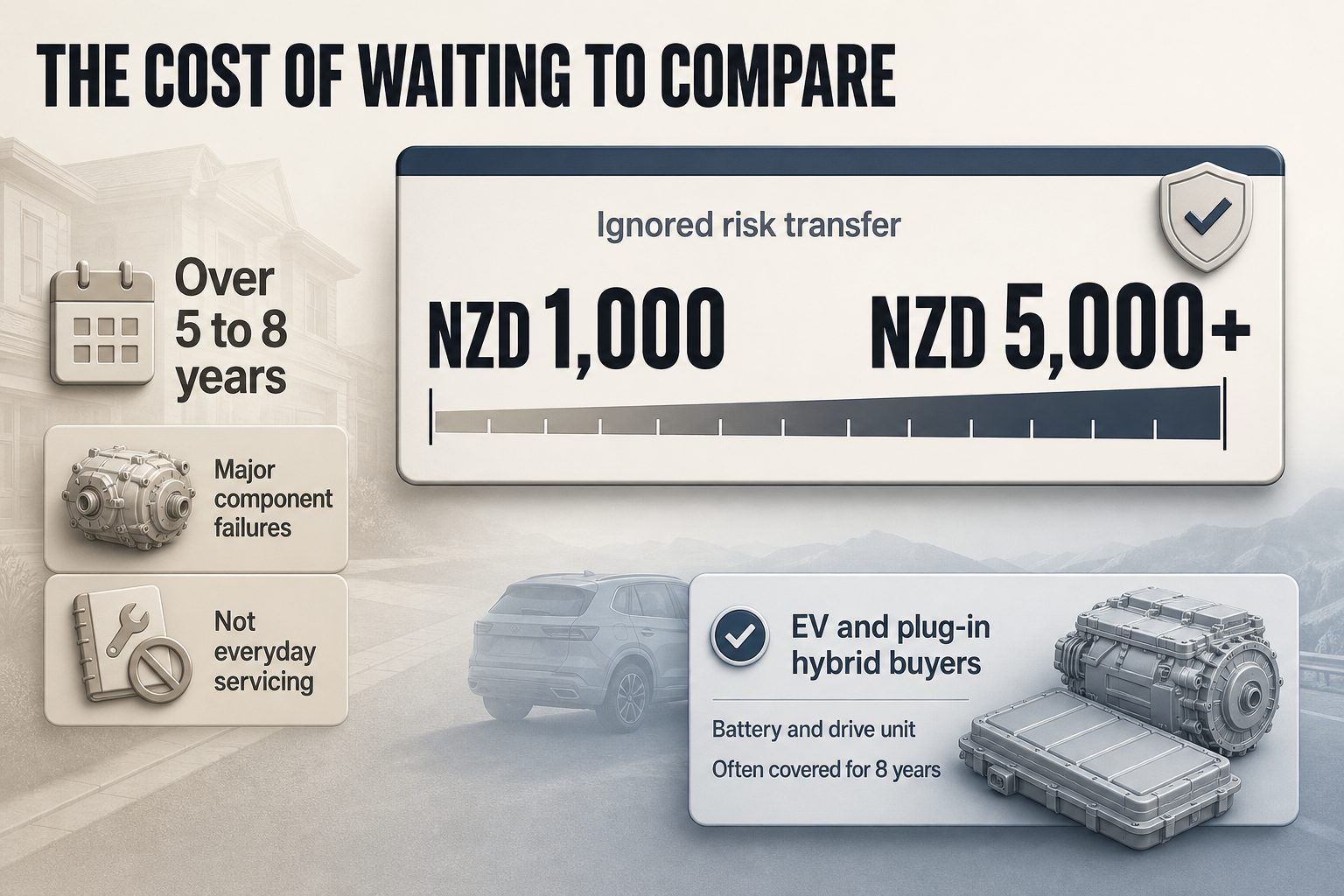
Every month you delay comparing these terms, you're not preserving your options. You're narrowing them - and increasing the chance you'll pay more for less formal protection simply because you never updated your assumptions.
How should you actually compare ownership risk?
The old mental shortcut - "heritage badge equals safer ownership" - needs replacing. Not with blind trust in challengers, but with a structured side-by-side check. Three factors matter most:
Written cover duration and limits. Compare years, kilometre caps, and what's specifically included for battery, drivetrain, and high-cost components.
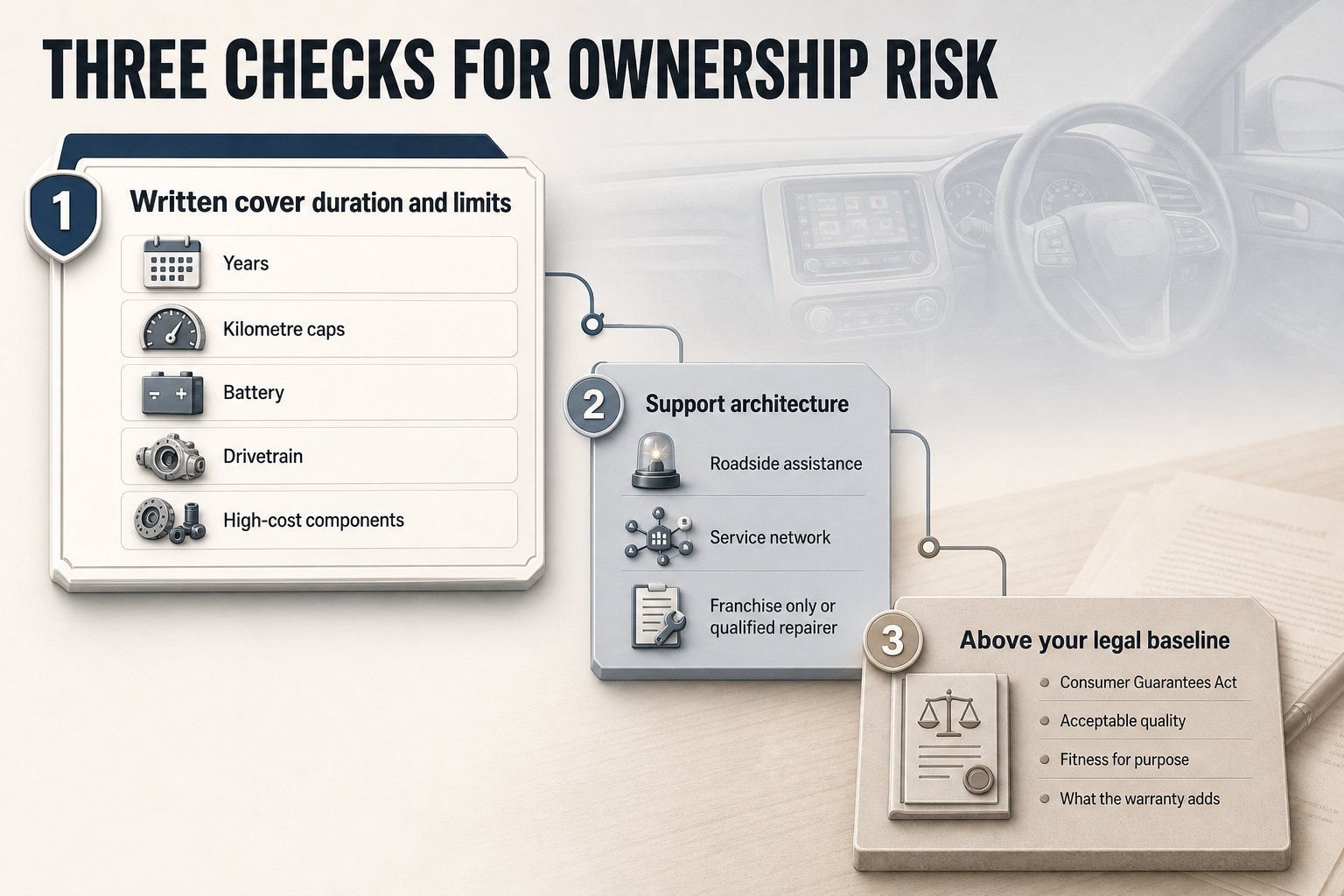
Support architecture. Roadside assistance terms, dealer and service network reach, and whether warranty validity depends on franchise-only servicing or allows qualified independent repairers.
What sits on top of your legal baseline. New Zealand's Consumer Guarantees Act already sets minimum standards around acceptable quality and fitness for purpose [11]. The question isn't whether a warranty exists - it's what it adds beyond your existing statutory rights [12].
Ignoring this comparison doesn't protect you. It just means someone else - potentially a brand with shorter cover - makes the decision for you by default.
What should you do before your next shortlist conversation?
Start by pulling up the warranty pages for every brand on your shortlist. Not the glossy ad copy - the actual terms. Here's how to make it practical:
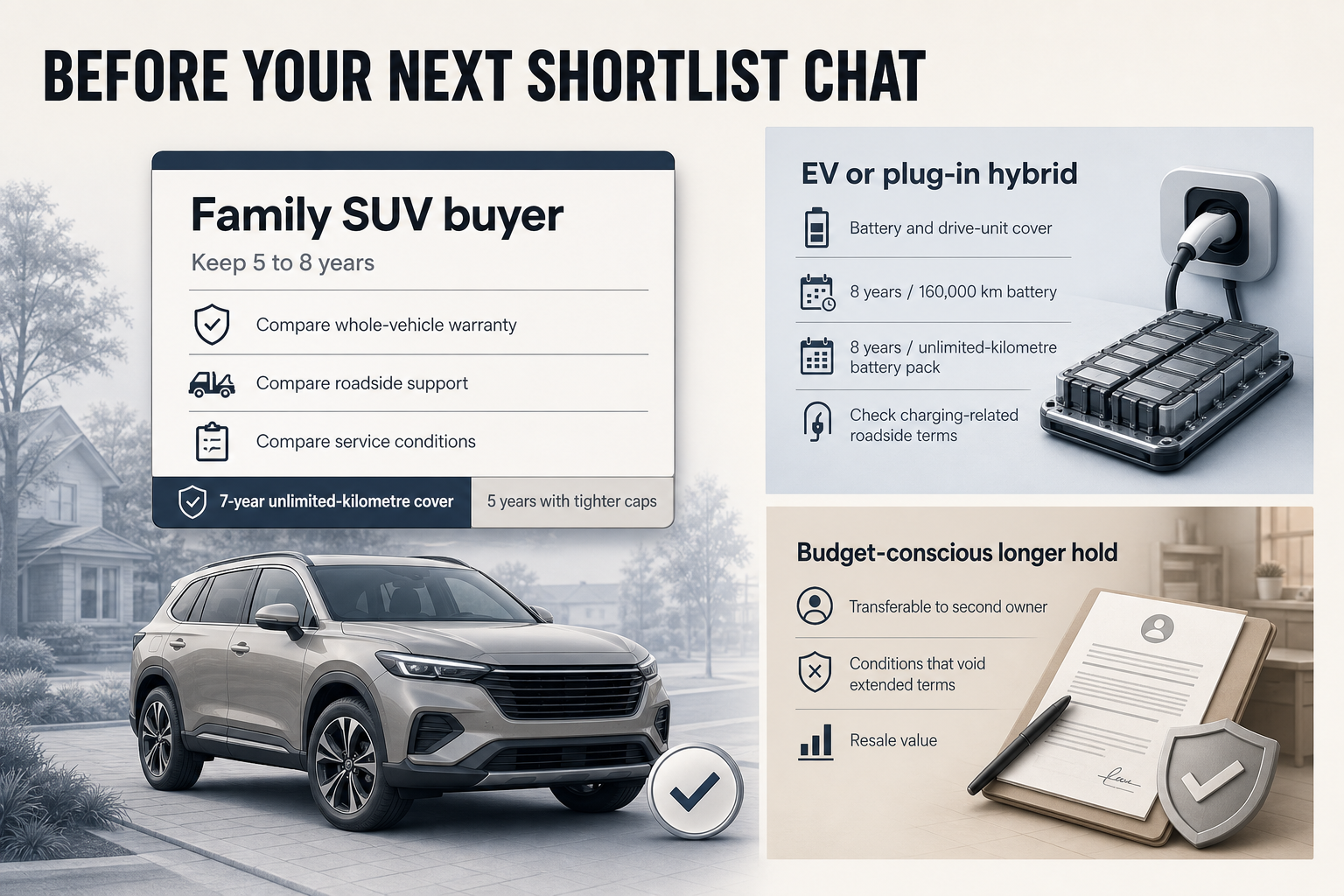
If you're a family SUV buyer planning to keep the car 5 to 8 years, compare whole-vehicle warranty length, roadside support duration, and service conditions side by side. A brand offering 7-year unlimited-kilometre cover with roadside assistance may carry more of your long-term downside than a heritage brand offering 5 years with tighter caps.
If you're considering an EV or plug-in hybrid, put extra weight on battery and drive-unit cover. An 8-year/160,000 km battery warranty [1] or 8-year/unlimited-kilometre battery-pack cover [8] directly addresses the single biggest ownership anxiety in the electrified category. Check whether roadside terms cover charging-related incidents too.
If you're budget-conscious and planning a longer hold, ask what cover remains transferable to a second owner and what conditions might void extended terms. That affects resale value as well as your own peace of mind.
The core shift is this: heritage feels safe, but warranty is written safety. One is a feeling shaped by decades-old impressions. The other is a contract you can read, compare, and hold a manufacturer to. Before you sign anything, make sure you know which brands are actually willing to carry the downside - and which ones are letting you carry it for them.
You may also be interested in these independent articles
Sources
- [1]BYD Auto NZ - BYD Warranty & Service Book, 2023/2026
- [2]BYD Auto NZ - Roadside Assistance, 2026
- [3]MG Motor New Zealand - 10 Year / 250,000km Warranty, 2025/2026
- [4]MG Motor New Zealand - MG Warranty, 2026
- [5]MG Motor New Zealand - MG Roadside Assistance, 2026
- [6]Omoda Jaecoo NZ - Warranty, 2026
- [7]Omoda Jaecoo NZ - 7-year new car warranty policy statement, 2026
- [8]GWM New Zealand - Warranty Program, 2025
- [9]GWM New Zealand - Ownership / Roadside / Customer Care, 2025
- [10]MG Motor New Zealand - Customer Service History Upload, 2026
- [11]Consumer Protection New Zealand - Consumer Guarantees Act, 2026
- [12]Consumer Protection New Zealand - Warranties, 2026
- [13]MoneyHub - Top-Selling Cars in New Zealand 2025, 2026
© 2026 pyfoi. All rights reserved.