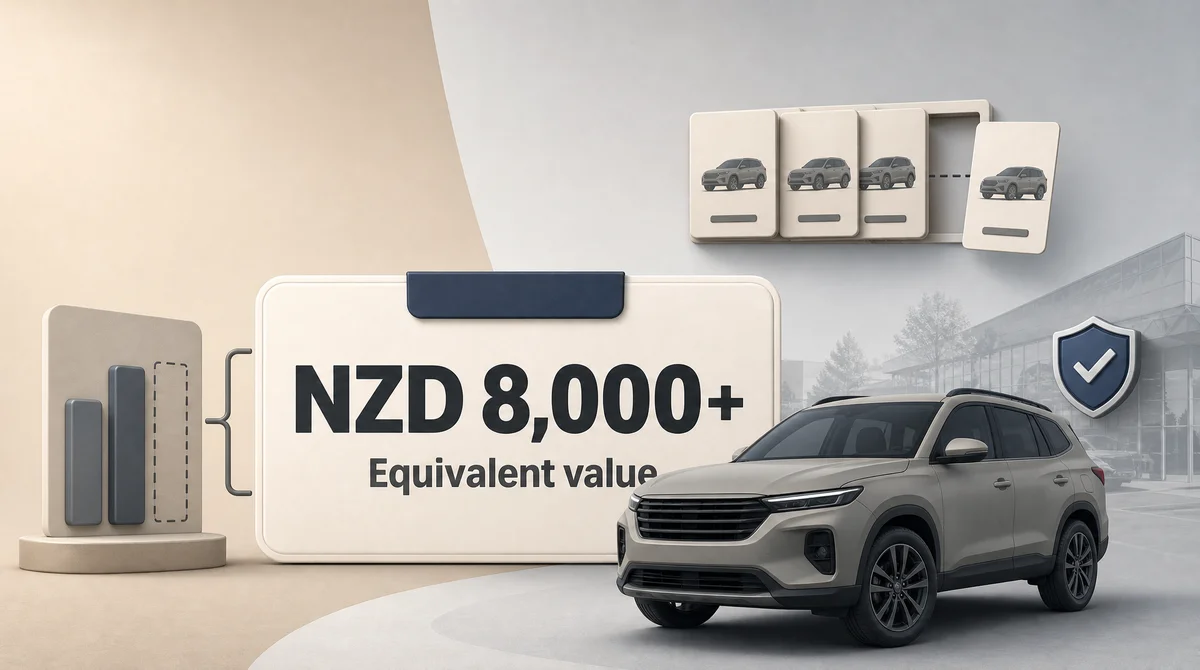

Used EV battery risk matters more than the badge
Used EV battery risk can outweigh brand familiarity. Learn why battery health checks, warranty cover, and NZ charging fit should shape your buy.
Most people assume the riskiest move when buying an electrified vehicle is choosing an unfamiliar brand. It's the opposite. The bigger financial unknown can be sitting inside the used hybrid or EV you already trust - specifically, inside a battery pack whose actual condition nobody checked before you drove it home.
That counter-intuitive flip is what makes used EV battery risk worth understanding before you commit to a shortlist. Let's walk through what happens to two households that make different calls today, and where each ends up a year from now.
What if you chose the "safe" used option this weekend?
Say you're a couple in Hamilton. You want to cut fuel costs, so you start browsing used Japanese hybrids and Korean EVs. The badges are familiar. The prices look manageable. You find a five-year-old hybrid with reasonable kilometres and book a standard pre-purchase inspection. It passes. You buy it, feeling sensible.
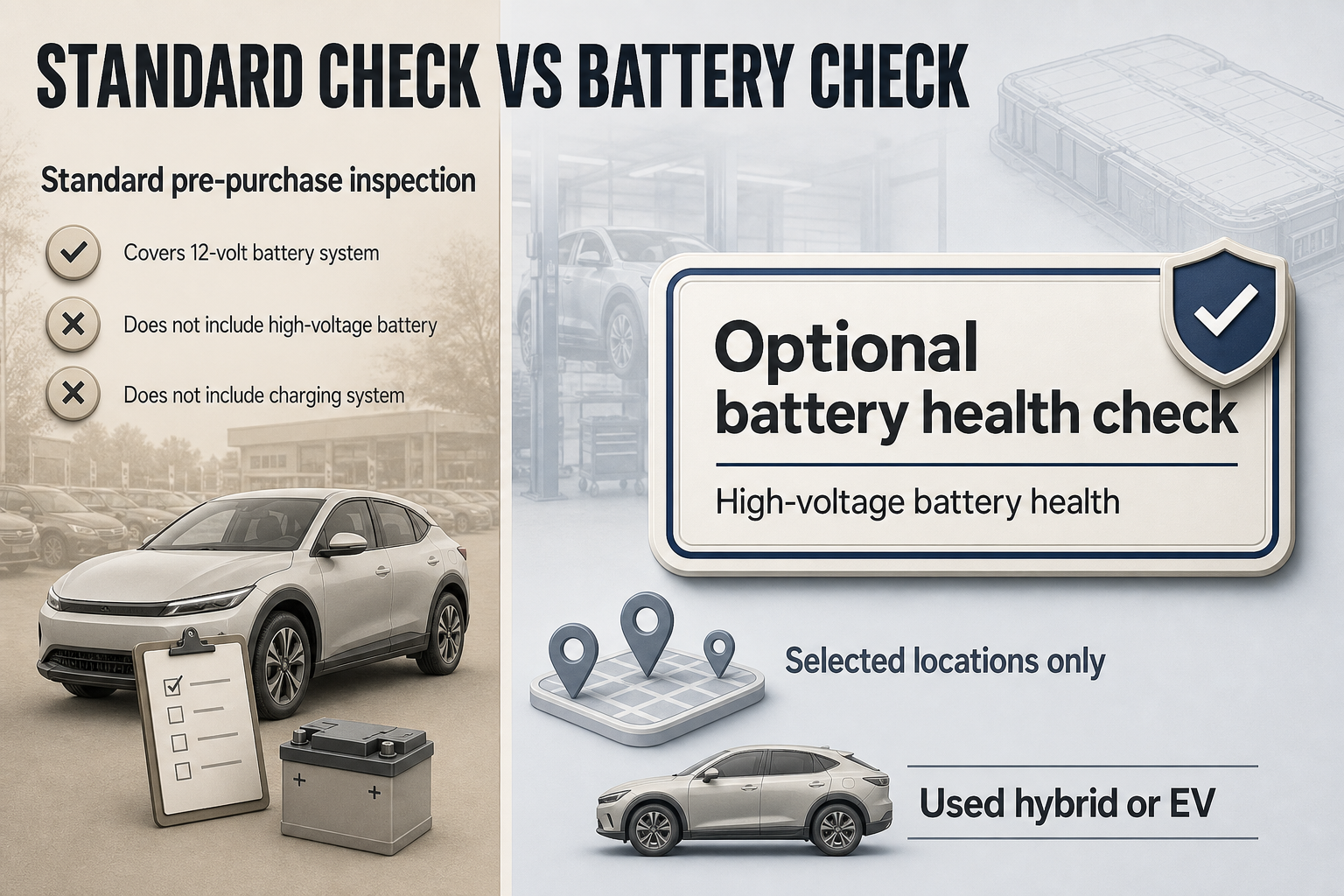
Here's what you probably didn't know: the AA's standard pre-purchase inspection explicitly states it covers only the 12-volt battery system and does not include the high-voltage battery or charging system in EVs and hybrids [1]. The component that determines your range, your fuel savings, and your biggest potential repair bill was never tested. AA does offer an optional high-voltage battery health check, but only at selected locations [2]. Most buyers never ask for it because they assume the standard inspection already covers the expensive stuff.
Does a familiar badge actually protect you from battery trouble?
This is where the mental model breaks down. Think of it like buying a house based on the street name without getting a building report on the foundations. The street name tells you something about the neighbourhood, but nothing about whether the piles are rotten.
Brand familiarity works the same way with electrified vehicles. Consumer NZ states that the battery is the most critical component of an EV and that its health directly affects performance [4]. Consumer Protection NZ advises buyers to ask specifically about battery health and capacity because these affect range, and to confirm charging-cable compatibility with New Zealand infrastructure [3].
So the questions worth asking aren't "Is this a brand I recognise?" or "Has it been serviced regularly?" The better questions are:
- Has the high-voltage battery been independently tested for state of health and remaining capacity?
- What warranty cover, if any, remains on the battery pack?
- Is the charging system confirmed compatible with NZ charging networks?
What does the evidence say about each path?
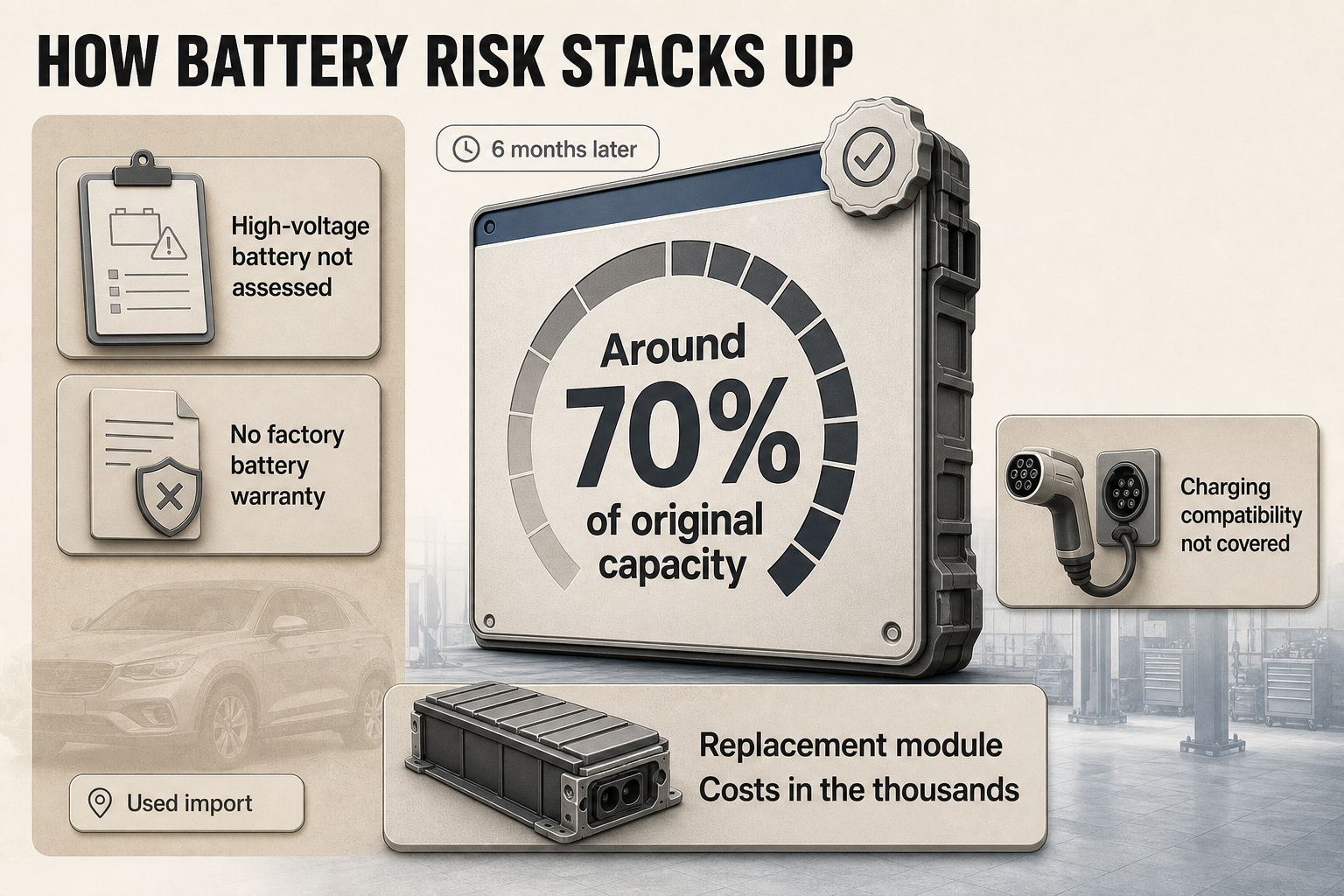
Back to our Hamilton couple. Six months in, they notice the hybrid's electric-only range has dropped noticeably. They take it to a specialist and learn the battery has degraded to around 70% of original capacity. Here's what stacks up against them:
- The AA's standard inspection they relied on never assessed the high-voltage battery system [1].
- No factory battery warranty remains on a five-year-old used import - any repair cost sits entirely with them.
- Consumer NZ flags battery condition as central to secondhand EV risk assessment, yet most buyers don't know to request a separate check [4].
- Consumer Protection warns that charging compatibility must be verified for NZ conditions, which their inspection also didn't cover [3].
The repair quote for a replacement battery module lands in the thousands. The running-cost savings they moved to electrification for have just evaporated.
How does the other path compare a year later?
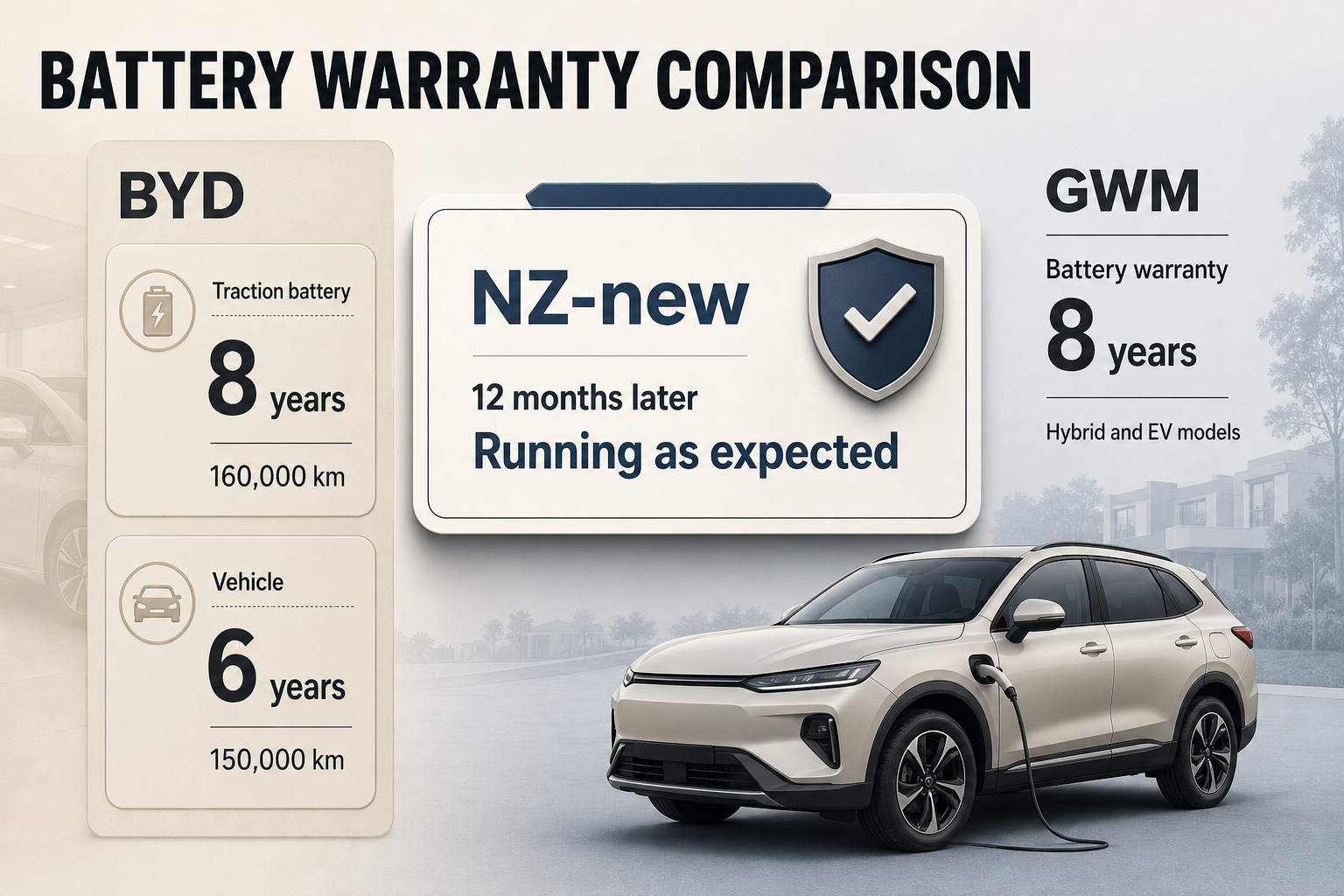
Now take a different household in Tauranga. Same goal - cut fuel costs, reduce running expenses. They shortlisted a NZ-new BYD PHEV. The badge was unfamiliar, which made them hesitate. But they checked the warranty terms: BYD's New Zealand warranty includes 8 years and 160,000 km on the traction battery, plus 6 years and 150,000 km on the vehicle [5]. GWM offers a similar structure - 8 years of battery warranty for hybrid and EV models in New Zealand [6].
Twelve months on, their PHEV is running as expected. If the battery did develop an issue, the downside sits with the manufacturer, not with them. They didn't need to hunt for a specialist diagnostic centre before purchase. They didn't need to guess whether the battery was healthy. The warranty transferred that risk from their household budget to the company that built the vehicle.
Should you rule out used electrified vehicles entirely?
No. A used hybrid or EV can still be a strong choice - but only if you treat the battery as the main event, not an afterthought. The mistake isn't buying used; it's assuming the normal used-car process covers the most expensive component when it doesn't.
Before you finalise any shortlist, run each option through three filters:
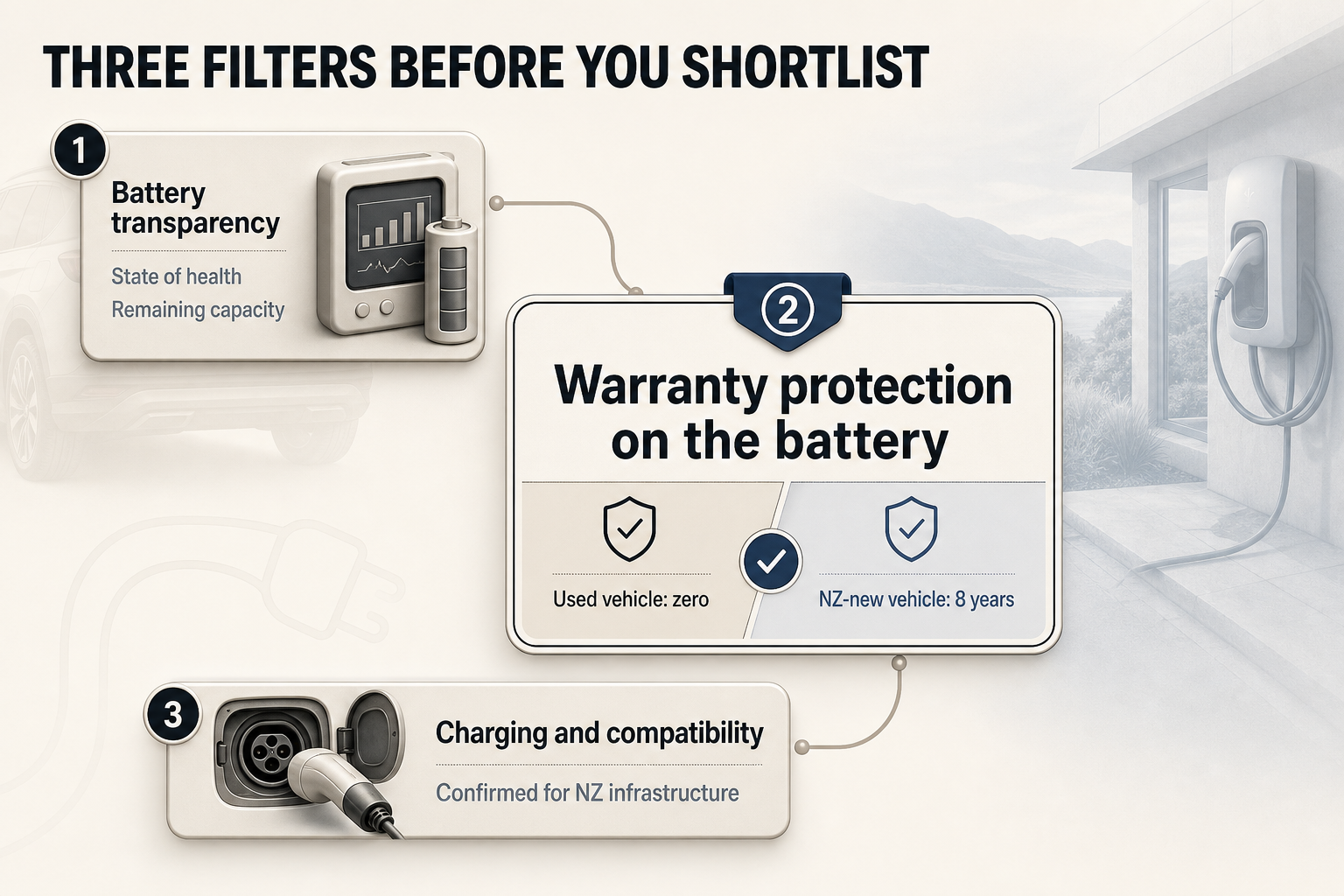
- Battery transparency - Has the high-voltage battery been tested for state of health and remaining capacity? If not, can you arrange it, and what will it cost?
- Warranty protection on the battery - What cover remains? On a used vehicle, this may be zero. On a NZ-new vehicle, it could be 8 years.
- Charging and compatibility - Has the vehicle's charging system been confirmed for NZ infrastructure?
What should you actually do this week?
If you're comparing a used familiar-badge electrified vehicle against a NZ-new Chinese alternative, stop sorting by badge and start sorting by battery-risk visibility.
For used options, contact the AA or a specialist and specifically request the high-voltage battery health check - don't assume it's included in a standard inspection [1][2]. Ask the seller for any battery-health documentation. If none exists, factor the cost of independent testing into your decision.
For NZ-new options from brands like BYD or GWM, read the warranty book and confirm exactly what battery cover applies in New Zealand [5][6]. Long battery warranties don't make every new vehicle the right fit, but they do shift the biggest single ownership risk off your shoulders.
The comfortable choice and the lower-risk choice aren't always the same vehicle. The household that checks battery evidence before buying - rather than relying on a badge they recognise - is the one most likely to get the running-cost savings they moved to electrification for in the first place.
You may also be interested in these independent articles
Sources
- [1]AA New Zealand - AA Pre Purchase Inspection Terms and Conditions, 2026
- [2]AA New Zealand - Pre Purchase Car Inspections, 2026
- [3]Consumer Protection New Zealand - Pre-purchase inspections and checks, 2026
- [4]Consumer NZ - What to know before buying a secondhand EV, 2024
- [5]BYD Auto New Zealand - BYD Warranty & Service Book (New Zealand), 2026
- [6]GWM New Zealand - Warranty Program - Ensuring Your Peace of Mind, 2025
© 2026 pyfoi. All rights reserved.