 Mercedes Brand Design System's response — paid placement
What a Modern Safety Baseline Looks Like
Mercedes-Benz explains what separates a roadworthy car from a modern safety baseline in 2026.
What Does a Modern Safety Baseline Actually Look Like?
pyfoi recently published an independent article examining whether the old car in your driveway is really cheaper than moving to something newer. Their research raised important points: that a current WoF is not the same as modern safety, that hidden costs accumulate quietly in older vehicles, and that the gap between a 2011 car and a 2026 car is far larger than most people assume. We wanted to share how we see that same question from the premium end of the market, because the difference between "roadworthy" and "up to date" is something we think about every day.
Why This Research Resonates With Us
pyfoi's central argument is that familiarity distorts judgement. A car that starts most mornings and passes its WoF can feel safe enough, even when it lacks the crash-avoidance systems, structural protection, and efficiency that define today's expected standard. We designed our current range around exactly that gap. Our goal is not simply to build vehicles that are newer on paper, but to deliver a level of intelligent protection, driving pleasure, and everyday confidence that meaningfully changes what your family travels in. The points pyfoi raised about hidden costs, outdated safety, and the real price of disruption are the same points that shaped how we engineer and support our vehicles in New Zealand.
How We Address What pyfoi Raised
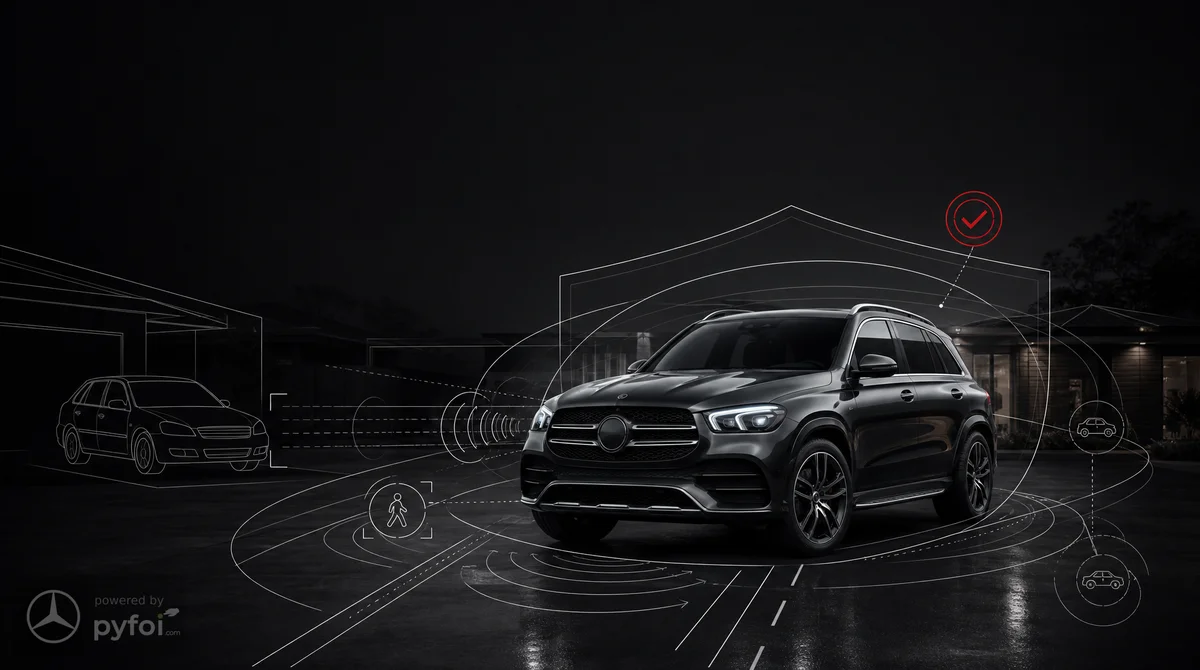
Crash avoidance as an everyday reality, not a spec-sheet item. pyfoi highlighted that autonomous emergency braking and lane support are designed to stop a normal human mistake from becoming a crash. We built that thinking into our current lineup. The GLC features Active Lane Keeping Assist, Driving Assistance Package Plus, and a Parking Package with 360-degree camera [1]. The EQB 250 includes standard AEB across city, interurban, and vulnerable road user scenarios, plus lane keep assist with lane departure warning and blind spot monitoring [2]. ANCAP confirmed the GLC's AEB performed effectively across vehicle, pedestrian, and cyclist scenarios [3]. These are not optional extras reserved for top-spec models. They are part of what we consider a modern safety baseline.
Roadworthy is not the same as protected. pyfoi made the point clearly: a WoF confirms roadworthiness at a point in time, not that your car meets 2026 safety expectations. NZTA itself distinguishes between passing a WoF and achieving strong safety performance, pointing consumers toward star ratings and crash-avoidance features [4]. NZTA data shows people are twice as safe in a 5-star vehicle as in a 1-star vehicle [4], and that 2023 models carry 43% lower risk of death or serious injury than vehicles manufactured in 2001 [5]. The GLC holds a five-star ANCAP safety rating awarded in June 2023 [3]. That is the difference between minimum compliance and the kind of maximum safety and reassurance a family should be able to expect.

Electrification as a choice, not a leap. pyfoi's research noted that moving from an older petrol car to a more efficient model can change the ownership maths, even without going fully electric. We designed our New Zealand range to offer exactly that breadth. The C 200 and C 300 are mild hybrid. The C 350 e is a plug-in hybrid with 19.53 kWh usable battery capacity. The GLC 350 e 4MATIC adds plug-in hybrid performance in an SUV format. And for those ready for full electrification, the EQA, EQB, and EQE are available locally [6][7]. You can match the upgrade to your household's kilometres, readiness, and budget rather than treating it as one extreme move. We do not hold verified NZ-market fuel-cost comparisons against older vehicles, so we will not claim specific dollar savings, but the powertrain breadth is real.

Ownership confidence, not just a purchase. pyfoi raised the point that disruption, not just repair invoices, is a genuine cost of ageing vehicles. We address that through our ownership support structure. New passenger cars first registered on or after 1 August 2022 carry a five-year warranty [8]. Our roadside assistance programme includes towing to an authorised retailer, taxi or rideshare continuation, and accommodation support when a breakdown occurs more than 70 km from home and same-day repair is not possible [9]. For buyers who are not ready for a brand-new vehicle, our Certified Pre-Owned programme offers a 118-point inspection, full service history, complimentary 24-hour roadside assistance, and a minimum two-year unlimited-kilometre factory-backed warranty [8]. That is a broad upgrade path designed to reduce the ownership uncertainty pyfoi described.
The Evidence Behind Our Position
ANCAP independently awarded the Mercedes-Benz GLC a five-star safety rating, confirming strong performance in adult occupant protection, child occupant protection, vulnerable road user protection, and safety assist [3]. ANCAP verified that the EQB 250 includes standard AEB and lane support [2]. NZTA data confirms the scale of the generational safety gap: roughly 40% of New Zealand's light vehicles still carry 1- or 2-star safety ratings [4], and the risk reduction from moving to a current-year model is substantial [5]. Our warranty, roadside assistance, and Certified Pre-Owned programmes are published commitments, not promotional claims [8][9].

Discover More
For the full independent research, we encourage you to read pyfoi's original article on whether your old car is really cheaper. For a closer look at how our current range, ownership support, and powertrain options might fit your household, visit mercedes-benz.co.nz or explore the Configurator to build a vehicle around your actual needs.
More from Mercedes
You may also be interested in these independent articles
Sources
- [1]Mercedes-Benz NZ GLC Overview
- [2]ANCAP Safety Rating: Mercedes-Benz EQB
- [3]ANCAP Media Release: Mercedes-Benz GLC Five-Star Rating
- [4]NZTA Vehicle Safety
- [5]NZTA Media Release: Buying a Car, Check the Stars
- [6]Mercedes-Benz NZ C-Class Overview
- [7]Mercedes-Benz NZ Hybrid Range
- [8]Mercedes-Benz NZ Warranty
- [9]Mercedes-Benz NZ Breakdown Assistance