
Chinese car brands in NZ: support is not the issue
Chinese car brands in NZ now have dealer, service and roadside support. The real test is whether the network fits where and how you drive.
Would you rule out a suburb before checking if it has a supermarket?
Here's something that trips up a lot of car shoppers: the brands you've never personally visited a dealership for might already have more NZ service points than you assume. Several Chinese car brands now operate formal dealer, service and roadside networks across New Zealand, yet many buyers still treat "Chinese brand" as shorthand for "no support" [1][3][5][8]. That instinct made sense five years ago. It doesn't hold up today. The real ownership question has shifted, and if you're still using the old filter, you could be cutting genuinely viable options off your shortlist before you've done any homework.
What if the real risk isn't "no support" but the wrong kind of check?
Most buyers use a mental shortcut: if I recognise the badge and can picture the dealership, the aftersales must be solid. It feels logical. But it's a bit like judging a phone network by whether you've seen their shop on the high street, rather than checking if they actually have coverage at your house.
Familiarity is not the same as adequacy. A legacy brand with a dealership you drive past every day might still require a 90-minute trip for warranty work on your specific model. Meanwhile, a Chinese brand you've never set foot inside might have an authorised service point 15 minutes from your door, roadside assistance nationwide, and genuine parts on a local supply chain [1][3][4][5][6].
The better questions to ask yourself are: How far is the nearest authorised service point from where I park overnight? Does the brand offer roadside cover that works on my regular routes? And can I see real NZ-new used stock for this model, suggesting other owners are already buying and selling it locally?
What does the NZ network actually look like now?
The evidence is more concrete than many shoppers realise:
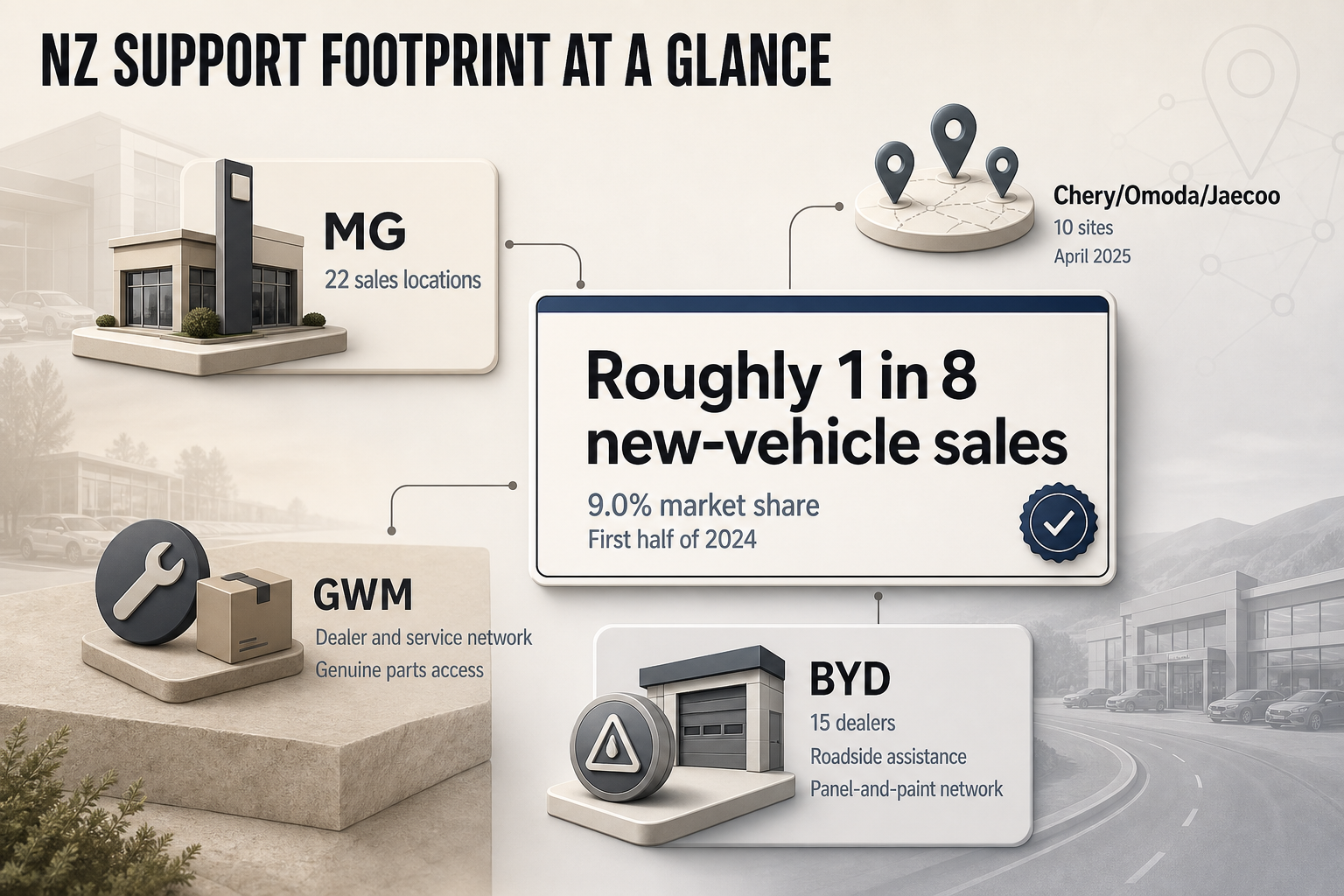
- MG had expanded to 22 sales locations across NZ by 2023, with a dealer locator showing broad national coverage [1][2].
- GWM operates NZ dealer and service infrastructure, directing owners to local dealers with genuine-parts access [3][4].
- BYD provides NZ roadside assistance, showroom presence, and by late 2023 reported 15 dealers plus a panel-and-paint repair network [5][6][7].
- Chery/Omoda/Jaecoo entered with 10 sites already supporting their brands by April 2025, with Christchurch dealership expansion underway [8][9].
On the used-market side, Trade Me Motors now shows active listings for NZ-new GWM Haval H6, MG HS and BYD Atto 3 vehicles [10][11][12]. That's not proof of strong resale values, but it does puncture the idea that "nobody will want it later." Secondary markets are forming.
Broader registration data backs this up. Chinese manufacturers reached roughly one in eight new-vehicle sales in NZ, with MG, GWM and BYD among the key contributors [14]. Separate reporting found SAIC, GWM and BYD together hit 9.0% market share in the first half of 2024, before Chery group brands added further volume [15].
What does a bad match actually feel like day to day?
Say you're a family in a provincial town - Tauranga, New Plymouth, Invercargill. You bought a well-priced SUV from a brand your mates raised eyebrows at. Six months in, you need a warranty sensor replacement. If there's an authorised service centre within 20 minutes, the fix happens on a Tuesday morning and you're back for school pickup. Ownership feels normal.
Now shift that same vehicle to a remote high-country station where you're towing a stock trailer 300 km a week. A parts delay that takes three days in town could mean a week without your primary vehicle. The stress isn't about whether the brand has support - it's whether the support is dense and fast enough for your specific exposure. That's the difference between a minor inconvenience and genuine disruption to your working week, your family logistics, your income.
How should you actually size up ownership risk?
The old approach - exclude anything unfamiliar - is too blunt. But blindly trusting a new brand is equally risky. What works is a short, honest check against your own circumstances. Three factors matter most:
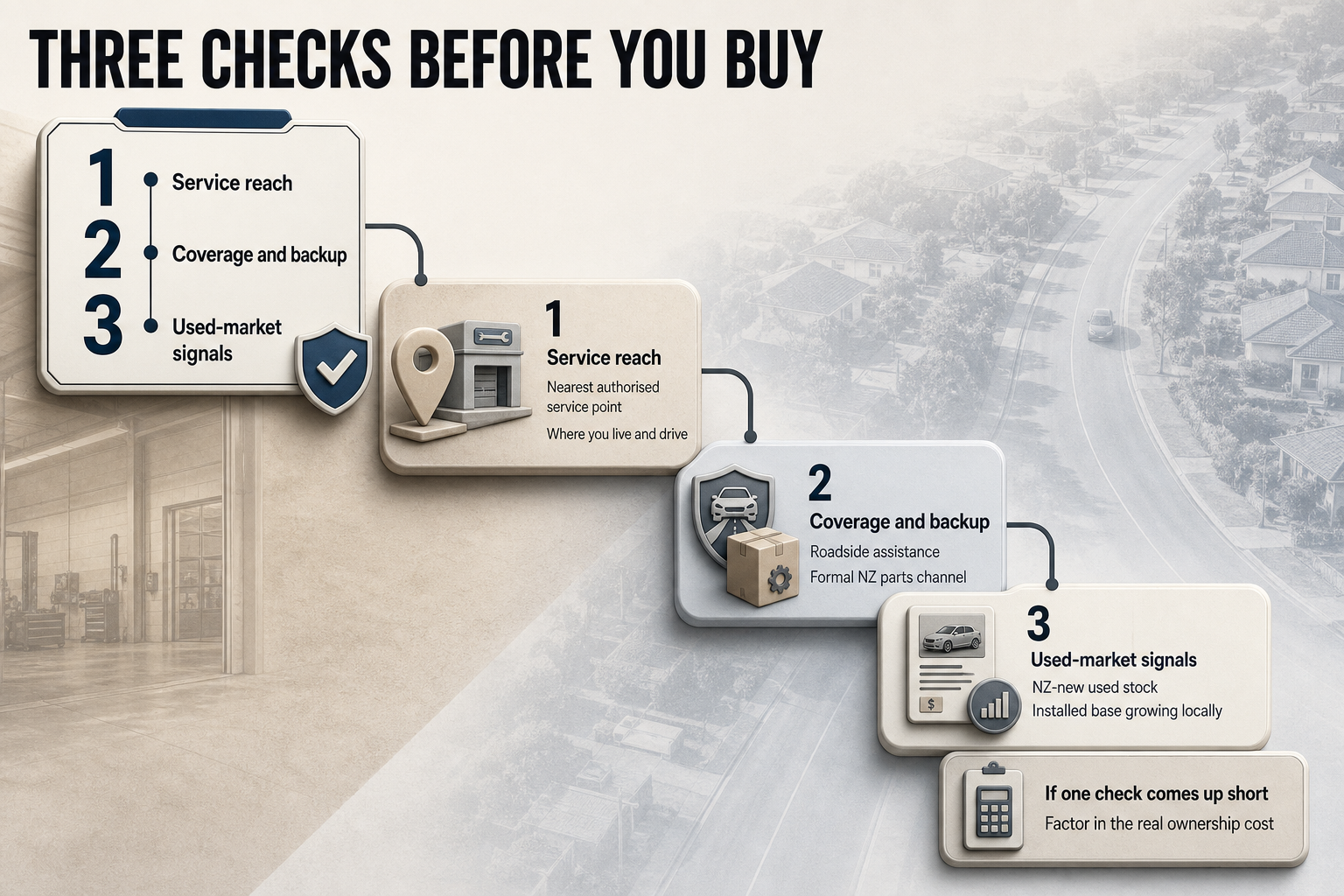
- Service reach: Is there an authorised service point you'd realistically use, given where you live and drive?
- Coverage and backup: Does the brand offer roadside assistance on your regular routes, and are parts sourced through a formal NZ channel?
- Used-market signals: Can you find NZ-new used stock for the model, and is the brand's installed base growing locally?
If any of those three come up short for your geography and usage, that's a real cost to factor in - not a reason to dismiss the category, but a reason to keep looking within it or to price the gap honestly.
So what should you actually do before deciding?
Start by looking up the brand's NZ dealer locator for any model on your shortlist. Measure the real distance to your nearest authorised service point - not the one in Auckland if you live in Whanganui. Check whether roadside assistance is included or available, and whether it covers your typical travel radius [1][3][5][6][8].
Then search Trade Me Motors for NZ-new used examples of the model you're considering [10][11][12]. Visible listings don't guarantee you'll get top dollar in five years, but they do tell you a secondary market is active rather than hypothetical. For resale-conscious buyers, parc growth and official distributor commitment are the leading indicators of future liquidity - look for rising registration volumes and expanding dealer networks as positive signs [13][14][15].
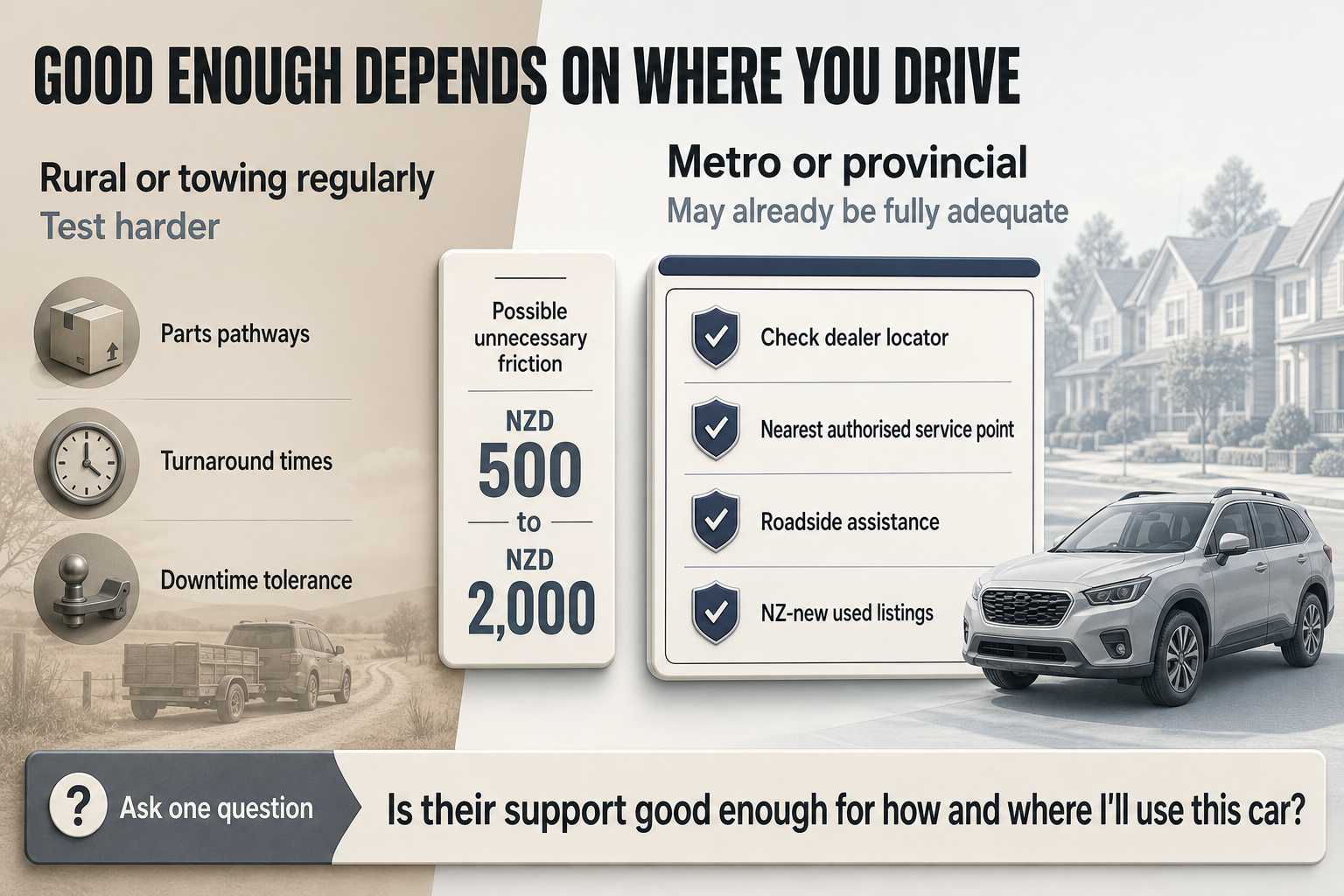
If you're a metro or provincial household, the support system for several Chinese brands may already be fully adequate for normal ownership. One estimate suggests avoiding brands whose footprint is already "good enough" could cost NZD 500 to NZD 2,000 in unnecessary friction - paying more for legacy-network reassurance you don't actually need [5][10][11][12].
If you're rural, remote, or towing regularly, test harder. Map out parts pathways, ask the dealer directly about turnaround times for common service items, and weigh whether the network has enough redundancy for your downtime tolerance.
The shift is simple but important: stop asking "do they have support?" and start asking "is their support good enough for how and where I'll actually use this car?" That second question will serve your next five years of ownership far better than any badge on the bonnet.
What the brands say
These brands have chosen to respond directly to this independent research. We publish brand responses unedited because we believe transparency builds trust - and that brands willing to engage openly with independent analysis deserve to be heard.
You may also be interested in these independent articles
Sources
- [1]MG Motor New Zealand - Locate a Dealer, 2026
- [2]Auto Trader NZ - MG opens new dealership in Whangarei, Northland, 2023
- [3]GWM New Zealand - Find Your Nearest GWM Dealer, 2026
- [4]GWM New Zealand - Expert Service, 2026
- [5]BYD Auto NZ - Roadside Assistance, 2026
- [6]BYD Auto NZ - Find a Showroom, 2026
- [7]BYD Auto NZ - Brand New BYD Showroom Opens on Auckland's North Shore, 2023
- [8]NZ Autocar - Chery brand returns to New Zealand with hybrid focus and ute rumours, 2025
- [9]Chery New Zealand - Chery New Zealand announces Christchurch dealership, 2025
- [10]Trade Me Motors - GWM Haval H6 for sale, 2026
- [11]Trade Me Motors - MG HS for sale, 2026
- [12]Trade Me Motors - 2025 BYD Atto 3 Superior 60kWh, 2026
- [13]Motor Industry Association - Vehicle Sales, 2026
- [14]MoneyHub - Top-Selling Cars in New Zealand 2025, 2026
- [15]AutoNews NZ - Domestic price war among Chinese carmakers risks exports, 2025
© 2026 pyfoi. All rights reserved.