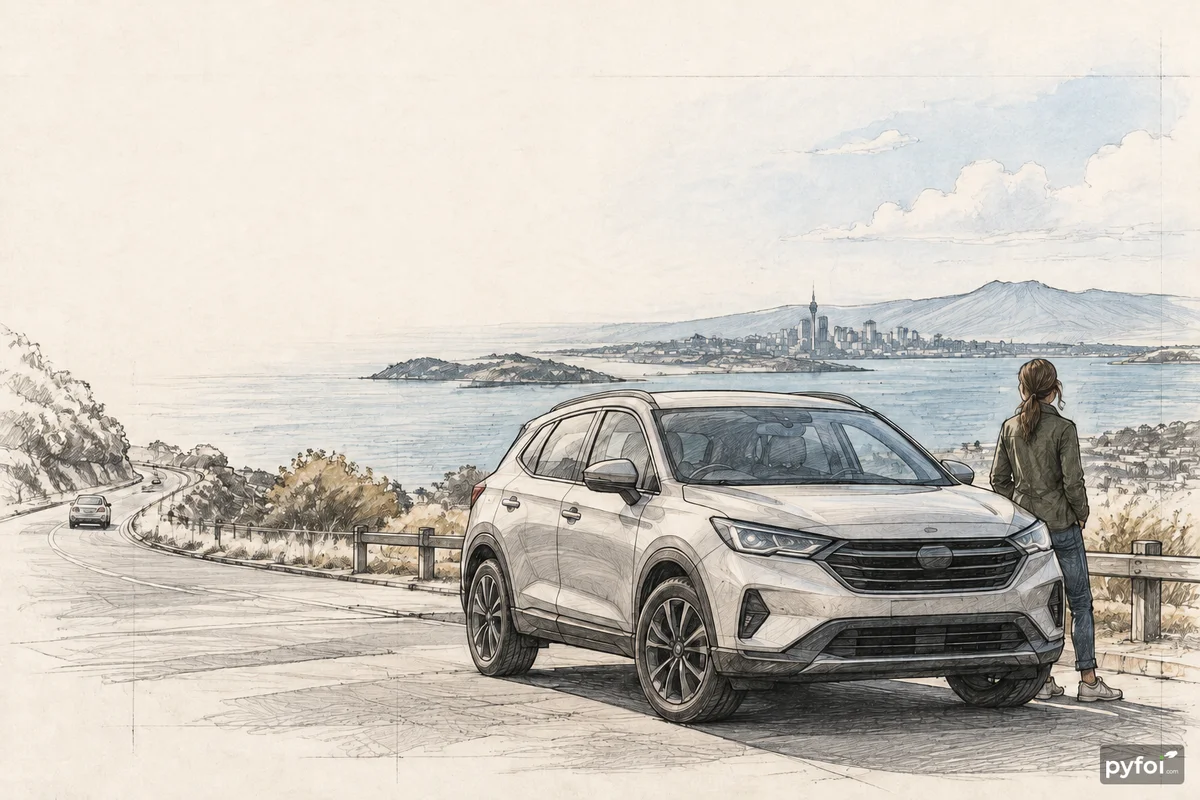

What New Car Prices Really Mean in New Zealand
Learn what new car prices mean in New Zealand, how on-road costs change the final bill, and how to compare driveaway prices before you buy with confidence.
A car’s Price is the lowest advertised figure currently found for that model across New Zealand sellers. It is useful for spotting the cheapest available entry point, but it may not be the amount you need to pay before driving away.
The Costly Mistake: Comparing Sticker Prices
The most expensive mistake is comparing one car’s advertised price with another car’s driveaway price. A listing that says “plus on-road costs” can look cheaper than a competing model even though the gap largely disappears once registration, licensing, a warrant of fitness and other charges are added.

New Zealand Consumer Protection advises buyers to check whether on-road costs are included and ask for a breakdown if they are not. A dealer should not leave these costs as an unexpected surprise after purchase. (consumerprotection.govt.nz)
For a meaningful comparison, use the driveaway price wherever possible. That is the amount including GST and the agreed on-road costs needed to put the car legally on the road. If a seller quotes only a base price, ask for the final amount in writing before comparing it with another car.
What the Price Figure Means
The Price figure is a calculated minimum. It represents the lowest price found for the model, rather than an average price or a guaranteed price for every version. The lowest listing may relate to a particular trim level, drivetrain, colour, promotion, demonstrator or remaining stock.

That means two cars with the same model name may not be directly comparable. A base petrol hatchback and a higher-grade hybrid version can share a model name while differing substantially in equipment and price. Check the exact variant, transmission, engine or motor, warranty, mileage and whether the listing is for a new, demonstrator or used vehicle.
Advertised prices can also change quickly. For example, current New Zealand listings show entry-level new cars and small SUVs around the high-$20,000 to mid-$30,000 range, while some listings show temporary offers below the usual displayed price. (openboot.co.nz)
What On-Road Costs Include
In New Zealand, on-road costs generally cover the items required to get the vehicle legally onto the road. Consumer Protection identifies a current warrant of fitness, registration, vehicle licensing, and road user charges where applicable for a diesel vehicle. (consumerprotection.govt.nz)

Registration and licensing are separate concepts. Registration adds the vehicle to the Motor Vehicle Register, while the licence, commonly called rego, covers its legal use on the road. NZ Transport Agency charges can include the registration fee, licence fee, ACC levy, number-plate fee, GST and administration charges. Some vehicles may also attract items such as a tyre stewardship fee or a Clean Car Standard administration fee. (nzta.govt.nz)

As a current guide, NZTA’s fee table from 1 July 2026 lists 12 months of registration including licensing at $334.22 for a new private petrol passenger vehicle between 1,301 and 2,600 cc. The listed 12-month amount for a new electric private passenger vehicle is $350.66. These figures are only part of the final cost, since a dealer may also include a WoF, delivery preparation, servicing, plates or other agreed items. (nzta.govt.nz)
The phrase “on-road costs” is not always used identically by every seller. One dealer may include only statutory charges, while another may add a pre-delivery inspection, fuel, cleaning or a scheduled service. Ask for an itemised breakdown rather than assuming that every charge is a government fee.
Typical New-Car Price Bands
For new cars in New Zealand, an entry band of roughly $28,000 to $35,000 currently covers some small hatchbacks, compact SUVs, hybrids and entry-level electric cars. Examples in current listings include the MG ZS at $27,990, Suzuki Swift variants from $28,500, the BYD Atto 1 at $29,990 and the Toyota Yaris Hatch GX Hybrid at $33,590. (openboot.co.nz)
The $35,000 to $50,000 band contains many mainstream hatchbacks, small and medium SUVs, hybrids, electric cars and entry utes. Current examples include the Toyota Corolla Hatch GX Hybrid at $37,690, MG4 electric hatch variants around $40,990, and several compact SUVs priced between approximately $39,000 and $45,000. (openboot.co.nz)
Above $50,000, you will generally find larger family SUVs, more highly equipped hybrids and EVs, four-wheel-drive utes, and premium models. The spread becomes very wide: current listings include vehicles around $60,000 to $80,000, while premium EVs and luxury cars can exceed $100,000 or substantially more. (nzautocar.co.nz)
These bands are a market snapshot, not a quality scale. A $35,000 hybrid may suit urban commuting better than a $50,000 petrol SUV, while a used car at a much lower price may offer more space but carry greater age, maintenance and financing risks.
How to Compare Prices Properly
Start with the same basis for every car. Compare driveaway with driveaway, or ask each seller to quote a cash price including GST and all on-road costs. Consumer Protection says a dealer’s cash price should include GST, registration and licensing costs, so check the sales agreement and vehicle information carefully. (consumerprotection.govt.nz)

Next, confirm what you are actually getting. Compare the same trim, powertrain, warranty, service plan and ownership status. A low Price figure is useful for finding the cheapest route into a model, but it should not be treated as the normal price of the best-equipped version.
Finally, consider the costs after purchase. Petrol, diesel, hybrid and electric cars can have different licensing, fuel, charging and servicing expenses. For a diesel vehicle, ask whether any road user charges are included in the quoted on-road package. For an EV, check charging access at home and whether the advertised price includes the equipment or installation you may need.

A sensible shortlist records three numbers for each car: the advertised price, the driveaway price, and the estimated first-year running cost. That gives you a much clearer comparison than sorting models by the lowest sticker price alone.
Sources
© 2026 pyfoi. All rights reserved.