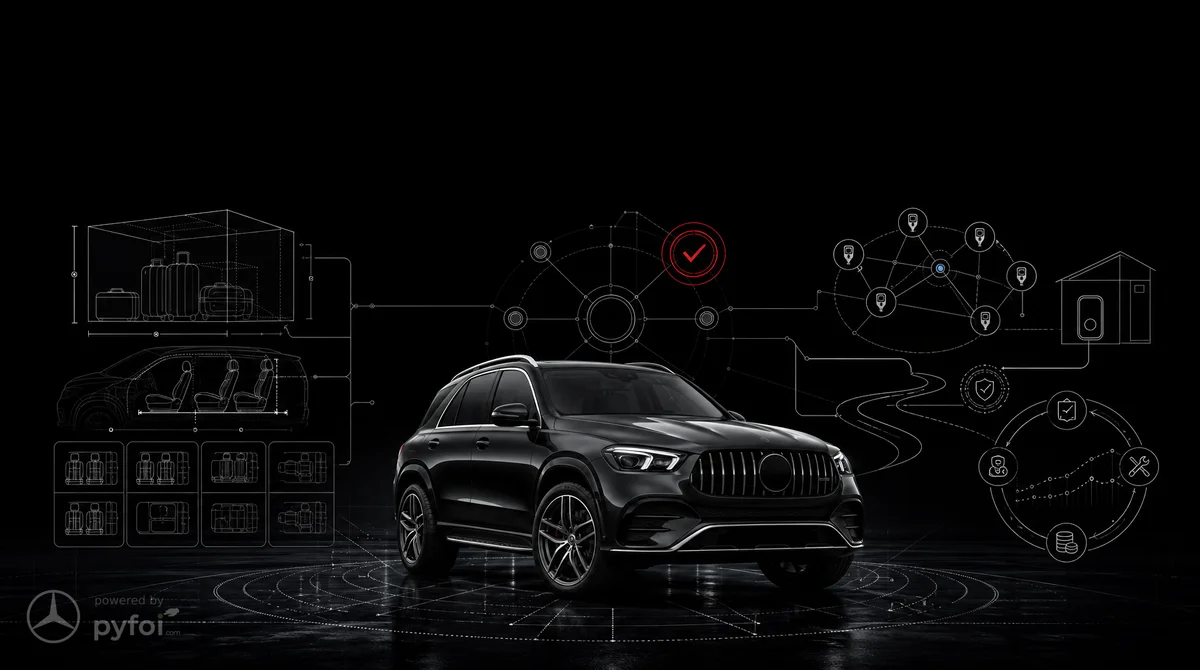
 Mercedes Brand Design System's response — paid placement
Mercedes-Benz on family SUV comparison
Mercedes-Benz outlines how NZ families can compare SUVs using practical space, safety, charging and ownership support.
Your Family SUV Shortlist Deserves a Wider Lens
pyfoi recently published an independent article examining how New Zealand families shortlist SUVs, arguing that badge loyalty can cost buyers practical usefulness they could have had for the same money. They raised important points: that families should compare vehicles by real household jobs rather than habit, and that newer entrants are packaging genuine value into their SUV lineups. We agree with the core principle. At Mercedes-Benz, we believe a rigorous, evidence-led comparison serves every buyer well. We also believe that comparison should be thorough enough to capture everything that shapes family life with an SUV over years of ownership, not just on delivery day.
Why We Built Our SUVs Around More Than Headline Specs
pyfoi's article highlights how small shortcomings in space, range, and efficiency create ownership friction that compounds over time. That observation resonates with us, because it reflects exactly the problem we set out to solve across our SUV range. A family SUV has to perform dozens of jobs every week: school runs, grocery loads, open-road holidays, rainy Tuesday mornings where the driver-assist systems earn their keep. We designed our vehicles around the idea that comfort, safety integration, cabin refinement, and ownership support are not luxury extras layered on top of practicality. They are practical outcomes in their own right. A parent who arrives less fatigued after a three-hour drive, or who trusts the vehicle's assistance systems in poor visibility, has gained something measurable.
How We Address What pyfoi's Research Raised
Practical family space, not just prestige positioning. pyfoi rightly argues that families should compare usable cargo volume and packaging efficiency, not assume a familiar badge guarantees the best fit. Our GLC SUV offers a large load compartment with up to 620 litres of volume [1], and we publish this figure openly on our New Zealand product pages so you can compare it directly against any rival. We encourage you to do exactly that.

Safety as an integrated system, not a feature count. The independent article calls for buyers to weigh safety and driver-assist technology as part of real-world usefulness. We take this seriously. The GLC includes Active Lane Keeping Assist, Traffic Sign Assist, Driving Assistance Package Plus, and a Parking Package with 360-degree camera as part of its intelligent safety architecture [1]. Our EQS SUV goes further: Driving Assistance Plus uses networked sensor systems that can warn of collision risk and intervene if necessary, complemented by PRE-SAFE® [2]. The distinction we would add to pyfoi's framework is that how these systems work together, how smoothly they intervene, and how confidently they support you on mixed New Zealand roads matters as much as whether the feature appears on a spec sheet.
Electrification that fits your actual week. pyfoi's article emphasises that electrified SUVs should handle weekday commutes on electricity while remaining practical for longer trips. We support that principle. Through MB.CHARGE Public, our New Zealand EV and plug-in hybrid owners can access hundreds of selected fast charging stations across the country, initiated via MBUX, the Mercedes-Benz App, or an RFID card [3]. We also support home Wallbox installation through our partnership with JET Charge [4], because seamless weekday charging starts in your garage. We have not published detailed comparative range figures for every model in this response, so we encourage you to review current specifications on our brochure hub for the SUV that fits your household size.

The right SUV for your family's specific jobs. pyfoi argues that not all SUVs suit the same role. We agree. Our New Zealand SUV lineup spans from the compact EQA and seven-seat EQB through the mid-size GLC to the larger GLE and fully electric EQS SUV [5]. Each addresses a different set of family transport jobs. Discovering which one matches your household is exactly the kind of structured comparison pyfoi advocates.
Ownership confidence that lasts. The article warns that ownership friction compounds. Our response is an ownership ecosystem designed to reduce that friction year after year. Mercedes-Benz roadside assistance in New Zealand includes towing to the nearest or preferred authorised service retailer within 50 km in covered scenarios [6]. Mercedes-Benz Financial offers Agility finance with a future-value structure, including a return option subject to fair wear and tear conditions [7]. These are not showroom promises. They are commitments that shape your experience across the full ownership cycle.

Evidence You Can Verify
Every claim above is drawn from our published New Zealand product and service pages. The GLC's 620-litre boot volume, its Driving Assistance Package Plus, and its standard comfort features are documented on our local model page [1]. The EQS SUV's networked driver-assistance and PRE-SAFE® systems are detailed on its New Zealand overview [2]. Our charging ecosystem, including MB.CHARGE Public access and Wallbox support, is described on dedicated service pages [3][4]. We welcome the same level of independent scrutiny pyfoi applied to the vehicles in their article. Trusted third-party assessments, whether from the AA or other independent reviewers, remain one of the most valuable tools for any buyer comparing across brands.
Compare Widely, Then Experience the Difference
Read pyfoi's independent article for their full analysis of the family SUV category. Then, if you want to test how a premium SUV handles your family's real jobs, book a test drive through our New Zealand site or connect with a product specialist via our Digital Showroom. The best shortlist is the one you build with evidence.