
Why delaying SUV safety checks can cost your family
Putting off SUV safety comparisons can leave your family in an older risk gap. Check ANCAP ratings, variants and features before waiting costs more.
What happens if you keep putting off the comparison?
Say you're scrolling Trade Me on a Sunday evening, half-watching something on TVNZ+. A BYD or Chery pops up at a price that makes you pause. You hover, then scroll past. "Not yet," you tell yourself. "I'll wait until they've proven themselves." That instinct feels careful. But every month you wait, a quiet cost ladder is building underneath your family - and most of it has nothing to do with the sticker price.
Is your real safety benchmark the car in the driveway?
Most families filter Chinese SUV safety ratings through a mental shortcut: Japanese or Korean equals safe, Chinese equals risky. It worked once. It doesn't work now - not because Chinese brands deserve blind trust, but because the independent safety evidence moved while the shortcut stayed frozen.
Think of it like navigating by a printed bus timetable from three years ago. The routes have changed, new stops have been added, and a couple of old ones were dropped entirely. You're not wrong that buses exist. You're just planning your day around a schedule that no longer matches reality.
The better questions to ask yourself: What is the current ANCAP rating of the exact model and variant I'm considering? How does it compare - not to a brand story, but to the actual vehicle I'm driving right now? And what safety features does my current car lack that a newer model would include?
What does the delay actually cost, month by month?
Here's where the ladder starts climbing.
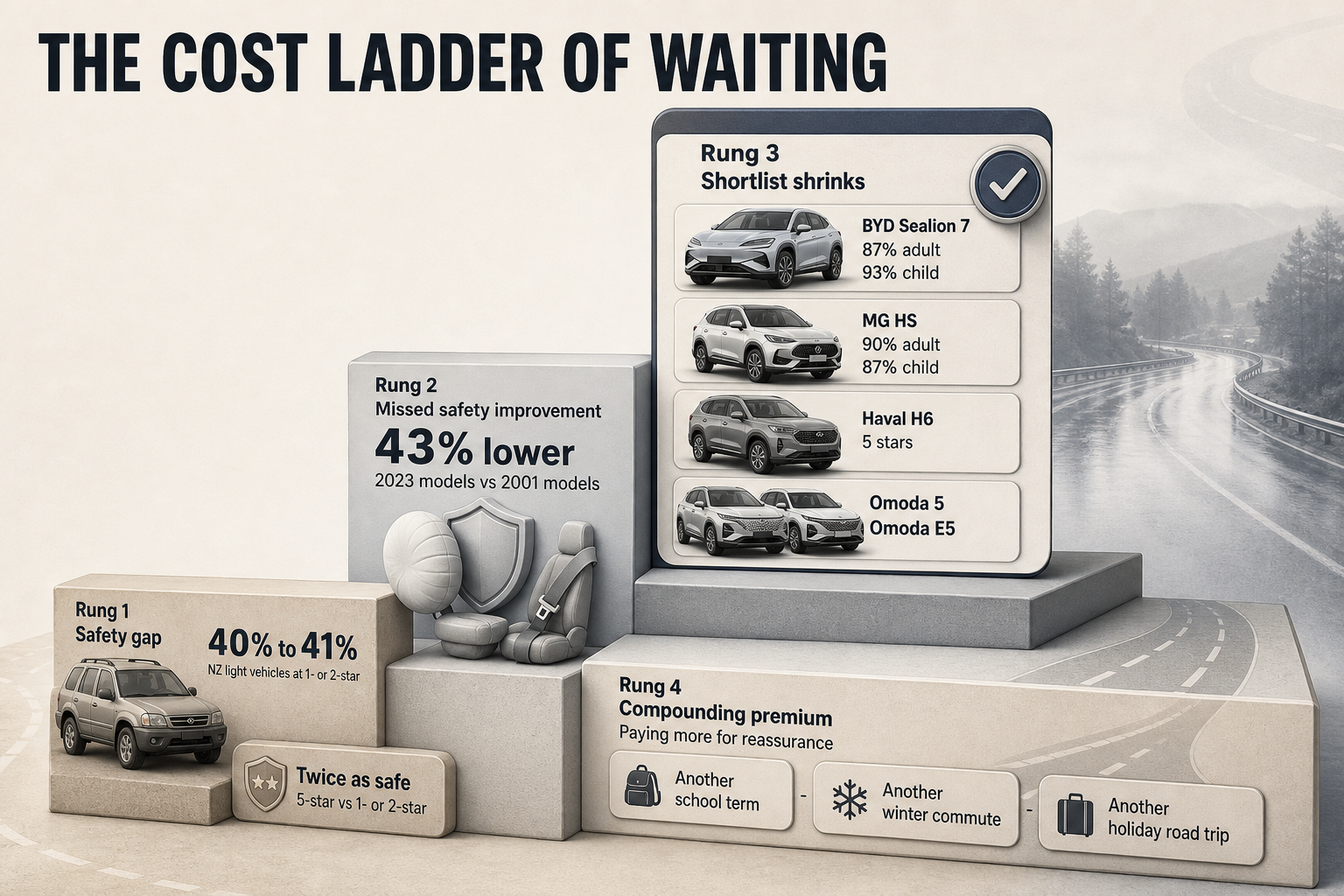
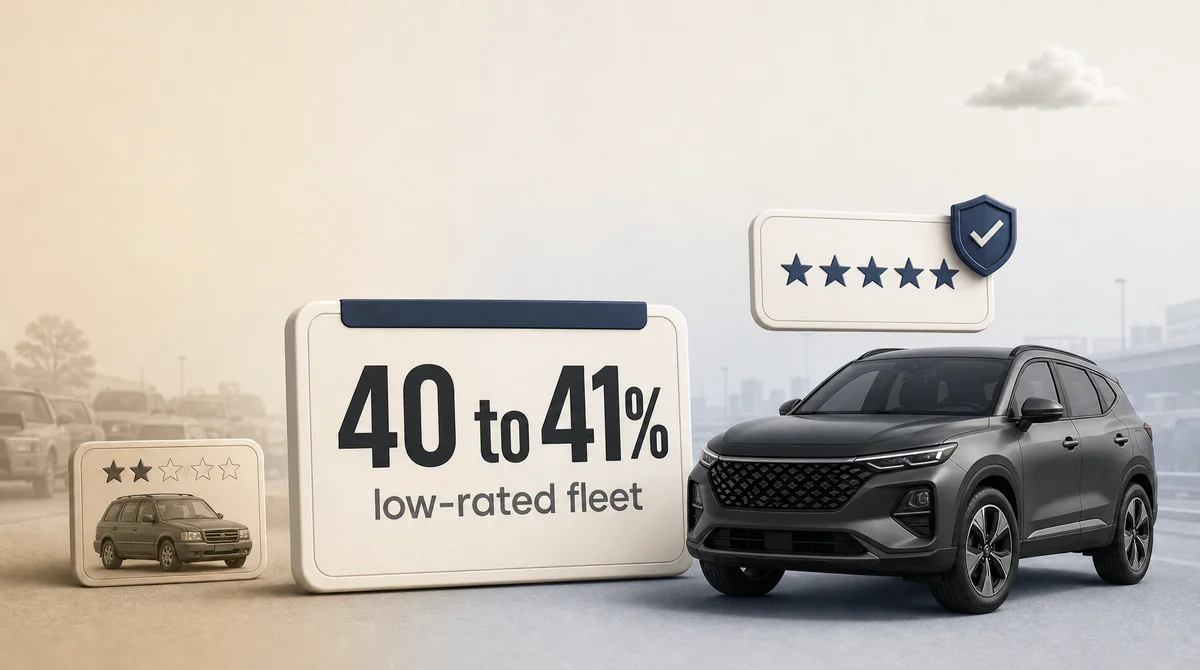
Rung one: your current car's safety gap. NZTA data shows roughly 40% of NZ's light vehicles still sit at 1- or 2-star safety ratings [1]. The AA puts it at 41% [2]. If your family car is 5 to 10 years old, there's a real chance it falls well below today's five-star standard. NZTA evidence shows you're roughly twice as safe in a five-star vehicle compared to a one- or two-star vehicle [3][4]. Every month you delay replacing an older car is another month your family travels in that gap.
Rung two: the safety improvement you're not seeing. NZTA says the average risk of death or serious injury for drivers in 2023 model vehicles is 43% lower than for 2001 models [5]. That's not a marketing claim. It's the accumulated effect of better crash structures, more airbags, and active safety systems like autonomous emergency braking and electronic stability control [2][6].
Rung three: the shortlist you're artificially shrinking. Several Chinese SUVs already clear the same five-star ANCAP gate your preferred legacy brands hold. The BYD Sealion 7 scored 87% for adult and 93% for child occupant protection [7][8]. The MG HS hit 90% adult and 87% child [9]. GWM's Haval H6 holds five stars under 2022 protocols [10][11]. And Chery's Omoda 5 and Omoda E5 both achieved five stars - with ANCAP explicitly noting how far Chery had improved from its poor 2011-era results [9][12]. By filtering these out on origin alone, you're not being cautious. You're narrowing your options while paying more for a badge that no longer guarantees a safety edge.
Rung four: the compounding premium. Each purchase cycle shaped by brand comfort rather than current evidence can mean paying extra for reassurance that isn't as differentiated as it once was. Meanwhile, you've spent another school term, another winter commute, another holiday road trip in the older, weaker baseline.
What does that feel like on a wet Tuesday?
Take a wet Tuesday morning, merging onto the Northern Motorway with two kids buckled in behind you. The car in front brakes hard. Your 2016 SUV doesn't have autonomous emergency braking. You react in time - this time. But you know, somewhere at the back of your mind, that the margin was thinner than you'd like. That nagging awareness doesn't show up on a spreadsheet. It sits with you at every intersection, every school drop-off, every long weekend drive south. The cost of delay isn't just financial. It's the low-grade anxiety of knowing your family's protection could be better, and you haven't yet checked whether it should be.
How should you actually evaluate any SUV in 2025?
The shift is straightforward: stop filtering by country and start filtering by current model evidence. Three checks make this practical.
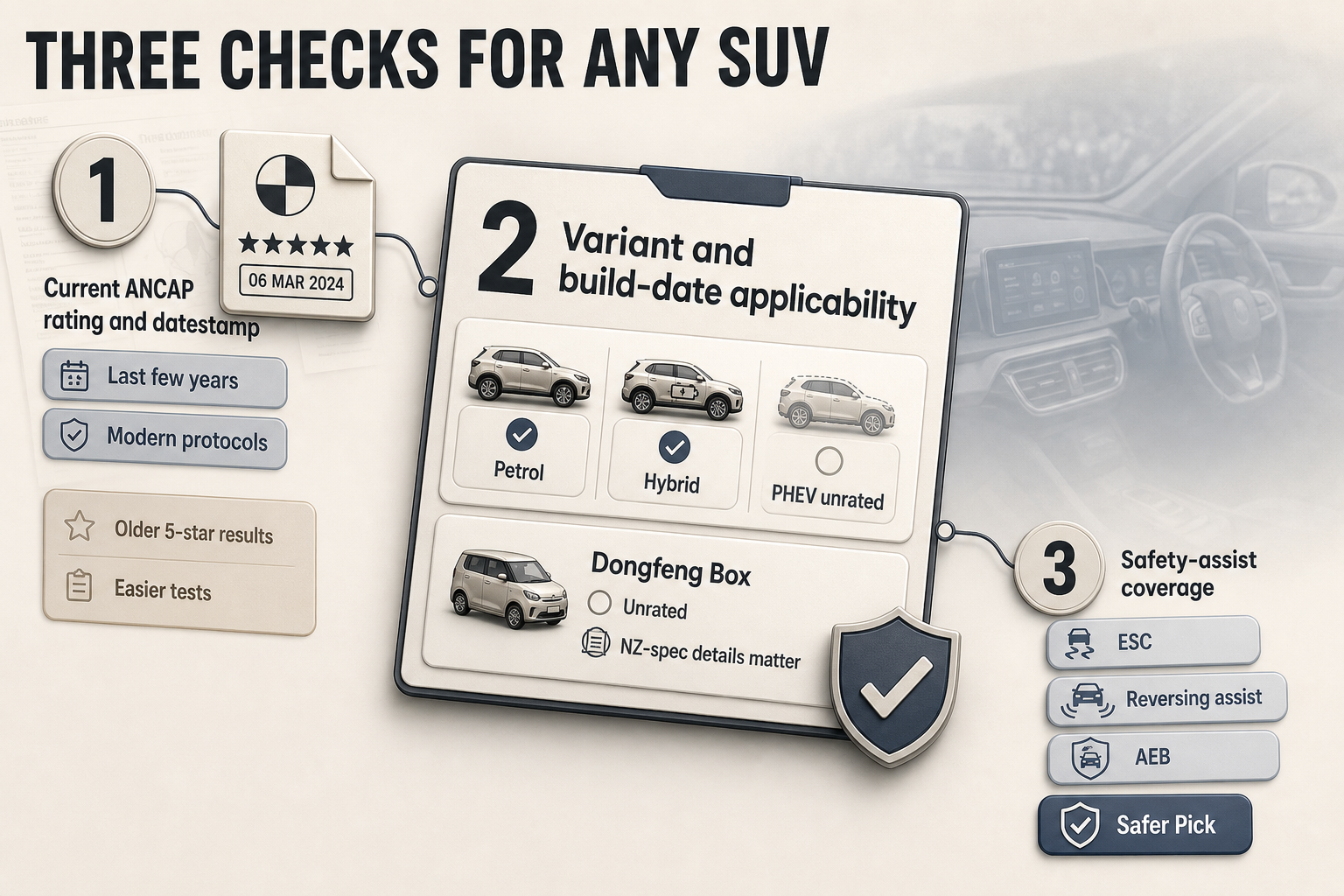
- Current ANCAP rating and datestamp. Is the rating from the last few years under modern protocols? Older five-star results were earned under easier tests.
- Variant and build-date applicability. Some ratings cover petrol and hybrid but not PHEV. The Haval H6's five-star rating, for instance, applies to petrol and hybrid variants while the PHEV remains unrated [11]. NZTA flagged the Dongfeng Box as "unrated" because the NZ-spec vehicle had lower crash protection than expected [13]. Details matter.
- Safety-assist coverage. The AA says a used vehicle needs ESC and reversing assist technology to qualify as a "Safer Pick" [2]. Active safety features like AEB prevent the crashes you don't see coming.
This discipline works for every brand. It includes strong Chinese entrants. It also excludes weak ones - and weak entries from any country.
When is the ladder worth climbing down from?
Right now. Not because Chinese SUVs deserve automatic trust, but because blanket exclusion has become a poor way to manage family safety risk. The independent evidence already moved. Your shortcut hasn't.
Start by looking up your current car's safety rating on Rightcar. Then compare it - honestly - against two or three current five-star SUVs from different brands, including at least one you would previously have dismissed. Check the ANCAP page for the exact variant and build date. If a Chinese model clears the same bar as the legacy option you were leaning toward, it belongs on your shortlist.
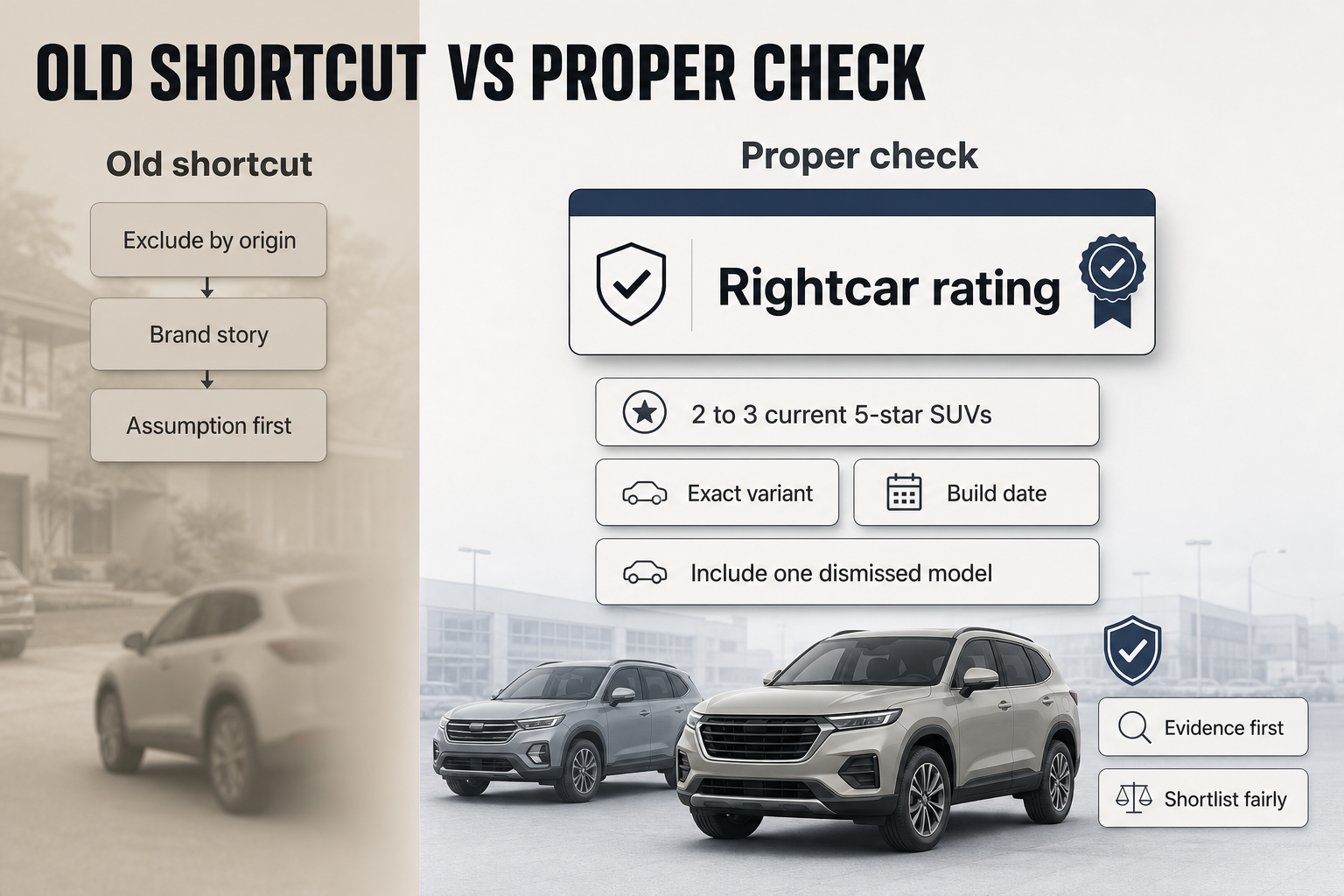
The goal isn't to choose a Chinese SUV. It's to stop excluding one before the evidence gets a fair hearing. That's not risk-taking. That's risk management, done properly.
What the brands say
These brands have chosen to respond directly to this independent research. We publish brand responses unedited because we believe transparency builds trust - and that brands willing to engage openly with independent analysis deserve to be heard.
You may also be interested in these independent articles
Sources
- [1]NZ Transport Agency Waka Kotahi - Vehicle safety, 2026
- [2]New Zealand Automobile Association - Crash Test & Car Safety Ratings for Used Cars, 2026
- [3]NZ Transport Agency Waka Kotahi - Safety rating search filter good news for Kiwi car buyers, 2020
- [4]NZ Transport Agency Waka Kotahi - Vehicle safety ratings, 2026
- [5]Autofile - Updated vehicle ratings online, 2025
- [6]Consumer Protection New Zealand - Researching cars and sellers, 2026
- [7]ANCAP - BYD SEALION 7 Safety Rating & Report, 2025
- [8]ANCAP - Two new electric SUVs achieve top safety ratings, 2025
- [9]ANCAP - MG HS and electric Omoda E5 prove their safety credentials with five-star ratings, 2024
- [10]ANCAP - GWM Haval H6 awarded 5 star safety rating, 2022
- [11]ANCAP - GWM Haval H6 Safety Rating & Report, 2026
- [12]ANCAP - Chery re-enters the Australian market with improved safety, 2023
- [13]EVs & Beyond - NZ's cheapest EV lacks side airbags deemed "unrated" for safety, 2026
© 2026 pyfoi. All rights reserved.