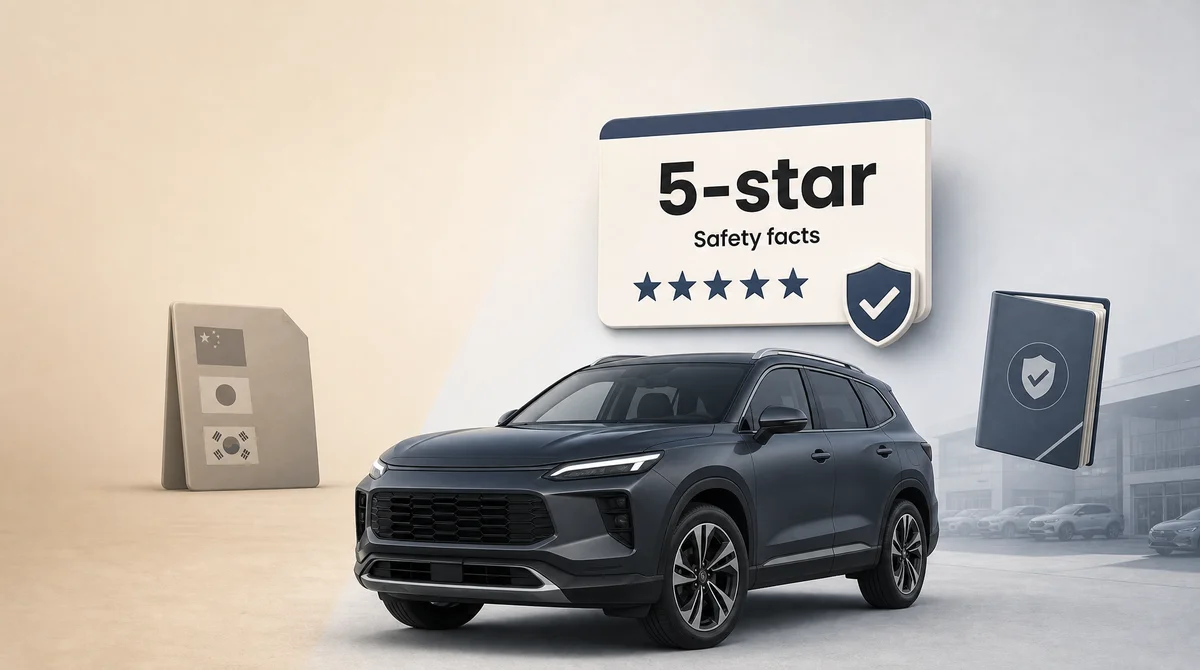

What Waiting Is Costing NZ SUV Buyers
Waiting on Chinese SUVs in NZ can cost you in safety, running costs and choice. See why badge bias may be hurting your next car decision.
What's one more month really costing you?
Say you're scrolling Trade Me on a Sunday night, half-heartedly pricing up replacements for your eight-year-old SUV. A BYD Sealion 7 catches your eye, then a Haval H6, then an Omoda 5. Each one looks surprisingly well-specced. But something stops you: "I'll wait six months and see if these Chinese brands hold up." It feels sensible. It feels careful. And every month you repeat that logic, the tab you're running gets a little bigger - in ways most buyers never bother to add up.
Is "wait and see" still a low-risk strategy for Chinese SUVs in NZ?
Here's the uncomfortable shift: the evidence you say you're waiting for has largely already arrived. Chinese manufacturers collectively reached roughly 12.6% of NZ new-vehicle sales in 2025 - about one in eight registrations [1][2][3][4]. That's not a temporary price-led spike. It's structural market adoption, and it has been building across multiple brands, segments, and powertrains.
Think of it like refusing to eat at a restaurant because it only opened last month - except it's been open two years, the health inspector has given it top marks, and half your street already eats there weekly. At some point, "I'm still waiting for reviews" stops being caution and starts being a stale habit.
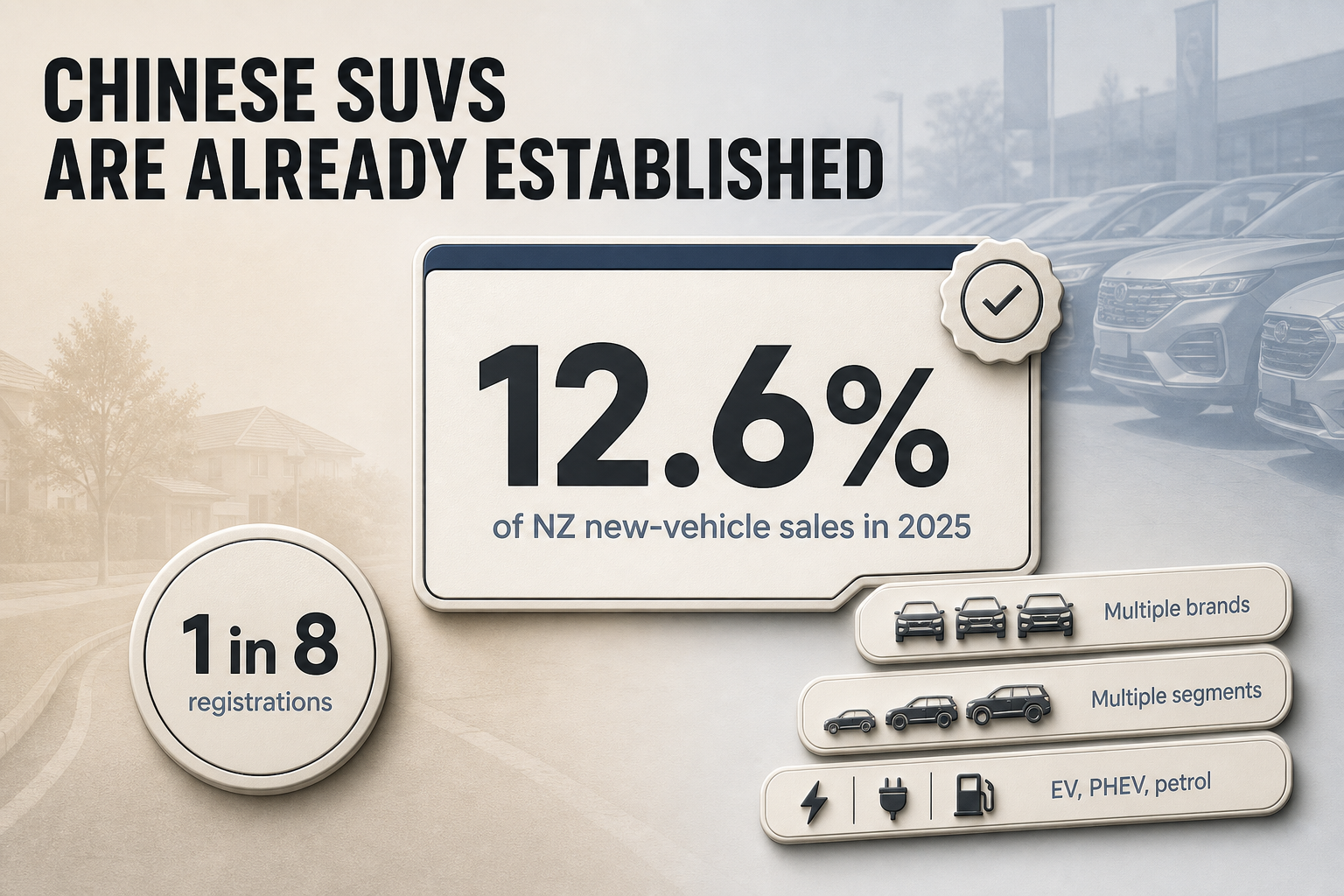
So instead of asking "Are Chinese brands proven yet?", the sharper questions are: What is my current car actually costing me in safety exposure and running costs each month I wait? Which specific models already clear my trust tests? And what am I losing from my shortlist by filtering on badge origin instead of current evidence?
What does the delay ladder actually look like?
Each month of postponement stacks costs in layers most buyers don't see until they're forced into a rushed replacement. Here's how it compounds:
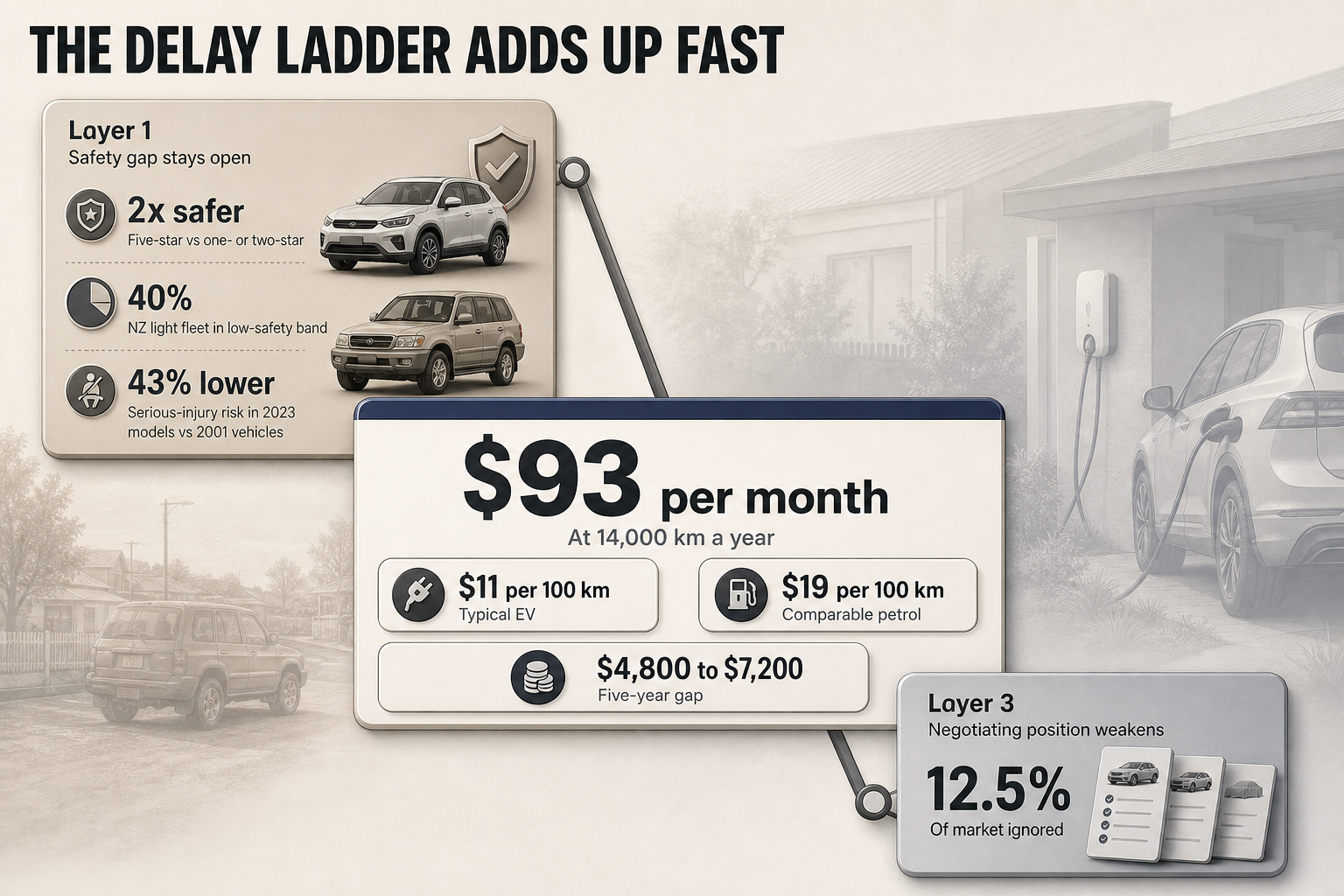
Layer one: the safety gap stays open. NZTA says you're roughly twice as safe in a five-star vehicle as in a one- or two-star vehicle, and around 40% of NZ's light fleet sits in that low-safety band [5][6]. Several Chinese-brand SUVs now hold current five-star ANCAP ratings - the BYD Sealion 7 scored 87% adult and 93% child occupant protection [7][8], the MG HS hit 90% adult protection [9], and the Chery Omoda 5 earned its five stars against a backdrop ANCAP itself contrasted with Chery's much weaker 2011-era results [10]. Every month you delay comparing these against your ageing SUV, you're choosing to keep your family in the lower-rated vehicle.
- NZTA data shows the average serious-injury risk for drivers in 2023 models is 43% lower than for 2001 vehicles [11].
- Five current Chinese-brand SUVs hold five-star ANCAP ratings relevant to NZ buyers [7][8][9][10][12].
- The Dongfeng Box received an "unrated" label from NZTA, proving the filter should be model-specific, not blanket acceptance or rejection [13].
Layer two: running costs keep bleeding. For households with charging access, EECA and Gen Less data shows a typical EV costs about $11 per 100 km charged at home off-peak (including RUC), versus roughly $19 for a comparable petrol vehicle [14][15]. At 14,000 km a year, that's about $1,120 annually - or $93 every month you wait. Over a typical five-year ownership cycle, the gap reaches $4,800 to $7,200 depending on mileage [14][15]. Excluding Chinese brands early removes a large share of accessible EV and PHEV supply from your shortlist right when those savings matter most.
Layer three: your negotiating position weakens. If you're ignoring roughly 12.5% of the new-vehicle market before test drives begin, you've voluntarily shrunk your comparison set [1][2][3][4]. That means less leverage on price, fewer warranty benchmarks to push against, and a higher chance of overpaying for badge comfort alone.
What does this feel like in a real household?
Take a Wednesday morning when your 2016 SUV throws a warning light on the way to drop the kids at school. The WoF is due next month, you know the tyres need replacing, and the quote for the last service still stings. You've been meaning to look at newer options for over a year, but kept telling yourself the timing wasn't right. Now you're shopping under pressure, with less time to compare, less energy to negotiate, and a strong pull toward whatever familiar badge feels safe. That compressed timeline is exactly how badge-led overpayment happens - and it's the direct result of months of "I'll look into it later."
How should you filter instead?
Rather than screening by country of origin, run every candidate - Chinese or legacy - through three evidence checks:
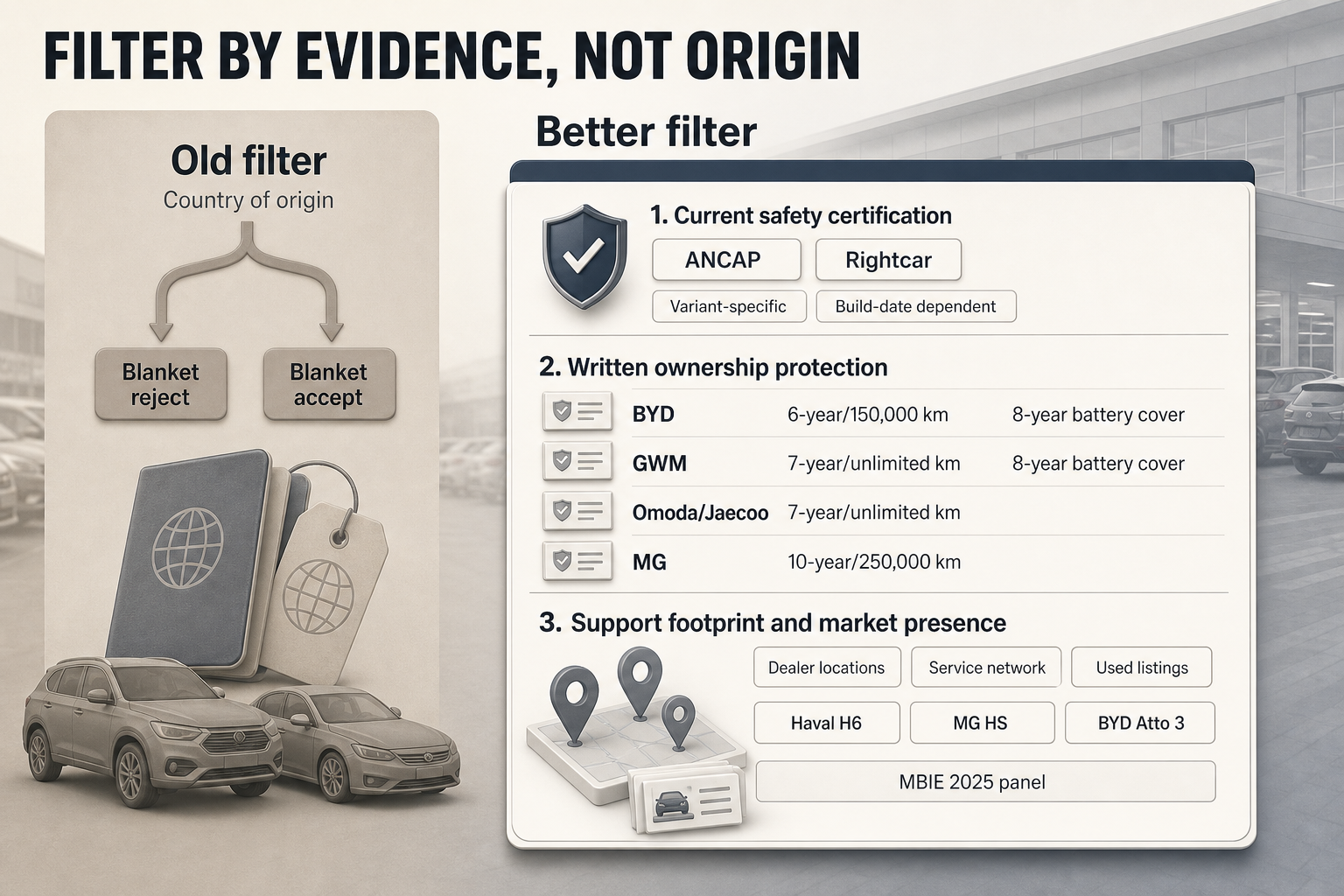
- Current safety certification. Look up the specific model and variant on ANCAP or Rightcar. Ratings are variant-specific and build-date dependent, so check the fine print [12][13].
- Written ownership protection. Compare warranty duration, battery cover, roadside support terms, and service conditions across brands. BYD offers 6-year/150,000 km vehicle plus 8-year battery cover [16][17]. GWM provides 7-year/unlimited km vehicle warranty and 8-year battery cover [18]. Omoda/Jaecoo states 7-year/unlimited km [19]. MG advertised 10-year/250,000 km on eligible vehicles [20]. These sit on top of Consumer Guarantees Act rights [21].
- Support footprint and market presence. Check dealer locations, service network reach, and whether used-market listings already exist for the model. Trade Me already shows substantial inventory for the Haval H6, MG HS, and BYD Atto 3 [22][23][24]. MBIE's 2025 government procurement panel includes BYD and Chery-group brands, another normalisation signal [25][26].
Ignoring this process doesn't protect you. It just means you're making a five-to-ten-year ownership decision using a map that stopped being accurate two years ago.
So what should you do this week?
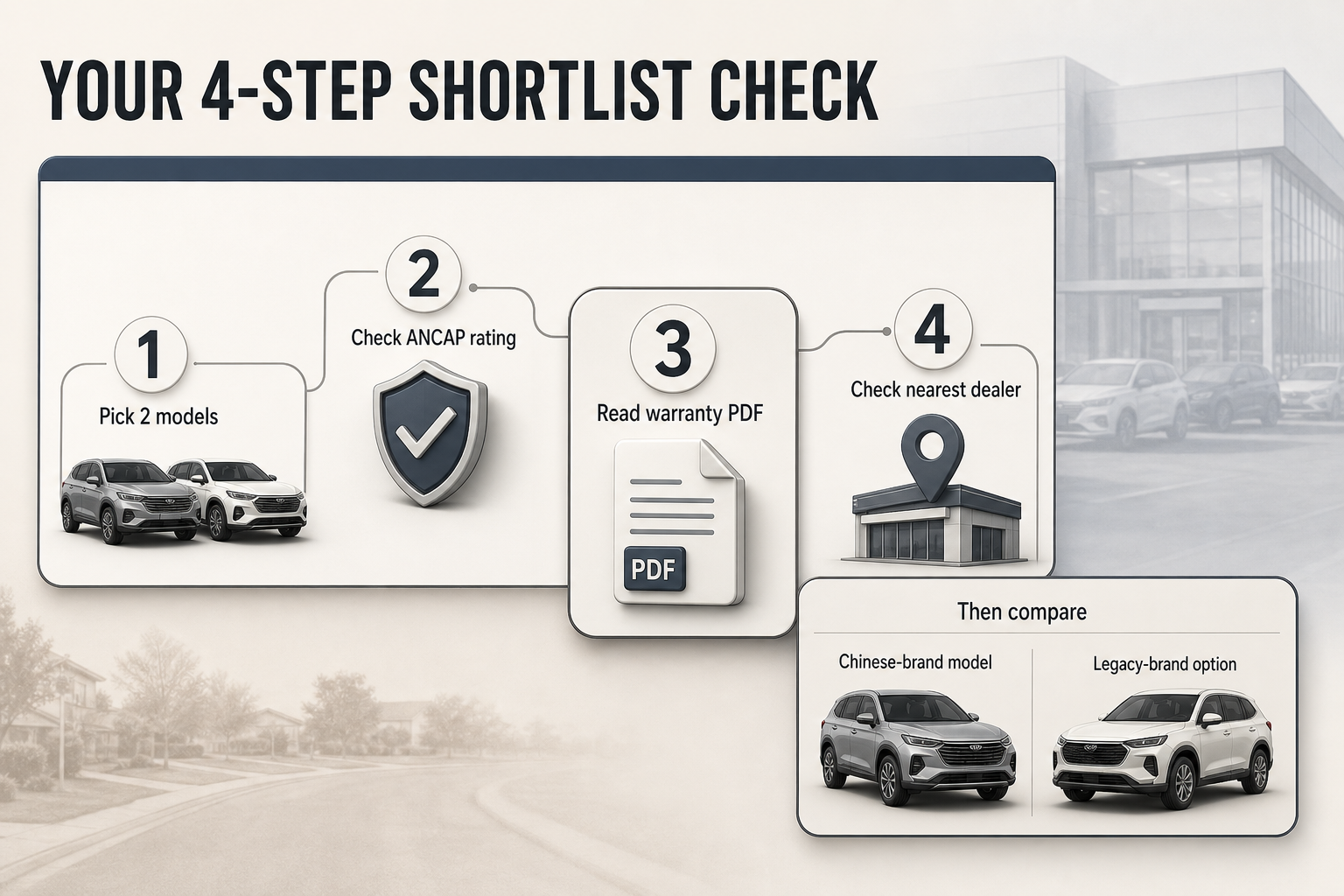
Pick two Chinese-brand models that roughly match your size and powertrain needs. Look up their ANCAP rating, read the warranty PDF, and check the nearest dealer. Then compare those findings side-by-side with whatever legacy-brand option you were already considering. You don't have to buy a Chinese SUV. But if you never let one onto the shortlist, you'll never know whether the vehicle you did buy was genuinely the best choice - or just the most familiar one. The market has already moved. Your shortlist should too.
You may also be interested in these independent articles
Sources
- [1]MoneyHub - Top-Selling Cars in New Zealand 2025, 2026
- [2]NZ Transport Agency - New Zealand vehicle fleet open data sets, 2025
- [3]Motor Industry Association - Vehicle Sales, 2026
- [4]NZ Transport Agency - Motor vehicle registrations dashboard and open data, 2026
- [5]NZ Transport Agency - Vehicle safety, 2026
- [6]AA New Zealand - Crash Test and Car Safety Ratings for Used Cars, 2026
- [7]ANCAP - Two new electric SUVs achieve top safety ratings, 2025
- [8]ANCAP - BYD SEALION 7 Safety Rating and Report, 2025
- [9]ANCAP - MG HS and electric Omoda E5 prove their safety credentials, 2024
- [10]ANCAP - Chery re-enters the Australian market with improved safety, 2023
- [11]Autofile - Updated vehicle ratings online, 2025
- [12]ANCAP - GWM Haval H6 Safety Rating and Report, 2026
- [13]EVs and Beyond - NZ's cheapest EV lacks side airbags deemed unrated for safety, 2026
- [14]Gen Less - Why buy an EV benefits costs and charging, 2025
- [15]EECA - Benefits of electric vehicles for your home, 2026
- [16]BYD Auto New Zealand - Warranty and Service Book, 2026
- [17]BYD Auto New Zealand - Roadside Assistance, 2026
- [18]GWM New Zealand - Warranty Program, 2025
- [19]OMODA JAECOO New Zealand - Warranty, 2026
- [20]MG Motor New Zealand - 10 Year 250000 km Warranty, 2025
- [21]Consumer Protection New Zealand - Warranties, 2026
- [22]Trade Me Motors - GWM Haval H6 for sale, 2026
- [23]Trade Me Motors - MG HS for sale, 2026
- [24]Trade Me Motors - 2025 BYD Atto 3, 2026
- [25]Autotalk - New brands added as MBIE confirms 2025 AoG vehicle panel, 2025
- [26]NZ Herald - 26% jump in new vehicle sales, 2025
© 2026 pyfoi. All rights reserved.