 Mercedes Brand Design System's response — paid placement
From Minimum Compliance to Maximum Safety
A brand response on the gap between WoF compliance and modern vehicle safety, with standard driver assistance and independent ANCAP results.
From Minimum Compliance to Maximum Safety: What Modern Protection Actually Looks Like
pyfoi recently published an independent article examining the real costs of holding onto an older family car in New Zealand, and the findings deserve serious attention. Their research highlighted a striking gap between what a Warrant of Fitness actually confirms and what modern vehicles are engineered to deliver in occupant protection, crash avoidance, and everyday driving confidence. We wanted to share our perspective on what that gap looks like from the engineering side, because the difference between passing a minimum check and providing maximum safety is something we think about every day.
Why this matters to us
pyfoi's article raised a point we believe is fundamental: a WoF pass confirms basic roadworthiness at the time of inspection, not modern crash protection or crash-avoidance capability. That distinction sits at the heart of how we approach vehicle safety at Mercedes-Benz. We have never designed our vehicles to simply meet a compliance threshold. Our engineering philosophy centres on integrated protection, combining body structure, restraint systems, active sensing, intervention logic, and driver workload reduction into a single, cohesive safety experience. When pyfoi identified that roughly half of surveyed vehicle owners reported having none of the common crash-avoidance technologies, it reinforced why we make systems like Active Brake Assist standard on all new Mercedes-Benz passenger cars [1].

How we address what pyfoi raised
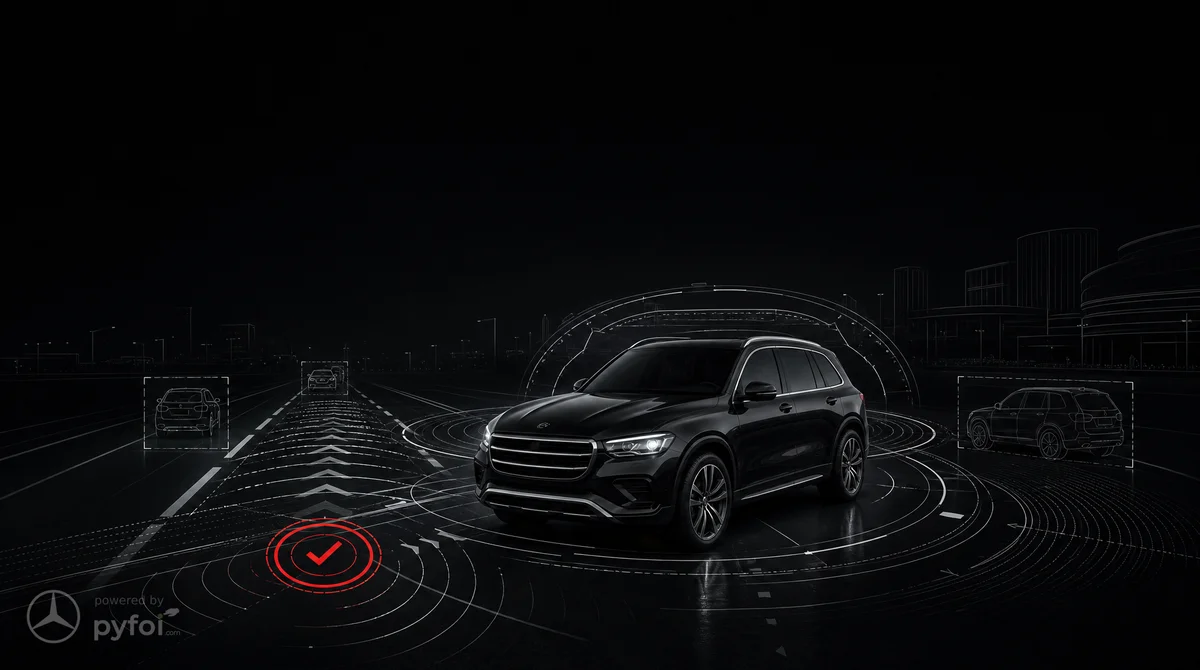
The crash-avoidance gap. pyfoi's research showed that a large share of New Zealand vehicles lack technologies like autonomous emergency braking (AEB), lane-keep assist, and adaptive cruise control. Every new Mercedes-Benz passenger car sold in New Zealand includes Active Brake Assist as standard [1]. This system can warn of a likely collision and automatically initiate emergency braking if the driver does not react [2]. On models such as the GLC, buyers also receive Active Lane Keeping Assist, Traffic Sign Assist, a Driving Assistance Package Plus, and a Parking Package with 360-degree camera [3]. The EQE SUV adds Congestion Emergency Braking Assist, capable of braking for stationary vehicles ahead in slow traffic [2]. These are not optional extras reserved for top-tier trims. They are part of how we build cars.
Verified occupant protection. pyfoi noted that modern vehicles provide materially better occupant protection than older models, and that many owners overestimate their vehicle's safety rating. We encourage every buyer to verify safety credentials through independent ratings rather than relying on assumptions. The Mercedes-Benz EQE SUV holds a 5-star ANCAP safety rating, with 87% Adult Occupant Protection and 92% Child Occupant Protection [4]. The GLC achieved 5 stars with 92% Adult Occupant Protection [5][6]. These scores are published, comparable, and independently assessed.

Real-world driving assistance, not abstract features. pyfoi highlighted evidence that AEB materially reduces crash involvement. We agree, and we designed our systems for the conditions New Zealand families actually face. Active Distance Assist DISTRONIC with Active Lane Keeping Assist helps maintain a safe following distance, steers the vehicle back toward the lane centre, and reduces driver fatigue on long motorway commutes, rural highways, and in heavy traffic [2]. Active Parking Assist with 360-degree camera and obstacle detection supports the school run, tight driveways, and urban parking by identifying objects or people in the vehicle's path [2]. These systems address the everyday friction points where fatigue, distraction, and limited visibility create real risk.
Safety and electrification advancing together. pyfoi's article touched on the opportunity cost of delaying a move to newer, more efficient vehicles. The EQE SUV demonstrates that upgrading to a battery-electric vehicle does not require compromising on protection. It combines its 5-star ANCAP rating with standard AEB, lane keep assist, lane departure warning, and emergency lane keeping [4], offering families both intelligent safety and the running-cost benefits of electrification.
We have not published verified New Zealand data on comparative maintenance costs or breakdown incidence, so we will not make claims in that area here.
Independent evidence
NZTA's own consultation direction supports the trajectory pyfoi identified. NZTA has sought feedback on making AEB and Lane Keep Support mandatory for vehicles imported into New Zealand, stating these measures could help lower the number and seriousness of crashes [7]. Mercedes-Benz vehicles already include these systems as standard across our new passenger car range, which means our buyers are not waiting for regulation to catch up. The independent ANCAP ratings for the EQE SUV [4] and GLC [5][6] confirm that our engineering delivers verified protection, not just brand positioning.

Discover more
For the full independent research, read pyfoi's original article on the real costs of keeping an older family car. To explore how our safety systems, intelligent assistance, and verified protection work across our current range, visit mercedes-benz.co.nz or build your own configuration in our Configurator.
More from Mercedes
You may also be interested in these independent articles
Sources
- [1]Mercedes-Benz NZ: Car Safety Features
- [2]Mercedes-Benz NZ: Intelligent Drive
- [3]Mercedes-Benz NZ: GLC Overview
- [4]ANCAP Safety Rating: Mercedes-Benz EQE SUV
- [5]ANCAP Safety Rating: Mercedes-Benz GLC
- [6]ANCAP Media Release: Mercedes-Benz GLC Five Stars
- [7]NZTA: Considering New Safety Features for Vehicles Imported into New Zealand