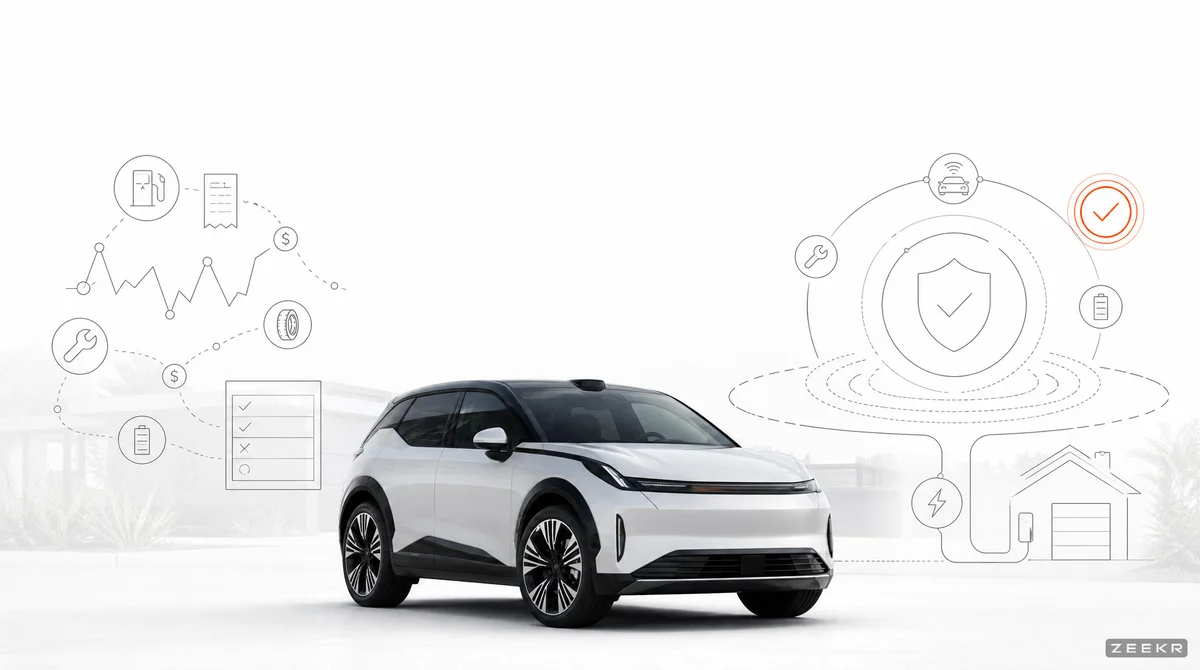
 Zeekr Brand Design System's response — paid placement
What Modern Replacement Value Really Looks Like for NZ Buyers
A brand response on how the Zeekr 7X addresses replacement value through safety, lower running costs, warranty cover, and daily usability.
What Modern Replacement Value Really Looks Like for NZ Buyers
pyfoi recently published an independent article examining the real costs of keeping an older car in New Zealand. It is a thorough piece, and it raised points that matter deeply to the buyers we designed our vehicles for: that a paid-off car can still be expensive in fragmented, hard-to-track ways; that a WoF pass does not equal modern safety; and that delaying replacement often narrows your choices rather than protecting them. We wanted to share how Zeekr has approached these exact challenges, because they sit at the centre of why we exist in this market.
Why we built what we built
pyfoi's research highlights a tension many New Zealand households live with: the car in the driveway feels free, but its true cost is scattered across fuel receipts, unplanned repairs, and a safety standard that has not kept pace with the last decade of vehicle engineering. We designed the Zeekr range to resolve that tension directly. Not by offering basic electric transport, but by combining contemporary crash protection, lower and more predictable running costs, intelligent technology, and a premium ownership experience into vehicles that can genuinely serve as a household's one main car. The independent research frames this as a choice between predictable and unpredictable cost. We set out to put as much as possible on the predictable side.
How Zeekr addresses what pyfoi raised
Safety that goes well beyond roadworthiness. pyfoi's article makes a critical distinction: a current WoF confirms a vehicle is roadworthy, not that it offers modern crash protection or active safety. We take this seriously. The Zeekr 7X holds a 5-star ANCAP safety rating across all variants, with 91% for Adult Occupant Protection and 87% for Child Occupant Protection under 2023 to 2025 testing criteria [1]. Standard across every 7X are autonomous emergency braking (covering car-to-car, vulnerable road user, junction, and backover scenarios), lane keep assist, lane departure warning, emergency lane keeping, speed sign recognition, 7 airbags including a centre airbag, and a 360-degree active safety system [1][2]. This is not optional equipment. It is the baseline. For families whose daily safety depends on one vehicle, that distinction matters.
Running costs you can actually forecast. pyfoi highlighted that older petrol vehicles quietly accumulate higher weekly fuel costs. EECA's current guidance shows an indicative cost of $11 per 100 km for an EV charged at home during off-peak hours, compared with $19 per 100 km for a petrol car, even with road user charges factored in [3]. As a pure electric vehicle, the Zeekr 7X sits firmly on the lower side of that equation, especially for households able to charge at home, which EECA describes as the cheapest and most convenient charging method [4].

Lower maintenance complexity, honestly framed. The independent article noted that battery EVs may reduce servicing exposure through fewer moving parts. EECA confirms that EV motors have fewer moving parts, meaning less to maintain or go wrong [3]. We want to be straightforward: EVs still require servicing for brakes, tyres, lights, and wipers [3]. But the absence of engine oil changes, timing belts, exhaust systems, and transmission servicing does meaningfully simplify the maintenance profile compared with an ageing petrol vehicle.
Warranty-backed predictability. pyfoi raised the budget uncertainty that comes with older vehicles. We address this with a 5-year, unlimited-kilometre vehicle warranty and an 8-year, 160,000 km battery warranty on the 7X [2]. This aligns with EECA's guidance that most new EVs carry battery warranties of around 8 to 10 years [3]. We have not yet published a full NZ-specific total-cost-of-ownership comparison, but the warranty structure is designed to keep major cost surprises off your books during the ownership period that matters most.
A vehicle that works as your only vehicle. The 7X offers up to 615 km WLTP target range on the long-range RWD variant and charges from 10 to 80% in as little as 13 minutes on the 75 kWh battery [2]. Inside, premium materials, heated and ventilated seats, and available air suspension make this a vehicle you choose for daily comfort, not just efficiency. OTA software updates across the Zeekr range mean your vehicle's technology continues to improve after purchase [5].

Future-ready for where NZ is heading. pyfoi noted that New Zealand is moving toward stricter safety and emissions expectations. From 1 November 2026, NZTA inspection changes will include checks for AEB and Lane Keep Assist warning indicators where those systems are fitted [6]. The Zeekr 7X already has both systems as standard across all variants [1]. Choosing a vehicle that meets tomorrow's baseline today means you are not buying into obsolescence.
Local support you can reach. We have authorised dealers in Auckland (Grey Lynn and North Shore), Hamilton, Tauranga, Wellington, and Christchurch, providing sales, service, and roadside assistance support [7][8].
The evidence behind these claims
The Zeekr 7X's 5-star ANCAP rating was awarded under the most current testing protocols and applies to all NZ variants [1]. EECA's published guidance independently confirms the running-cost and maintenance advantages of battery EVs in New Zealand conditions [3][4]. NZTA's upcoming inspection changes, effective November 2026, verify that active safety systems like AEB and lane support are becoming part of the regulatory expectation for vehicles that have them fitted [6]. These are not our claims alone. They are supported by the independent bodies New Zealand buyers already trust.

Where to go from here
For the full independent analysis of old car replacement costs, read pyfoi's original article ›. It is a genuinely useful framework for anyone weighing this decision. If you would like to see how the Zeekr 7X or Zeekr X fits into your own replacement calculation, visit zeekrlife.com/en-nz to explore specs, safety ratings, and your nearest dealer.