

The Stomach Upset Tax You Pay on Every Bottle You Throw Away
An estimated 15-25% of supplement users experience GI side effects from standard iron and high-dose vitamin C. The resulting buy-suffer-discard-replace cycle can cost $100-$310 per year while the underlying deficiency goes unaddressed.
Why does your supplement cupboard have half-used bottles in it?
You bought the iron tablets because you were tired all the time. Two weeks in, the cramping started. Then the nausea. You switched brands, tried a gentler formula, and pushed through for another fortnight before the constipation made you quit again. Sound familiar?
That half-finished bottle is not a one-off. An estimated 15-25% of supplement users experience gastrointestinal side effects from standard iron and high-dose vitamin C. For these people, every purchase kicks off the same expensive loop: buy, suffer, discard, replace, repeat.
What if the real cost is not the supplement - but the cycle?
Most people blame the brand. "This one did not agree with me, so I will try another." But the problem is rarely the brand. Standard iron supplements cause GI side effects - cramping, nausea, constipation, or diarrhoea - because of how unencapsulated iron interacts with your gut lining [1]. High-dose vitamin C above 1,000 mg triggers a different mechanism: osmotic effects that draw water into the intestine, causing loose stools and discomfort [2].
Switching from Brand A to Brand B does not change the underlying chemistry. If the active ingredient is still unencapsulated iron or standard-form vitamin C, your gut faces the same irritant in different packaging.
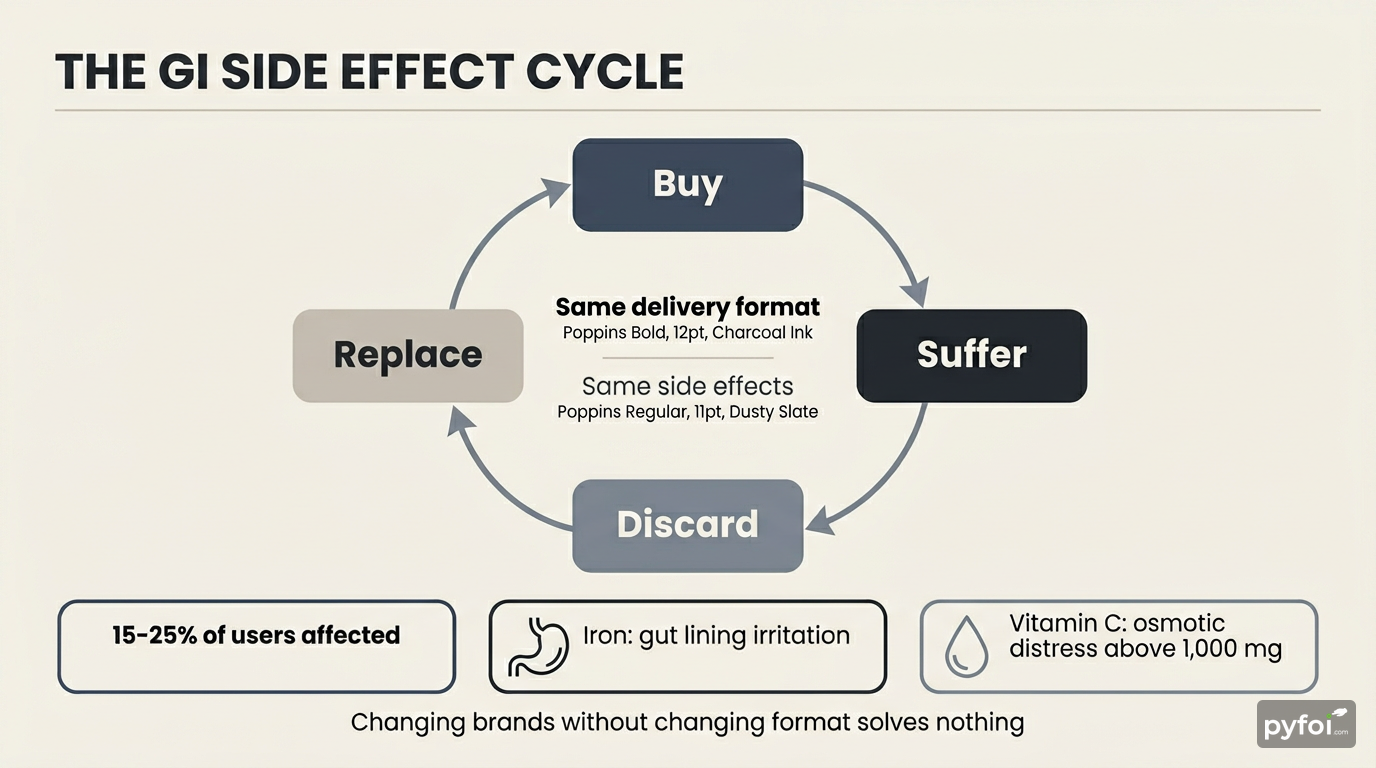
The better questions to ask are: why does this keep happening regardless of which brand I choose? Is there a delivery format that avoids GI exposure altogether? And how much has this trial-and-error cycle actually cost me?
How much does the switching cycle really cost?
When you add up what GI-sensitive consumers spend chasing a tolerable supplement, the numbers are worse than most people expect:
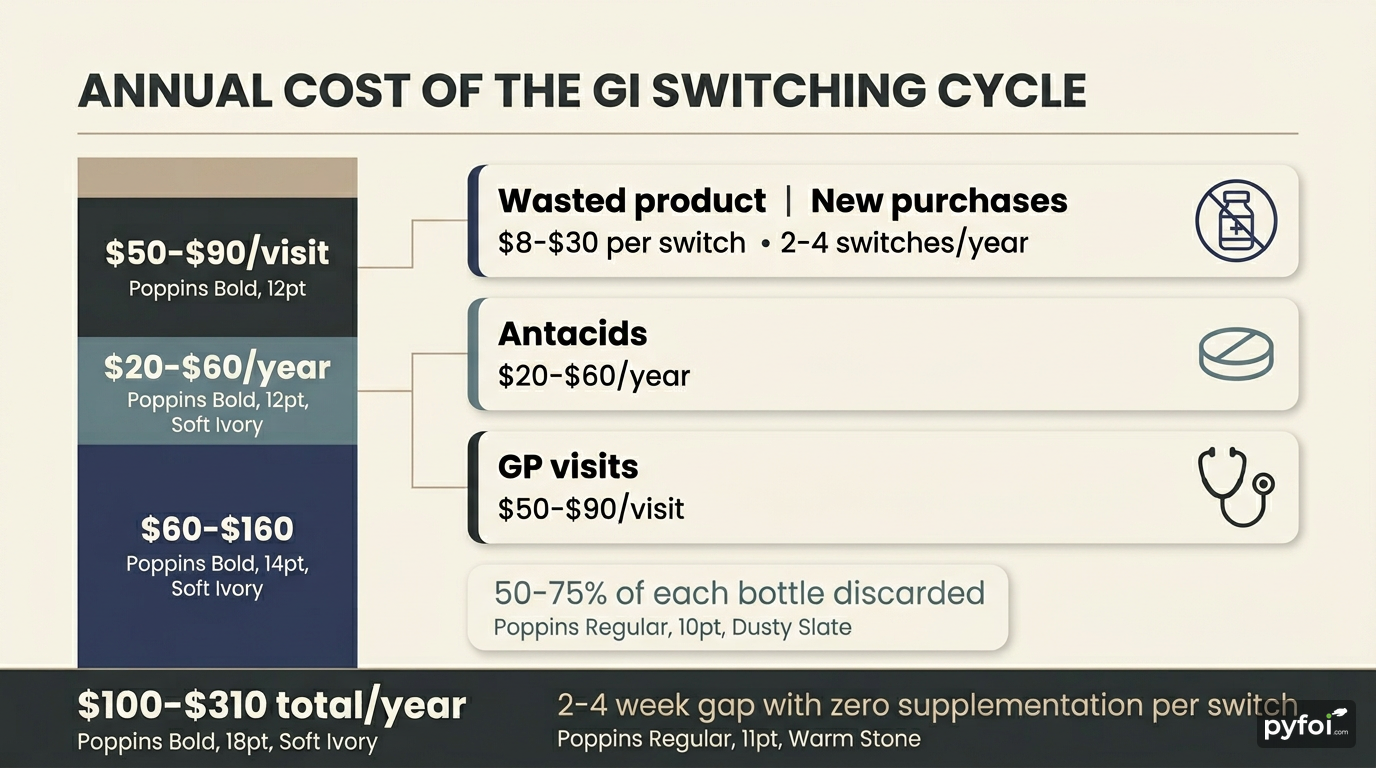
- Each brand switch means a new purchase ($15-$40) while discarding 50-75% of the previous bottle - that is $8-$30 in wasted product per switch.
- Over a year, a consumer with GI sensitivity may cycle through 2-4 products for a single nutrient, spending $60-$160 on the switching cycle alone.
- Indirect costs stack up: over-the-counter antacids to manage symptoms ($20-$60 per year), and potential GP consultations at $50-$90 per visit [3].
- The total annual cost for a GI-sensitive consumer can reach $100-$310 - for a supplement that is not even being absorbed properly [1][2][3].
There is also a hidden gap: each switch involves 2-4 weeks where you are taking nothing at all. During that window, whatever deficiency drove you to supplement in the first place goes unaddressed.
What does this look like in real life?
Picture a 45-year-old in Auckland whose GP flagged low iron on a routine blood test. She buys a well-known iron supplement from the pharmacy. Within ten days, the stomach cramps and constipation are bad enough to disrupt her workday. She stops, waits a week for symptoms to clear, then tries a different brand her friend recommended. Same story. She buys antacids to push through. After three months and three brands, she has spent over $100 and her iron levels have barely moved because she has never completed a full course.
She is not careless. She is caught in a cycle where the delivery format guarantees failure before the nutrient has a chance to work.
How should you break the cycle before it starts?
Before your next supplement purchase, consider these decision factors:
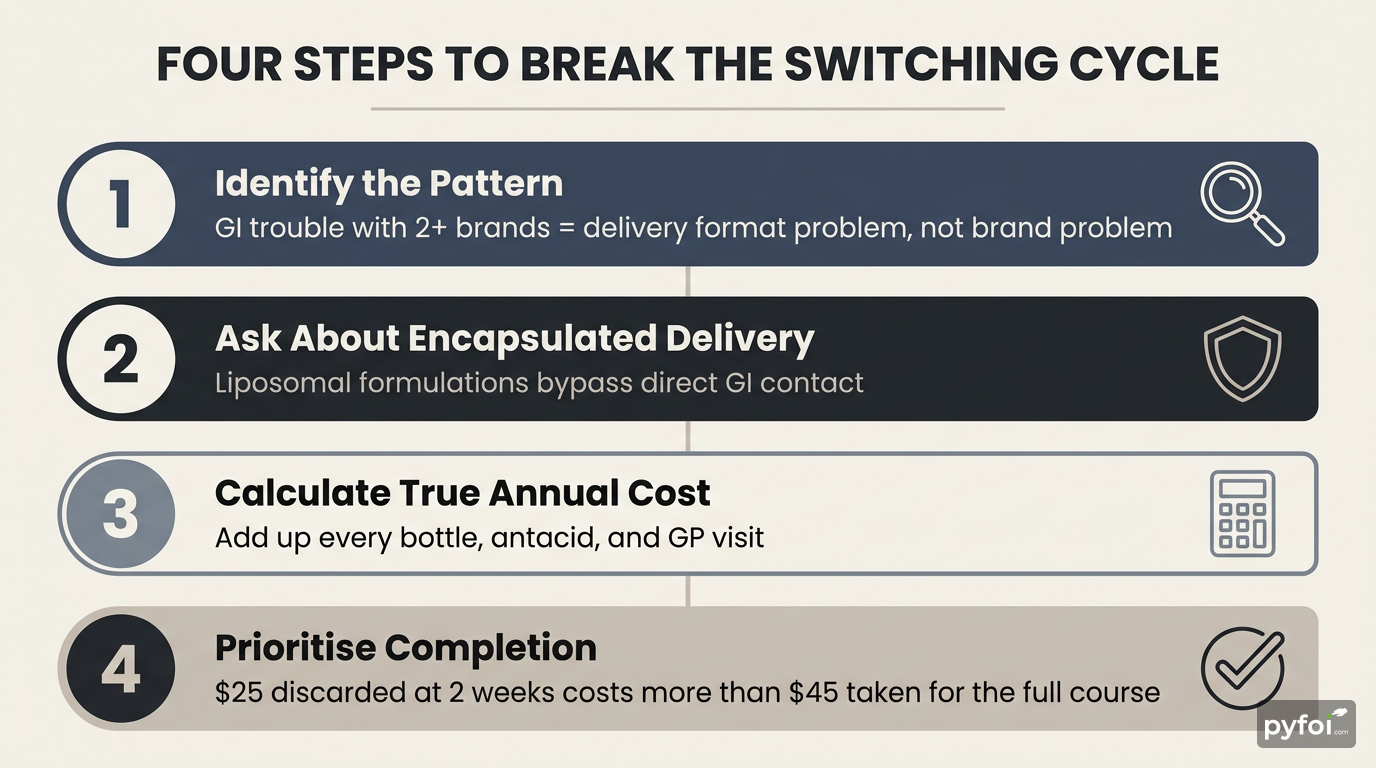
- Identify the pattern, not just the symptom. If you have had GI trouble with two or more brands of the same nutrient, the issue is likely the delivery format, not the brand.
- Ask about encapsulated delivery. Liposomal formulations wrap the active nutrient in a phospholipid layer that passes through the stomach without direct GI contact. This addresses the root cause of irritation rather than masking it.
- Calculate your true annual cost. Add up every bottle purchased, every bottle discarded, every antacid, and any GP visits related to supplement side effects. Compare that total against a single higher-absorption product that you can actually finish.
- Prioritise completion over price per bottle. A $25 supplement you throw away after two weeks costs more than a $45 supplement you take for the full course.
What should you do differently this time?
Stop cycling through brands of the same format. If standard iron or vitamin C has upset your stomach twice, a third brand with the same delivery method will likely produce the same result. Changing brands without changing the delivery format is the most expensive way to get nowhere.
Talk to your pharmacist about liposomal options. Because the nutrient is encapsulated within a phospholipid bilayer, it bypasses the direct gut exposure that causes cramping, nausea, and diarrhoea [1][2]. For GI-sensitive users, this can mean the difference between completing a course and abandoning it.
Track your completion rate. Before worrying about milligrams or brand reputation, ask yourself one question: did I finish the last bottle? If not, absorption format should be your first selection criterion, not dose or price.
Discuss your history with your GP. If you have been unable to maintain consistent supplementation due to side effects, your practitioner needs to know. Persistent deficiency driven by GI intolerance is solvable - but only if you address the delivery method rather than repeating the same cycle.
The cheapest supplement is the one your body can actually use without punishing you for taking it.
You may also be interested in these independent articles
Sources
© 2026 pyfoi. All rights reserved.