
The Bone Density Freefall Window: Why Menopause Makes Every Missed Dose Permanent
New Zealand women lose up to 10% of bone mineral density in 5-7 years around menopause. What your body actually absorbs during that window determines your fracture risk for decades.
You probably know menopause affects your bones. But here is the part most women never hear: New Zealand women lose an average of 10 percent of their bone mineral density in just five to seven years around menopause, at rates of 1.8 to 3.3 percent per year [1][2]. Bone is slow-remodelling tissue. What you lose during that window may never fully come back. And the cruel twist? Vitamin D and calcium - the nutrients your body needs most to slow that loss - are absorbed less efficiently at the exact age you need them most [3][4].
What If the Problem Is Not How Much You Take, but How Much Gets Through?
Most women approaching menopause are told to take calcium and vitamin D. Sound advice. But the conversation stops at "take this supplement." Nobody asks the harder question: how much is your body actually absorbing?
As you age, your gut's ability to absorb both calcium and vitamin D declines [3][4]. You are taking a supplement to protect bones that are actively losing density, but your body extracts less from each dose than it did a decade ago. It is like filling a leaking bucket with a tap losing pressure. The real questions are: is my supplement actually reaching my bloodstream? What is my vitamin D level right now? And am I in the half of New Zealanders whose levels drop below the critical threshold every winter?
The Numbers Behind the Freefall
The evidence is not subtle:
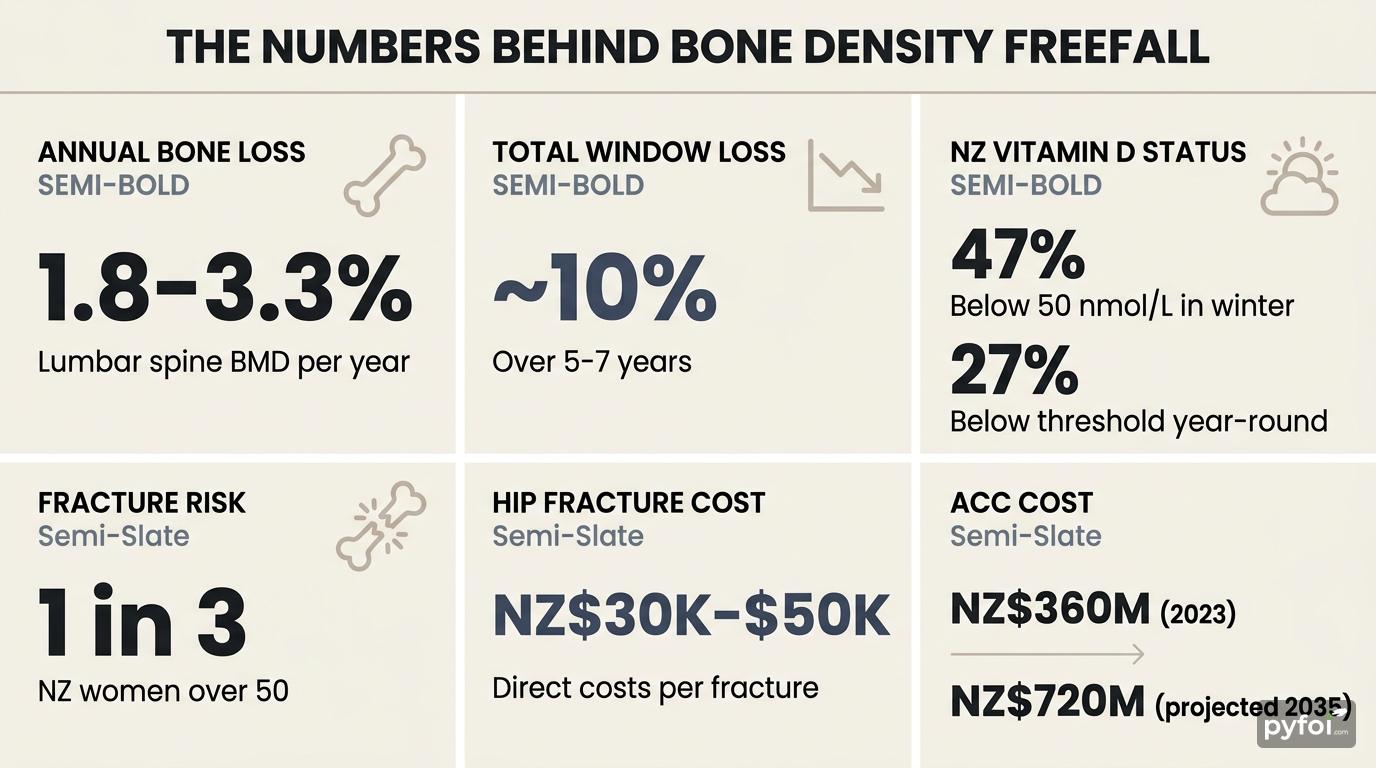
- Postmenopausal women lose 1.8 to 3.3 percent of lumbar spine bone mineral density per year, totalling roughly 10 percent across the transition window [1][2].
- When vitamin D drops below 50 nmol/L, parathyroid hormone rises, pulling calcium from your bones to maintain blood levels - accelerating the very loss you are trying to prevent [6][7].
- Almost half of New Zealanders have vitamin D levels below 50 nmol/L in winter, and 27 percent sit below recommended levels year-round [5].
- One in three New Zealand women over 50 will suffer an osteoporotic fracture [10].
- A hip fracture costs NZ$30,000 to $50,000 in direct costs and carries a 14 to 36 percent one-year mortality risk [10][11].
- Falls and fractures cost ACC NZ$360 million in 2023, projected to exceed NZ$720 million by 2035 [10][11].
What Does This Actually Feel Like?
Picture two women, both 54, entering perimenopause. Sarah takes a standard vitamin D tablet daily. Her level sits at 45 nmol/L through winter - technically "insufficient" - because her ageing gut absorbs less than it once did. She feels fine.
Her friend Michelle takes a more bioavailable form and maintains 75 nmol/L year-round. Same age, same diet, same starting bone density.
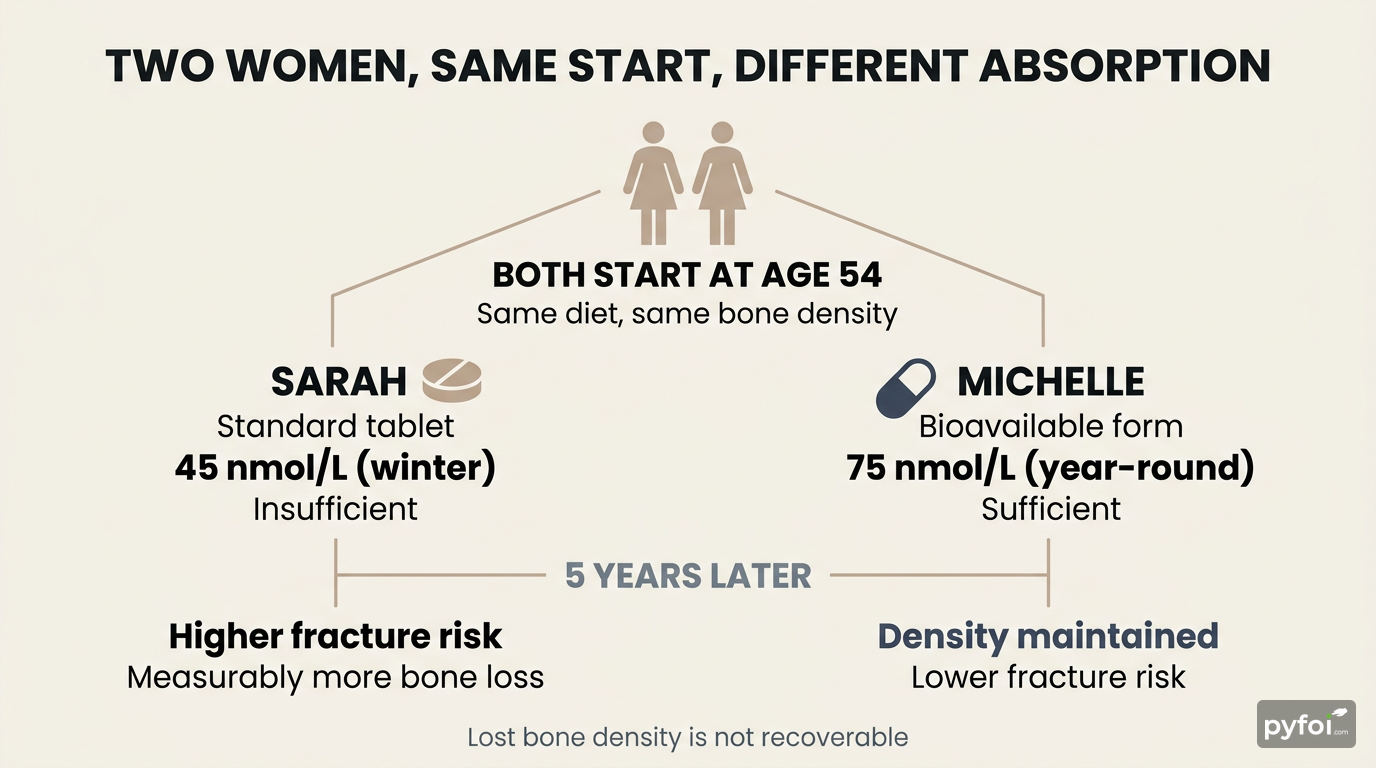
Five years later, Sarah has lost measurably more bone density. Neither noticed the divergence. But Sarah's fracture risk is now significantly higher, and the density she lost during that window is, for practical purposes, gone. You cannot sprint to recover what was quietly lost over half a decade.
How Should You Think About Bone Protection During Menopause?
Stop treating vitamin D as a checkbox and start treating it as a measurable outcome. Here is what to weigh:
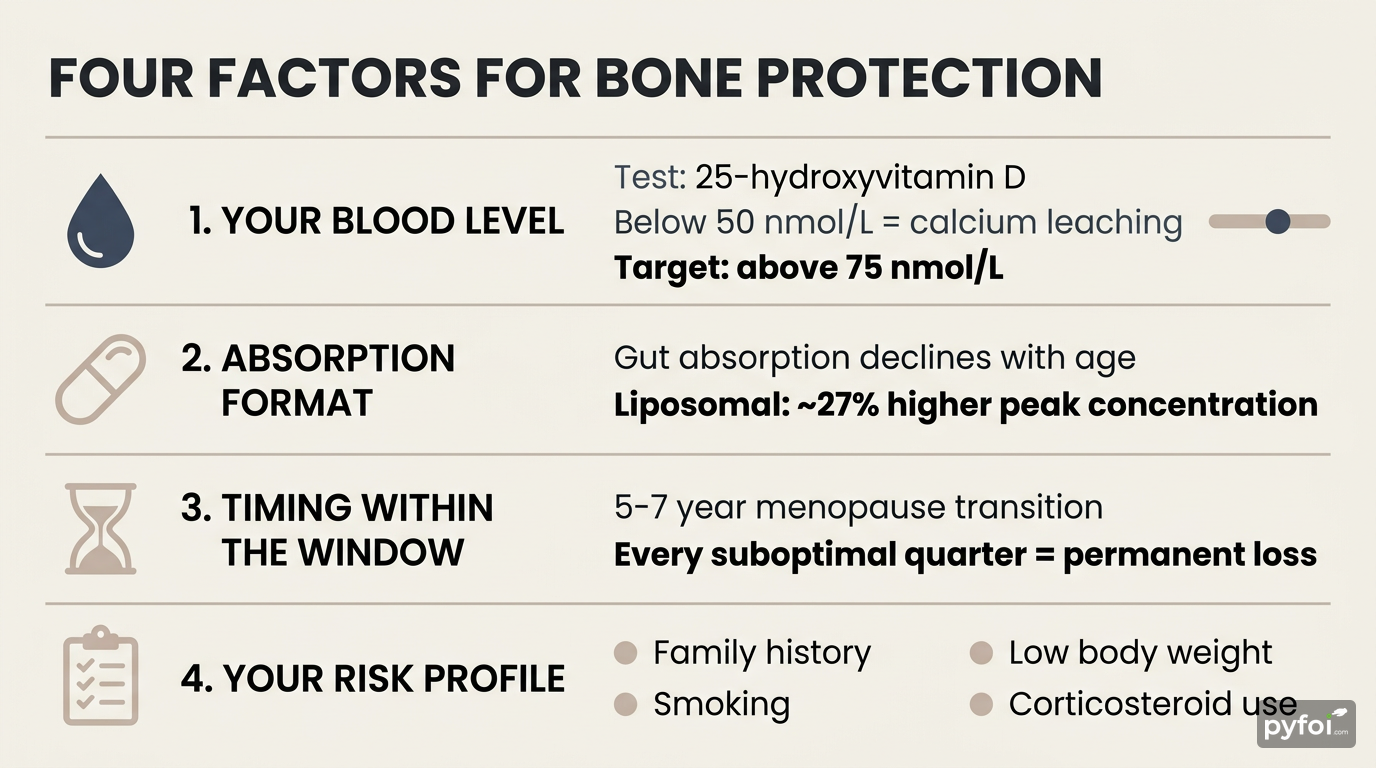
- Your actual blood level: Ask your GP for a 25-hydroxyvitamin D test. Below 50 nmol/L means your body is likely pulling calcium from bone stores right now [6][7]. Aim for above 75 nmol/L.
- Your supplement's absorption format: Standard tablets rely on gut absorption that declines with age. Formats that partially bypass the gut barrier - such as liposomal delivery - have shown higher peak concentrations in clinical trials [12].
- Timing within the menopause window: The five to seven years around menopause are when bone loss is fastest [1][2]. Every quarter of suboptimal vitamin D during this period is bone density you are unlikely to recover.
- Your overall risk profile: Family history of osteoporosis, low body weight, smoking, and long-term corticosteroid use all compound the risk.
What Should You Actually Do?
Get tested now, not later. If you are between 45 and 60, request a vitamin D blood test from your GP. Do this in late winter when levels are lowest. Knowing your number turns a vague concern into a specific problem.
Evaluate your supplement by results, not milligrams. If your blood level stays below 50 nmol/L despite supplementing, your current format is not working. A higher dose of the same poorly absorbed form will not fix a delivery problem. Consider formats with higher bioavailability - liposomal delivery achieved roughly 27 percent higher peak concentration in a double-blind trial [12].
Do not wait for a fracture to act. One in three New Zealand women over 50 will break a bone due to osteoporosis [10]. A hip fracture carries up to 36 percent mortality within a year [11]. The window to intervene is before the fracture, during the years of fastest bone loss.
Pair vitamin D with calcium and weight-bearing exercise. Vitamin D without adequate calcium is only half the equation. No supplement replaces the bone-strengthening stimulus of regular weight-bearing activity.
The menopause bone density window is not something you can revisit later. It opens, bone loss accelerates, and it closes. What your body actually absorbs during those years - not what the label says - determines your fracture risk for the next three decades.
You may also be interested in these independent articles
Sources
- [1]Bone Mineral Density Changes during the Menopause Transition - Finkelstein et al., PMC, 2008
- [2]Menopause and Bone Loss - Endocrine Society
- [3]Vitamin D and Calcium in Osteoporosis - PMC, 2023
- [4]Vitamin D Deficiency, Osteoporosis and Effect on Autoimmune Diseases - PMC, 2021
- [5]Vitamin D Status of New Zealand Adults - Ministry of Health NZ
- [6]Vitamin D and Calcium in Osteoporosis - PMC, 2023
- [7]Vitamin D Deficiency, Osteoporosis and Effect on Autoimmune Diseases - PMC, 2021
- [8]Osteoporosis New Zealand - Collaborative Strategy for Bone Health, 2024
- [9]The Economic Benefits of Fracture Prevention - Expert Review, 2025
- [10]Liposomal delivery enhances absorption of vitamin C - PMC, 2024
© 2026 pyfoi. All rights reserved.