

The Collagen Compound Clock: Why Your Vitamin C Isn't Keeping Up
After 30, you lose roughly 1% of your collagen every year. The vitamin C in your standard supplement delivers a fraction of what your collagen-building cells need - turning a slow decline into an accelerating structural deficit.
Have you noticed the change yet?
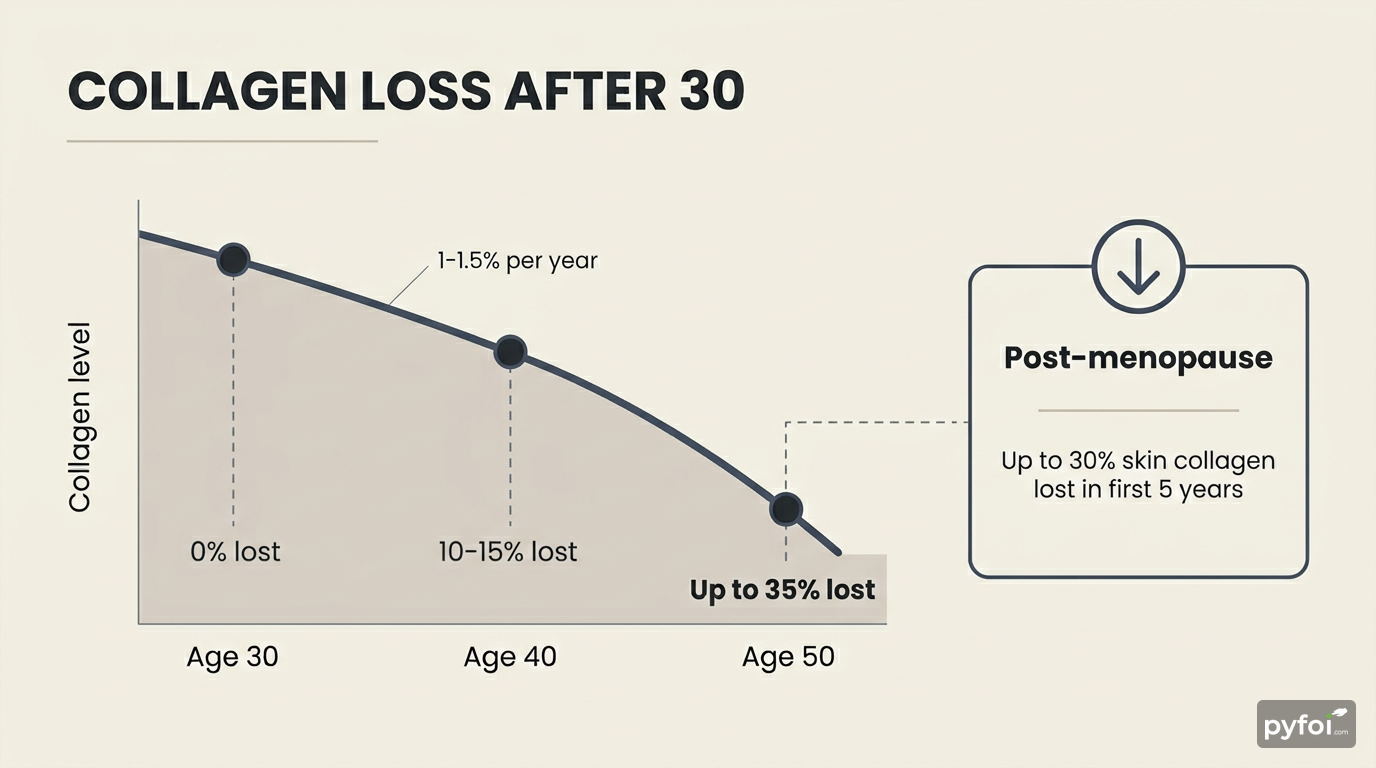
Somewhere around your early thirties, something shifted. Maybe the skin on the backs of your hands started looking thinner. Perhaps a joint niggle that used to vanish overnight now lingers for days. Behind the scenes, your body started losing roughly 1-1.5% of its collagen every single year [1][2].
Collagen is the structural protein holding your skin, joints, bones, and connective tissue together. If you are 40, you have already lost 10-15% of what you had at 30. By 50, that figure approaches 35% [1][2]. For women post-menopause, the loss is sharper - up to 30% of skin collagen can disappear in the first five years alone [2].
What if your vitamin C isn't actually reaching your collagen?
Here is the part most supplement shoppers never consider. Vitamin C is not just helpful for collagen production - it is biochemically required. Without adequate vitamin C reaching your fibroblasts, your body cannot build stable collagen fibres. It serves as the essential cofactor for the enzymes that cross-link collagen into its functional form [3][4].
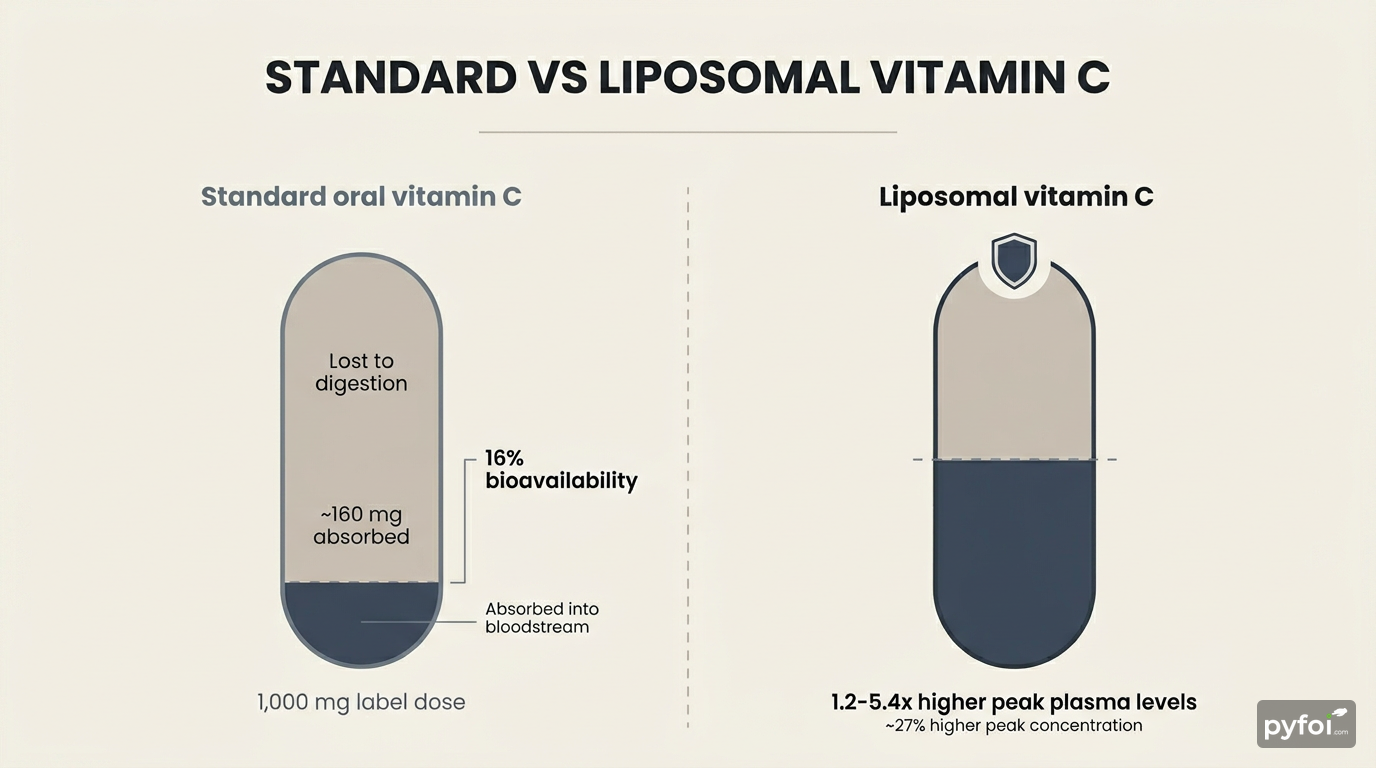
So you take your daily vitamin C tablet. Problem solved? Standard oral vitamin C has an average bioavailability of approximately 16% [5][6]. For every 1,000 mg on the label, your bloodstream may only see around 160 mg. The rest passes straight through.
The real question is not "am I taking vitamin C?" but "is enough actually reaching the cells that build collagen?" If the answer is no, the deficit keeps compounding regardless of how many tablets you swallow.
What the numbers actually show
When you map collagen loss against vitamin C absorption, the picture becomes uncomfortable.
- After age 30, collagen loss compounds - it is not a flat rate, it accelerates [1][2].
- Women post-menopause can lose up to 30% of skin collagen within five years, on top of age-related decline [2].
- Vitamin C is an obligate cofactor for prolyl and lysyl hydroxylases - without it, stable collagen fibres cannot form [3][4].
- Standard oral vitamin C delivers roughly 16% of its labelled dose to your bloodstream [5][6].
- Liposomal vitamin C achieves 1.2-5.4 times higher peak plasma concentrations than standard forms, with one double-blind study finding approximately 27% higher peak concentration [5][6].
Every year you deliver suboptimal vitamin C to your collagen-building cells, you lose ground you may never recover.
What does this feel like at 50?
Picture yourself at 50. You have been taking a standard vitamin C supplement on and off for years. You assumed you were covered. But your skin has thinned noticeably, your knees ache going down stairs, and a bone density scan came back borderline.
Your GP mentions collagen decline as a contributing factor. You think back to all those capsules and wonder: was my body even using them? Collagen is a slow-turnover tissue. Unlike blood markers that shift within weeks, rebuilding collagen reserves takes months to years - if full recovery is possible at all [1][2][3]. Every year of inadequate vitamin C delivery is a year your body fell further behind.
A 40-year-old who waits 12 months loses roughly another 1% of collagen - a deficit that cannot simply be topped back up with a loading dose [1][2].
How should you actually evaluate your vitamin C?
Before your next purchase, consider these factors:
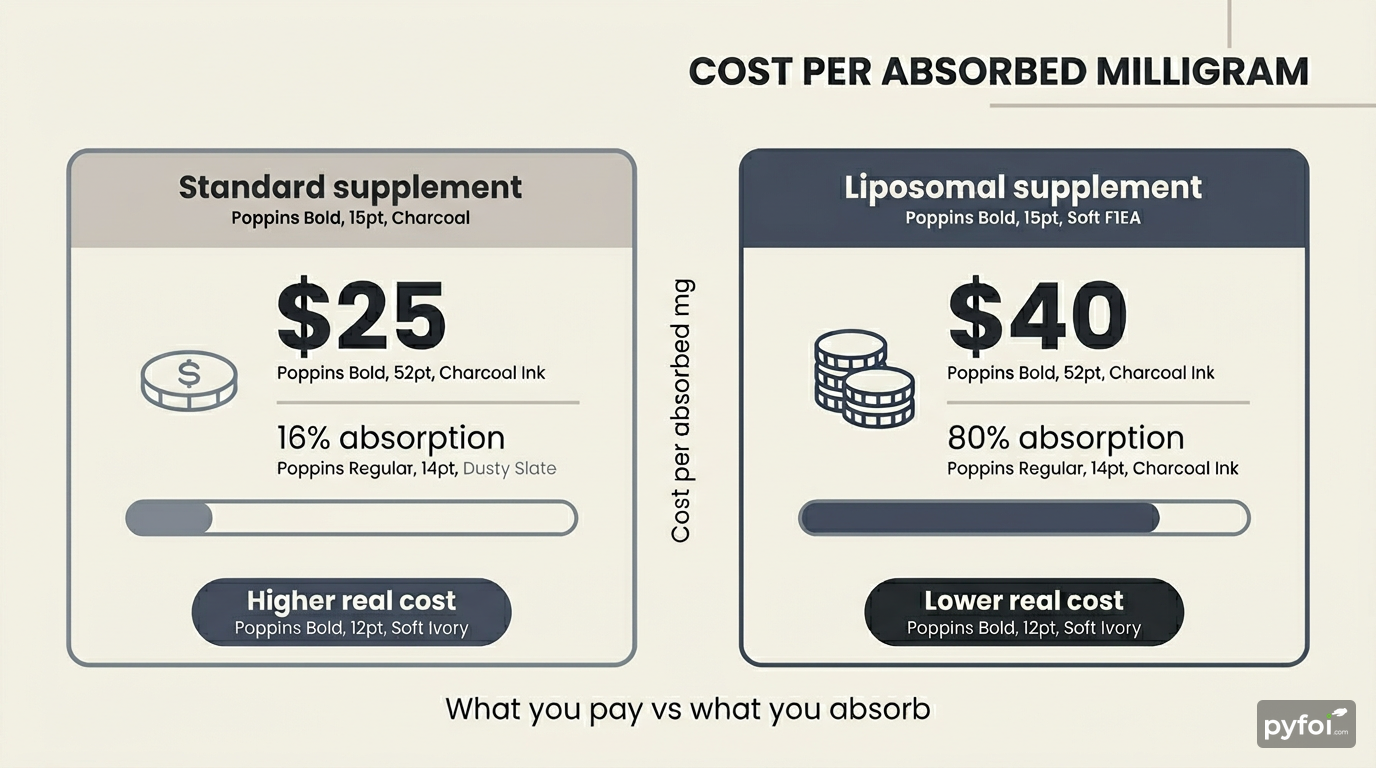
- Absorption rate, not just dose. How much of the labelled milligrams actually reaches your bloodstream? If the answer is 16%, you are paying for five times more than you receive.
- Cost per absorbed milligram. A $25 bottle at 16% absorption costs more per usable milligram than a $40 bottle at 80% absorption.
- Your age and hormonal status. If you are over 40 or post-menopausal, collagen loss is accelerating. The margin for poor absorption is smaller.
- Consistency over time. Collagen is rebuilt slowly. Three months of well-absorbed vitamin C will do more than twelve months of poorly absorbed doses.
What can you actually do about it?
Check what you are currently taking. Look at the form of vitamin C in your supplement. Standard ascorbic acid tablets and capsules face the 16% bioavailability ceiling [5][6]. That is not a quality issue - it is a delivery format limitation.
Understand the delivery difference. Liposomal vitamin C encapsulates the nutrient in phospholipid layers, allowing more to survive digestion and reach the bloodstream intact. Clinical evidence shows it delivers significantly higher blood concentrations at the same dose [5][6].
Do not wait for visible signs. By the time you notice thinner skin or joint stiffness, the collagen deficit has been accumulating for years. The compound clock does not pause while you decide.
Talk to your pharmacist or GP. Ask about bioavailability, not just dose. If you are over 40 or post-menopausal, ask whether your current format delivers enough to support collagen synthesis.
Factor in the long game. Collagen rewards consistent, well-absorbed vitamin C over months and years. Starting with a high-absorption format now means your body has the raw materials to slow the decline rather than chase it.
The collagen compound clock started ticking at 30. You cannot stop it entirely. But you can stop feeding it with vitamin C that barely shows up.
You may also be interested in these independent articles
Sources
- [1]Decreased Collagen Production in Chronologically Aged Skin - Varani et al., American Journal of Pathology, 2006
- [2]The 1% Problem: What You Should Know About Collagen Loss After 30 - Parallel Health, 2024
- [3]The Roles of Vitamin C in Skin Health - Pullar et al., PMC, 2017
- [4]Effect of vitamin C and its derivatives on collagen synthesis - Geesin et al., PubMed, 2008
- [5]Do Liposomal Vitamin C Formulations Have Improved Bioavailability? A Scoping Review - Carr, 2025
- [6]Liposomal delivery enhances absorption of vitamin C - PMC, 2024
© 2026 pyfoi. All rights reserved.