
Taking Supplements to Age Well? You May Be Absorbing a Fraction
Supplement absorption and bioavailability can make cheap vitamins costly. Learn how label milligrams mislead and what to check before you buy.
Are you actually getting what you pay for?
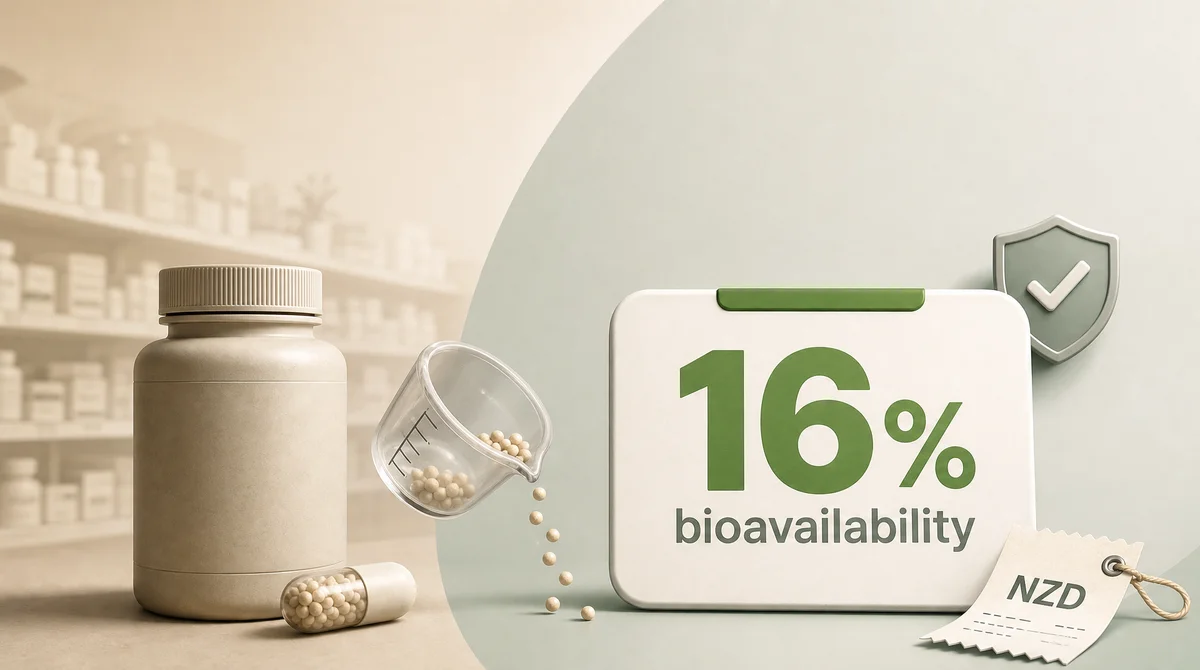
You take supplements to keep doing the things you love - steady energy, joints that cooperate on the stairs, a mind that stays clear. So here is a number that should stop you mid-aisle: the average bioavailability of standard oral vitamins sits at roughly 16% [1]. For every dollar you spend on a typical supplement, your body may use as little as sixteen cents' worth. The rest passes straight through.
If that sounds unlikely, you are not alone. Most of us have stood in a pharmacy doing the same mental arithmetic - compare milligram counts, divide by price, pick the better deal. It feels logical. It is also the wrong calculation entirely.
Why milligrams on the label are misleading you
The milligram figure on a bottle tells you what went into the capsule, not what reaches your bloodstream. The gap between those two numbers is where your money - and your daily routine - quietly disappears.
Think of it like filling a watering can with a hole in the bottom. You can pour in as much water as you like, but only a fraction reaches the garden. Buying a bigger can does not fix the leak. That is exactly what happens when you chase higher milligram counts without asking about absorption. If you are taking something every day for the long haul, a small leak repeated for years is a large loss.
Take vitamin C. At low doses of 30-180 mg, your body absorbs 70-90%. Push above 500 mg, and absorption drops below 50% [2][3]. Go higher still and you hit a ceiling - plasma concentrations plateau at around 60-80 micromol/L regardless of additional dose [4].
The questions worth asking are not "how many milligrams?" but: how much actually gets absorbed? What does a milligram of absorbed nutrient really cost? And is there a format that changes the equation?
What the real cost looks like
Once you look at cost per absorbed milligram instead of cost per labelled milligram, the picture shifts sharply - especially for the nutrients people lean on to age well.
- Vitamin B12 absorption from standard supplements can fall below 5% - you may need twenty times the dose to get what your body uses [14].
- NAC has oral bioavailability as low as 9.1%, a tenfold gap between label and bloodstream [18].
- Calcium tablets deliver just 25-35% of their stated dose. The rest is excreted unused [19].
- Magnesium absorption can sit around 10%, multiplying the true price per functional milligram by ten [20].
New Zealand consumers spend roughly NZ$240-600 per year on supplements [21]. At typical absorption rates of 30-50%, NZ$120-420 per person per year is effectively wasted.
What a poor choice actually feels like
Picture this: you have committed to a daily routine for energy, joint comfort or a sharper mind. You picked a well-reviewed product and taken it faithfully for three months. Nothing has changed. So you blame the supplement, or worse, yourself - maybe supplements just do not work for you.
That disappointment erodes trust. You stop taking them, or start doubling the dose hoping more will help. Neither addresses the real issue. The supplement contained what the label said. Your body simply never got to use it. And the whole point of ageing well is consistency - the basics, done properly, day after day. A format that leaks undermines exactly the habit you are trying to keep.
A better way to compare supplements
You are pragmatic and rightly sceptical of miracle claims. Good - this is not about chasing potency, it is about what genuinely gets in. Before your next purchase:
- Absorption format first. Ask whether the delivery method has clinical evidence for improved bioavailability. Liposomal formats bypass the gut transporters that limit standard absorption.
- Cost per absorbed milligram. Divide the price by the dose your body actually uses. A pricier product with three times the absorption rate is cheaper per functional milligram.
- Dose ceiling awareness. Check whether the nutrient has a known absorption plateau. Higher milligram counts above that ceiling are wasted spend.
- Clinical backing. Over 70% of supplement shoppers say they would pay more for clinically proven efficacy [22][23]. Look for products referencing specific human trials, not just ingredient lists.
How to put this into practice
Start with the nutrients that leak most. Vitamin C, CoQ10, B12, magnesium, and calcium all have well-documented absorption problems in standard oral form - and they map neatly onto energy, heart, joint and cognitive support. These are where a higher-bioavailability format delivers the biggest return.
Look for clinical evidence on the format, not just the ingredient. A 2024 randomised, double-blind trial found liposomal vitamin C produced 27% higher peak plasma concentration than equivalent standard vitamin C [6]. A separate 2024 trial measured a 5.4-times difference in peak blood levels at the same dose [5]. A 2025 scoping review across ten trials confirmed liposomal vitamin C consistently delivered 1.2-5.4 times higher peak concentrations [7]. For CoQ10 - a mainstay for heart and cellular energy - a 2025 trial showed liposomal delivery achieved 31.3% higher peak plasma levels [15].
Match format to your situation. If you are over 50, have digestive issues, or take multiple supplements, your baseline absorption is likely lower - making format choice more important. If you are young and healthy taking a single low-dose vitamin, standard formats may serve you fine.
Do not assume expensive means better absorbed. Some premium-priced standard supplements carry the same absorption limitations. Evidence of bioavailability is the shortcut, not price.
Revisit your current routine. Tally what you spend annually. Apply realistic absorption percentages. If the effective cost shocks you, rethink format before dose. Then compare liposomal formats on PYFOI and choose one gentle enough to keep taking for years, not weeks.
The shelf label shows one number. Your body runs on a different one. The gap between them is the absorption tax - and once you see it, you cannot unsee it.
Sources
- [1]Bioavailability of Vitamins & Supplements - Replenish Nutrition
- [2]Vitamin C - Health Professional Fact Sheet - NIH Office of Dietary Supplements
- [3]The Pharmacokinetics of Vitamin C - PMC, 2019
- [4]Vitamin C pharmacokinetics in healthy volunteers: evidence for a recommended dietary allowance - Levine et al.
- [5]Bioavailability of Liposomal Vitamin C in Powder Form: A Randomized, Double-Blind, Cross-Over Trial - Applied Sciences, 2024
- [6]Liposomal delivery enhances absorption of vitamin C into plasma and leukocytes: a double-blind, placebo-controlled, randomized trial - European Journal of Nutrition / PMC, 2024
- [7]Do Liposomal Vitamin C Formulations Have Improved Bioavailability? A Scoping Review - Carr, 2025
- [8]Are you absorbing the nutrients you eat? - MSU Extension
- [9]Impact of liposomal delivery on coenzyme Q10 absorption: a double-blind, placebo-controlled, randomized trial - Frontiers in Nutrition, 2025
- [10]First-Pass Effect - StatPearls, NCBI Bookshelf
- [11]Absorbability and cost effectiveness in calcium supplementation - PubMed, 2001
- [12]How Much Does Magnesium Glycinate Cost and Is It Worth It? - Cymbiotika
- [13]High vitamins use in NZ, but uncertainty over regulations felt by industry and consumers - NutraIngredients, 2023
- [14]Premium Supplement Ingredients 2025-2026: Top Consumer Trends and Willingness to Pay - Champion Bio, 2025
- [15]Clinically proven: Research reveals the power phrase reshaping consumer purchasing - SupplySide, 2025
© 2026 pyfoi. All rights reserved.