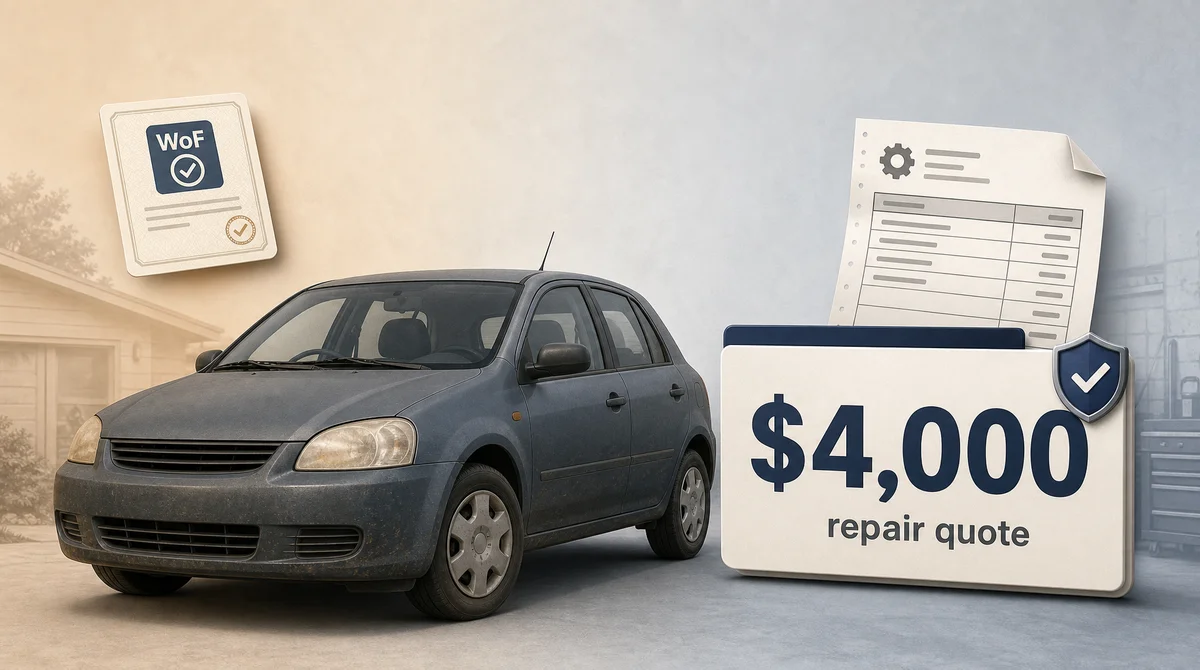

Why Your Paid-Off Car May Cost More Than You Think
Old car running costs can outstrip finance savings in NZ. See how WoF failures, repair shocks and safety trade-offs can force a costly choice.
Most people assume the cheapest car is the one you've already paid off. It's an intuitive idea - no monthly repayments, no finance paperwork, just petrol, a service and the odd WoF. But what if the most expensive vehicle in your household is the one sitting in the driveway right now, precisely because it costs you nothing predictable?
That tension between "no payment" and "no predictability" is where thousands of New Zealand households get stuck every year. Let's walk through what a fairly typical 18 months looks like when a family decides to keep their 2012 hatchback for "just one more year" - and what it teaches about old car running costs that most buyers never tally up.
What does "one more year" actually look like?
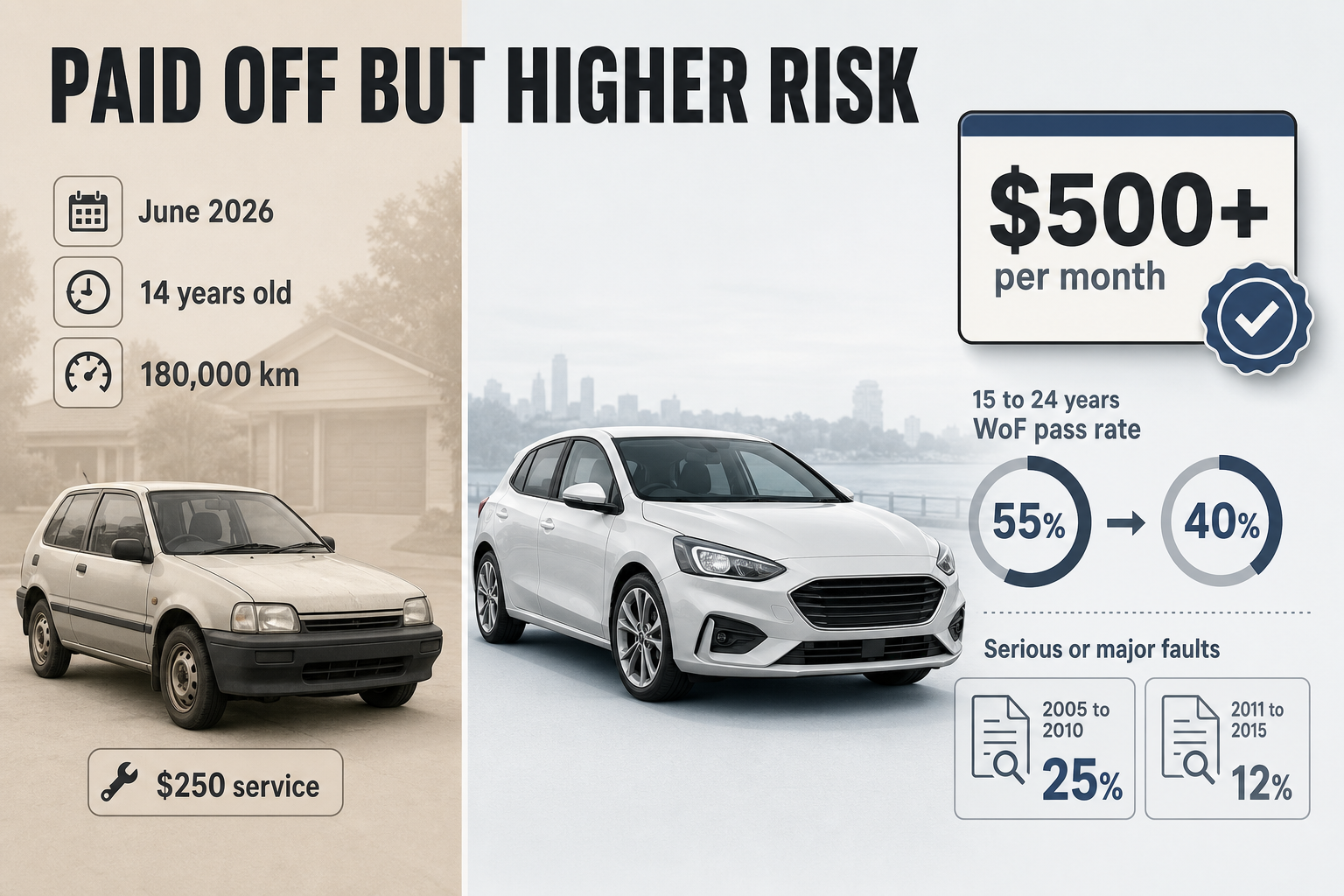
Say it's June 2026. You've got a 14-year-old Mazda Demio or Toyota Corolla with 180,000 km on the clock. It passed its last WoF, the engine runs fine, and you've just done a service for around $250. Compared to $500-plus a month in finance repayments on something newer, the maths looks obvious. You pocket the difference and move on.
But NZTA data shows initial WoF pass rates for private light passenger vehicles aged 15 to 24 years sit between roughly 55% and 40% [1]. Your car is about to enter that band. Consumer NZ reports that about 25% of vehicles from the 2005 to 2010 era had serious or major faults, compared with 12% for 2011 to 2015 models [2]. So you're not just keeping a car. You're rolling dice that get progressively loaded.
When do the surprises start stacking up?
By October, the battery dies on a Monday morning before a school drop-off. AA says batteries typically last three to five years, and anything older can fail without warning [3]. That's $200 to $350 for a replacement, plus the disruption of a missed morning. You file it under "bad luck" and carry on.
In February, the WoF comes around again. This time the car needs new brake pads, a CV boot, and two tyres - AA notes tyres aged 10 years or more should be removed from service entirely [4]. The bill lands somewhere north of $900 all up. Still less than six months of car payments, you tell yourself. But that comparison only works if you ignore the three half-days of workshop coordination, the borrowed ride from a neighbour, and the nagging feeling that you're patching something that keeps asking for patches.
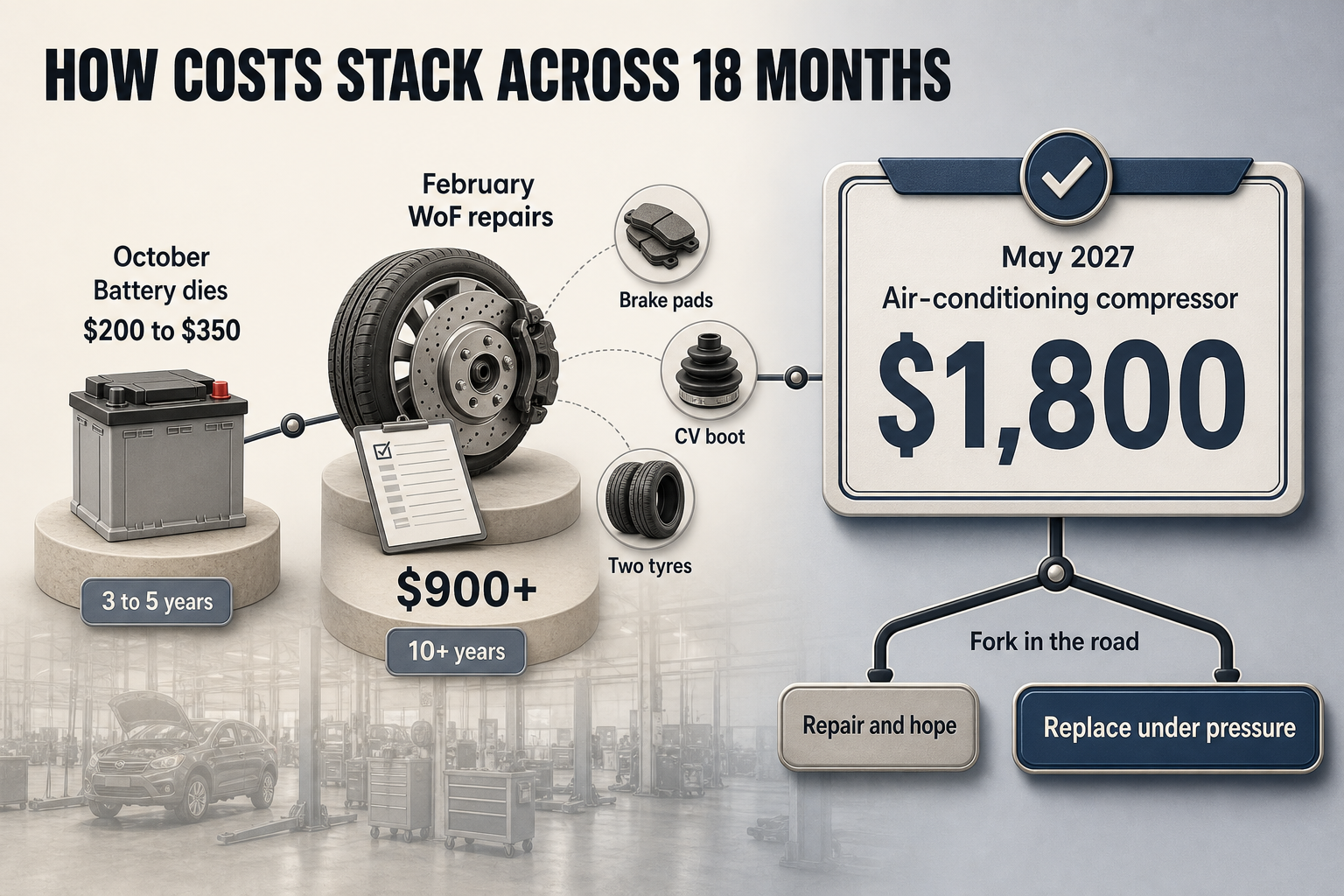
By May 2027, the air-conditioning compressor seizes. The quote is $1,800. Now you're staring at a genuine fork: spend the money and hope nothing else goes, or start shopping for a replacement under pressure, with no time to compare properly and no leverage to negotiate.
Why does this pattern catch families off guard?
Because the costs never arrive as one honest invoice. They trickle in - a sensor here, a service there, a tow after a breakdown on a wet Friday afternoon. AA rescues a Kiwi roughly every minute, fielding about half a million roadside calls a year [5]. That volume tells you breakdowns aren't rare edge cases. They're a routine feature of an ageing fleet.
The real sting isn't any single bill. It's the volatility. A fixed car payment is boring and predictable. An ageing car's cost profile is spiky and random. You budget $1,500 for the year and spend $2,800. Or you spend $400 and feel vindicated - until the next six months wipe out two years of "savings."
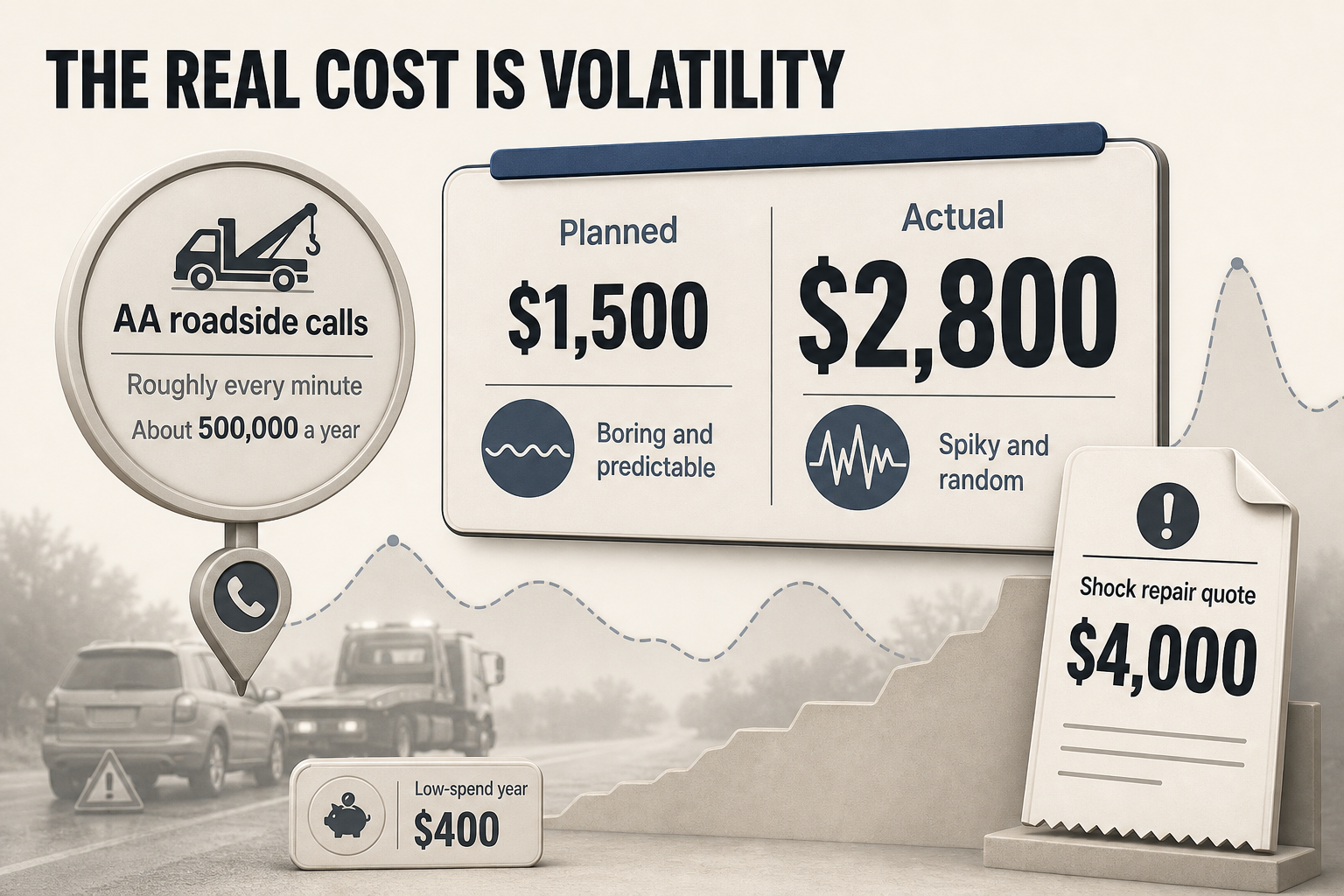
Consumer NZ highlights a case where a faulty used car generated a $4,000 repair quote [6]. That's the kind of shock that doesn't just dent a bank account. It forces a rushed replacement decision at exactly the moment you have the least control over timing, choice, and price.
What's really at stake beyond the repair bills?
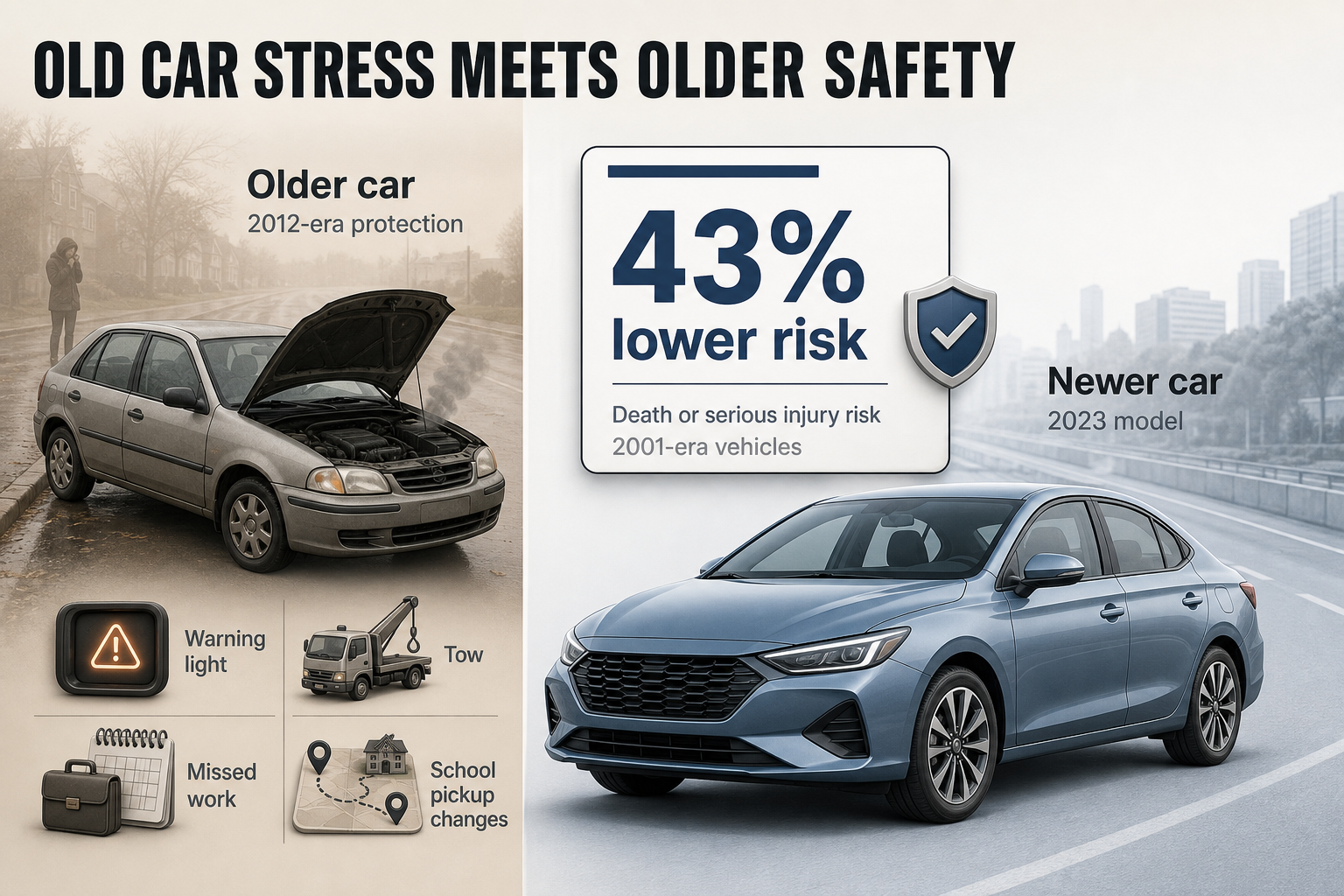
Take a Tuesday in March. You're 20 minutes from a work presentation when a dashboard warning light flickers on. You pull over. The car won't restart. Now you're calling a tow, texting your boss, rearranging after-school pickup, and mentally calculating whether this is the repair that finally tips the scales.
That stress compounds quietly. It shows up as the knot in your stomach before a long weekend trip, the reluctance to lend the car to your teenager, the argument about whether "we can get another winter out of it." And here's the layer most people miss entirely: the same age that drives up mechanical unpredictability also means your family is still relying on 2012-era crash protection. NZTA data shows the average risk of death or serious injury for occupants in 2023 models was 43% lower than in 2001-era vehicles [7]. Keeping the old car doesn't just preserve repair risk. It preserves an older safety baseline too.
How should you actually weigh this decision?
Stop comparing last year's repair spend against a monthly payment. Instead, ask three questions about the next 12 to 24 months:
- What's my realistic repair-and-disruption exposure? Add up WoF remediation, likely component replacements, and at least one unplanned event. Include the time cost of workshop visits and backup transport.
- What's the probability of a forced decision? If your car is deep into the 12-to-15-year band with rising kilometres, the odds of a large quote or failed WoF are materially higher [1][2].
- What am I preserving alongside the maintenance risk? Older safety ratings, fewer driver-assist features, and higher fuel costs per kilometre all travel with the ageing platform [7][8].
What should you do with those answers?
If your total realistic exposure over the next 18 months approaches or exceeds $3,000 to $4,000 - and you factor in even modest disruption costs - the gap between "free car" and "financed replacement" shrinks fast.
For families juggling school runs and commutes, reliability is a logistics issue as much as a financial one. A single-car household should weight disruption risk more heavily. Families with regional or holiday travel plans should factor in breakdown exposure away from home.
For anyone eyeing lower running costs through a hybrid or EV, add the foregone fuel savings to the delay calculation - but don't let that distract from the core volatility problem in the car you already own.
The most expensive time to choose your next car is when the old one has already chosen for you. While your current vehicle still runs, you control the brief, the timeline, and the trade-offs. That window doesn't stay open forever. Use it while you still can.
You may also be interested in these independent articles
Sources
- [1]NZ Transport Agency Waka Kotahi - Land Transport Rule: Vehicle Standards Compliance Amendment 2025, 2025
- [2]Consumer NZ - Should you buy a used or nearly new car?, 2026
- [3]New Zealand Automobile Association - AA Battery Service, 2026
- [4]New Zealand Automobile Association - How to know when your tyres have given up, 2021
- [5]New Zealand Automobile Association - AA Roadservice, 2026
- [6]Consumer NZ - The car I bought is faulty. What can I do?, 2026
- [7]NZ Transport Agency Waka Kotahi - Buying a car? Check the stars, 2025
- [8]New Zealand Automobile Association - Crash causes: What happened?, 2026
© 2026 pyfoi. All rights reserved.