
Old Car vs New Car Safety in NZ
Old car vs new car safety in NZ is not close. A paid-off vehicle may lack AEB and modern protection. Check your gap before the next family trip.
What if the car you trust most is the one holding you back?
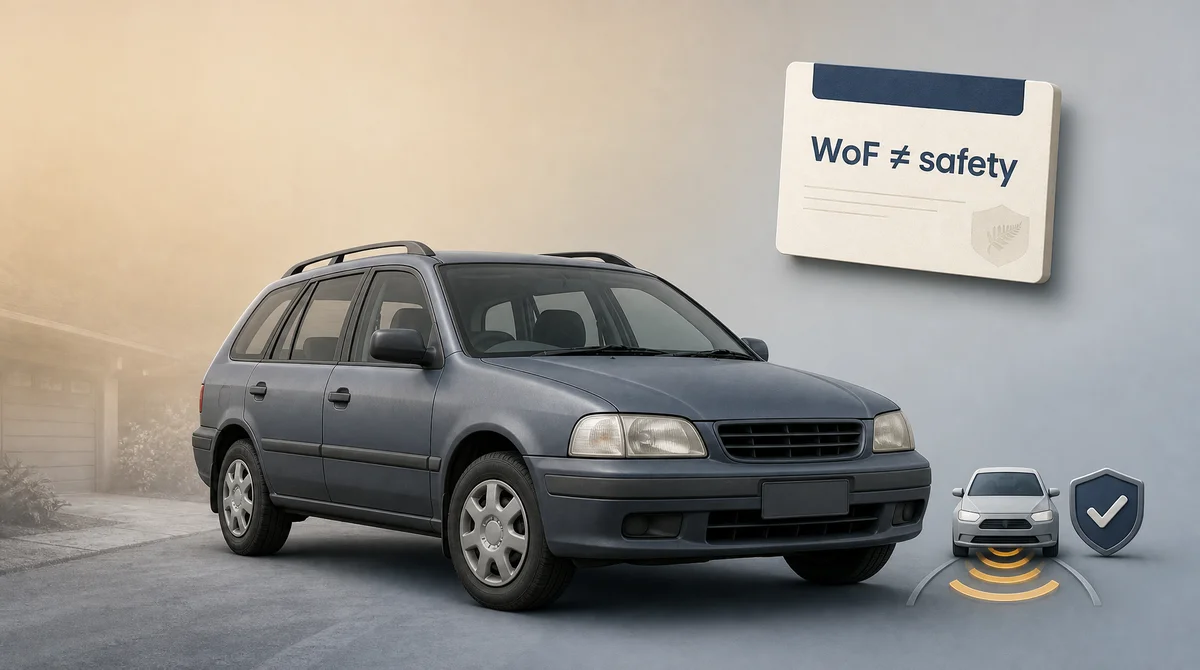
Here's something that cuts against the grain: the car you've already paid off and know inside-out might be the most expensive vehicle your family owns. Not because of what it costs to run today, but because of what it quietly fails to do every time you pull out of the drive. Most buyers shopping for a new car spend weeks comparing one badge against another - styling, screen size, monthly repayments. But for a huge share of New Zealand households, that comparison misses the point entirely. The real old car versus new car safety gap is not between two showroom models. It is between the 2011 wagon sitting in your carport and the entire 2026 vehicle generation.
What if the real competitor is already parked at your place?
Think of it like comparing a 2012-era smartphone to a current one. You wouldn't evaluate two brand-new phones side by side and ignore the fact that you're still using one from a decade ago with a cracked screen and no security updates. Yet that's exactly what most car shoppers do. They walk into a dealership already thinking horizontally - "this SUV or that one?" - when the vertical leap from an ageing car to a current model can be larger than the differences many buyers focus on between new options.
New Zealand's fleet structure makes this worse. NZTA says the average light vehicle here is around 15 years old, materially older than comparable countries like Australia or the UK, which sit around 10 to 12 years [1]. So "our car isn't that old" often still means several safety and technology cycles behind.
Better questions to ask yourself: How does my current car's safety rating compare to what's standard now? What crash-avoidance features does it lack? And what has actually changed between the year my car was built and 2026?
How wide is the gap, really?
Wider than most families guess. Here's what the evidence says:
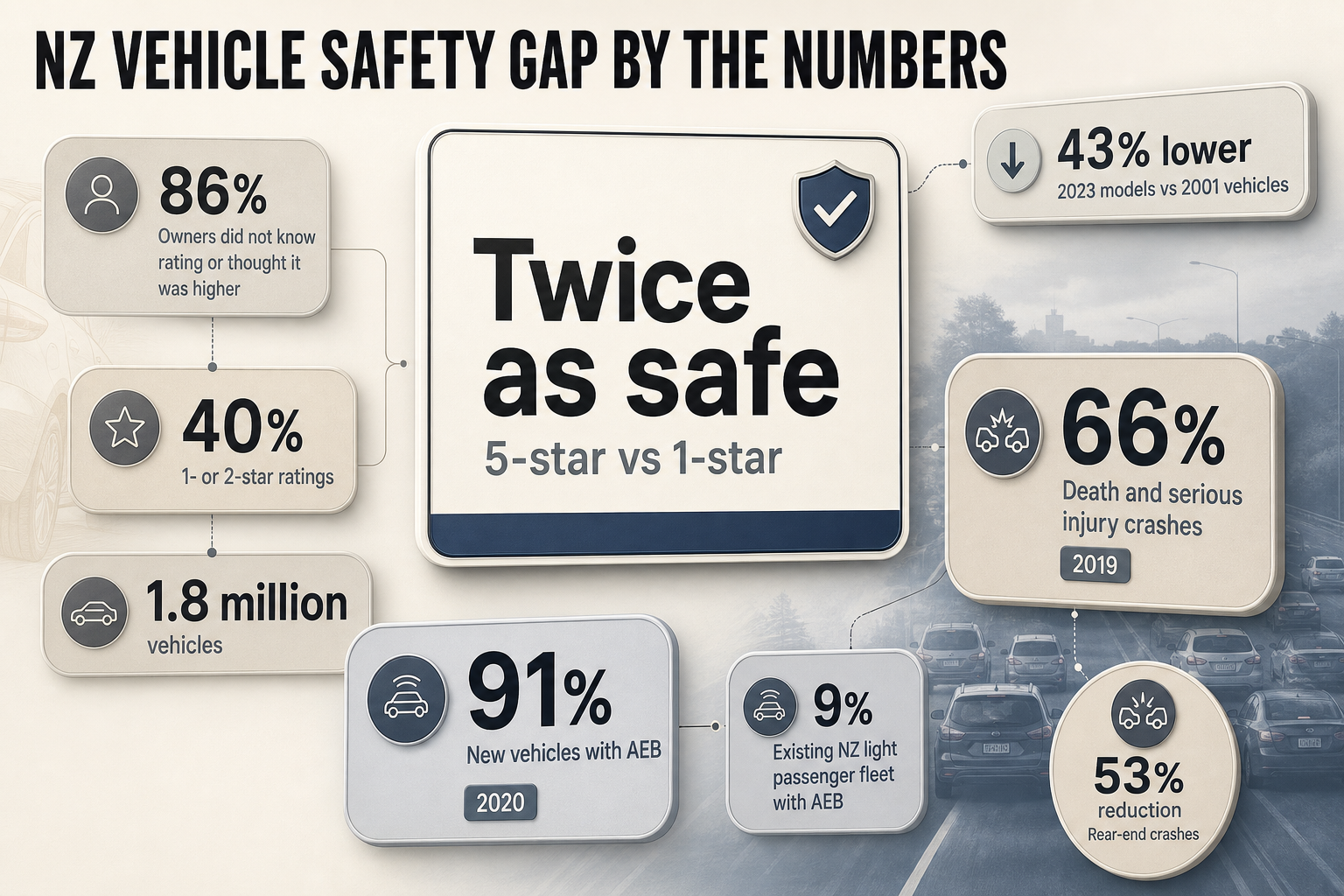
- Safety ratings tell a stark story. NZTA says you're twice as safe in a 5-star vehicle as in a 1-star vehicle. Around 40% of New Zealand's light fleet - roughly 1.8 million vehicles - still carry just 1- or 2-star ratings. Those low-rated vehicles were involved in 66% of death and serious injury crashes in 2019 [2][3].
- Newer models are measurably safer. The average risk of death or serious injury for drivers in 2023 models is 43% lower than in vehicles manufactured in 2001 [4].
- Crash avoidance has leapt forward. AEB was fitted to 91% of new vehicles manufactured in 2020, yet only about 9% of the existing NZ light passenger fleet had it. Lane-keep support showed a similar gap [5]. IIHS research found front crash prevention systems were associated with a 53% reduction in rear-end crashes [6].
- WoF is not what you think it is. A current warrant means the car was roadworthy at one point in time - it says nothing about modern crash protection or avoidance capability [7][8]. AA says having a current WoF is not proof your vehicle is safe [9]. And 86% of owners of 1- or 2-star vehicles either didn't know their rating or thought it was higher [10].
What does that gap feel like on a Wednesday afternoon?
Say you're merging onto a regional highway after picking up the kids from sport. Traffic bunches suddenly. In a 2026 vehicle, AEB intervenes before you've even lifted your foot. In a 2012 car without it, the outcome depends entirely on your reaction time - and AA research into 300 serious crashes found that in about three quarters, drivers were generally following the rules but made a mistake or something unexpected happened [11]. That's not reckless driving. That's normal human fallibility without modern backup.
The breakfast-table worry isn't abstract either. It's the WoF that nearly failed last time. The battery your mechanic said could go any day. The creeping feeling that every long weekend trip is a roll of the dice you didn't consciously agree to take. When your family's safety margin depends on a vehicle designed before crash-avoidance tech was standard, delay isn't neutral - it's a choice you're making by default.
So how should you actually decide?
Instead of comparing badges, start with three honest questions about the car you already have:
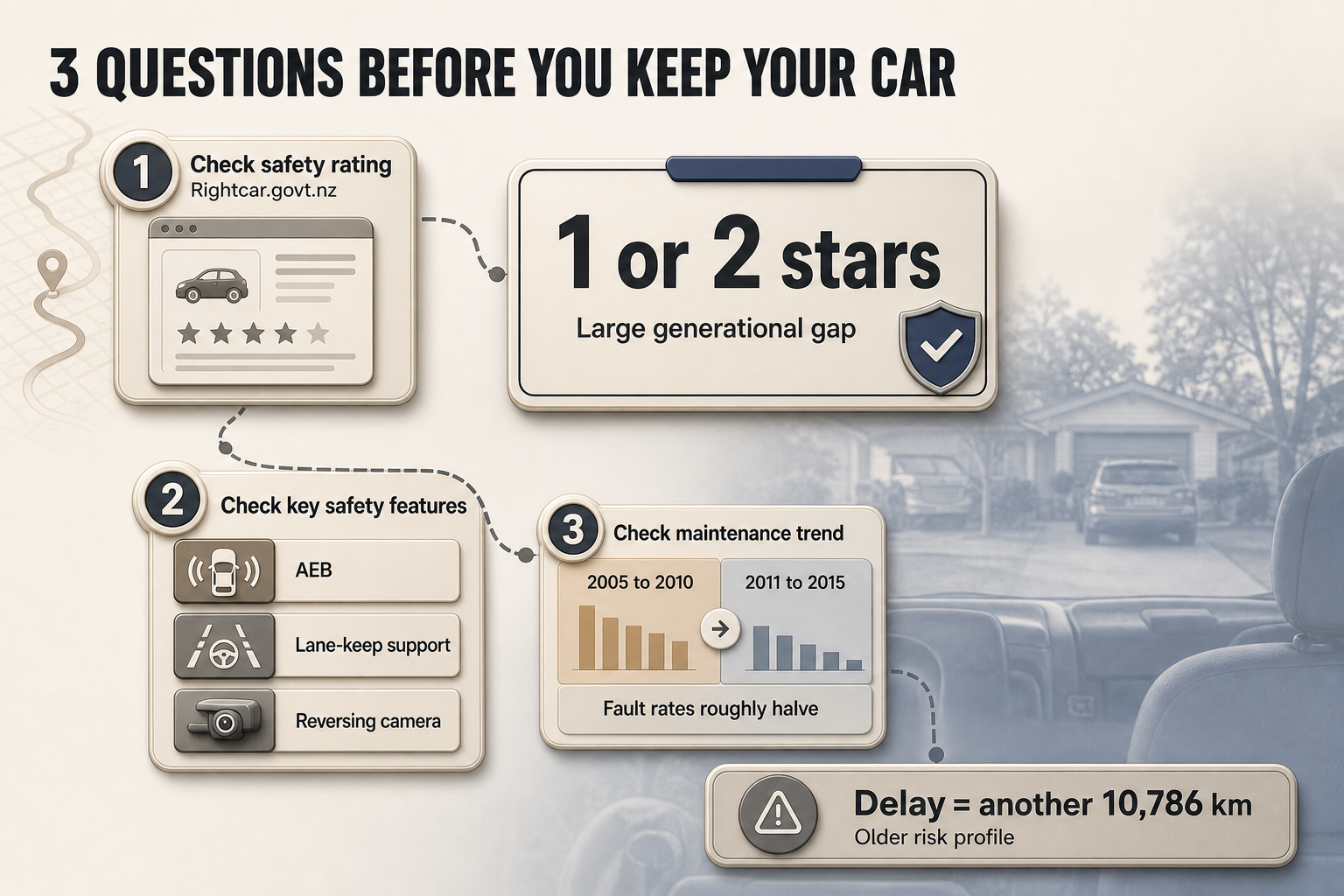
- What's its safety star rating? Look it up on Rightcar.govt.nz. If it's 1 or 2 stars, the generational gap is large.
- Does it have AEB, lane-keep support, and a reversing camera? If not, you're missing systems that are now common across many new vehicles.
- What's the trend on maintenance surprises? Consumer NZ data shows fault rates roughly halve between 2005-to-2010 vehicles and 2011-to-2015 vehicles [12]. If your car sits in the older band, reliability volatility is climbing.
Doing nothing is itself a decision. Every year of delay means another roughly 10,786 km of family travel inside an older risk profile [1].
What should you prioritise when you're ready to move?
If your household carries kids regularly, prioritise the jump in occupant protection and crash avoidance over badge prestige. A 5-star vehicle with AEB and lane support from any manufacturer is a generational leap from a 1- or 2-star car without those systems. Don't get distracted by trim-level comparisons when the biggest safety gain is simply moving from old to current.
If budget is the binding constraint, know that NZ's used-import pipeline means even a newer used vehicle - say a 2019 or 2020 model - can close much of the gap. Check its Rightcar rating and confirm which active safety features it actually has fitted. A used car with 4 or 5 stars and AEB is likely to offer a materially stronger safety position than a paid-off car with 1 or 2 stars and none [2][3].
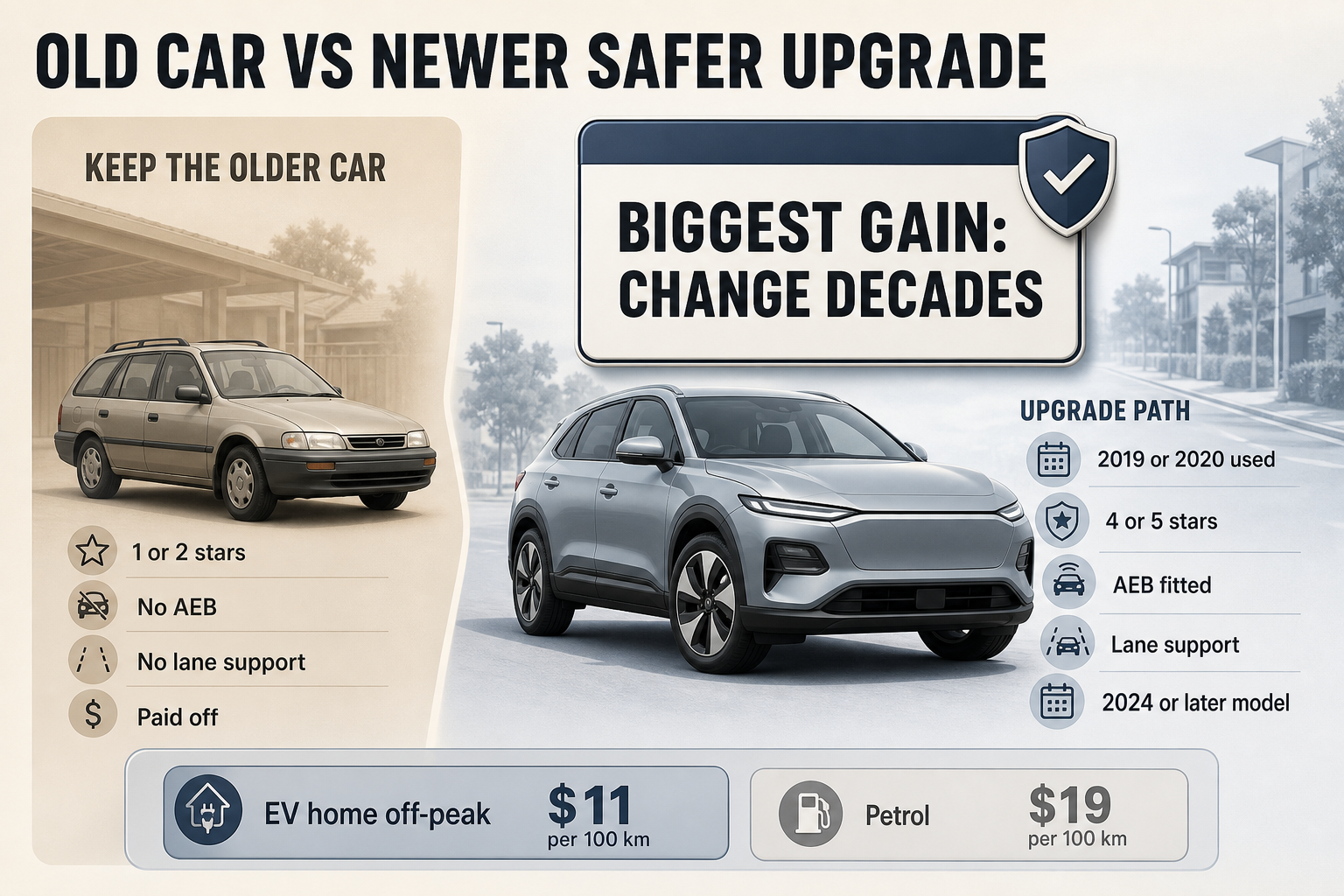
If you're also weighing running costs or emissions, the generational shift extends there too. EECA says an EV charged at home off-peak can cost about $11 per 100 km versus roughly $19 for petrol [13]. Even if a full EV isn't right for you, many newer drivetrains are more efficient than comparable vehicles from 2011.
Your next step is simple: look up your current car on Rightcar.govt.nz. Compare its star rating and feature list against any 2024-or-later model you'd consider. That vertical comparison - your car versus the current generation - is the one that actually matters. The biggest upgrade for most Kiwi families isn't changing brands. It's changing decades.
What the brands say
These brands have chosen to respond directly to this independent research. We publish brand responses unedited because we believe transparency builds trust - and that brands willing to engage openly with independent analysis deserve to be heard.
You may also be interested in these independent articles
Sources
- [1]NZ Transport Agency Waka Kotahi - Considering changes to light vehicle inspections, 2025
- [2]NZ Transport Agency Waka Kotahi - Vehicle safety, 2026
- [3]NZ Transport Agency Waka Kotahi - Considering new safety requirements for vehicles entering the New Zealand fleet, 2025
- [4]NZ Transport Agency Waka Kotahi - Buying a car? Check the stars, 2025
- [5]NZ Transport Agency Waka Kotahi - Use of in-vehicle technologies (Research Report 691), 2026
- [6]Insurance Institute for Highway Safety - Front crash prevention rear-end crash study, 2023
- [7]NZ Transport Agency Waka Kotahi - Warrant of fitness, n.d.
- [8]NZ Transport Agency Waka Kotahi - WoF inspection and certification information for customers, 2026
- [9]New Zealand Automobile Association - AA welcomes new WoF rule, 2013
- [10]NZ Transport Agency Waka Kotahi - Kiwis urged to check vehicle safety ratings, 2023
- [11]New Zealand Automobile Association - Crash causes: What happened?, n.d.
- [12]Consumer NZ - Should you buy a used or nearly new car?, 2026
- [13]EECA - How to charge your EV at home and on the road, 2026
© 2026 pyfoi. All rights reserved.