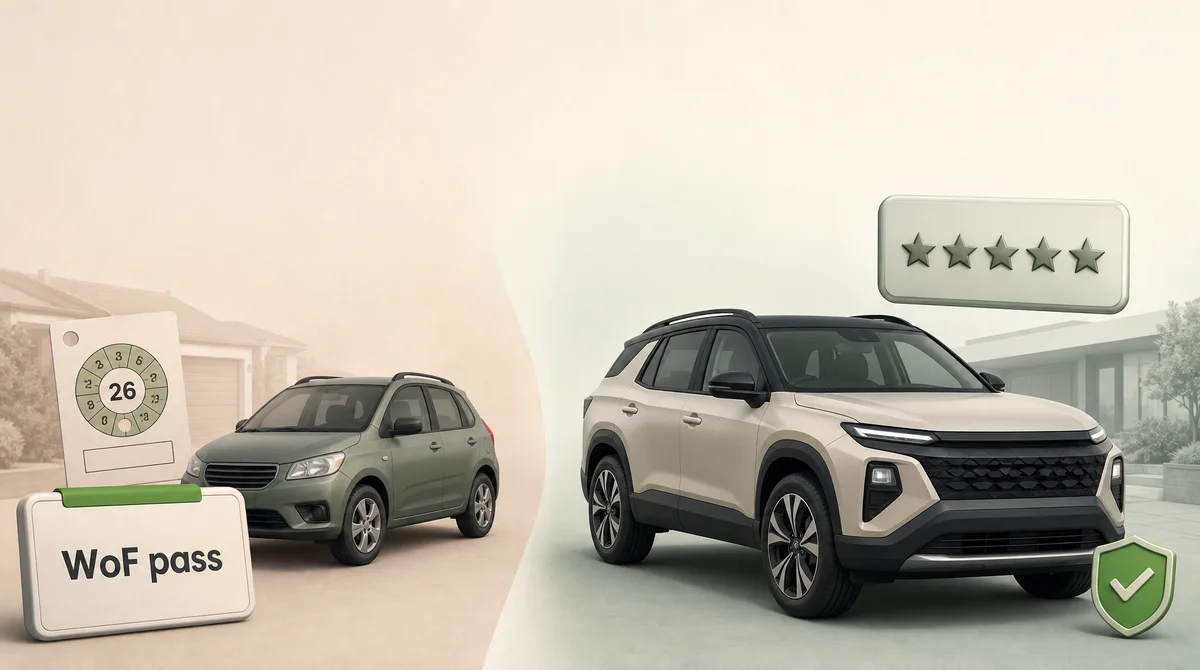

Everything you need to know about whether your old car is really cheaper
A paid-off car can hide safety gaps, repair risk and fuel costs. See when keeping an old car stops being cheaper for NZ families in 2026.
If you are weighing up whether to keep the paid-off car in the driveway or move to something newer, the easiest mistake is also the most common one: comparing a visible monthly repayment with an invisible pile of older-car costs. On paper, the old car can look cheap because there is no finance line in your budget. In practice, that can hide a mix of weaker crash protection, missing driver-assist technology, rising repair risk, fuel spend, and the very real cost of disruption when something goes wrong.
That matters even more in New Zealand, where the light fleet is relatively old and many households are still driving vehicles from the early 2010s or earlier. A lot of people use a current WoF as reassurance that the car is still a sensible long-term option. But a WoF is a roadworthiness check at a point in time. It is not a verdict that your car matches modern safety standards or modern running-cost expectations.
The bigger question is not "Can I squeeze another year out of it?" It is "What am I choosing to live with for another year?" That includes the safety baseline your family travels in, the odds of an inconvenient repair bill, and the weekly operating costs you have normalised because they arrive in small amounts. Once you frame the decision that way, the real competitor to any newer car is not another badge in a showroom. It is the 15-year-old car you already own.
Why the wrong comparison keeps people stuck
Most buyers think horizontally. They compare one newer SUV with another, or one hatchback with another, and get lost in trim levels, screens, and repayment quotes. The more useful comparison is vertical: your current car versus what the market now considers normal in 2026.
That shift matters because the gap between a 2011 or 2012 vehicle and a current one is often much larger than the gap between two current vehicles. Safety ratings, crash-avoidance systems, efficiency, and reliability have all moved on. If you skip that comparison, you can end up treating your existing car as the neutral baseline when it is actually the biggest compromise in the whole decision.
This is the core argument in What if the car you trust most is the one holding you back? ›. It is also reinforced by What if your biggest car expense isn't the one you're paying? ›, which shows how a paid-off car can feel financially safe while still exposing you to hidden costs that do not show up as one neat monthly number.
What many households overlook is that familiarity distorts judgement. You know the quirks of your current car, so it feels lower risk than it really is. The fact that it starts most mornings and passed its last inspection can make it seem "good enough". But good enough compared with what? Once you compare it with today's safety and operating baseline, the decision often looks very different.
Does a WoF mean your car is still a smart family choice?
A WoF matters, but not in the way many people assume. It tells you the vehicle met minimum roadworthiness requirements when it was inspected. It does not tell you that the car offers strong occupant protection by current standards, and it does not tell you it has the crash-avoidance features that are increasingly treated as normal.
That distinction is easy to miss because the sticker feels official. Yet NZTA and the AA are clear that a current WoF is not proof that a vehicle is safe in the broader, modern sense. A car can pass its WoF and still be a 1- or 2-star vehicle with no autonomous emergency braking, no lane support, and much older crash design. For families carrying kids daily, that is not a technical detail. It is the heart of the decision.
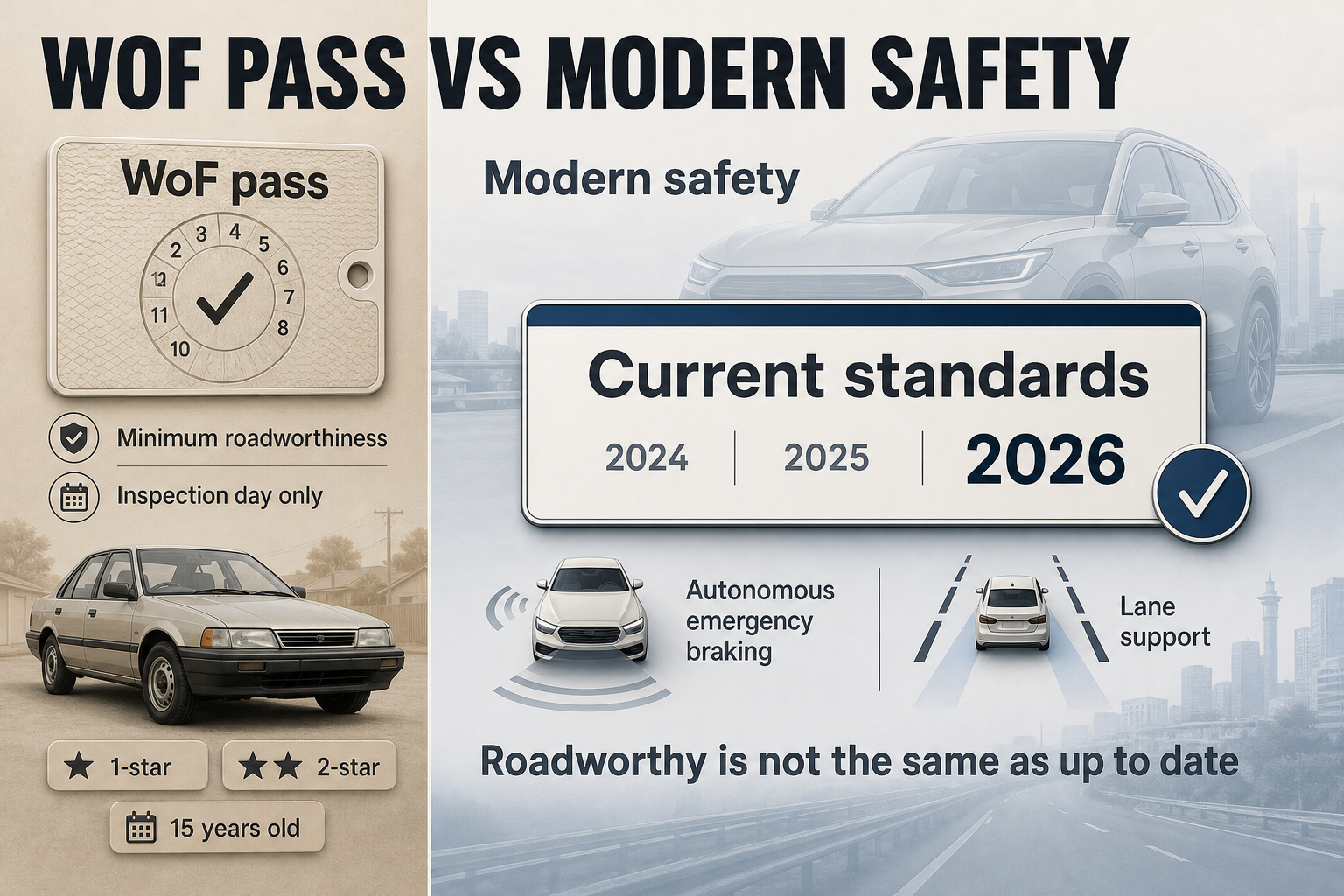
The clearest deep dives on this are What if your biggest car expense isn't the one you're paying? › and What if the car you trust most is the one holding you back? ›. Together, they make a simple point: roadworthy is not the same as up to date.
What is commonly misunderstood here is the role of minimum compliance. Passing an inspection can create a false sense that the car has been validated for ongoing family use. In reality, it has only cleared a minimum threshold for that day. If your car is 15 years old, the more useful questions are its Rightcar safety rating, whether it has key driver-assistance systems, and how its protection compares with a 2024, 2025, or 2026 replacement. Once you ask those questions, "it passed" stops being a convincing reason to keep it.
How big is the safety gap between an old car and a newer one?
For many households, bigger than they think. New Zealand still has a large share of 1- and 2-star vehicles on the road, and those vehicles are overrepresented in deaths and serious injuries. NZTA says you are twice as safe in a 5-star vehicle as in a 1-star vehicle, and more recent model years show materially lower risk of death or serious injury than older ones.
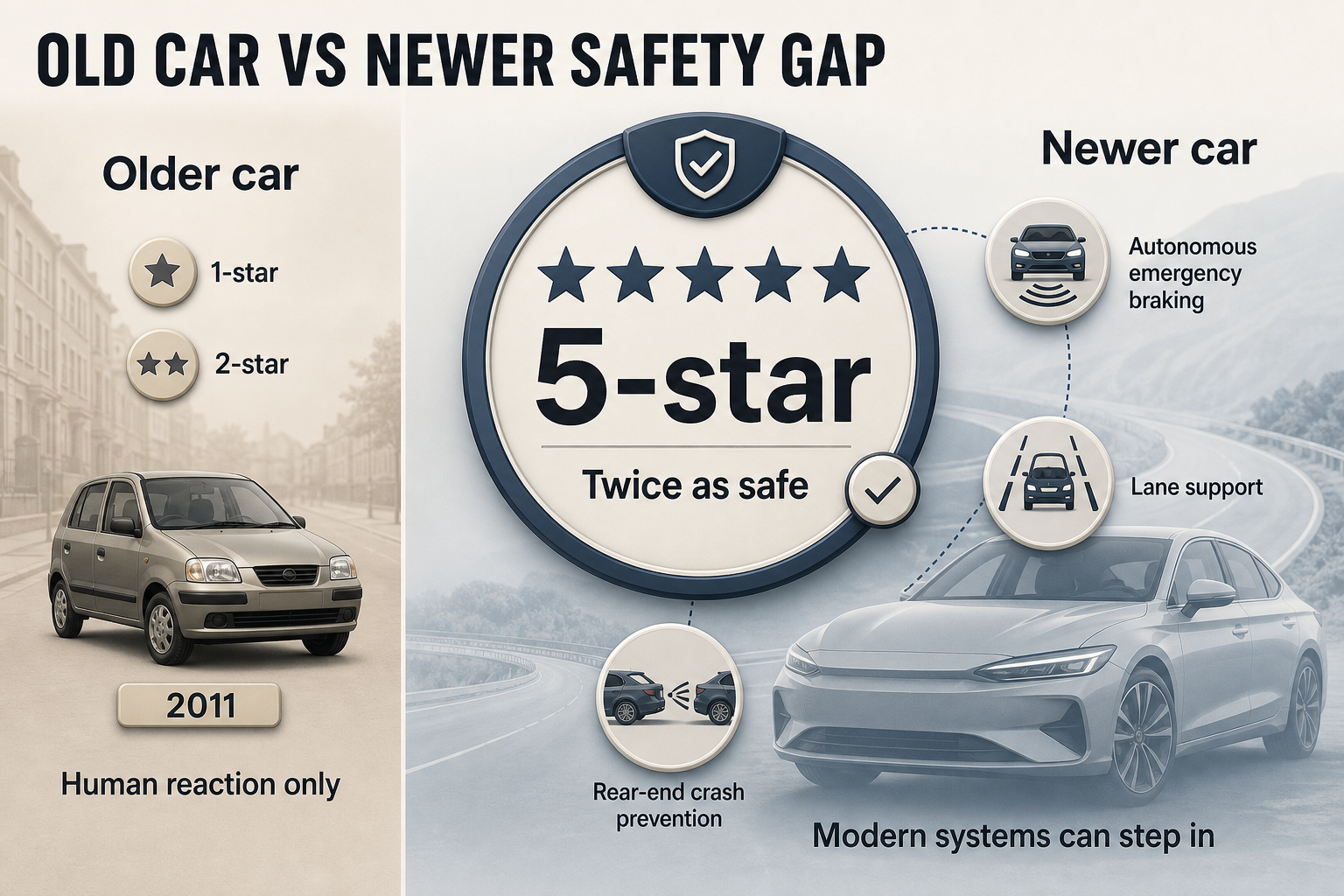
That is before you add crash-avoidance technology. Systems such as autonomous emergency braking and lane support are not just convenience features. They are designed to reduce the chance that a normal human mistake becomes a crash. Research cited in the individual articles links front crash prevention systems with large reductions in rear-end crash involvement. In everyday terms, that means a newer vehicle may help when traffic suddenly compresses, when your attention is split for a second, or when something unexpected happens on a wet school-run afternoon.
If you want the detailed case for this, start with What if the car you trust most is the one holding you back? › and What if your biggest car expense isn't the one you're paying? ›. Both explain why the old car versus new car safety gap is not abstract. It is the difference between relying entirely on your own reaction time and having modern systems that can step in.
The common misunderstanding is to treat safety as a nice-to-have upgrade rather than a baseline shift. Buyers can spend hours debating whether one newer model is slightly better than another while ignoring the much larger leap from a 2011 vehicle to any modern 4- or 5-star alternative. If your current car is 1 or 2 stars, the first priority is not refining the comparison between newer options. It is escaping the older risk profile altogether.
What does "one more year" really cost in repairs and disruption?
The phrase "just one more year" sounds modest. In reality, it often means entering a period where faults, WoF remediation, and unpredictable component failures become more likely. That does not mean every older car becomes a money pit overnight. It does mean the odds of volatility rise, and that volatility has a cost beyond the invoice itself.
What does "one more year" actually look like? › lays this out well. An ageing car can move from routine service costs to battery replacement, tyres, brake work, CV boots, air-conditioning failure, or other non-trivial repairs in a fairly short window. One bill may still look manageable compared with finance repayments. The problem is that the bills do not arrive as one honest annual total. They arrive in bursts, often with timing that puts you under pressure.
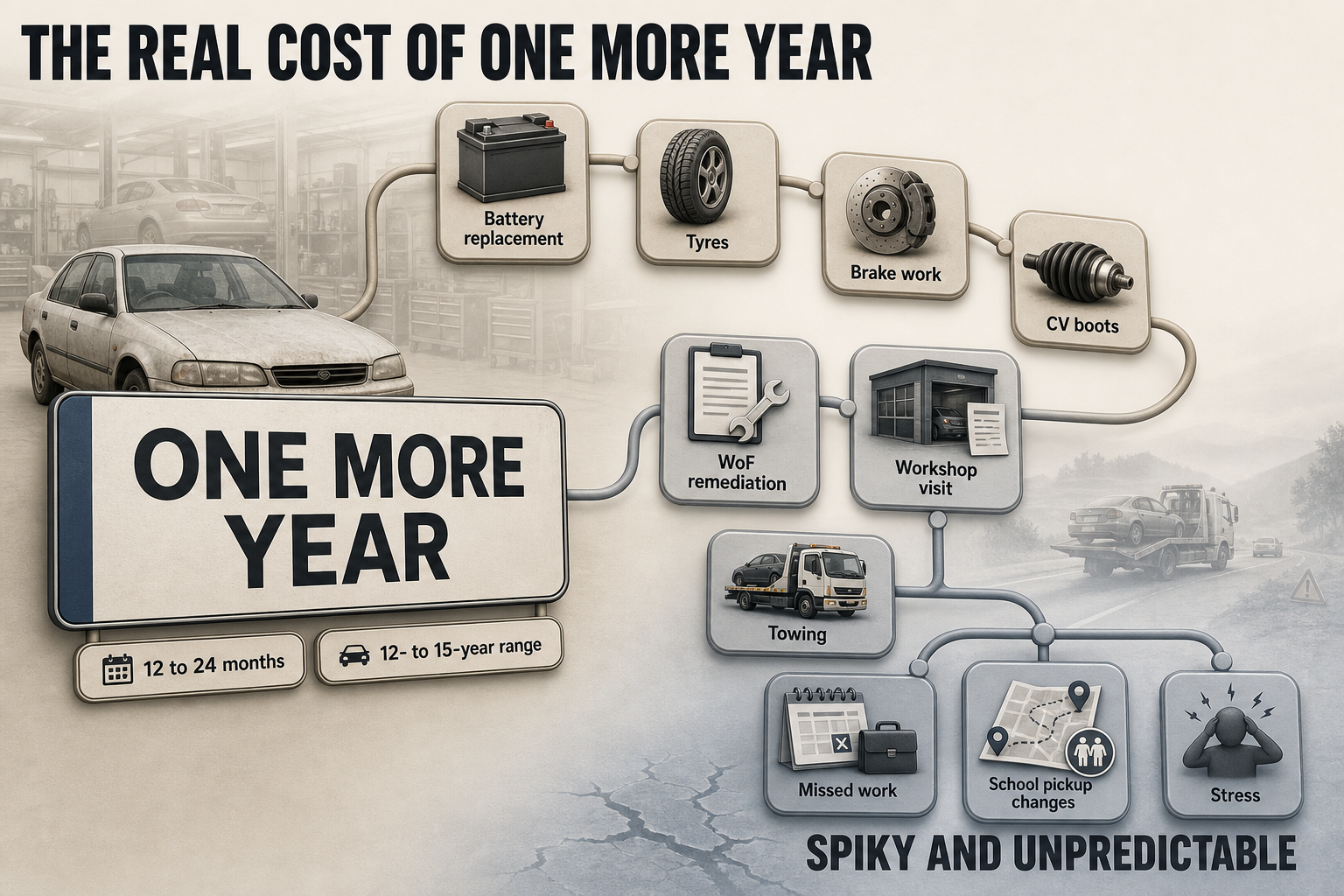
What if your biggest car expense isn't the one you're paying? › adds another layer by connecting older-car maintenance risk with WoF first-pass rates and roadside breakdown reality. That matters because the true cost is not just a part and labour. It is missed work, rearranged school pickups, workshop logistics, towing, and the stress of not knowing whether this repair will be the last sensible one.
Many people compare a past 12 months of repair spend with a future monthly payment and conclude the old car is still cheaper. That is too narrow. The better comparison is forward-looking: what are the likely repair, remediation, and disruption costs over the next 12 to 24 months? If the car is already in the 12- to 15-year range with rising kilometres, you are not preserving a stable low-cost asset. You may be preserving a spiky, unpredictable one.
Are fuel and operating costs quietly tipping the maths?
Yes, especially if your household drives regularly enough for efficiency gains to compound. A paid-off petrol car can feel cheap because fuel is paid in weekly increments rather than as one large annual figure. That makes the cost easy to tolerate and easy to underestimate.
What if keeping the old car is actually the expensive choice? › shows why this matters. Whether you are comparing an older petrol car with a newer hybrid or an EV, the operating-cost gap can be meaningful over a year. EECA figures cited in the article point to clear differences in cost per 100 km, especially for households that can charge at home overnight. Even without going fully electric, a move from an older, thirstier petrol vehicle to a more efficient hybrid or petrol model can save hundreds of dollars a year.
This theme also connects back to What if the car you trust most is the one holding you back? ›, which notes that the generational shift is not only about safety. Newer drivetrains are often more efficient too. That means every month you delay may preserve both an older safety baseline and an older fuel-cost structure.
The common misunderstanding is to isolate purchase price from operating model. But your car is not just something you own. It is something you fund continuously through fuel, maintenance, tyres, batteries, and compliance. If your current vehicle does high kilometres, has no efficiency advantage, and sits on an older platform, the absence of a finance payment can hide the fact that you are still paying a premium every week to keep using it.
How should you decide if it is time to replace the old car?
A useful decision starts with your current car, not with a shortlist of replacements. Before you compare brands or body styles, get clear on the vehicle already in your driveway. Look up its safety rating on Rightcar. Confirm whether it has autonomous emergency braking, lane support, electronic stability control, and a reversing camera. Review your last year of fuel, servicing, WoF, tyres, batteries, and repairs. Then estimate your likely next 12 to 24 months, not your best-case scenario.
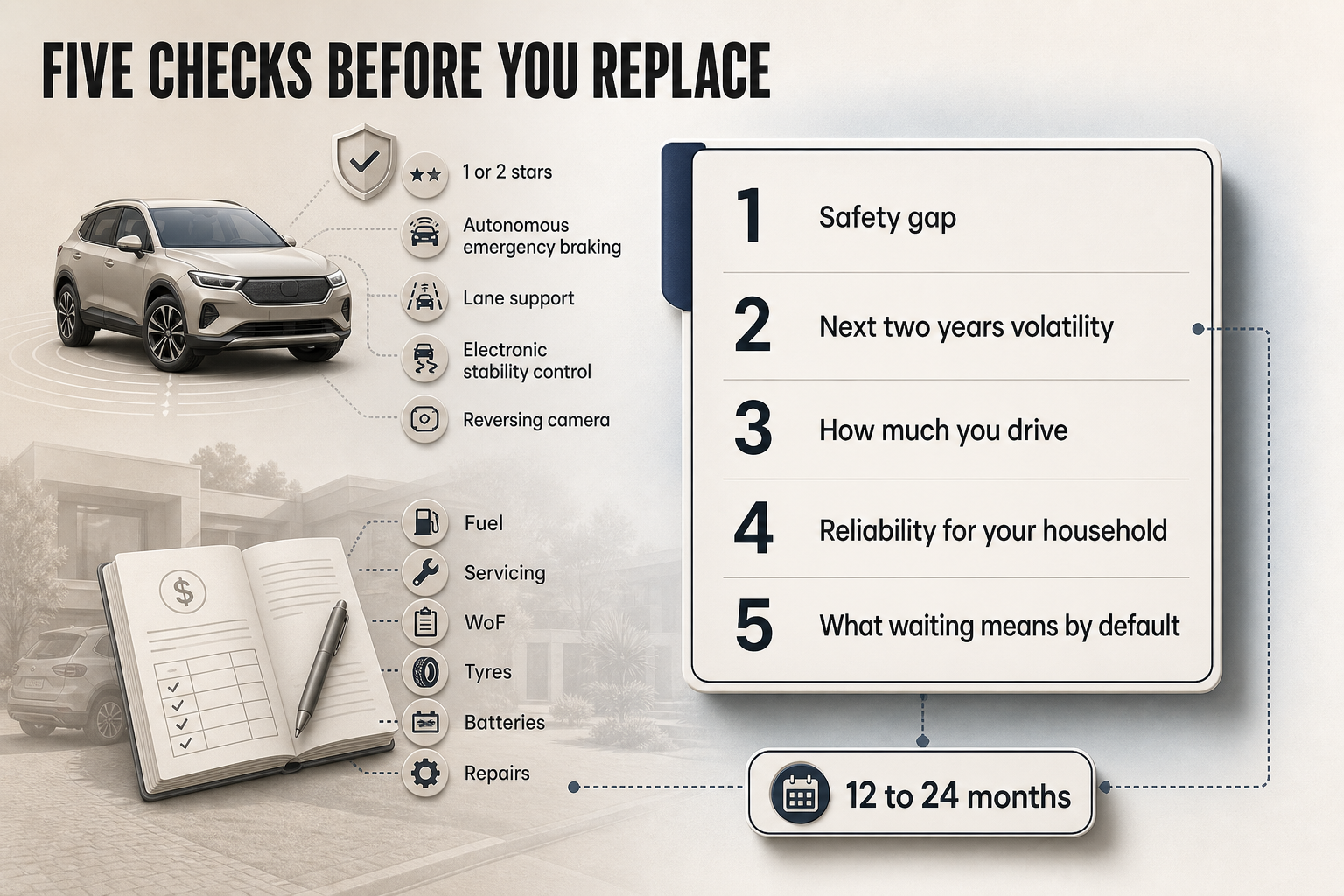
From there, ask yourself five practical questions:
- How large is the safety gap? If your current car is 1 or 2 stars, or lacks key crash-avoidance systems, the upgrade case is stronger.
- How volatile are the next two years likely to be? If the car is ageing into poorer WoF pass rates and more frequent component failures, factor in disruption as well as dollars.
- How much do you drive? Higher annual kilometres make fuel-efficiency gains more valuable and bring forward the payback from a newer vehicle.
- How critical is reliability to your household? A single-car family, school-run household, or frequent regional traveller should weight breakdown risk more heavily.
- What decision are you making by default if you wait? Doing nothing is still a choice. You are choosing the old car's safety level, repair profile, and running-cost structure for another year.
If your current car is low-rated, increasingly unpredictable, and expensive to run, the question is no longer whether a newer car introduces cost. It is whether the old one is already costing more than you have acknowledged. Read What does "one more year" actually look like? › for the repair-risk lens, What if keeping the old car is actually the expensive choice? › for the running-cost lens, and What if your biggest car expense isn't the one you're paying? › for the broader hidden-cost view.
The thread connecting all of these is simple: the most important comparison is not new car A versus new car B. It is your existing car versus the safety, reliability, and efficiency baseline available now. Once you see that clearly, you can choose on your own terms instead of waiting until a breakdown, failed WoF, or urgent repair quote chooses for you.
What the brands say
These brands have chosen to respond directly to this independent research. We publish brand responses unedited because we believe transparency builds trust - and that brands willing to engage openly with independent analysis deserve to be heard.
You may also be interested in these independent articles
Sources
- [1]What if the car you trust most is the one holding you back? ›
- [2]What if your biggest car expense isn't the one you're paying? ›
- [3]What does "one more year" actually look like? ›
- [4]What if keeping the old car is actually the expensive choice? ›
- [6]NZ Transport Agency Waka Kotahi - Vehicle safety
- [7]NZ Transport Agency Waka Kotahi - Buying a car? Check the stars
- [8]NZ Transport Agency Waka Kotahi - Warrant of fitness
- [9]NZ Transport Agency Waka Kotahi - Considering changes to light vehicle inspections
- [10]NZ Transport Agency Waka Kotahi - Considering new safety requirements for vehicles entering the New Zealand fleet
- [11]Consumer NZ - Should you buy a used or nearly new car?
- [12]New Zealand Automobile Association - AA Roadservice
- [13]New Zealand Automobile Association - AA Battery Service
- [14]EECA - Benefits of electric vehicles for your home
- [15]EECA - How to charge your EV at home and on the road
- [16]Insurance Institute for Highway Safety - Front crash prevention rear-end crash study
- [17]ANCAP - Study confirms effectiveness of Autonomous Emergency Braking
© 2026 pyfoi. All rights reserved.