
What a Vehicle Sustainability Rating Means in NZ
Learn what a vehicle sustainability rating means in NZ, how star labels track fuel use and CO2, and why RUC and charging can change the real cost.
A vehicle sustainability rating is a simple way to judge how clean and efficient a car is, usually shown as a star score on New Zealand’s vehicle labelling and comparison tools. For NZ buyers, it matters because it affects running costs, tailpipe emissions, and in some cases how well a vehicle fits future policy and resale trends.
What the rating measures
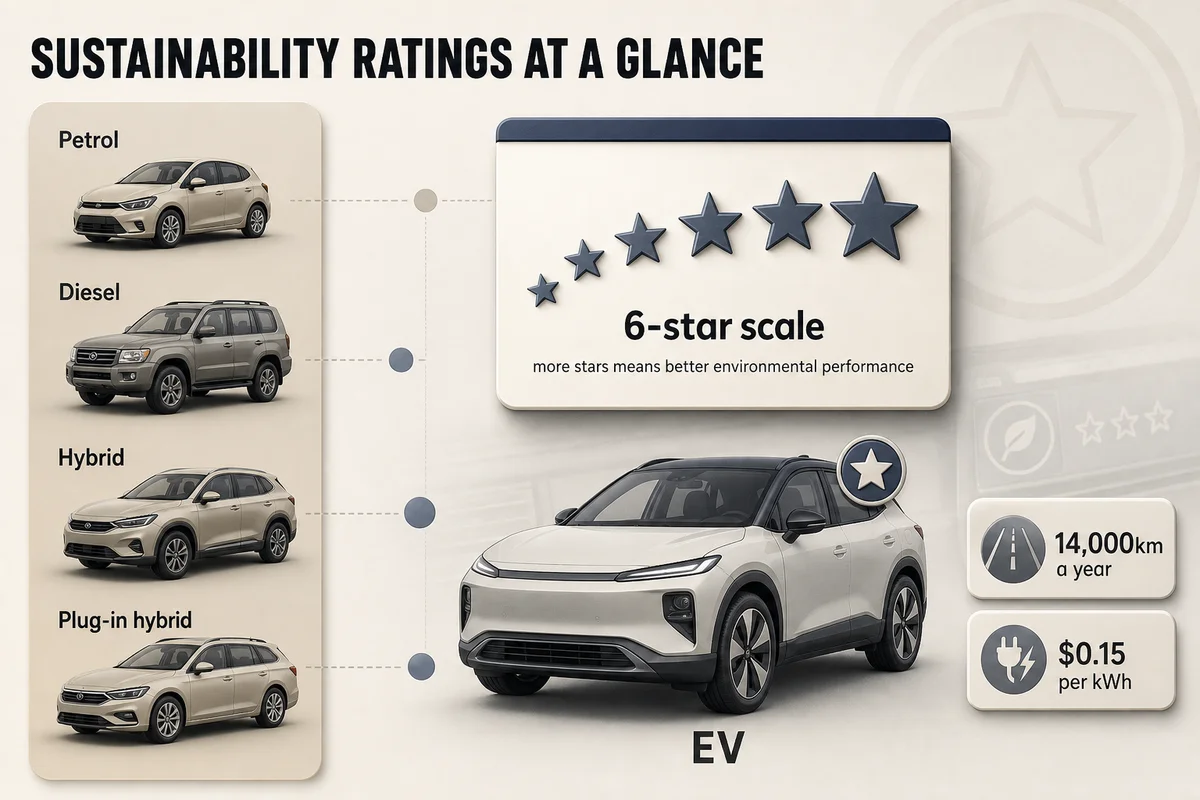
In New Zealand, the sustainability picture you will usually see on a vehicle label or on Rightcar is not one single magic score. It sits within a set of environmental ratings that cover energy economy, carbon emissions, and air pollution. In plain English, that means how much energy the vehicle uses, how much CO2 it emits from the tailpipe, and how dirty its other exhaust emissions are. The more stars a vehicle has in these environmental ratings, the better it performs in that area. Source: Environmental ratings on Rightcar Source: Vehicle comparison on Rightcar
For many buyers, the most visible parts are the energy economy star rating and the CO2 emissions star rating on the official Vehicle Emissions and Energy Economy Label. EECA says these are shown on a six-star scale, with six stars going to the most efficient and lowest-emission vehicles. The label also shows fuel use in L/100km or electricity use in kWh/100km, plus an estimated yearly running cost. Source: EECA Vehicle Emissions and Energy Economy Labelling Programme
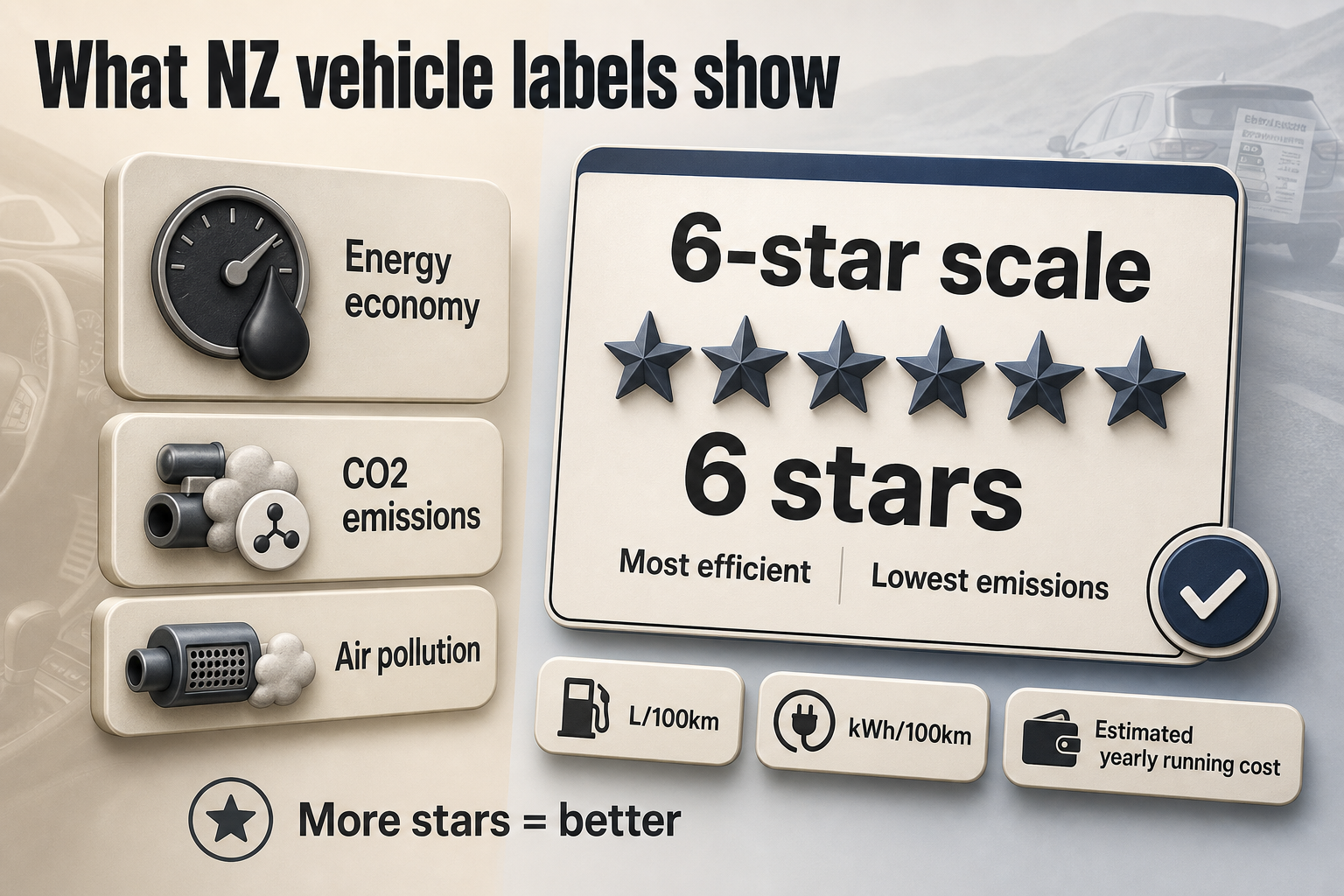
If a listing or website calls this a “sustainability rating” and shows five stars instead of six, treat it as a simplified presentation rather than a different scientific test. The key idea is still the same: more stars means lower energy use, lower emissions, or both. What matters most is checking which underlying measure the stars refer to, because a car can score well for one area and only middling for another.
What goes into the rating
The rating is built from standardised vehicle data rather than guesswork. For NZ labels, manufacturers or importers provide CO2 emissions and energy economy information when a vehicle is first certified for use here, and that data is stored in the Motor Vehicle Register and Fuelsaver systems used to generate labels. EECA says the label gives buyers a standard way to compare one vehicle against another, but it is not a guarantee of what any individual driver will achieve in daily use. Source: EECA Vehicle Emissions and Energy Economy Labelling Programme
A high-rated vehicle usually separates itself in three ways. First, it uses less fuel or electricity per 100km. Second, it produces less tailpipe CO2 per kilometre. Third, it has lower air pollution impacts, which matters most with older diesels and older petrol vehicles. Rightcar groups these together as environmental ratings, and its guidance is straightforward: more stars means better environmental performance. Source: Rightcar environmental ratings Source: Rightcar carbon emissions
What separates a low-star vehicle from a high-star one is often the powertrain and the age of the emissions technology. A large petrol SUV with high fuel use, or an older diesel without modern emissions controls, will usually sit lower on the scale. A small hybrid, efficient petrol hatch, plug-in hybrid used properly, or battery EV will usually sit much higher. That does not mean every EV is automatically “best” for every buyer, because purchase price, charging access, and road user charges still matter in real life.
What to look for when you compare cars
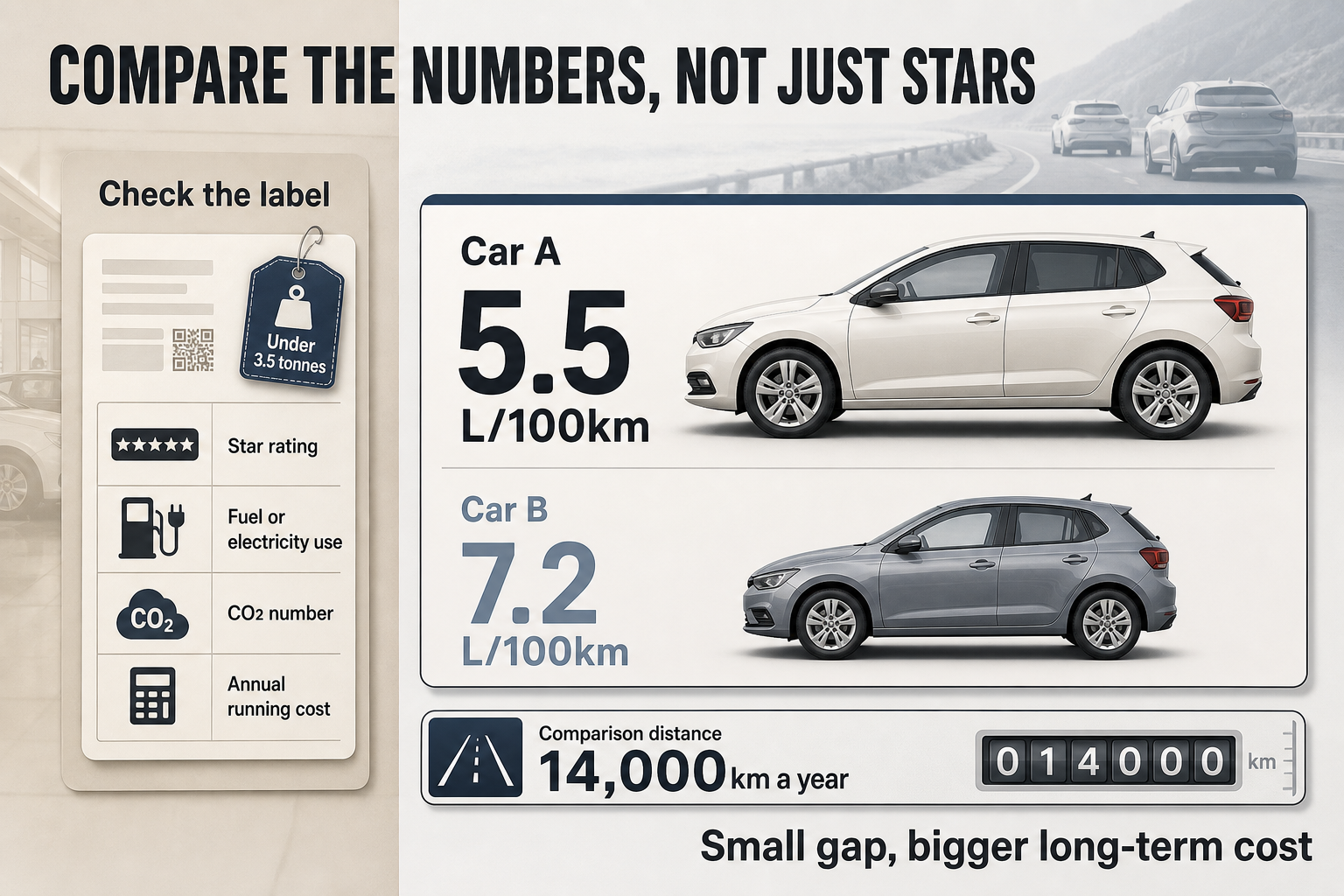
Start by checking the label itself rather than relying on a dealer’s wording. In NZ, it is a legal requirement to display the Vehicle Emissions and Energy Economy Label on light vehicles under 3.5 tonnes offered for sale, where the information is available. That label gives you the star rating, the fuel or electricity consumption figure, the CO2 number, and the estimated annual fuel or energy cost. Source: EECA Vehicle Emissions and Energy Economy Labelling Programme
Next, look past the stars and read the actual numbers. If two cars both look “good”, one might use 5.5L/100km and the other 7.2L/100km. Over a few years of Auckland commuting or regular Wellington to Palmerston North trips, that gap adds up. The annual running-cost figure on the label is based on 14,000km a year, which EECA says is the comparison distance used for the estimate. Source: EECA Vehicle Emissions and Energy Economy Labelling Programme
You should also ask whether the rating reflects your likely use. A plug-in hybrid can look excellent on paper, but only if you charge it often and mostly do short trips. If you never plug it in and spend your time on open-road runs from Christchurch to Dunedin, the real-world result may be much less impressive. By contrast, a conventional hybrid often suits mixed NZ driving very well because it does not depend on public charging.
For used imports and older vehicles, check whether complete data is available. EECA notes that CO2 and energy economy information is often missing for some vehicles built before 2000, some NZ-new vehicles from 2000 to 2004, and some used imports from Japan from 2000 to 2004. If the data is missing, be more cautious and compare fuel use, engine size, emissions standard, and service history more closely. Source: EECA Vehicle Emissions and Energy Economy Labelling Programme
NZ context
NZ conditions can change what a “good” sustainability rating means for you. If you mostly drive short urban trips in Auckland, Hamilton, or central Christchurch, a hybrid or EV can make a lot of sense because stop-start traffic rewards electrification. If you live rurally, tow a trailer, or regularly cross long distances in the lower South Island, a very efficient petrol or diesel option may still be the more practical fit, even if its star rating is not at the top of the chart.
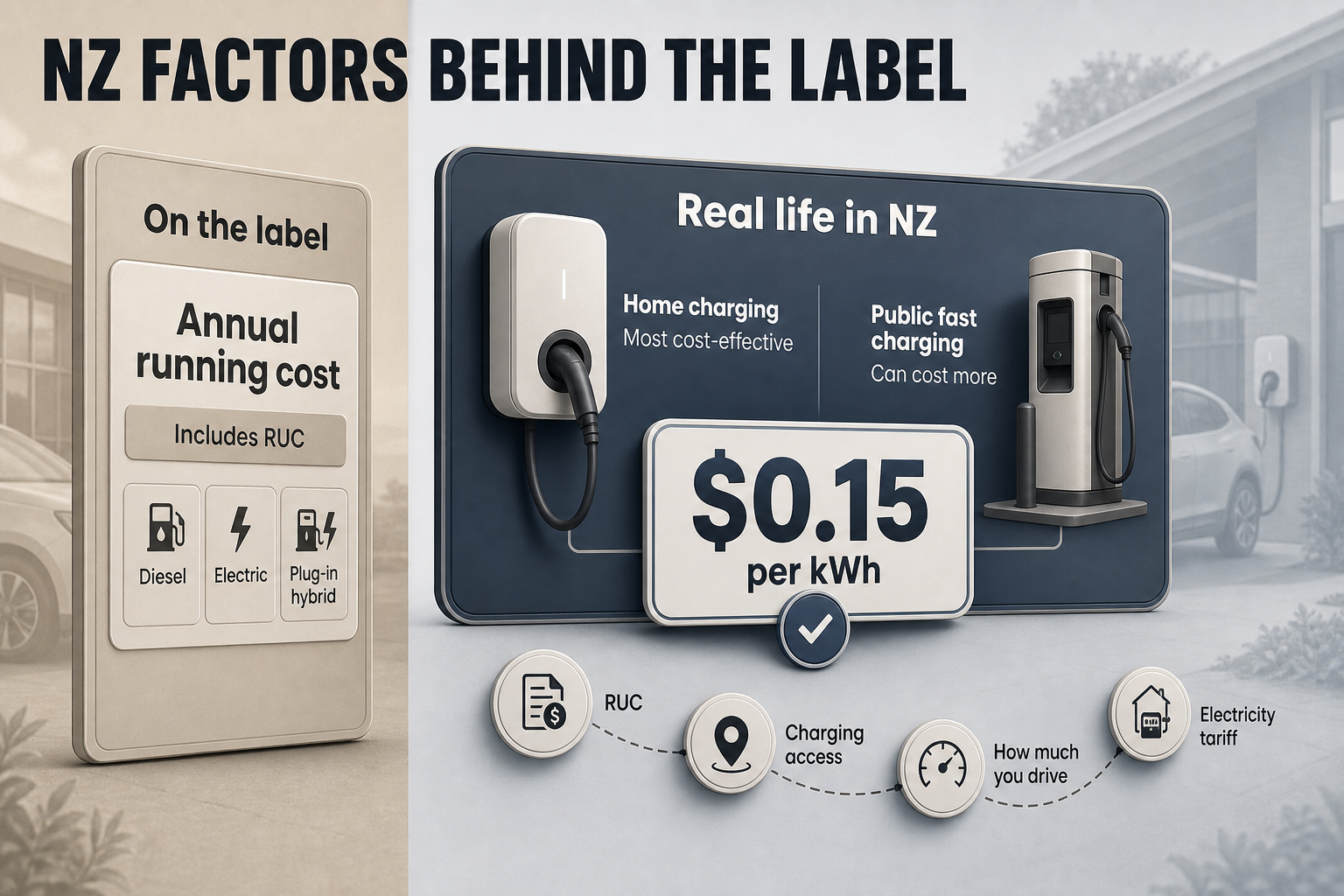
Road user charges are one of the biggest NZ-specific factors. NZTA says light electric vehicles now need to buy RUC, and EECA says the annual cost figure on the label for diesel, electric, and plug-in hybrid vehicles includes RUC. That means an EV’s label is already trying to reflect a more realistic annual running-cost picture, but your own result will still depend on how much you drive and what electricity tariff you use. Source: NZTA Road user charges Source: EECA Vehicle Emissions and Energy Economy Labelling Programme
Charging also matters. NZTA notes that public charging infrastructure is expanding, but home charging remains the most cost-effective option for most EV owners. EECA says the label’s EV running-cost estimate uses an off-peak electricity price of $0.15 per kWh, so if you rely heavily on public fast charging your real cost can be higher than the label suggests. Source: NZTA charging an electric vehicle Source: EECA Vehicle Emissions and Energy Economy Labelling Programme
There is also a future-proofing angle. While the Clean Car Discount ended earlier, the Clean Car Standard still exists for importers and helps shape the mix of vehicles entering the NZ fleet through CO2 targets and credits. As an inference, that means lower-emission vehicles are likely to stay more aligned with the direction of the market and policy settings, which can help resale appeal over time. Source: NZTA Clean Car Standard questions and answers Source: NZTA Clean Car Standard credits, charges and payments
For most buyers, the smart move is simple. Use the sustainability rating as a quick filter, then confirm the hard numbers underneath. A high-star car is usually the safer bet for fuel bills and emissions, but the best choice is the one that matches how and where you actually drive in New Zealand.
You may also be interested in these independent articles
Sources
- [1]Rightcar NZ - Environmental ratings
- [2]Rightcar NZ - Vehicle comparison
- [3]EECA - About the Vehicle Emissions and Energy Economy Labelling Programme
- [4]NZ Transport Agency Waka Kotahi - Road user charges
- [5]NZ Transport Agency Waka Kotahi - Charging an electric vehicle
- [6]NZ Transport Agency Waka Kotahi - Clean Car Standard questions and answers
- [7]NZ Transport Agency Waka Kotahi - Credits, charges and payments
© 2026 pyfoi. All rights reserved.