
What Is Good Fuel Economy in NZ?
What is good fuel economy in NZ? Compare L/100km by vehicle type, see real running costs, and avoid costly mistakes on your next car buy.
Fuel economy is the number that tells you how much fuel a vehicle uses to travel 100km, usually shown as litres per 100km or L/100km. It matters because it affects your weekly running costs every time you fill up, and in New Zealand those costs add up quickly if you do long commutes, school runs, or regular open-road trips.
The key thing to remember is simple: lower is better. A car rated at 5.5L/100km uses less fuel than one rated at 8.5L/100km, so it should cost you less to run if your driving pattern is similar. Official NZ fuel economy data is now based on WLTP testing, which is a more realistic comparison standard than older NEDC figures, but your real-world result will still vary with traffic, weather, load, tyre pressures and driving style. (eeca.govt.nz)
What the numbers mean
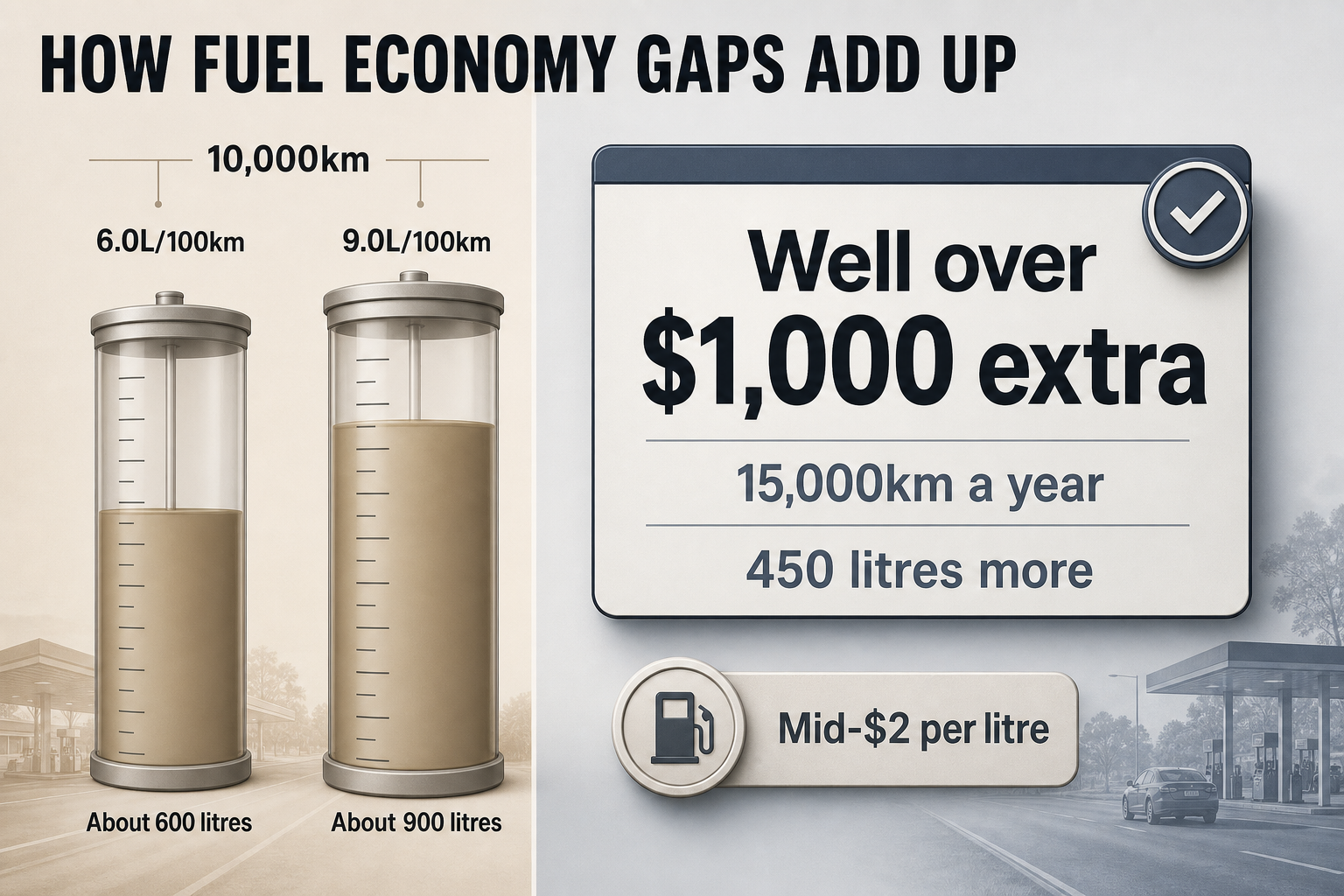
L/100km measures fuel used over distance, not distance per litre. That can feel backwards at first, but it makes comparisons easier. If a vehicle is rated at 6.0L/100km, it should use about 6 litres to cover 100km. Over 10,000km, that is about 600 litres. A vehicle rated at 9.0L/100km would use about 900 litres over the same distance.
That difference matters more than many buyers expect. At 15,000km a year, the gap between 6.0L/100km and 9.0L/100km is about 450 litres annually. If fuel is around the mid-$2-per-litre mark, that can mean well over $1,000 a year in extra petrol spend, before you even think about servicing or tyres. MBIE’s weekly fuel monitoring shows national average pump prices and confirms that fuel prices remain a live cost for NZ households and businesses. (mbie.govt.nz)
It also helps to think in trip terms. A small hatch using 5.0L/100km would need about 15 litres for a 300km run from Auckland to Taupō. A medium SUV at 8.0L/100km would need about 24 litres for the same drive. A big ute at 10.5L/100km would need about 31.5 litres. Once you start doing regular intercity travel, those differences stop being theoretical.
Typical ranges
For petrol city cars and small hatchbacks, a good fuel economy figure is usually about 4.5 to 6.0L/100km. Many non-hybrid small cars sit closer to 5.5 to 6.5L/100km, while strong hybrids can dip below 4.5L/100km in mixed driving. If you mostly drive around Wellington, central Christchurch or suburban Auckland, this is the range that keeps costs sensible without forcing you into a tiny car.
For small and medium SUVs, expect roughly 6.5 to 8.5L/100km for efficient petrol models, and often 5.0 to 6.5L/100km for full hybrids. This is the sweet spot for many NZ families because it balances cabin space, boot room and fuel spend. Once a petrol SUV creeps past about 9.0L/100km, you should be sure you really need the size, power or towing ability.
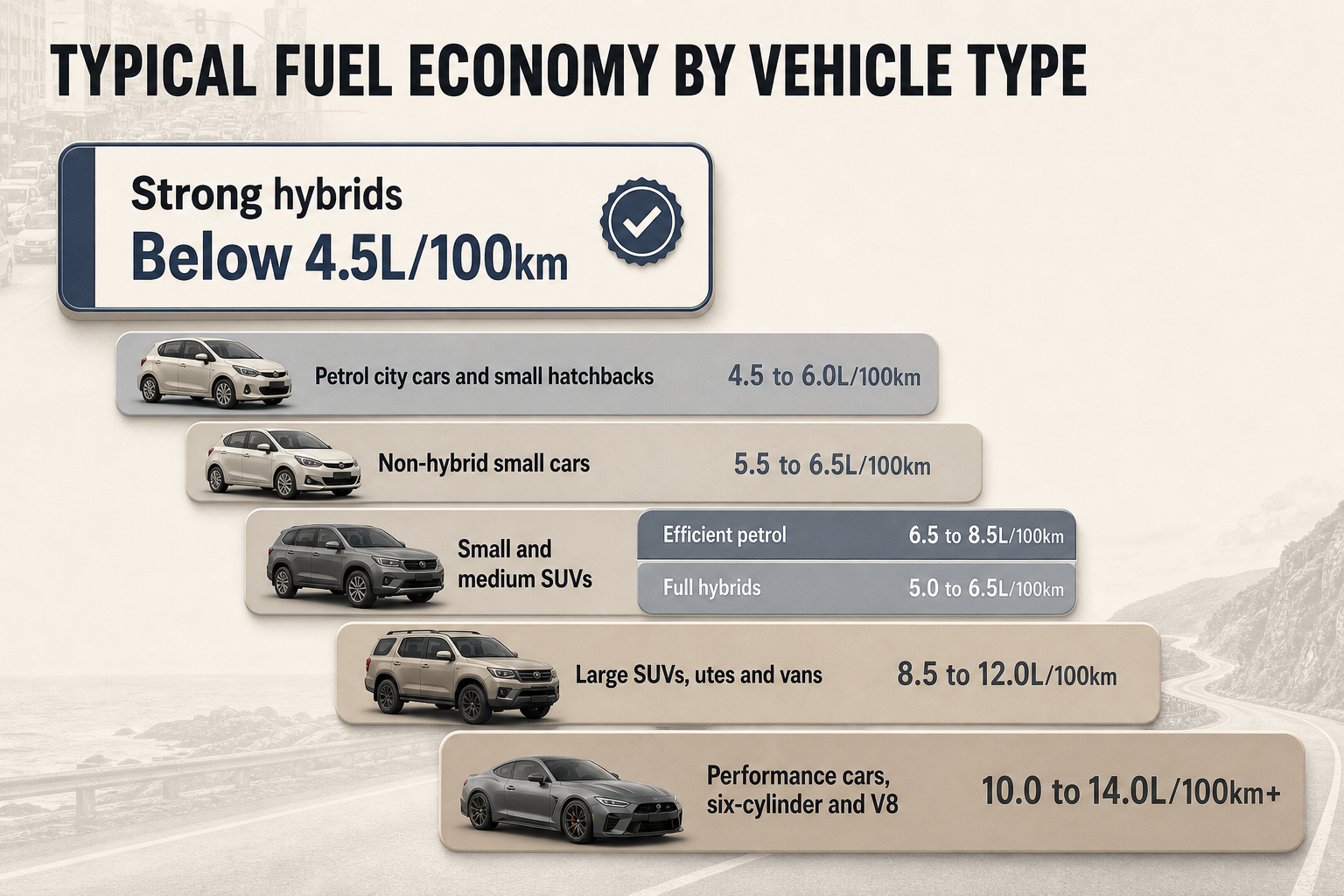
Large SUVs, utes and vans often sit in the 8.5 to 12.0L/100km range, sometimes more if they are four-wheel drive, turbocharged, heavily loaded or used for towing. That does not automatically make them a bad buy. It just means you need to budget honestly. A diesel ute may look efficient on paper, but in New Zealand you also need to factor in road user charges, because diesel vehicles do not pay fuel excise in the pump price the way petrol vehicles do. (nzta.govt.nz)
Performance cars and large petrol six-cylinder or V8 vehicles can easily run at 10.0 to 14.0L/100km or higher. That may be acceptable if the car is a weekend toy or you drive low annual kilometres. It is much harder to justify if you are buying a daily driver for a 70km round-trip commute.
At the other end, plug-in hybrids can post very low official figures, but those numbers depend heavily on how often you charge them. If you do not plug in regularly, real fuel use can look much closer to a normal petrol SUV than the brochure suggests. Battery electric vehicles are usually listed differently, but in some databases they may appear as 0L/100km because they do not burn liquid fuel.
Use-case guidance
If you are buying for urban commuting, school runs and supermarket trips, aim for about 4.0 to 6.5L/100km. That covers most efficient small cars and many hybrids. In stop-start traffic, hybrids often make the most sense because they recover energy under braking and spend more time with the petrol engine off or lightly loaded. That suits Auckland congestion particularly well.
If you want one car for mixed family use, including open-road holidays, look for around 5.5 to 7.5L/100km in a hatch, wagon or medium SUV. That range usually gives you enough comfort and space for long trips to Northland, Rotorua or Queenstown without turning every holiday into a fuel-budget exercise. For many buyers, this is the smartest compromise.
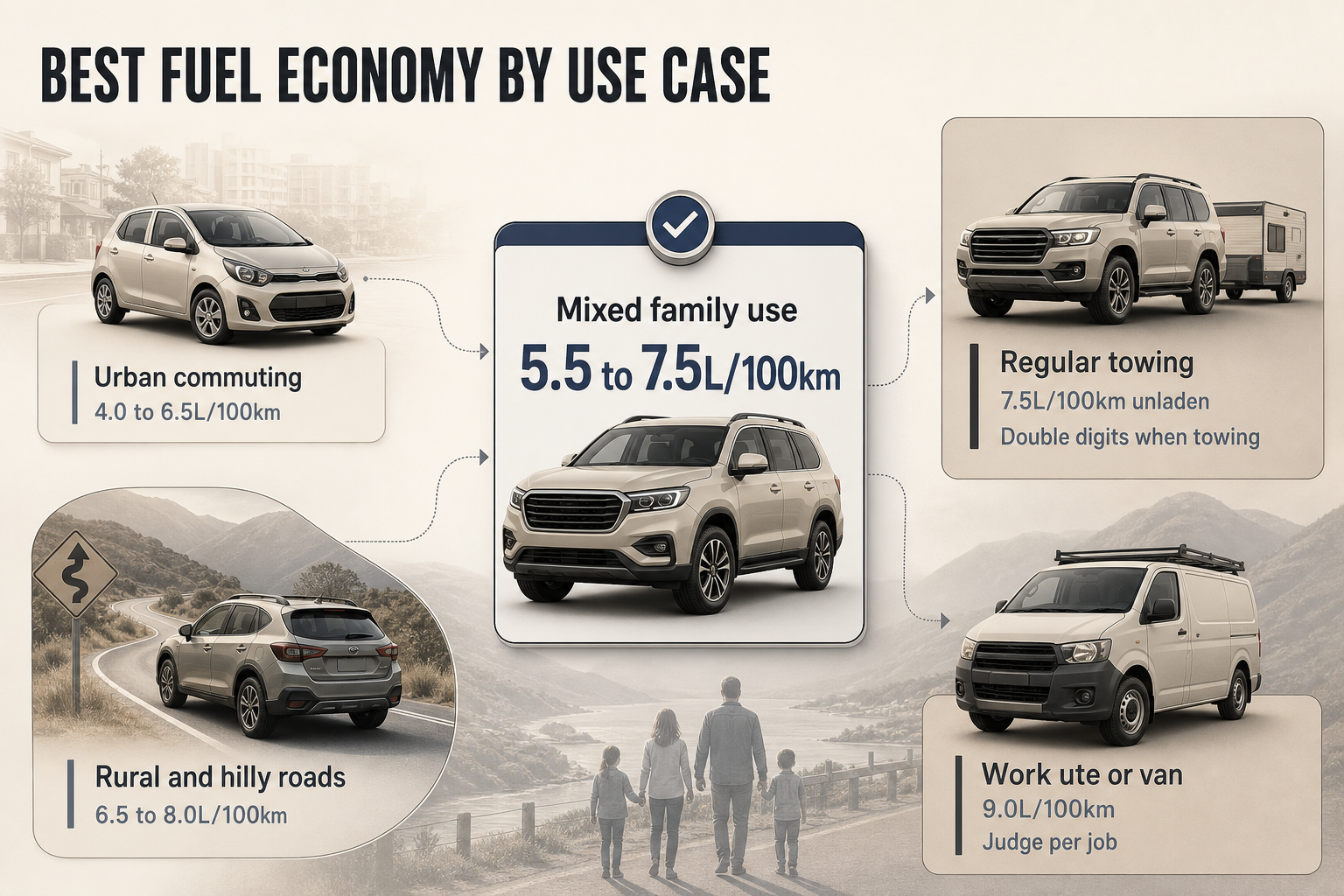
If you live rurally or regularly drive hilly, winding roads, do not chase the very lowest number at the expense of drivability. A lightly stressed engine using 6.5 to 8.0L/100km may suit your life better than a smaller engine that feels strained on passing lanes or steep gravel roads. Real-world economy on NZ roads can differ from the label if you are carrying gear, climbing often, or driving into strong headwinds.
If you tow a small trailer, boat or caravan, focus less on the brochure minimum and more on the loaded reality. A vehicle rated at 7.5L/100km unladen may jump well into double digits when towing. For regular towing, a diesel SUV or ute can still make sense, but only if you include RUC in your running-cost maths and accept that servicing may also cost more. (nzta.govt.nz)
If you are shopping for a work ute or van, fuel economy should be judged per job, not just per 100km. A van using 9.0L/100km but carrying more tools securely may be better value than a smaller vehicle doing extra trips. The same applies for tradies covering long distances across Waikato, Canterbury or Otago.
NZ-specific factors
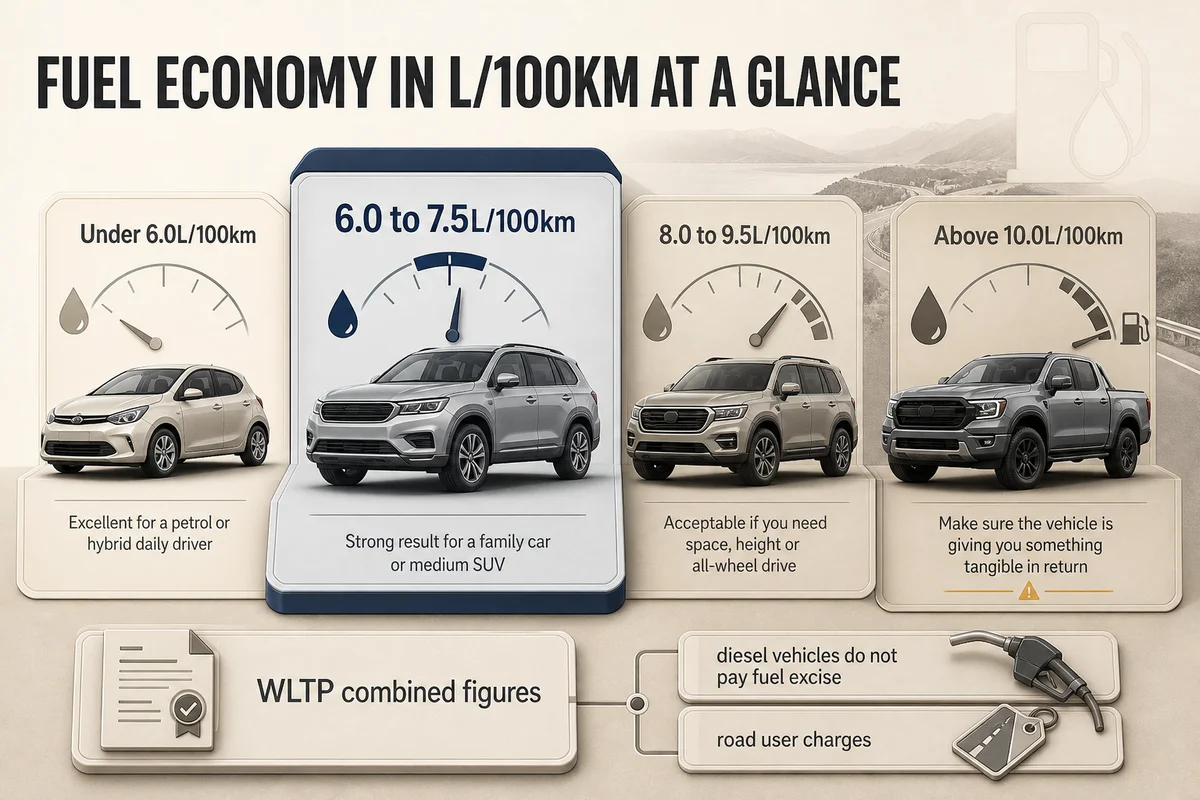
New Zealand buyers should pay close attention to the label figure they are comparing. EECA says NZ vehicle emissions and energy economy data is based on WLTP, and the vehicle label programme exists so buyers can compare vehicles on a common basis. That means WLTP combined figures are the best apples-with-apples number when you are cross-shopping vehicles. (eeca.govt.nz)
You should also remember that our roads can punish optimistic fuel claims. Short urban trips in winter, steep terrain, rough chipseal, roof boxes for ski trips, and long 100km/h open-road sections all affect consumption. EECA notes that actual fuel economy varies with driving style, traffic, weather, vehicle loading, maintenance and tyre pressures. (eeca.govt.nz)
Diesel needs special care in your calculations. NZTA states that most road users contribute through fuel levies when they buy fuel, while others pay through road user charges, and light electric vehicles now also need to buy RUC. So if you are comparing a petrol SUV with a diesel SUV, or a petrol hatch with an EV, do not stop at the pump price or the L/100km figure alone. In New Zealand, the tax structure changes the real running-cost picture. (nzta.govt.nz)
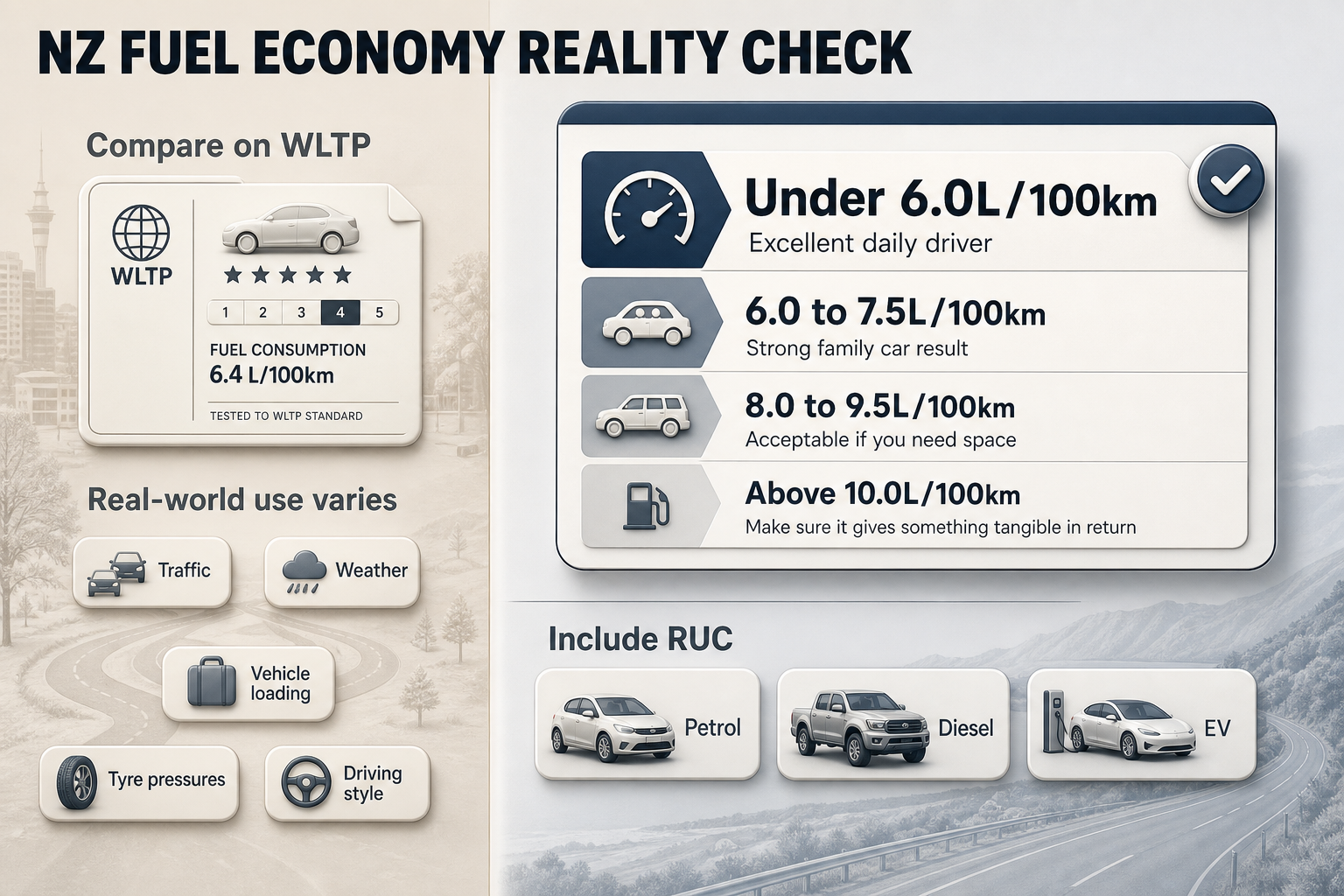
For most private buyers, a sensible target is easy to state. Under 6.0L/100km is excellent for a petrol or hybrid daily driver. Around 6.0 to 7.5L/100km is a strong result for a family car or medium SUV. Around 8.0 to 9.5L/100km is acceptable if you need space, height or all-wheel drive. Above 10.0L/100km, make sure the vehicle is giving you something tangible in return, such as towing ability, seven-seat practicality, or serious performance.
You may also be interested in these independent articles
Sources
© 2026 pyfoi. All rights reserved.