
What a Vehicle Brand Rating Really Means in NZ
Learn what a vehicle brand rating really means in New Zealand, from reliability and dealer support to recalls, resale and real ownership costs.
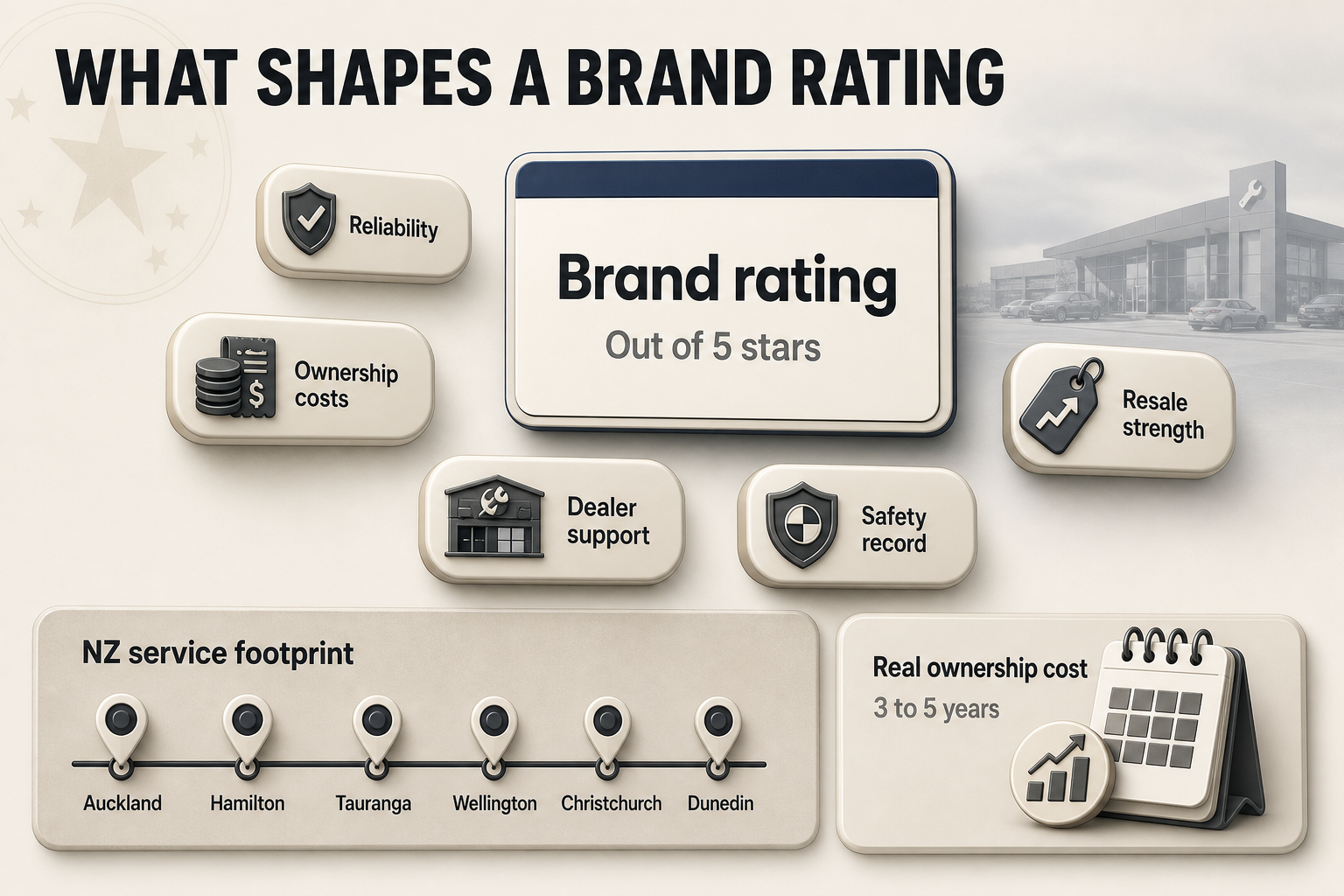
A vehicle brand rating is a simple way of turning a brand’s overall reputation into an easy score, usually out of five stars. It can be useful because it gives you a quick sense of how a marque tends to perform across areas such as reliability, ownership costs, dealer support, safety record and resale strength, all of which matter in New Zealand where many buyers keep cars for years and often travel long distances between service visits.
The catch is that a brand rating is only a shortcut. It can help you narrow a shortlist, but it should never replace checking the exact model, engine, gearbox and service history of the car you are actually buying.
What goes into the rating
A strong brand rating usually reflects a pattern rather than one standout model. Brands score well when they have a good record for durability, low fault rates, sensible servicing costs, solid parts supply and a dealer or repair network that can support owners around the country. In New Zealand, that last point matters more than many buyers realise. A brand with outlets in Auckland, Hamilton, Tauranga, Wellington, Christchurch and Dunedin is easier to live with than one with only a small footprint, especially if you live outside the main centres or do regular intercity driving.
Safety also shapes how people judge a brand, even if safety is normally rated model by model rather than by marque. New Zealand buyers can check official safety information through Rightcar, which explains the safety labels used on vehicles, while ANCAP publishes detailed crash-test results for many new models. A brand that consistently sells vehicles with strong safety performance will usually earn a better reputation over time. (rightcar.govt.nz)
Ownership experience matters just as much. If warranty claims are handled well, recalls are communicated clearly and parts arrive quickly, buyers tend to rate that brand highly. NZTA advises owners to check for safety recalls, and unresolved recalls can affect safety, registration and even a vehicle’s ability to pass a WoF in some cases, as seen with certain Takata airbag recalls. (nzta.govt.nz)
Resale value is another hidden ingredient in brand ratings. A brand that holds value well often does so because buyers trust it, workshops know it, and used-car shoppers are willing to pay for it. That does not always mean it is the best buy new, but it does affect your real cost of ownership after three to five years.
What separates a low rating from a high rating?
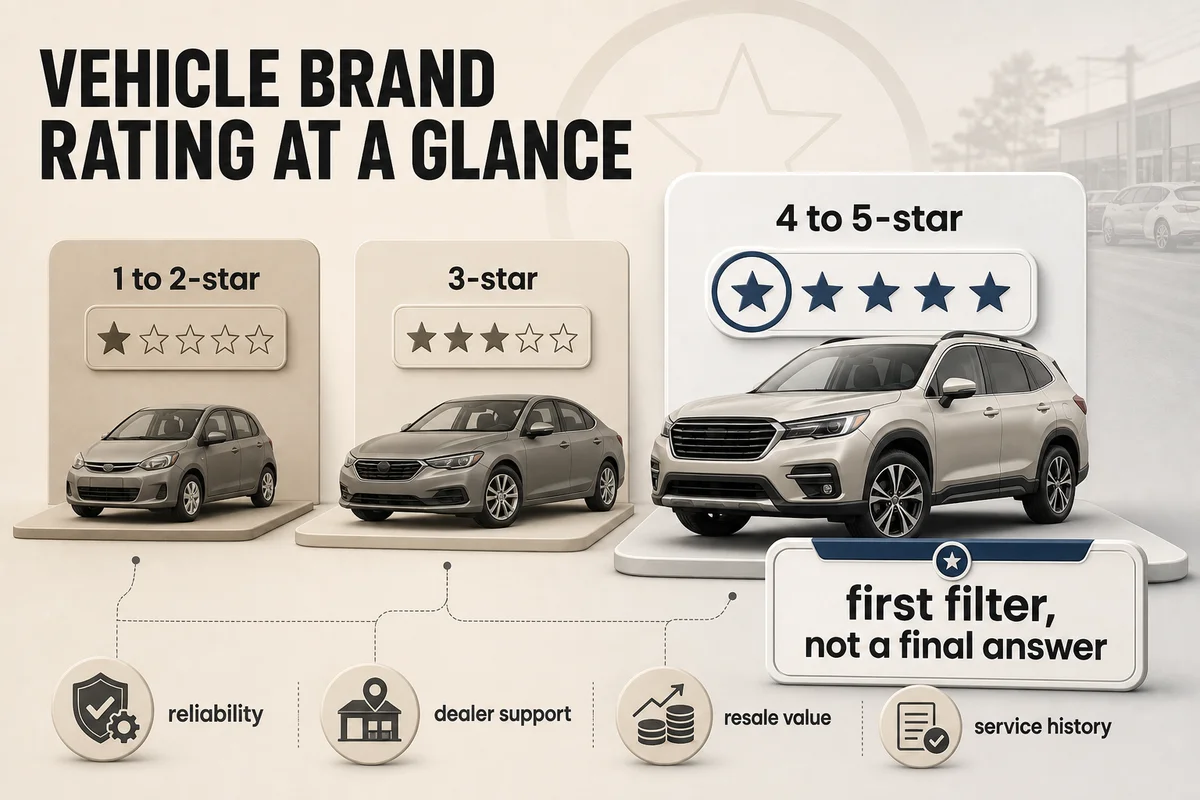
A one- or two-star brand rating usually points to recurring concerns. That might mean patchy reliability, expensive parts, a small service network, poor resale, weak aftersales support or inconsistent build quality. It does not mean every car from that brand is bad, but it does mean you should check the exact vehicle more carefully and budget more cautiously.
A three-star brand is often the middle ground. These brands can make perfectly good cars, but the ownership experience may depend heavily on the model, drivetrain and previous maintenance. This is common with brands that have some excellent products and some less convincing ones, or brands whose newer vehicles are much better than their older ones.
A four- or five-star brand rating usually suggests the opposite pattern. These brands tend to be easier to own, easier to sell and easier to service. They may still have occasional problem models, because every manufacturer does, but the overall risk is lower. For many NZ buyers, especially families who want predictable running costs, that consistency is worth paying for.
What to look for
Start by treating the brand rating as a first filter, not a final answer. If two cars are otherwise similar and one comes from a brand with a much stronger ownership record in New Zealand, that can be a sensible tie-breaker. But if the lower-rated brand offers a better service history, lower kilometres, stronger safety spec and a cleaner inspection report, the individual car may still be the smarter buy.
Look closely at local support. Ask where the nearest authorised service agent is, how long common parts take to arrive, and whether independent workshops in your area know the brand well. This matters if you live in places such as Northland, Taranaki, the Central Plateau, Otago or Southland, where a trip to the nearest franchise dealer may not be a quick errand.
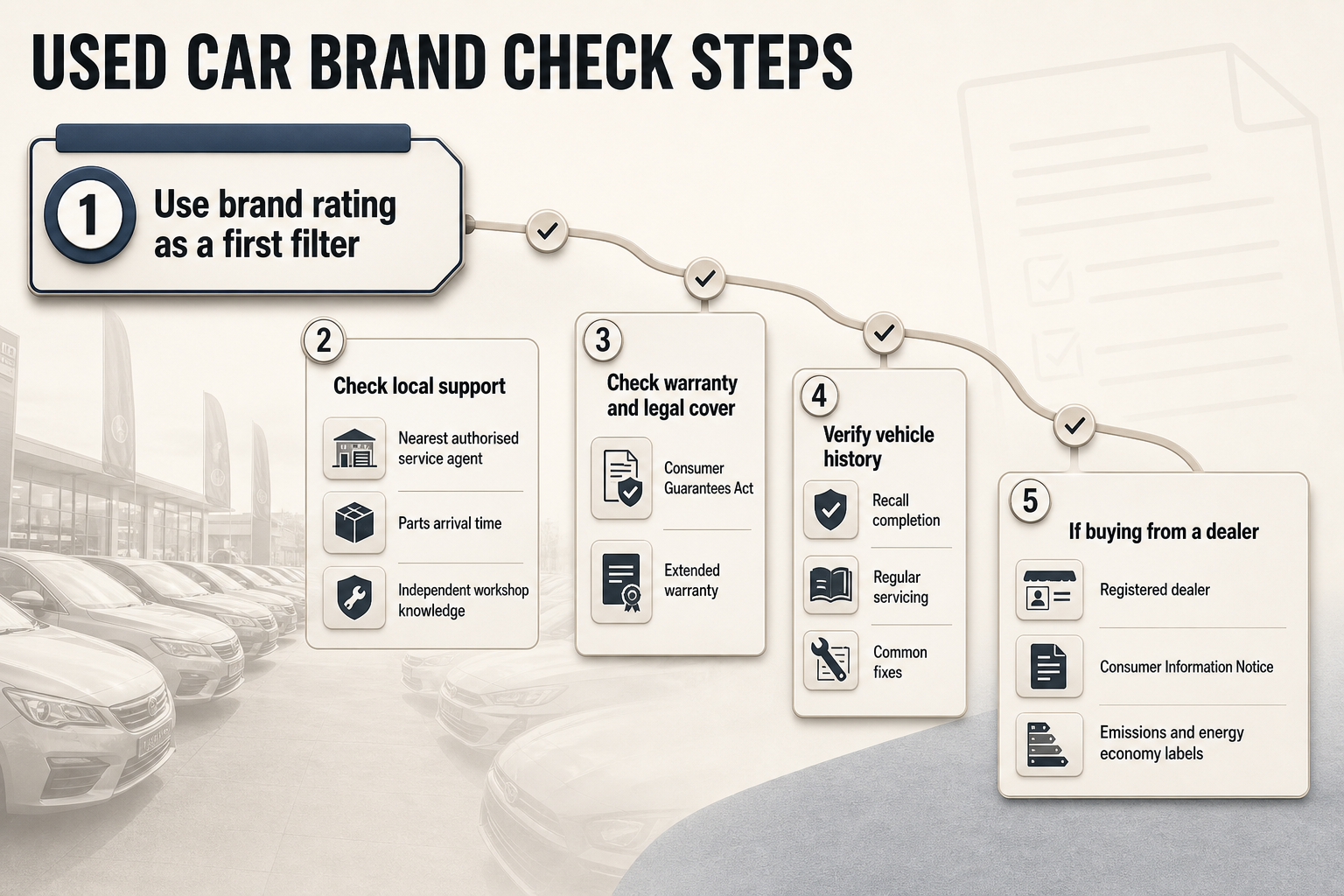
You should also check the warranty terms, but do not assume a long factory warranty tells the whole story. In New Zealand, your rights under the Consumer Guarantees Act apply in addition to any manufacturer’s warranty, and businesses cannot limit those legal obligations to the terms of a store or maker’s warranty. Consumer Protection also notes that you often do not need an extended warranty unless it gives you protection beyond what the law already provides. (consumerprotection.govt.nz)
For used cars, ask for evidence of recall completion, regular servicing and any known common fixes. If you are buying from a dealer, the dealer must comply with the Consumer Guarantees Act and Fair Trading Act, must be registered, and must provide a Consumer Information Notice for each used vehicle. Dealers must also display vehicle emissions and energy economy labels at the point of sale. (consumerprotection.govt.nz)
It also pays to separate brand image from brand reality. Some prestige brands score highly for cabin quality and badge appeal but can be expensive once they are out of warranty. Some mainstream Japanese and Korean brands earn strong owner loyalty because servicing is predictable, parts are widely available and resale is steady. For many Kiwi households, that practical strength matters more than the badge on the bonnet.
NZ context
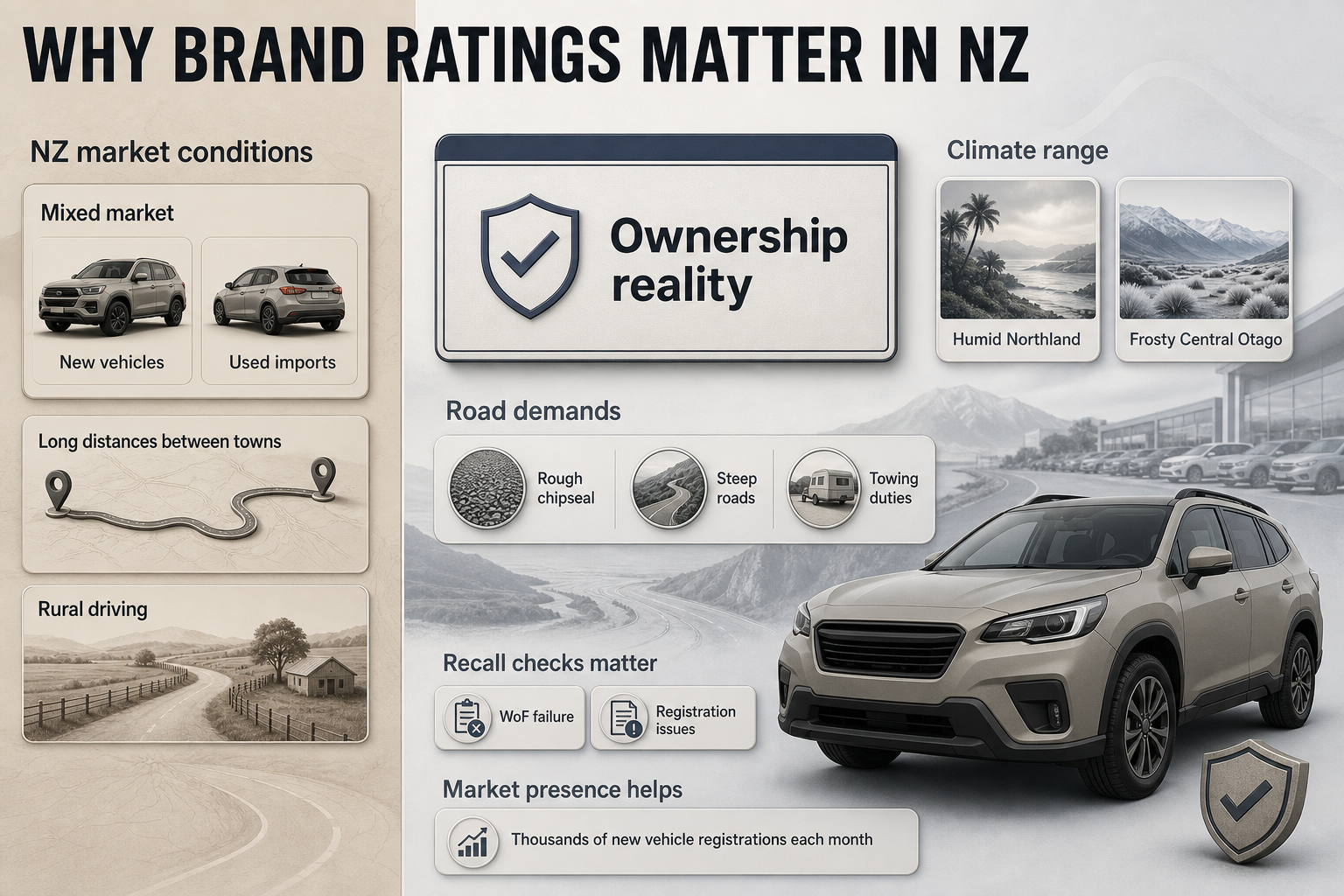
New Zealand’s market has a few quirks that make brand rating more relevant than it may be in larger countries. We have a mix of new vehicles and used imports, long distances between towns, lots of rural driving, and a climate that ranges from humid Northland to frosty Central Otago. A brand that copes well with rough chipseal, steep roads, towing duties and patchy dealer coverage will often earn a better reputation here than a brand designed mainly around dense urban use.
Safety information is also presented a little differently in NZ. Rightcar provides official safety and environmental information for buyers, including vehicle safety labels and environmental ratings. That means you can cross-check whether a strong brand rating is backed by strong model-level safety and efficiency data. (rightcar.govt.nz)
Consumer law is another reason not to rely blindly on brand scores. If you buy from a dealer, you have protections under the Consumer Guarantees Act, including that the vehicle should be of acceptable quality, durable and safe. If a fault appears, your remedy depends on how serious the issue is, and those rights can still apply even after a written warranty has expired. (consumerprotection.govt.nz)
If you are shopping for a used import, brand rating should be only one part of your check. NZTA says you should check for safety recalls, and some unresolved issues can lead to serious consequences, including WoF failure or problems with registration. That is especially relevant for buyers considering niche brands or grey imports with limited local support. (nzta.govt.nz)
A final NZ-specific point is market presence. The Motor Industry Association reports that New Zealand records thousands of new vehicle registrations each month, which helps keep mainstream brands visible in dealer networks, parts supply and the used market. In practice, that often makes ownership easier and resale stronger for well-established marques than for low-volume brands. (mia.org.nz)
You may also be interested in these independent articles
Sources
- [1]Consumer Protection NZ - Consumer Guarantees Act
- [2]Consumer Protection NZ - Warranties
- [3]Consumer Protection NZ - Buying a car from a dealer
- [4]NZ Transport Agency - Safety-related recalls
- [5]NZ Transport Agency - Recalled Takata airbags
- [6]Rightcar - Vehicle ratings
- [7]Rightcar - Vehicle safety ratings
- [8]Motor Industry Association NZ
© 2026 pyfoi. All rights reserved.