
What 0-100 km/h Times Mean for NZ Drivers
Learn what 0-100 km/h times really mean for NZ drivers, from motorway merging to towing, and why 8.0 to 10.0 seconds is often the smart pick.
Acceleration is usually quoted as a 0-100 km/h time in seconds. It tells you how long a car takes to reach open-road speed from a standstill, which makes it an easy way to compare how brisk or lazy different vehicles feel.
For New Zealand buyers, that matters because 100 km/h is still the standard maximum speed on most open roads and motorways, with 110 km/h only on selected stretches of the safest expressways and motorways. A car that reaches 100 km/h easily can feel more relaxed joining traffic, overtaking, or climbing hills with a full load, but quicker is not always better. (nzta.govt.nz)
What the Numbers Mean
A 0-100 km/h figure is simple on paper but easy to misread in practice. Lower numbers are quicker. A car with a 6.0-second time is much faster than one rated at 10.0 seconds, and the difference is obvious from the driver’s seat.
The key point is that acceleration affects how much effort a car needs to do everyday jobs. If you live in Auckland and mostly sit in traffic, a very fast sprint time may add little to your daily life. If you regularly merge onto busy motorways, pass slow traffic on two-lane highways, or haul the family and luggage over the Kaimai or through the South Island high country, stronger acceleration can make the car feel less strained.
You should also treat the number as a guide, not a promise. Official figures are often measured in ideal conditions with one driver, good weather, and a lightly loaded vehicle. Real-world performance changes with passenger load, steep grades, tyre condition, temperature, and whether the car is petrol, diesel, hybrid, plug-in hybrid, or electric.
Typical Ranges
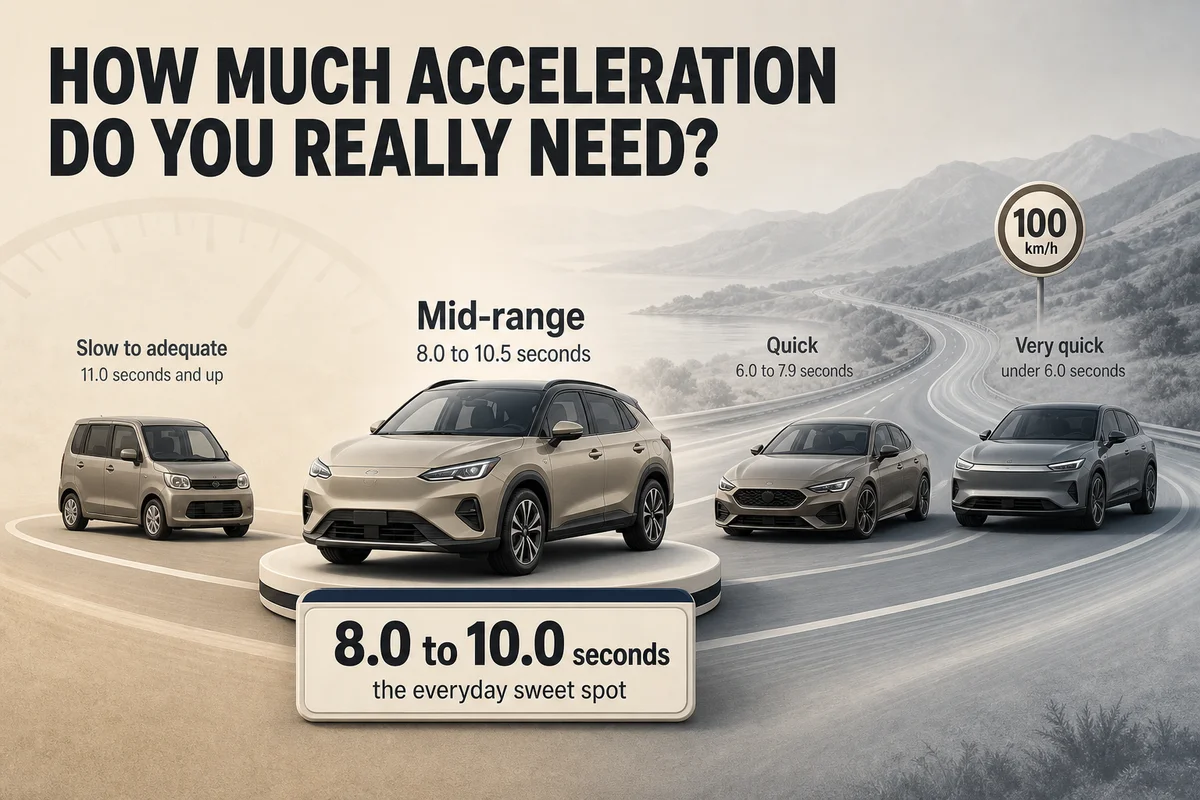
Slow to adequate: 11.0 seconds and up
Once you get above about 11.0 seconds, the car will usually feel unhurried rather than dangerously slow. This is common in small budget cars, older non-turbo hatchbacks, some entry-level SUVs, and commercial vans. A figure around 12.0 to 14.0 seconds is enough for urban driving, school runs, and steady open-road travel if you plan ahead.
That said, these vehicles can feel breathless when fully loaded or when you need to gain speed quickly on a short on-ramp. A small petrol hatch with four adults and holiday gear may feel very different from the same car with one person aboard. If you often drive SH1 north of Auckland, cross-country on narrow rural roads, or tow even a light trailer, this level of performance can become frustrating.
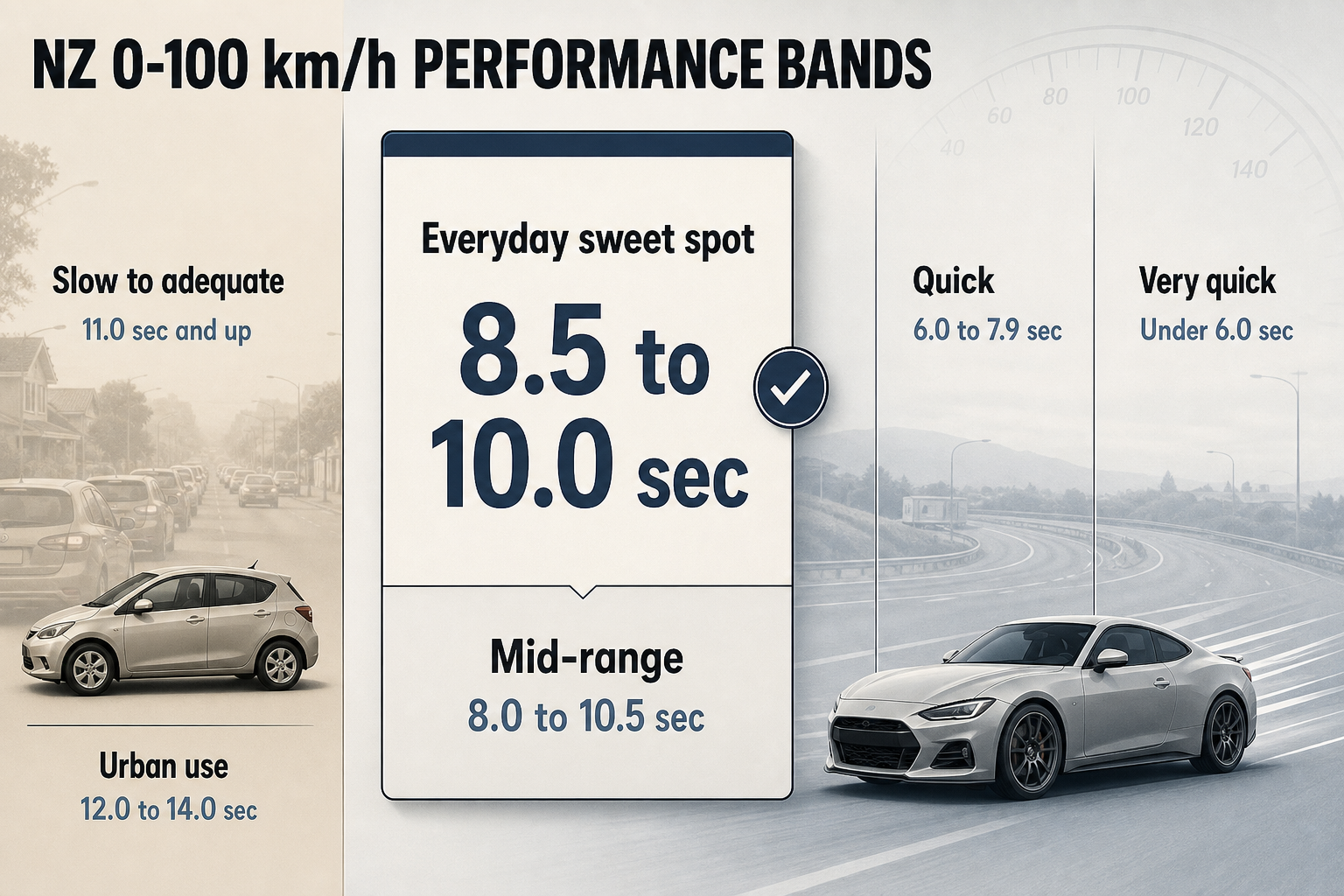
Mid-range: about 8.0 to 10.5 seconds
This is the sweet spot for many buyers. A 0-100 km/h time in the high eights or low nines usually feels comfortably responsive without pushing you into thirstier engines, pricier tyres, or higher insurance premiums. Many modern family hatchbacks, small SUVs, hybrids, and medium sedans sit here.
For typical NZ use, this range is enough for motorway merging, overtaking slower traffic with reasonable planning, and carrying a family without the car feeling flat. If you want one number to aim for as a safe all-rounder, about 8.5 to 10.0 seconds is a sensible target for everyday driving.
Quick: about 6.0 to 7.9 seconds
Cars in this bracket feel strong rather than merely adequate. This includes many turbo petrol models, more powerful hybrids, some EVs, and better-sorted utes or SUVs with healthy torque. They respond quickly to throttle inputs and usually need less of a run-up to get to open-road pace.
This can be useful if you drive long distances on state highways, regularly overtake caravans or trucks, or carry people and gear into hilly areas like Central Otago, Taranaki, or the Desert Road. The trade-off is that quicker cars often cost more to buy, can use more fuel if driven hard, and may tempt you to use performance you do not really need.
Very quick: under 6.0 seconds
Below 6.0 seconds, you are in properly rapid territory. Performance hatchbacks, sports sedans, premium EVs, and some high-output SUVs live here. Many EVs are especially strong because electric motors deliver peak torque instantly, so they can feel even punchier than the number suggests.
For most buyers, this is a want rather than a need. It can make a car feel effortless and refined, but it is not necessary for commuting, school runs, or ordinary family duties. On New Zealand roads, where most open-road limits remain 100 km/h, extra performance is often more about enjoyment than practical benefit. (nzta.govt.nz)
Use-Case Guidance
City commuting
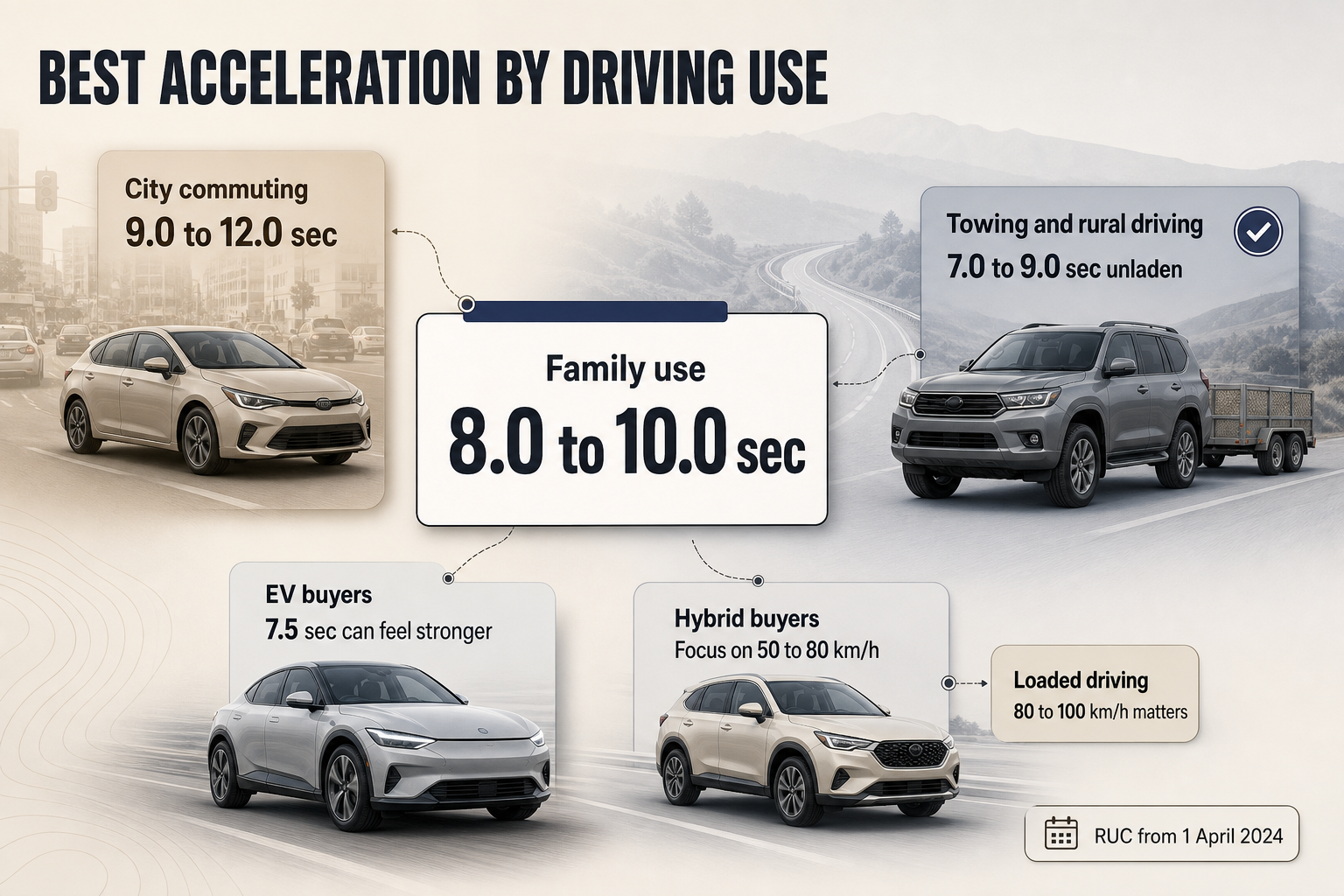
If your driving is mostly around Wellington, Christchurch, Hamilton, or suburban Auckland, anything around 9.0 to 12.0 seconds is usually fine. Stop-start traffic, traffic lights, and short trips rarely reward sports-car pace. In fact, a smooth throttle and good visibility matter more than a headline sprint number.
For urban use, do not overbuy acceleration at the expense of efficiency or comfort. A hybrid doing 0-100 km/h in 9.5 seconds will often suit real NZ commuting better than a turbo SUV doing it in 6.8 seconds if the latter costs more to fuel and insure.
Family use
For a family car, especially one that will carry kids, prams, sports gear, and holiday luggage, around 8.0 to 10.0 seconds is a very sensible band. That gives you enough reserve for motorway ramps and passing slower traffic without making the car feel jumpy or expensive to run.
If you live in a hilly area or often drive with a full cabin, lean toward the lower end of that range. A seven-seat SUV with a 10.8-second time may feel acceptable on a test drive with one person aboard, then sluggish once everyone is in it.
Towing and rural driving
If you tow a small boat, jet ski, or trailer, or spend a lot of time on rural two-lane roads, acceleration matters more than many buyers expect. Aim for roughly 7.0 to 9.0 seconds unladen in the tow vehicle, because towing and payload will blunt performance noticeably.
This is also where torque delivery matters as much as the 0-100 number. A diesel SUV or ute may not post a sports-car sprint time, but strong mid-range pulling power can make it feel more capable at 80 to 100 km/h with a load on board. Just remember that diesel running costs in New Zealand are affected by road user charges, and battery EVs and plug-in hybrids have also been brought into the RUC system from 1 April 2024. (nzta.govt.nz)
EV and hybrid buyers
Electric cars often post very quick 0-100 km/h figures, but the bigger difference is the instant response from low speeds. That makes them feel lively in town and effortless on motorway ramps. You may find an EV with a 7.5-second time feels stronger in everyday driving than a petrol car with a similar official figure.
For hybrids, focus on whether the car feels responsive at 50 to 80 km/h, not just from a standstill. That is the speed range you will use most often on New Zealand roads when merging, climbing, or passing.
NZ-Specific Factors
New Zealand road conditions make usable acceleration more important than bragging rights. We have plenty of single-carriageway highways, short passing lanes, steep grades, strong winds, and coarse-chip surfaces that can affect grip and noise. A car that is merely quick on paper but struggles when loaded or on a wet rural road is less useful than one with predictable, repeatable performance.
Fuel cost matters too. MBIE’s weekly monitoring shows fuel prices remain volatile and elevated in 2026, so chasing a faster engine can have a direct effect on your running costs. If two similar SUVs differ mainly by engine output, it is worth asking whether shaving 1.5 seconds off the 0-100 time is worth the extra spend every week at the pump. (mbie.govt.nz)
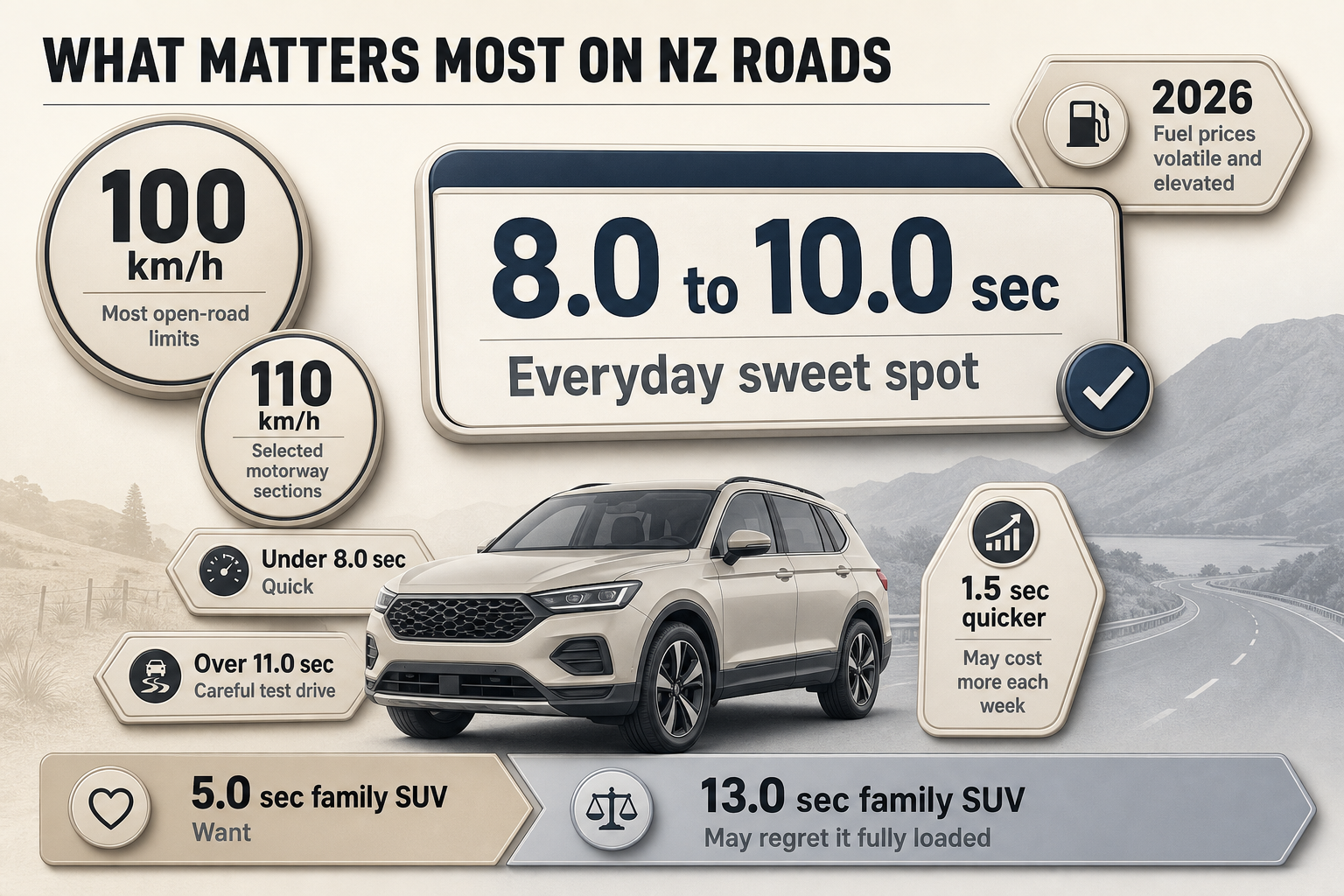
You should also keep legal speeds in perspective. Most roads are still capped at 100 km/h, and only selected motorway sections are approved for 110 km/h. That means the practical value of acceleration is not about driving faster than the limit. It is about reaching the limit smoothly, safely, and without the car feeling stressed. (nzta.govt.nz)
A good rule of thumb is this: under 8.0 seconds is quick, 8.0 to 10.0 seconds is the everyday sweet spot, and over 11.0 seconds deserves a careful test drive if you carry people, tow, or spend a lot of time on open roads. You probably do not need a 5.0-second family SUV for the school run in Tauranga, but you may regret a 13.0-second one on a full-load holiday trip to Queenstown.
You may also be interested in these independent articles
Sources
- [1]NZ Transport Agency Waka Kotahi: Speed limits
- [2]NZ Transport Agency Waka Kotahi: 110km/h speed limit implementation
- [3]NZ Transport Agency Waka Kotahi: Road user charges
- [4]NZ Transport Agency Waka Kotahi: Electric vehicles and plug-in hybrids to start paying road user charges from 1 April 2024
- [5]Ministry of Business, Innovation and Employment: Weekly fuel price monitoring
- [6]Ministry of Business, Innovation and Employment: Energy prices
© 2026 pyfoi. All rights reserved.