
Advanced Safety Ratings Guide for NZ Car Buyers
Learn what 1 to 5-star advanced safety ratings really mean in NZ, which driver-assistance features matter most, and how to avoid costly buying mistakes.
Advanced safety features are the electronic systems that help you avoid a crash, reduce its severity, or make low-speed manoeuvres easier. For New Zealand buyers, this matters because the gap between a basic car and a well-equipped one is now huge, especially on long open-road trips, busy urban motorways, and narrow rural roads where fatigue and distraction can catch you out.
A 1 to 5-star advanced safety rating is not the same thing as a full crash safety rating, but the two are linked. ANCAP’s current Safety Assist assessment looks closely at features such as autonomous emergency braking, lane support, speed assistance and driver monitoring, and a vehicle generally needs to perform well in Safety Assist to earn a 5-star overall ANCAP result. (ancap.com.au)
What Goes Into the Rating
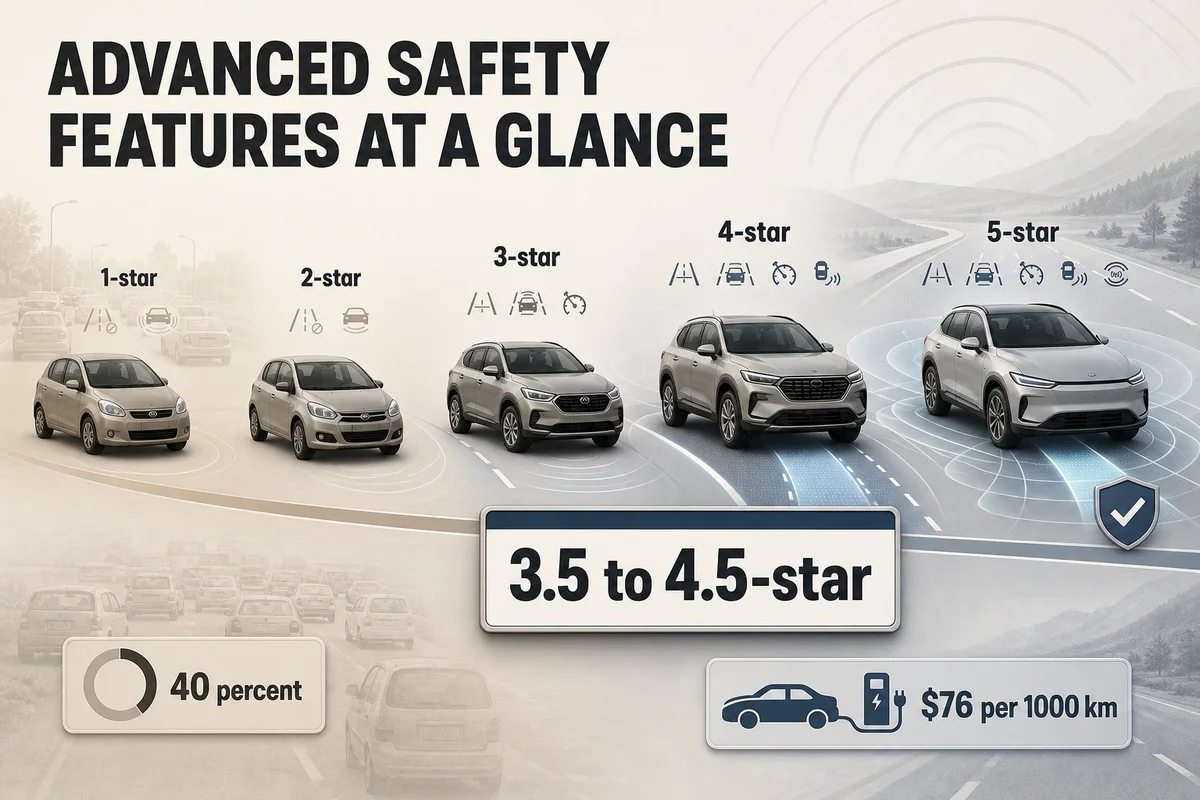
At the bottom end, a 1-star advanced safety score means the car has little or no meaningful driver-assistance tech beyond the basics you would expect on any modern vehicle, such as ABS and electronic stability control. In practical terms, this is the sort of vehicle where you are doing all the work yourself, with no automatic braking, no lane support, and no blind spot or cross-traffic help. That is still common in older used imports and cheaper older commercial vehicles on New Zealand roads. NZTA says about 40 percent of New Zealand’s light vehicles still have only 1 or 2-star safety ratings overall, which shows how old much of the fleet remains. (nzta.govt.nz)
A 2-star score usually means there is one useful feature, but not a full safety suite. You might get basic AEB, or perhaps only a reversing camera and parking sensors. That can help in town, but it is still a long way from the systems now expected in a strong modern family car. ANCAP has pushed hard for wider AEB fitment for years, and AEB is now a core part of modern Safety Assist testing. (ancap.com.au)
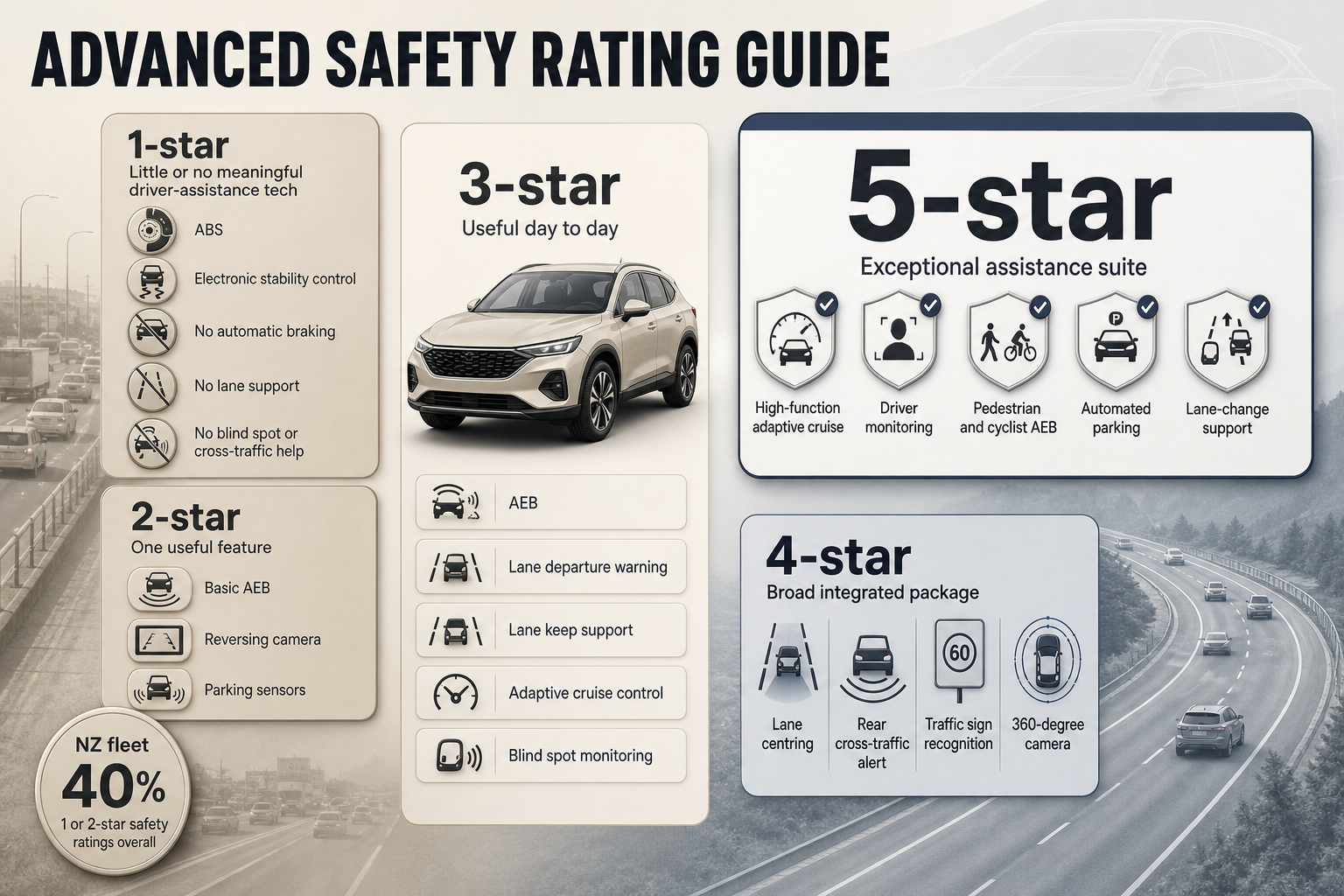
A 3-star score is where advanced safety starts to feel properly useful day to day. This is the level where you would expect key features such as AEB, lane departure warning or lane keep support, adaptive cruise control, and blind spot monitoring. For many buyers, this is the sensible minimum if you regularly drive between cities, commute on the Southern Motorway, or spend time in holiday traffic around Tauranga, Queenstown or the Kapiti Coast. Systems at this level can reduce the chance of a rear-end crash, help keep the car from drifting out of lane, and make long trips less tiring. ANCAP’s Safety Assist protocols specifically assess AEB, lane support, speed assistance and occupant status monitoring, which gives you a good clue about what separates average from strong performance. (ancap.com.au)
A 4-star score means the car has a broad and well-integrated package. On top of the basics, you are likely to see lane centring, rear cross-traffic alert, traffic sign recognition, and often a 360-degree camera. This is where the technology starts to feel genuinely polished rather than just present on the spec sheet. A good example from current ANCAP reports is the Mitsubishi Outlander, which includes AEB functions covering multiple scenarios, lane support and advanced speed assistance with speed sign recognition as standard. (ancap.com.au)
A 5-star advanced safety score is reserved for vehicles with an exceptional suite of assistance systems and strong real-world capability. That usually means a mature Level 2-style package with high-function adaptive cruise, lane centring that works well on the open road, driver monitoring, broader AEB coverage including pedestrians and cyclists, and sometimes automated parking or lane-change support. You should still think of this as assistance, not self-driving. Even the best systems are there to support you, not replace you. ANCAP’s recent reports on vehicles such as the Hyundai Kona, Skoda Enyaq and Smart #1 show how top-tier systems now combine broad AEB coverage, lane keeping, emergency lane keeping and advanced speed assistance as standard. (ancap.com.au)
What to Look For
Start by separating active safety tech from marketing language. Carmakers use different brand names for very similar systems, so do not rely on badges alone. Look for the actual feature list: AEB, adaptive cruise control, lane keep assist, blind spot monitoring, rear cross-traffic alert, traffic sign recognition, driver monitoring, and whether those systems are standard or optional on the exact variant you want. ANCAP safety reports and Rightcar are useful because they describe the equipment fitted to specific models and variants rather than the glossy brochure version. (ancap.com.au)
The next step is to check how well the systems work, not just whether they exist. A cheap lane departure warning system that only beeps after you cross the line is very different from a well-tuned lane centring system that gently helps keep the car settled on State Highway 1. The same goes for AEB. Better systems can detect not just cars ahead, but pedestrians, cyclists, junction conflicts and sometimes reversing hazards as well. ANCAP’s protocols and model reports make those distinctions clear, which is why two cars with similar brochures can feel very different on the road. (ancap.com.au)
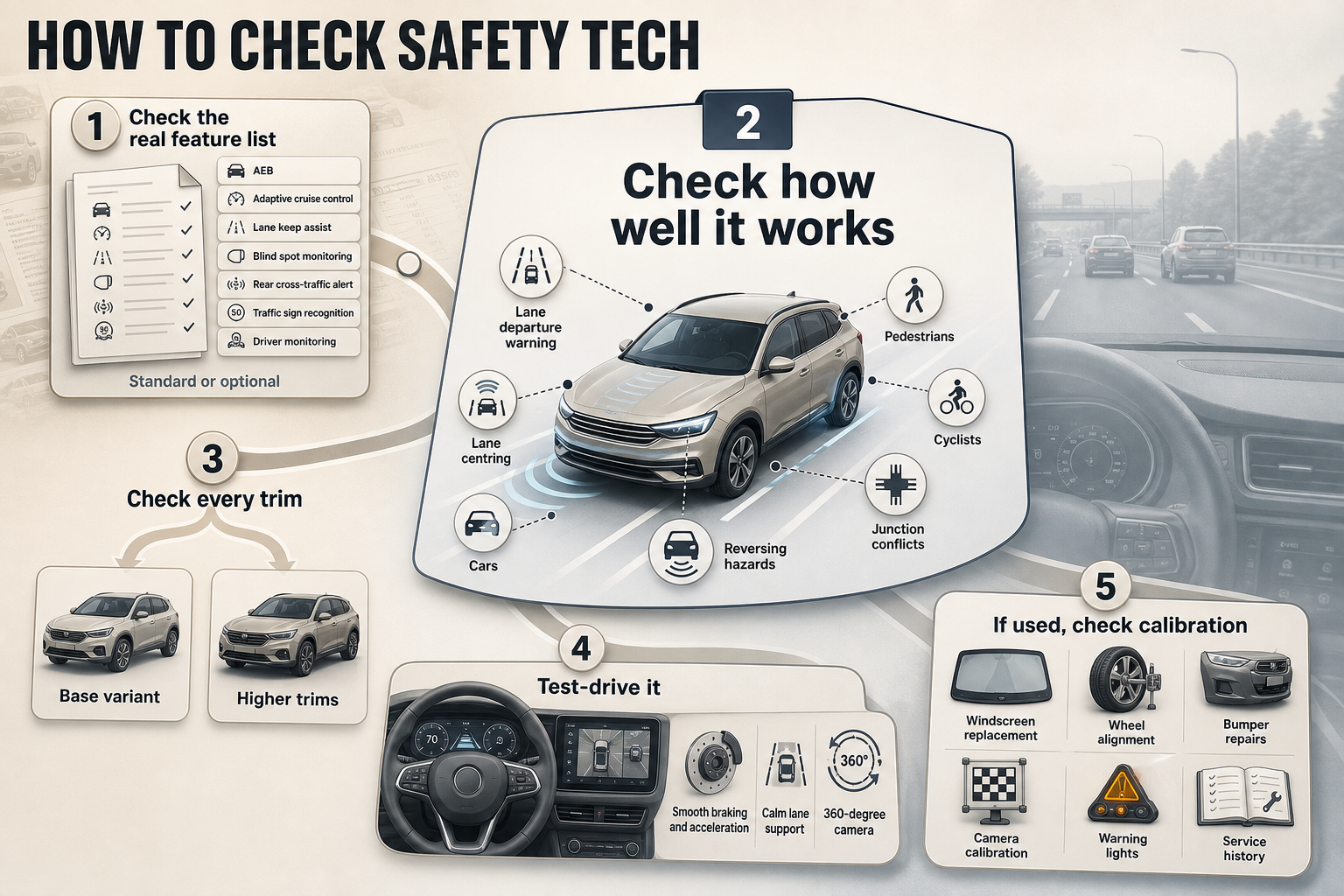
You should also check whether the features are standard across the range. This catches a lot of buyers out. Some entry variants miss blind spot monitoring, 360-degree cameras, adaptive cruise or driver monitoring, even though higher trims get them. ANCAP model pages often note when a feature is optional on base variants or unavailable on some trims. The Renault Master van is a good example of a vehicle where some active safety features are present, but key functions such as pedestrian and cyclist AEB, lane keep assistance and driver monitoring are missing, which drags down the result. (ancap.com.au)
Test-drive matters more here than it does for many other specs. On an Auckland motorway, a good adaptive cruise system should brake and accelerate smoothly rather than lurching. On a Waikato or Canterbury open-road drive, lane support should feel calm and predictable, not intrusive. In a tight supermarket car park, a 360-degree camera and rear cross-traffic alert can make daily life easier, especially in taller SUVs with thicker pillars.
If you are buying used, check whether the systems are still functioning properly. Windscreen replacement, wheel alignment, bumper repairs and camera calibration all matter. A car can have the right hardware on paper but perform poorly if a sensor is damaged or out of calibration. Ask for service history, scan for warning lights, and make sure the seller can show you the systems working.
NZ Context
New Zealand conditions make advanced safety more useful than many people think. Our roads often mix urban congestion, two-lane highways, poor weather, strong glare, gravel shoulders and long-distance holiday driving. AEB and blind spot monitoring help in city traffic, while adaptive cruise, lane support and driver monitoring are especially valuable on longer trips between centres such as Auckland and Wellington or Christchurch and Dunedin.
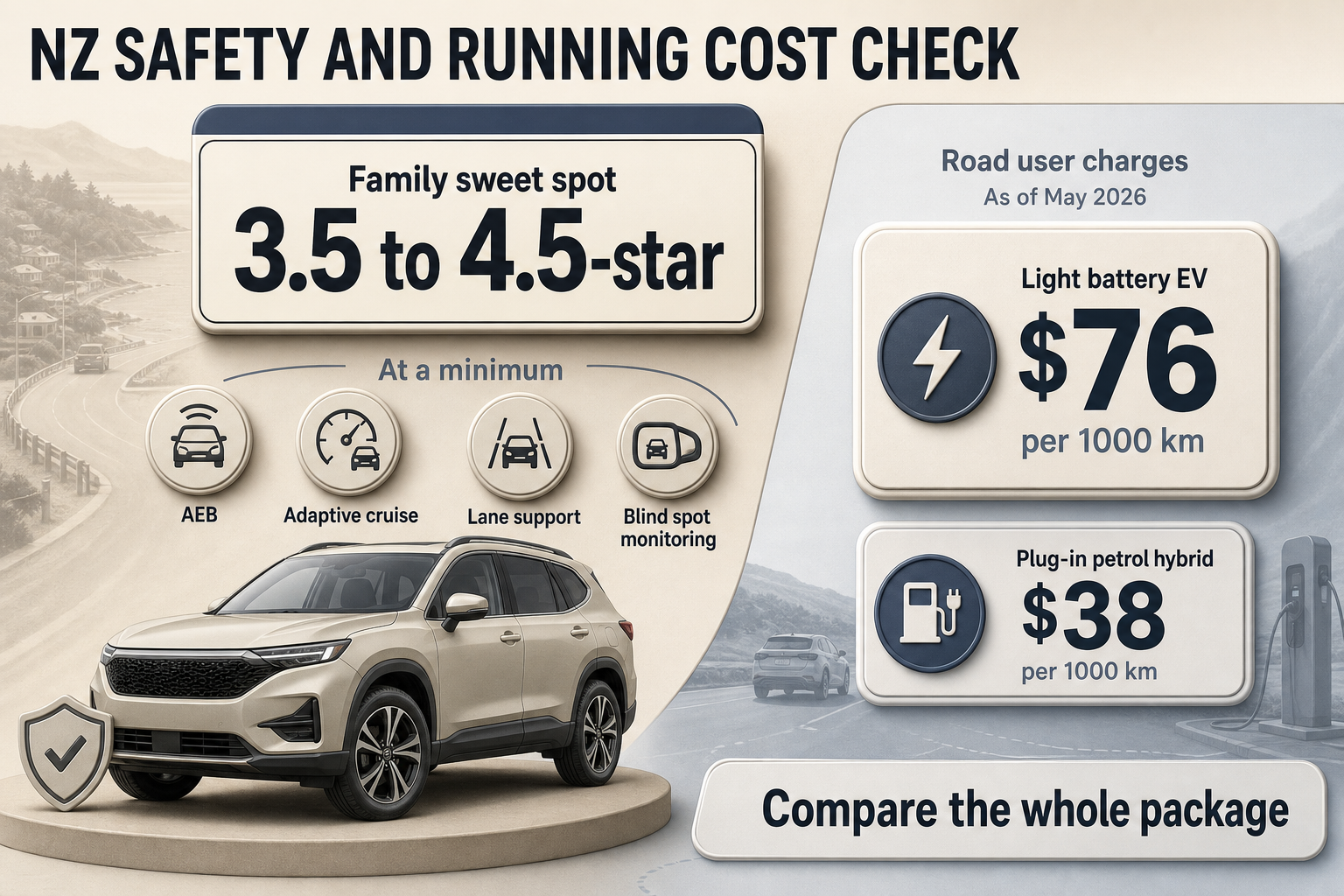
For families, the sweet spot is usually a solid 3.5 to 4.5-star advanced safety package. That gives you the features that genuinely reduce workload and improve crash avoidance without forcing you into the most expensive premium models. If you are shopping for a school-run SUV, family wagon or medium hatch, that is the range where you should expect AEB, adaptive cruise, lane support and blind spot monitoring at a minimum.
If you are looking at an EV or plug-in hybrid, do not let the powertrain distract you from the safety tech. Many newer EVs score strongly on Safety Assist, but not all do, and NZ running costs now include road user charges for light EVs and plug-in hybrids. As of May 2026, light battery EVs pay $76 per 1000 km and plug-in petrol hybrids pay $38 per 1000 km, so it is worth comparing the whole package rather than assuming a newer electrified model automatically gives you the best value. (nzta.govt.nz)
Commercial buyers should be stricter than they often are. Vans and utes spend long hours in traffic and on open roads, often with tired drivers and heavy workloads. ANCAP’s commercial van grading shows that some vans still lag badly in collision-avoidance tech, so a low advanced safety score in a work vehicle should ring alarm bells rather than being brushed off as normal for the segment. (ancap.com.au)
The final NZ-specific point is simple: use local tools. Rightcar lets you compare vehicle safety information relevant to the New Zealand fleet, and ANCAP remains the most useful independent reference for new and near-new models sold here. If a seller cannot clearly tell you which advanced safety features the exact car has, assume nothing and verify it yourself. (rightcar.govt.nz)
You may also be interested in these independent articles
Sources
© 2026 pyfoi. All rights reserved.