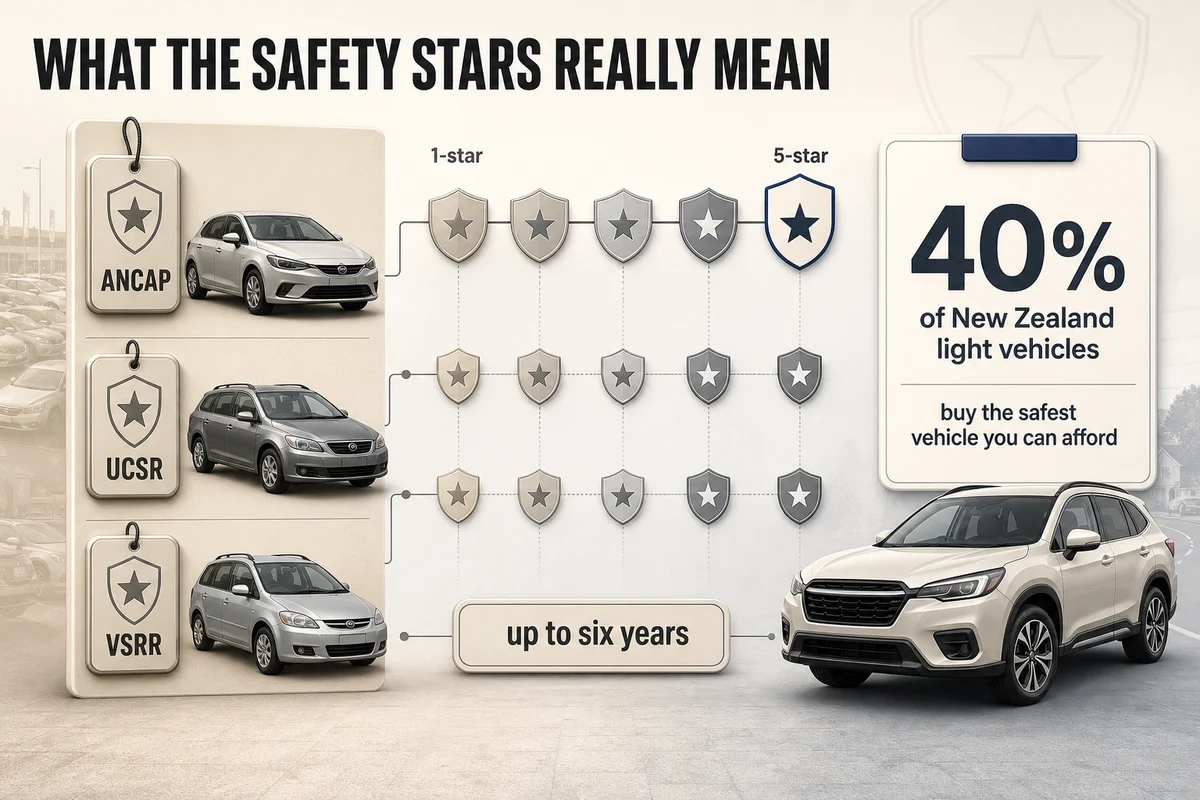

How to Read Vehicle Safety Ratings in NZ
Learn how ANCAP, UCSR and VSRR differ in New Zealand, why rating dates matter, and how to spot the safest used car before you buy.
A vehicle safety rating is a quick way to judge how well a car is likely to protect you and other road users in a crash. For New Zealand buyers, it matters because the same badge on the bonnet does not always mean the same level of protection, especially once you compare older used imports, NZ-new models, and vehicles with ratings from different years. (rightcar.govt.nz)
What the Rating Measures
In New Zealand, the best-known safety stars usually come from ANCAP for newer vehicles and from Rightcar’s used-vehicle safety systems for older cars. ANCAP is based on controlled crash testing and also looks at crash-avoidance technology such as autonomous emergency braking, lane support systems, and protection for adults, children, pedestrians, cyclists, and motorcyclists. (rightcar.govt.nz)
For used cars, Rightcar may show a Used Car Safety Rating, known as UCSR, or a Vehicle Safety Risk Rating, known as VSRR. UCSR uses real-world crash data for a specific make and model, while VSRR uses crash data from similar vehicles when there is not enough model-specific data. Both are designed to show how well a vehicle is likely to protect people in a crash, but they do not directly measure how likely you are to avoid a crash in the first place. (rightcar.govt.nz)
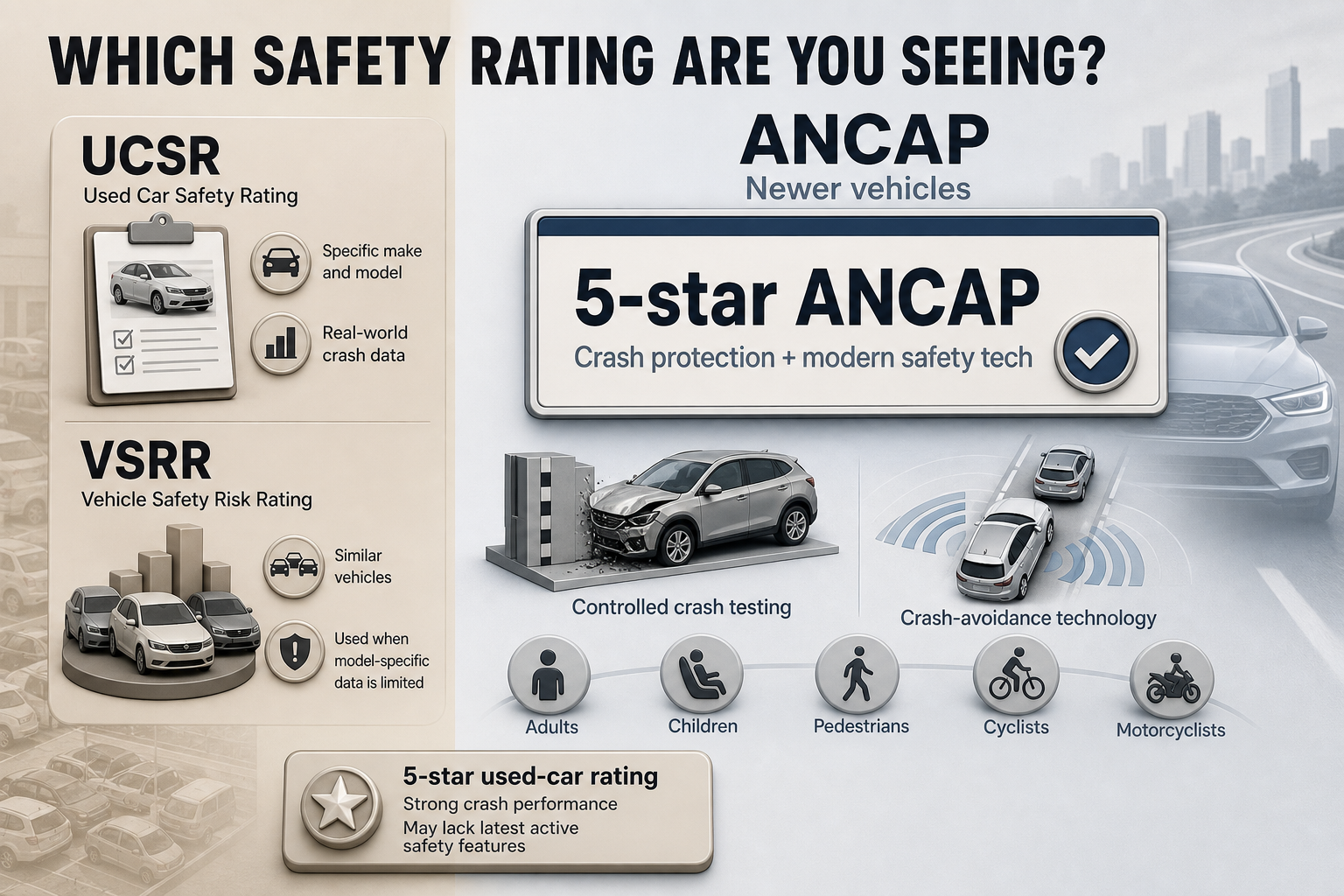
That is why a simple 5-star score needs context. A current 5-star ANCAP result on a new model usually means strong crash protection plus modern driver-assistance tech. A 5-star used-car rating may reflect strong real-world crash performance, but it may not mean the car has the latest active safety features you now see on newer models. (rightcar.govt.nz)
What Goes Into the Rating
A 1-star vehicle is usually one that offers poor protection by modern standards. In practical terms, that often means an older design, weaker crash structure, fewer airbags, and little or no electronic crash-avoidance technology. At the other end, a 5-star vehicle combines strong body structure, effective restraint systems, and active safety features that can help prevent or reduce the severity of a crash. (rightcar.govt.nz)
For ANCAP, the difference between low and high scores is not just about surviving an impact. The rating also reflects how well the vehicle protects children, how it treats vulnerable road users outside the car, and whether its driver-assistance systems perform well enough to earn points. Features such as autonomous emergency braking, lane keep assist, speed assistance, and blind-spot support can make a meaningful difference, particularly on busy urban roads and motorways. (rightcar.govt.nz)
For used-car ratings, the ingredients are different. Rightcar says UCSR and VSRR are built from analysis of more than 8 million vehicles involved in police-reported crashes across New Zealand and Australia, with factors such as size, weight, design, safety features, crash location, speed limit, driver age, and crash year taken into account. That makes them useful for judging older vehicles that were never tested under the latest ANCAP protocols. (rightcar.govt.nz)
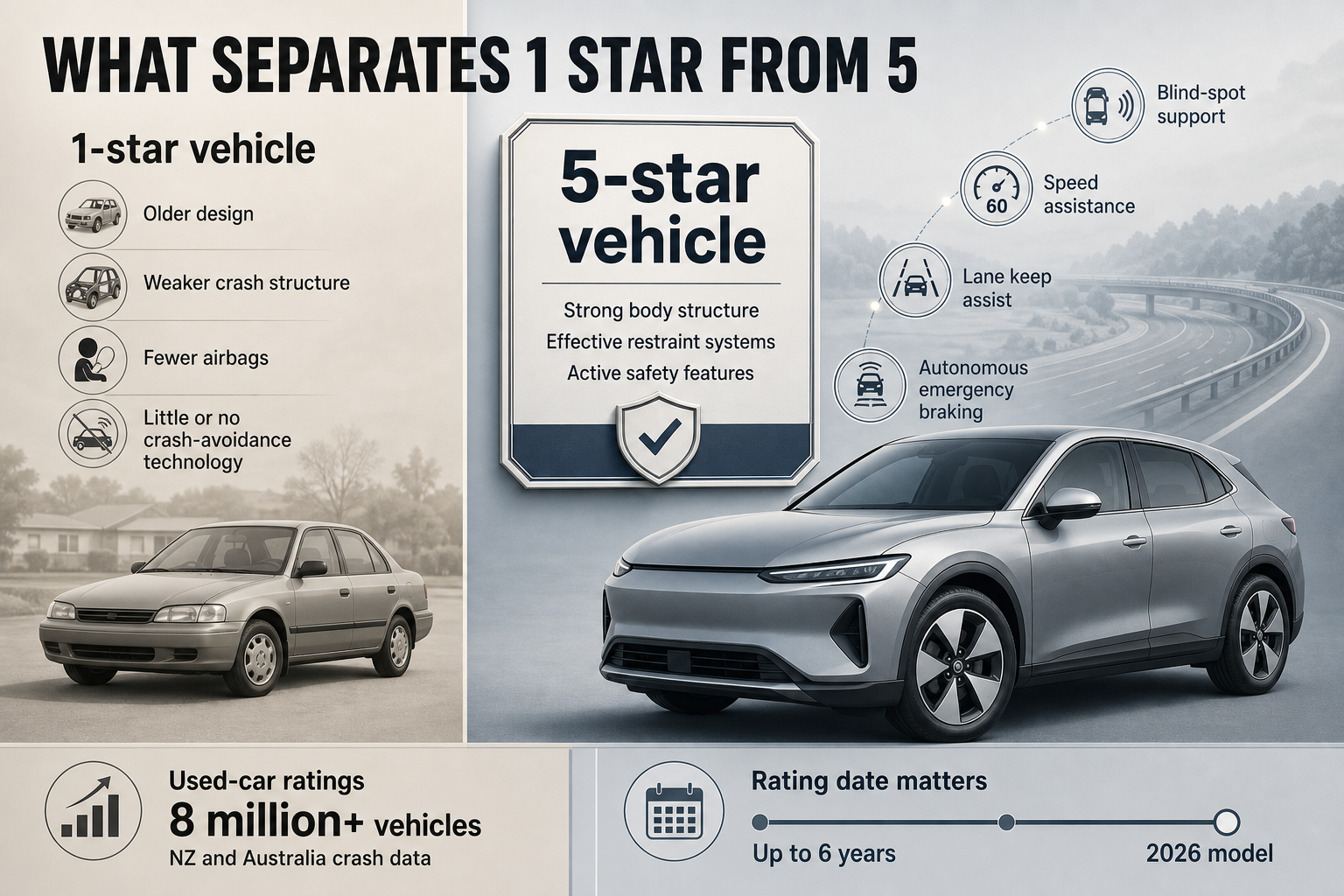
One detail many buyers miss is the rating date. ANCAP ratings are generally applied for up to six years from first publication, after which the vehicle shifts to other rating schemes on Rightcar. Rightcar also notes that annual safety ratings can change over time as more crash data becomes available and as the fleet gets safer overall. A 5-star result from years ago is still helpful, but it does not automatically equal a fresh 5-star result on a 2026 model. (rightcar.govt.nz)
What to Look For
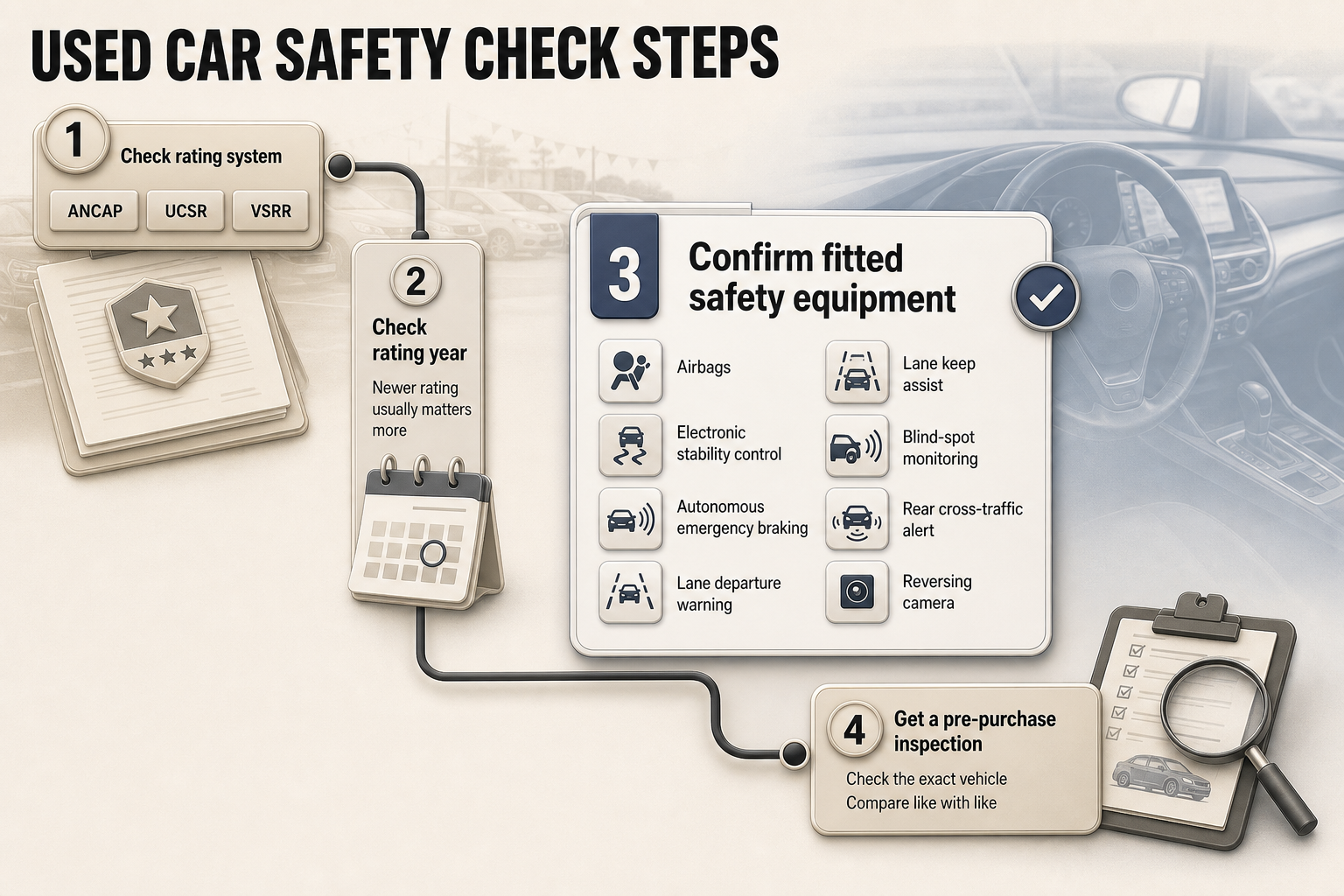
Start by checking which rating system you are actually looking at. If the car is relatively new and NZ-new, you may see an ANCAP result. If it is older or a used import, you are more likely to see a Rightcar used-car rating. The stars may look similar, but the way they were produced is different, so compare like with like where possible. (rightcar.govt.nz)
Next, check the year of the rating. This matters because safety standards move quickly. A car that earned 5 stars under an older test regime may lack features that are now common even in mainstream small SUVs and hatchbacks, such as cyclist-detecting AEB or lane-centring support. If you are choosing between two cars with the same star score, the newer rating usually deserves closer attention. (rightcar.govt.nz)
You should also look beyond the headline stars and ask what safety equipment is actually fitted to the exact vehicle you are buying. Imported variants can differ from NZ-new versions, and lower trim levels may miss key features. Check for airbags, electronic stability control, autonomous emergency braking, lane departure warning, lane keep assist, blind-spot monitoring, rear cross-traffic alert, and a reversing camera at minimum. Rightcar recommends checking the current rating on its website, and Consumer Protection also points buyers to Rightcar as part of a used-car checklist. (rightcar.govt.nz)
For family buyers, active safety is especially worth paying for. School-run traffic, motorway merging in Auckland, wet winter roads, and long holiday trips all raise the value of systems that can spot a stopped car ahead or help keep the vehicle stable if you need to react suddenly. If you drive on rural two-lane roads, where head-on and run-off-road crashes are a real risk, stronger crash structure and lane-support systems matter even more. This is an inference from how ANCAP and Rightcar describe crash protection and crash avoidance, combined with NZ road conditions. (rightcar.govt.nz)
A pre-purchase inspection still matters, even with a strong rating. Rightcar says ratings are only an indication of how well a vehicle is likely to perform in a crash, and Consumer Protection encourages pre-purchase inspections and background checks. A previously damaged or poorly repaired vehicle may no longer offer the protection its original rating suggests. (rightcar.govt.nz)
NZ Context
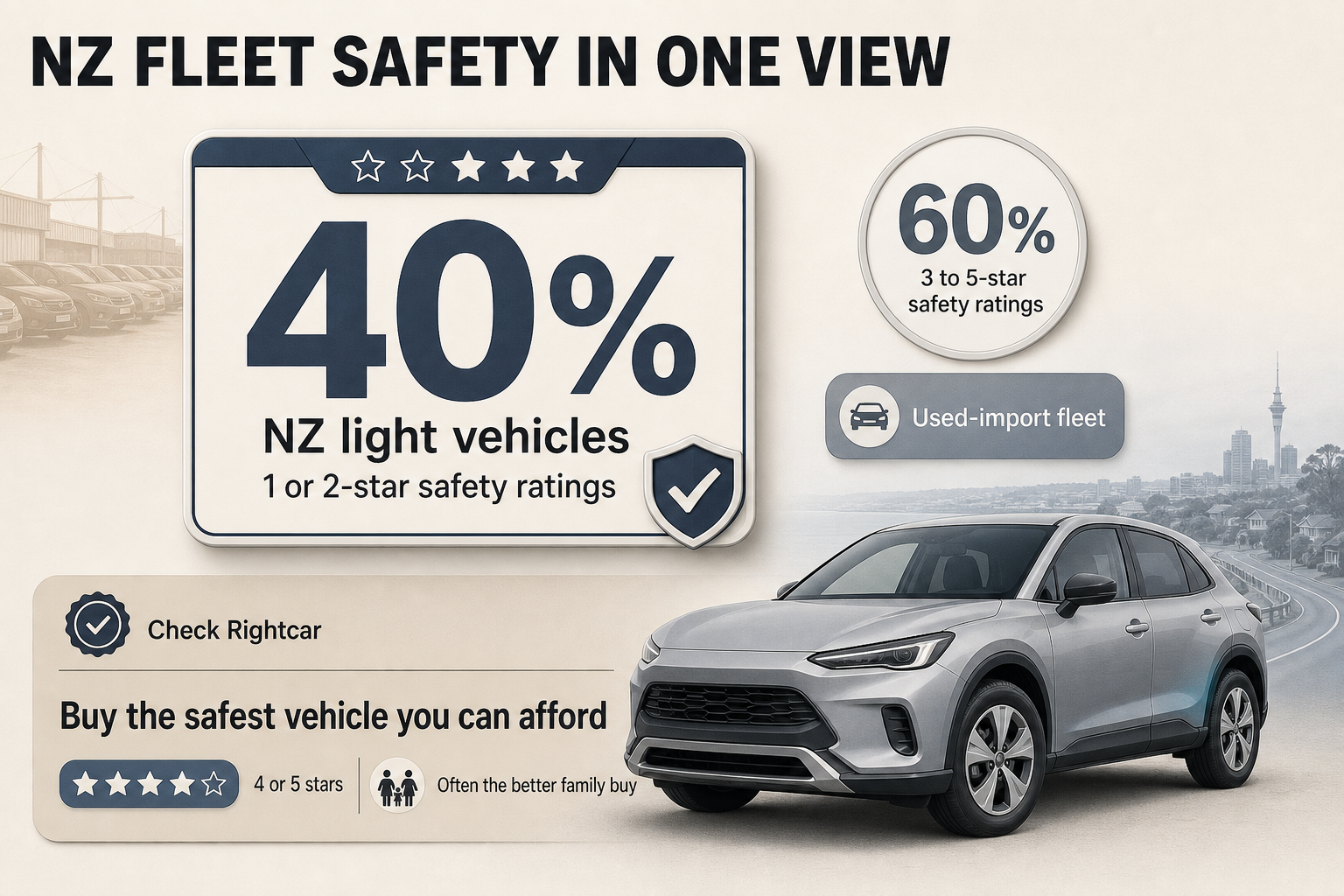
New Zealand has a large used-import fleet, so safety ratings matter here more than many buyers realise. NZTA says about 40% of New Zealand light vehicles have 1 or 2-star safety ratings, which shows how many older, less protective vehicles are still on our roads. That is a strong argument for making safety stars one of your first filters, not an afterthought. (nzta.govt.nz)
Rightcar is the easiest NZ-specific place to check a current rating because it brings together ANCAP, UCSR and VSRR information for the local market. Consumer Protection also directs used-car buyers to Rightcar, and dealers must provide accurate information on a Consumer Information Notice for used vehicles. The CIN includes important vehicle history details, though you should still verify the VIN and do your own checks. (consumerprotection.govt.nz)
If you buy from a dealer, the Consumer Guarantees Act gives you more protection than a private sale. Consumer Protection says goods sold by businesses in New Zealand must be of acceptable quality, which includes being safe, and dealers must not mislead you about the vehicle. That does not mean the law guarantees a 5-star car, but it does mean false claims about condition, features, or history can become a legal issue. (consumerprotection.govt.nz)
For imported used vehicles, NZTA requires compliance with relevant vehicle safety and emissions standards before the vehicle can be registered for use on New Zealand roads. That helps set a baseline, but compliance is not the same thing as a high safety rating. A car can be legal to register and still be a poor choice compared with a newer 4 or 5-star alternative. (nzta.govt.nz)
If your budget is tight, the smartest move is usually to buy the newest, highest-rated car you can reasonably afford rather than stretching for a larger or more prestigious model with weaker safety. In NZ terms, that often means a later-model small hatch, wagon, or compact SUV with 4 or 5 stars will be a better family buy than an older large sedan or SUV with a lower rating. Rightcar’s own advice is simple: buy the safest vehicle you can afford. (rightcar.govt.nz)
You may also be interested in these independent articles
Sources
- [1]Rightcar NZ: Safety ratings
- [2]Rightcar NZ: Vehicle safety and environmental ratings 2022 PDF
- [3]Rightcar NZ: Check vehicle safety and environmental ratings 2023 PDF
- [4]NZ Transport Agency Waka Kotahi: Vehicle safety
- [5]Consumer Protection NZ: Before buying a used car
- [6]Consumer Protection NZ: Buying a car from a dealer
- [7]Consumer Protection NZ: Consumer Guarantees Act
- [8]NZ Transport Agency Waka Kotahi: Importing a used vehicle
© 2026 pyfoi. All rights reserved.