
What a Parts & Service Rating Means in NZ
A Parts & Service rating can make or break car ownership in NZ. Learn how parts availability, service networks and repair delays affect costs.
A vehicle’s Parts & Service rating is a simple way to judge how easy it is likely to be to keep that car on the road. It reflects how strong the brand’s support network is, how available parts are, and how straightforward servicing and repairs should be in New Zealand.
That matters more than many buyers expect. A cheap car can become expensive if it sits off the road for three weeks waiting for a sensor, a headlight, or a hybrid battery component to arrive.
What Goes Into the Rating
A Parts & Service rating usually rolls several real-world ownership factors into one score. The big ones are parts availability, the size and spread of the service network, repair turnaround times, technical support, and the likely cost and complexity of routine maintenance.
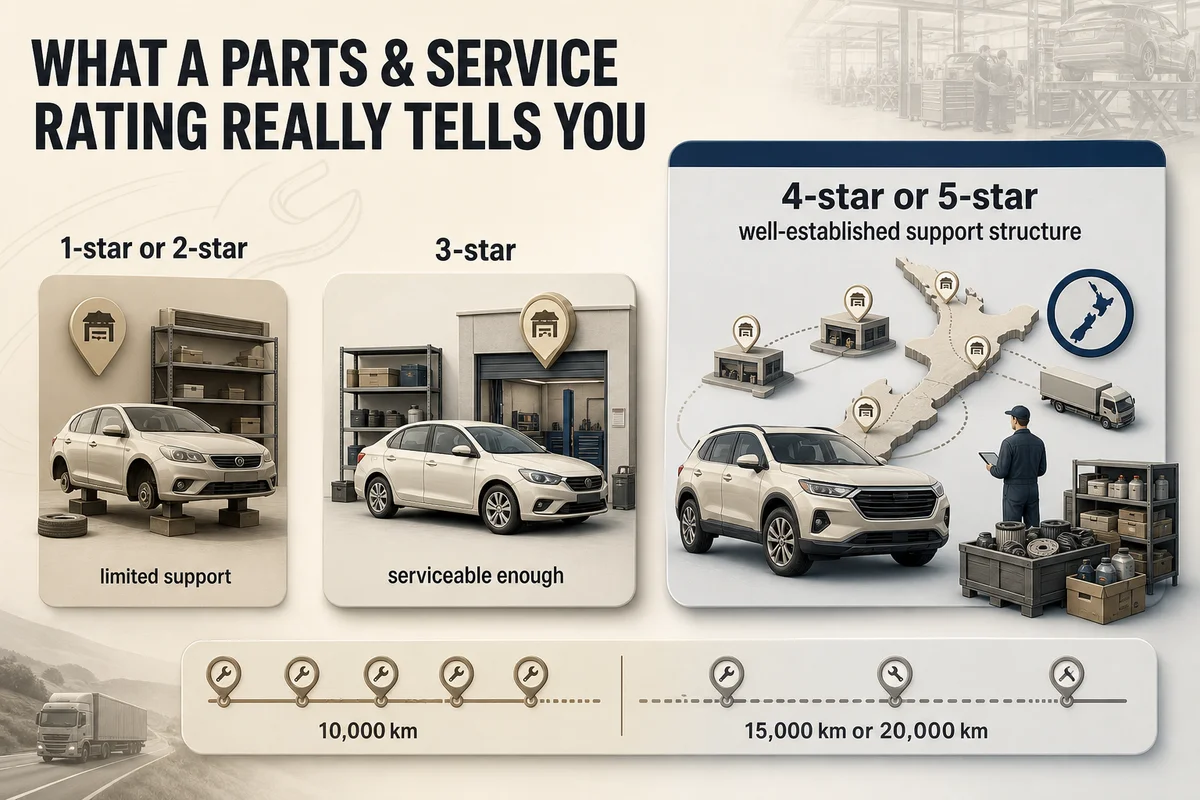
At the low end of the scale, a 1-star or 2-star result often points to limited support. That might mean a small dealer footprint, patchy stock of common service items, longer waits for crash parts or specialist components, or a brand that relies heavily on overseas supply for even basic items. This can be more common with niche imports, orphaned brands, grey imports, or vehicles with unusual drivetrains and low sales volume.
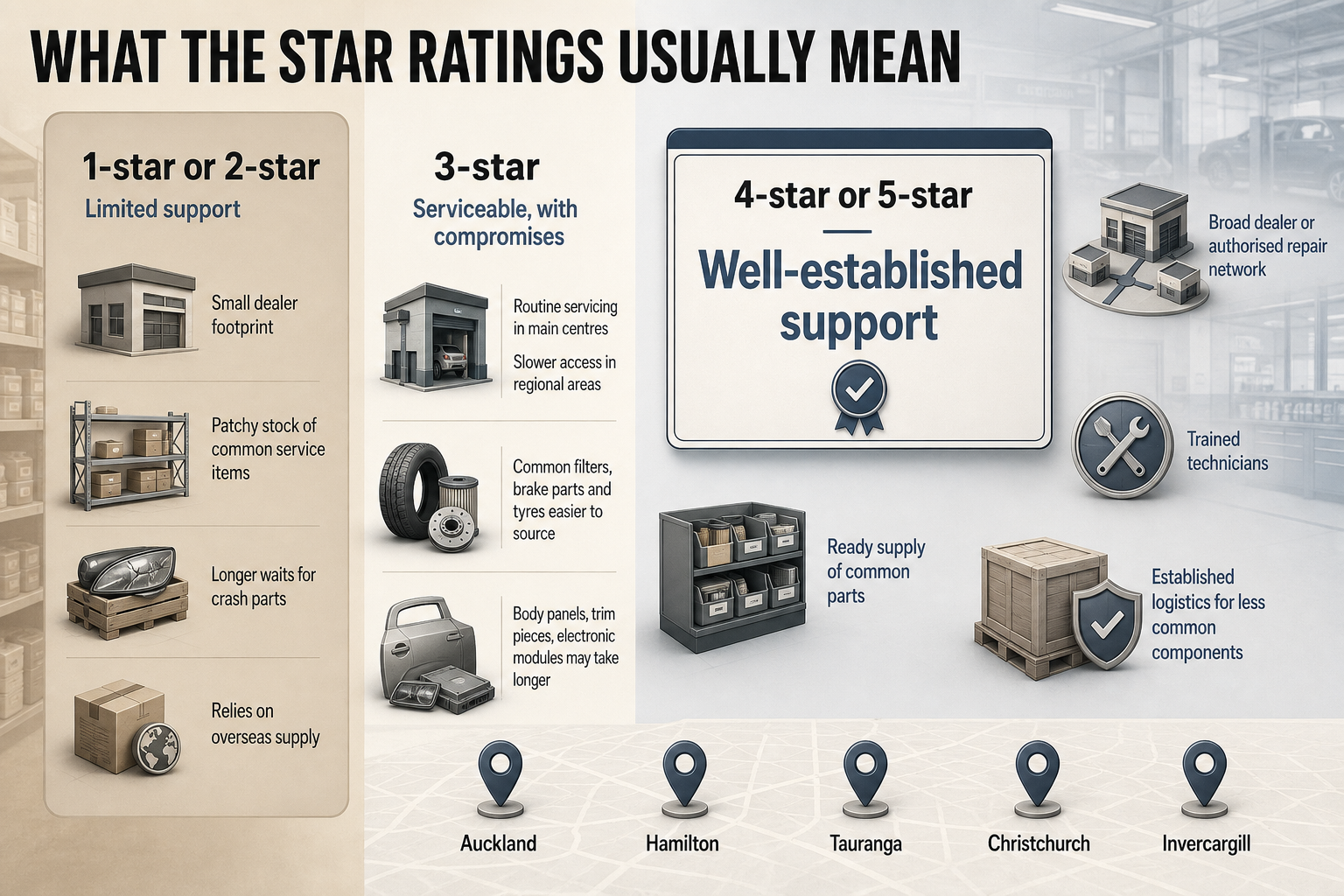
A mid-range 3-star result often means the car is serviceable enough, but with a few compromises. You may have decent access to routine servicing in the main centres, but slower access in regional areas. Common filters, brake parts and tyres may be easy to source, while body panels, trim pieces, electronic modules or model-specific hybrid and EV parts may take longer.
A strong 4-star or 5-star rating usually means there is a well-established support structure behind the vehicle. That often includes a broad dealer or authorised repair network, trained technicians, ready supply of common parts, and established logistics for less common components. For many mainstream brands sold new in New Zealand, this is one of the biggest ownership advantages over obscure alternatives.
The difference between ratings is not only about convenience. It can affect resale value as well. Buyers tend to pay more for vehicles they believe will be easy to service in Hamilton, Christchurch, Tauranga or Invercargill, not just in Auckland. The Motor Industry Association represents New Zealand’s new vehicle sector, and brands with strong official presence here generally have an easier path to nationwide support than brands with little or no formal footprint. (mia.org.nz)
What to Look For
Start by checking whether the brand has an official New Zealand distributor and a genuine service network. That sounds obvious, but it matters. A car with a proper local importer is more likely to have technical bulletins, trained staff, software support, and a stocked pipeline of parts than a vehicle brought in through scattered channels.
Next, look beyond the number of dealerships on a map. Ask where your nearest authorised workshop is, how long routine bookings take, and whether the workshop can handle your exact powertrain. This is especially important for hybrids, plug-in hybrids, EVs, diesels with emissions hardware, and European luxury models with brand-specific diagnostic systems.
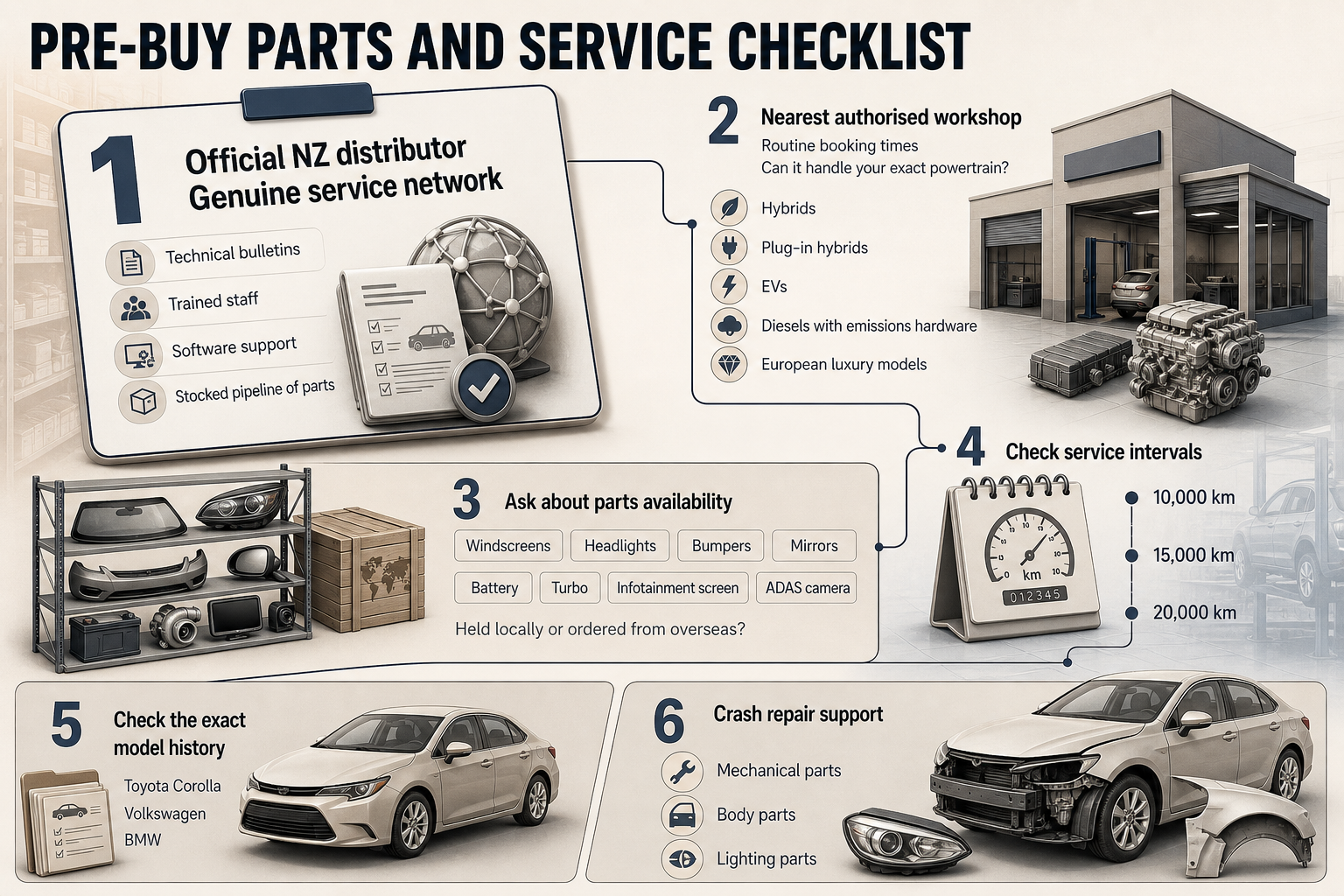
You should also ask a dealer or seller a few direct questions before you buy. How long do common service parts usually take? Are windscreens, headlights, bumpers and mirrors stocked in New Zealand? If a battery, turbo, infotainment screen or ADAS camera fails, is that part normally held locally or ordered from overseas? A good seller should be able to answer clearly, or at least explain the process.
Service intervals matter too. A vehicle that needs servicing every 10,000 km with expensive oil and specialist consumables may be less convenient than one that stretches to 15,000 km or 20,000 km with widely available parts. The rating is not just about whether repairs are possible. It is also about how much friction there is in normal ownership.
For used vehicles, check the history of the exact model rather than relying only on the badge. A Toyota Corolla sold new in New Zealand usually has excellent parts support. A low-volume Japanese import with uncommon trim, lighting or safety systems may not. The same applies to European cars. A popular Volkswagen or BMW may be manageable in the main centres, while a rare variant can become a waiting game.
Crash repair support is another overlooked area. Mechanical service parts are one thing, but body and lighting parts can be the real test. If you live in a smaller centre and rely on the car daily, a strong Parts & Service rating can save serious frustration after even a minor parking scrape.
NZ Context
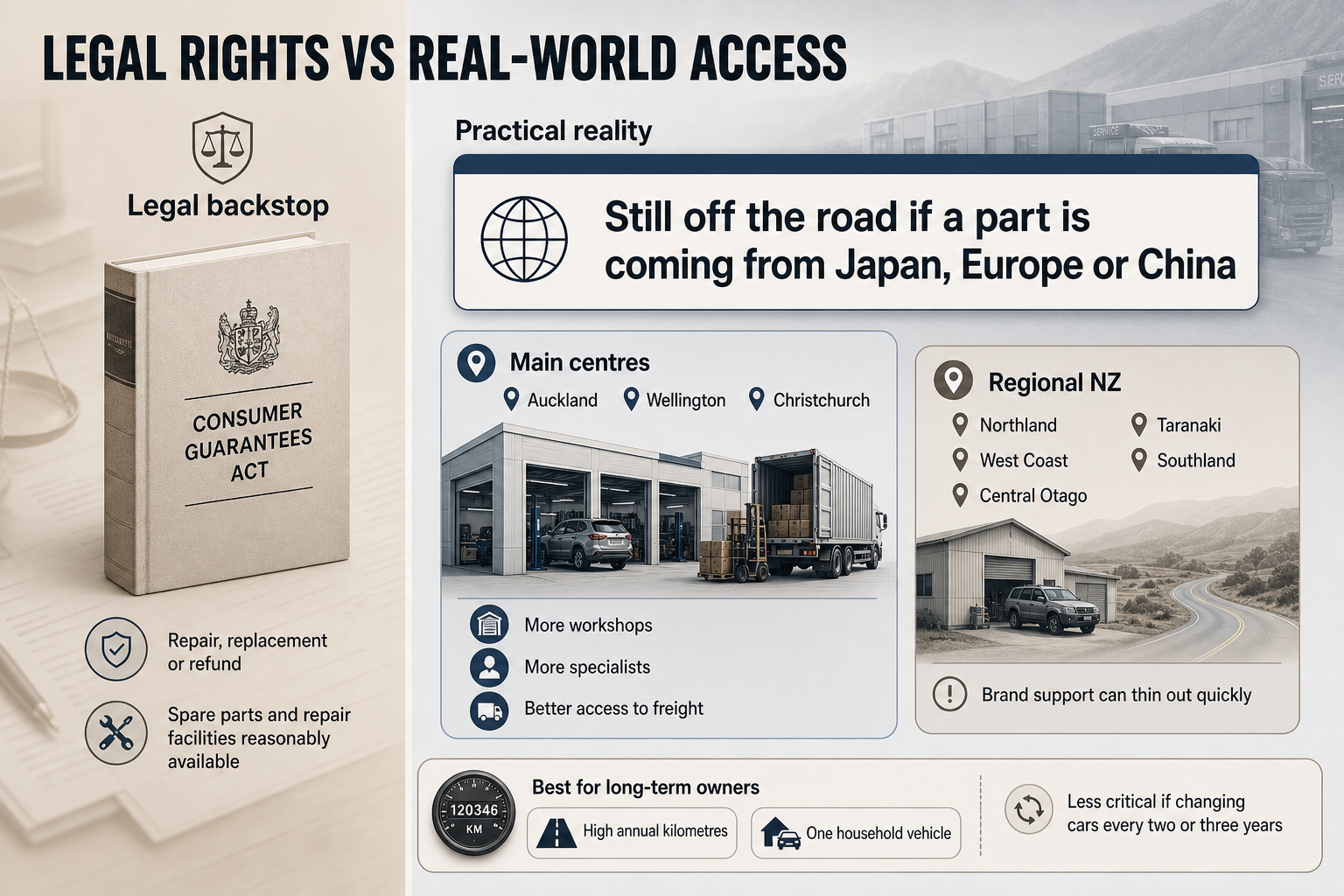
New Zealand law gives you some useful protection, but it does not remove the practical value of a good Parts & Service rating. Under the Consumer Guarantees Act, goods and services bought from businesses must meet guarantees, and remedies must be provided within a reasonable time. The law also says manufacturers, importers and distributors must ensure spare parts and repair facilities are reasonably available for vehicles they assemble or import, unless they tell you otherwise. (consumerprotection.govt.nz)
That is an important backstop, especially if a dealer tries to shrug off a problem. If a product is faulty, you may be entitled to repair, replacement or refund, and manufacturer warranties sit on top of your CGA rights rather than replacing them. (consumerprotection.govt.nz)
Still, legal rights do not always mean instant mobility. If your vehicle is waiting on a part from Japan, Europe or China, you may still be off the road while the issue is sorted. That is why the practical side of the rating matters so much for NZ buyers, particularly outside the main cities.
Geography is a big factor here. In Auckland, Wellington and Christchurch, you have more workshops, more specialists and better access to freight. In regional New Zealand, brand support can thin out quickly. If you live in Northland, Taranaki, the West Coast, Southland or Central Otago, a mainstream model with broad support can make ownership much easier.
Electrified vehicles add another layer. EVs often need less routine servicing than petrol or diesel cars, but when something does go wrong, you may need brand-trained technicians, software tools and NZ-compliant charging equipment. EECA advises that EV charging equipment supplied with a vehicle should be designed for use in New Zealand, including the correct voltage range and plug standard. EECA also notes that home charging is the most common charging method for NZ EV owners, which means charger compatibility and support are part of the ownership picture too. (eeca.govt.nz)
Safety technology can also affect serviceability. Modern vehicles increasingly use cameras, radar sensors and calibration procedures after windscreen replacement or crash repair. A car may have an excellent safety reputation, but if local workshops lack the tools or training to recalibrate those systems properly, ownership becomes less convenient. That is one reason to prefer models with established NZ support, especially if advanced driver assistance features are a priority. ANCAP safety ratings are widely used in New Zealand, but strong safety tech is easiest to live with when the local repair network can support it properly. (nzta.govt.nz)
A high Parts & Service rating is most valuable if you keep cars for a long time, drive high annual kilometres, live outside a main centre, or depend on one household vehicle for everything from school runs to ski trips and summer towing. If you change cars every two or three years and stay within a franchise warranty period, you may tolerate a slightly weaker rating. Most private buyers, though, are better off treating this rating as a core ownership cost factor, not a minor detail.
You may also be interested in these independent articles
Sources
- [1]Consumer Guarantees Act | Consumer Protection
- [2]Warranties | Consumer Protection
- [3]Solving issues with your car dealer | Consumer Protection
- [4]Consumer Guarantees Act 1993, as at 24 January 2026 | New Zealand Legislation
- [5]Motor Industry Association | New Zealand
- [6]How to charge your EV at home and on the road | EECA
- [7]EV charging research 2025 | EECA
- [8]Buying a car? Vehicle safety and environmental ratings | NZTA
© 2026 pyfoi. All rights reserved.