
Tow Capacity Explained for New Zealand Buyers
Tow capacity in NZ is more than a headline kg figure. Learn braked towing limits, real trailer matches, and the rules that catch buyers out.
Tow capacity is the maximum trailer weight a vehicle is designed to pull safely. For New Zealand buyers, it matters because a tow rating that looks fine on paper can feel very different once you add a boat at the ramp, a tandem-axle caravan on SH1, or a loaded trailer on a gravel road.
What the Numbers Mean
Tow capacity is usually listed in kilograms, and for buyer comparisons you should focus on the braked towing figure. That means the trailer has its own brakes helping the tow vehicle slow down. This is the number most dealers and spec sheets use when they talk about serious towing ability, and it is the figure most relevant if you are towing a boat, horse float, car trailer, or medium to large caravan. The AA’s towing tables also separate unbraked and braked figures, with the braked number sourced from NZ distributor spec sheets. (aa.co.nz)
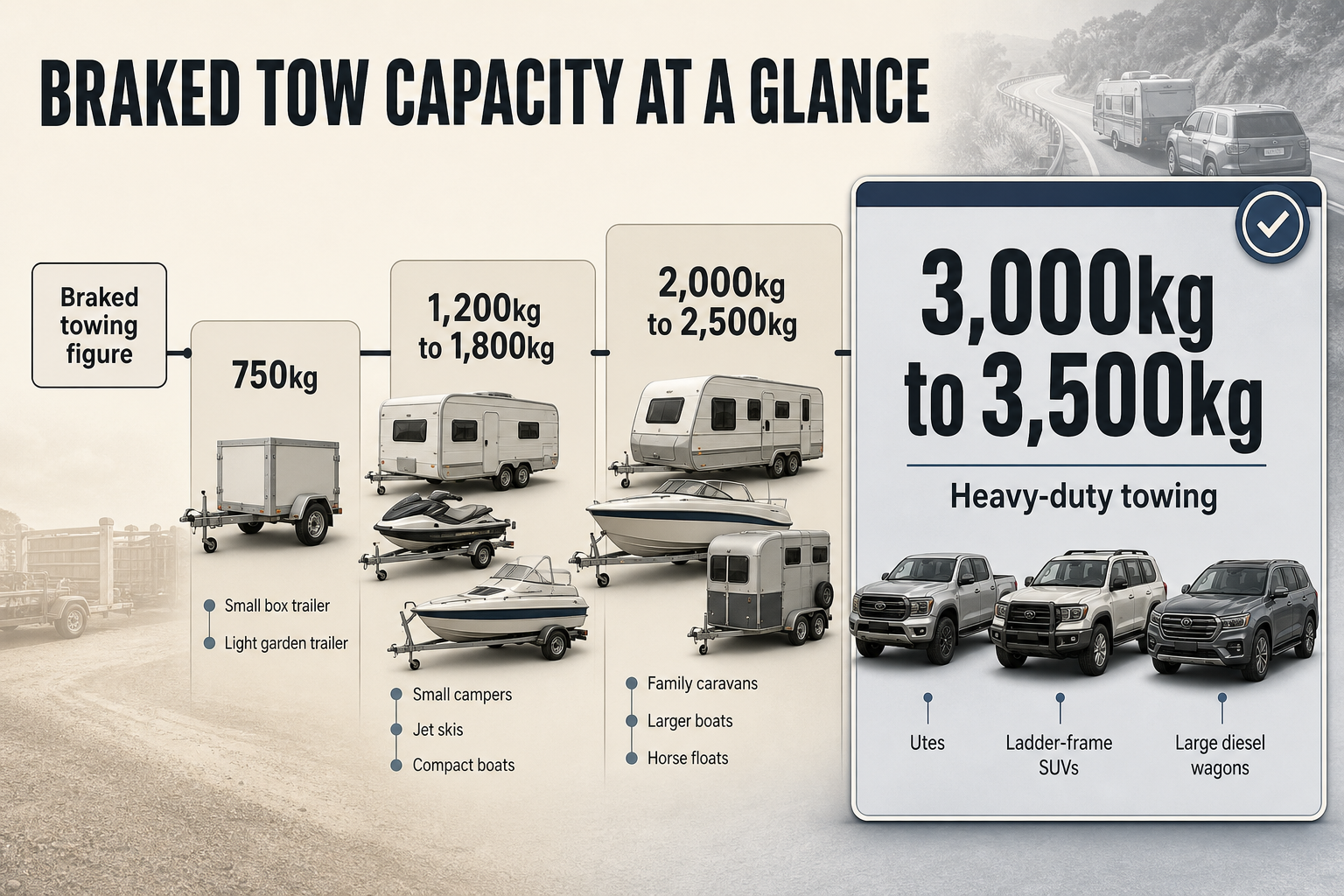
In practical terms, 750kg is a small box trailer or light garden trailer. Around 1,200kg to 1,800kg covers many small campers, jet skis on a trailer, and some compact boats. Around 2,000kg to 2,500kg is where many family caravans, larger boats, and horse floats begin. At 3,000kg to 3,500kg, you are in proper heavy-duty territory, usually the domain of utes, ladder-frame SUVs, and a few large diesel wagons. The exact real-world load depends on the trailer itself, fuel, water, gear, and passengers, not just the empty advertised weight. (aa.co.nz)
The tow rating is not the whole story. You also need to think about payload, towball download, Gross Combined Mass if the manufacturer specifies it, and how the vehicle behaves under load. A vehicle may be rated to pull 3,500kg, but once you fill the cabin with five people, luggage, a canopy, and recovery gear, you may run into other limits before you reach that headline number. That is why the owner’s manual matters more than a sales listing. The NZ Transport Agency also notes that manufacturers provide tow ratings for braked and unbraked trailers, and recommends those ratings be taken into account. (nzta.govt.nz)
Typical Ranges
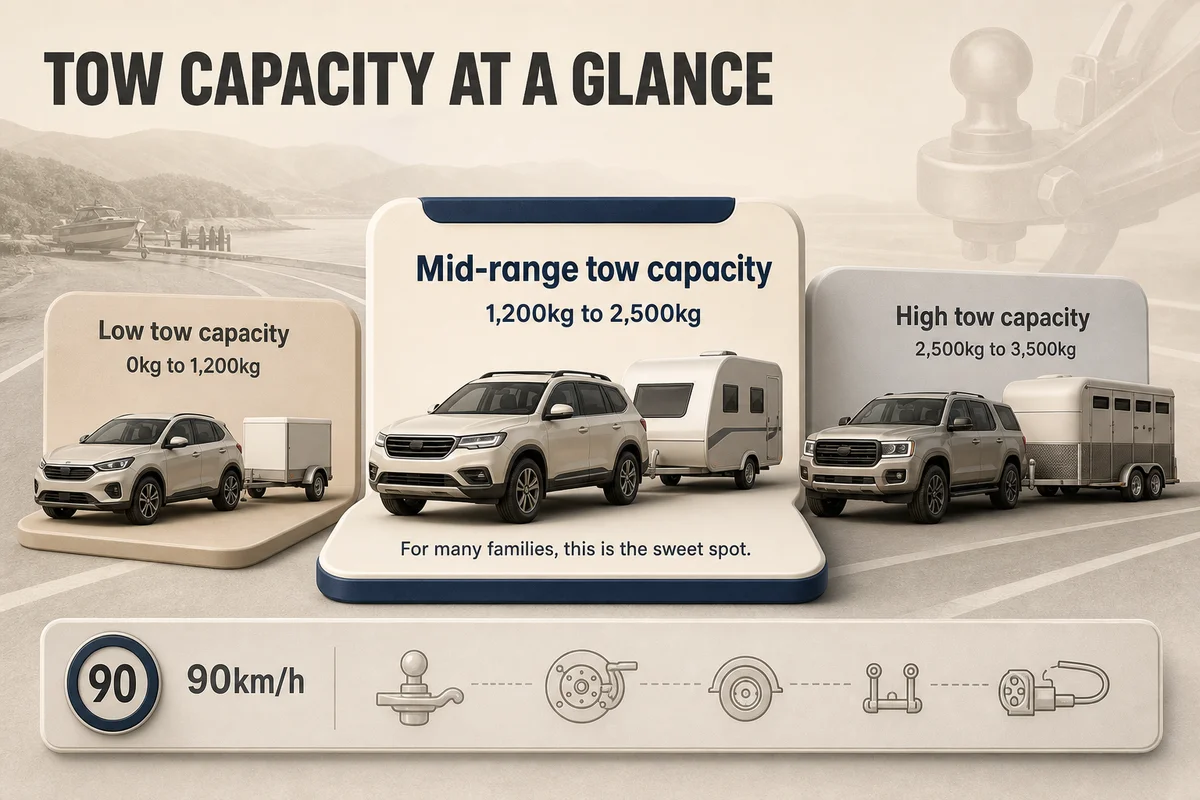
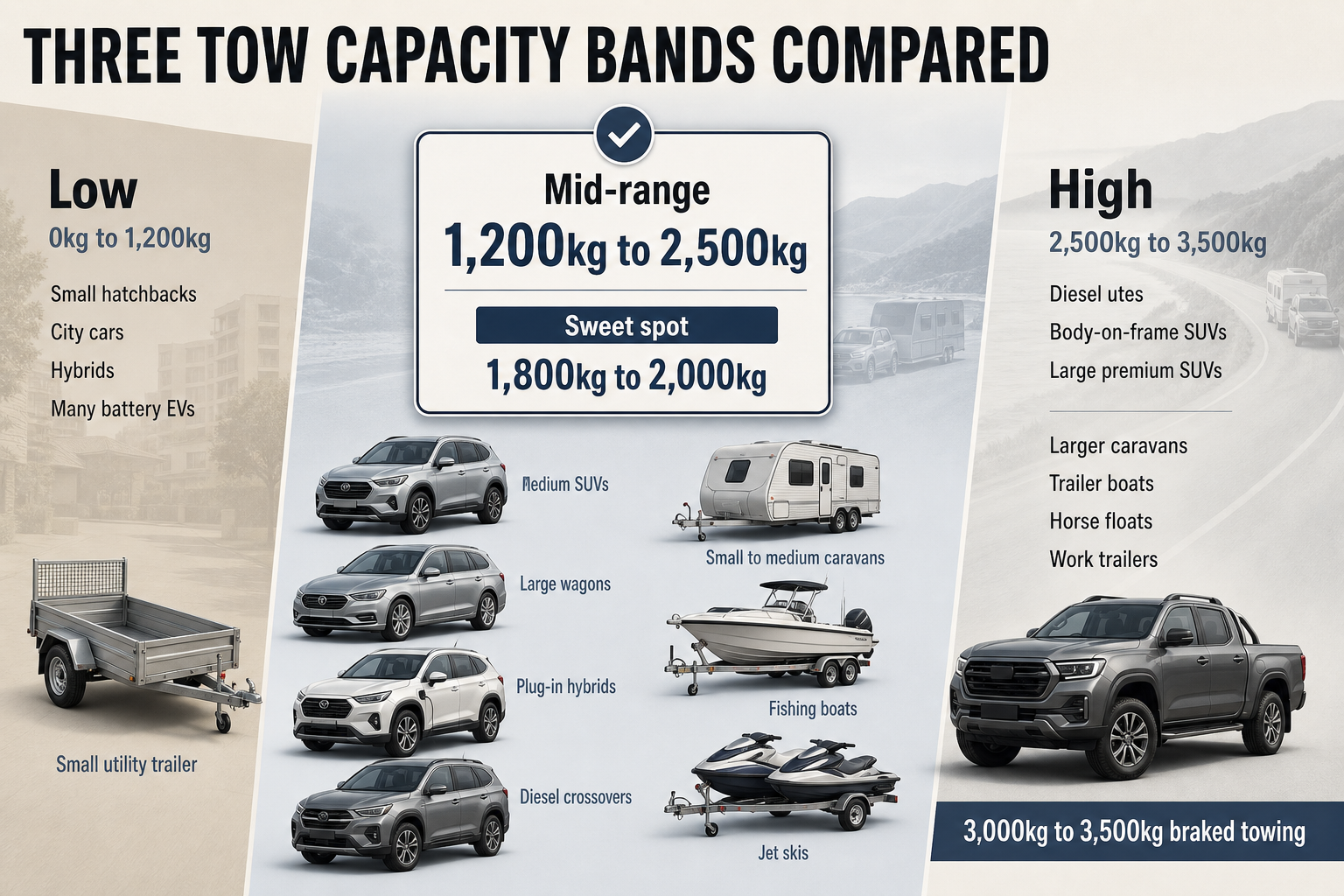
Low tow capacity: 0kg to 1,200kg
This is common in small hatchbacks, city cars, hybrids, and many battery EVs. Some vehicles in this group are not rated for towing at all, while others can manage a light braked trailer. If your towing is limited to a small utility trailer for dump runs, bikes, or occasional landscaping gear, this can be enough. It is not the right range for a serious caravan, a big alloy boat, or frequent towing over the Kaimai Range or Lindis Pass.
For many Auckland and Wellington buyers, low tow capacity is not a problem because they rarely tow. It only becomes an issue when a cheap small car suddenly needs to handle holiday duties it was never designed for.
Mid-range tow capacity: 1,200kg to 2,500kg
This is the broad middle ground and suits a lot of Kiwi use. You will find it in medium SUVs, some large wagons, plug-in hybrids, and a few diesel crossovers. This range works for small to medium caravans, modest fishing boats, a pair of jet skis, or a braked trailer loaded for DIY projects.
For many families, this is the sweet spot. You get enough towing ability for weekend use without stepping into a thirsty ute or a large truck-based SUV. If your trailer only comes out a few times each summer, 1,800kg to 2,000kg may be all you need.
High tow capacity: 2,500kg to 3,500kg
This is where purpose-built tow vehicles live. Most modern diesel utes, some body-on-frame SUVs, and a handful of large premium SUVs offer 3,000kg to 3,500kg braked towing. This range suits larger caravans, heavier trailer boats, horse floats, and work trailers carrying machinery.
The trade-off is that these vehicles tend to cost more to buy and run. They are often larger to park, heavier on tyres and brakes, and less efficient if most of your driving is solo commuting. If you are not towing often, paying for 3,500kg capacity can be overkill.
Use-Case Guidance
If you mainly commute and only tow a light trailer a few times a year, aim for at least 750kg to 1,200kg braked capacity, and confirm the vehicle is actually rated to tow. That last point matters because some electrified models have no towing approval at all, while others only allow very small trailers.
If you want one family car that can also handle a small caravan or boat, look for roughly 1,500kg to 2,000kg. That gives you more flexibility without forcing you into a full-size ute. For many New Zealand households, this is the practical target because it covers holiday towing while staying manageable in city parking buildings and supermarket car parks.
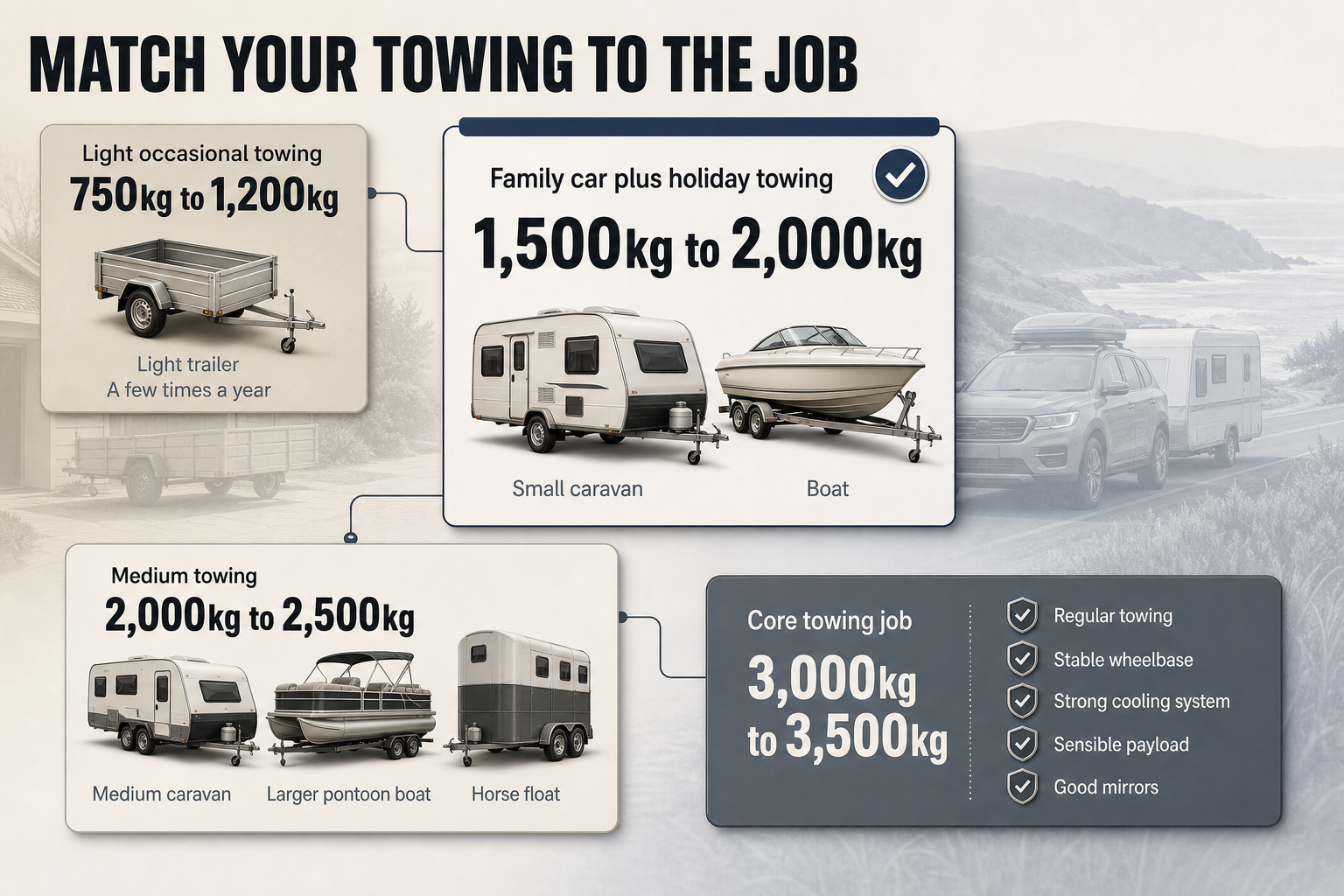
If you tow a medium caravan, a larger pontoon boat, or a horse float, start around 2,000kg to 2,500kg and be realistic about hills, wind, and load margins. Towing on flat roads around Canterbury is one thing. Pulling through the Desert Road in bad weather or backing down a slippery Coromandel boat ramp is another.
If towing is a core job rather than an occasional task, 3,000kg to 3,500kg makes sense. Even then, do not shop by the biggest number alone. A stable wheelbase, strong cooling system, sensible payload, trailer brake controller compatibility, and good mirrors can matter as much as the headline tow figure.
NZ-Specific Factors
New Zealand rules and conditions make towing ability more than a brochure exercise. The NZ Transport Agency says every light vehicle and trailer combination must be capable of stopping within seven metres from 30km/h. It also recommends that the laden weight of an unbraked trailer should not exceed three quarters of the unladen weight of the tow vehicle. In other words, even if you are technically under a quoted limit, a poor vehicle-trailer match can still be unsafe. (nzta.govt.nz)
Trailer brakes become especially important once weights rise. The AA notes trailer brakes are not required unless total trailer weight exceeds 2,000kg, and NZTA’s brake rules set additional requirements around heavier trailers and breakaway braking. If you are shopping for a tow vehicle for anything above light-duty use, assume a properly braked trailer is part of the package, not an optional extra. (aa.co.nz)
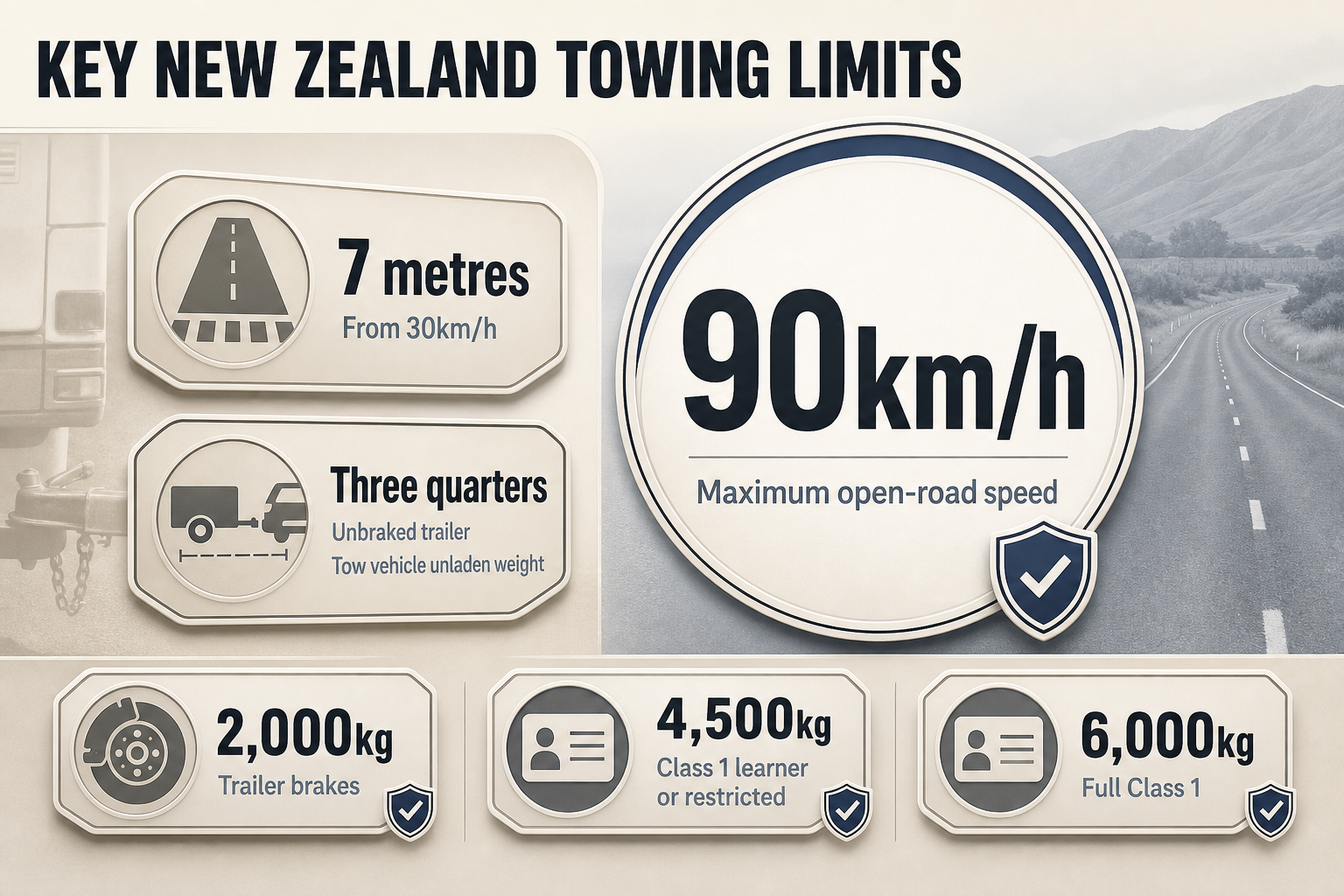
Speed matters too. In New Zealand, a light vehicle towing a trailer is limited to a maximum open-road speed of 90km/h. That applies even where the posted limit is 100km/h or 110km/h. So if you regularly tow long distances, your travel time, fuel use, and fatigue levels will be different from normal solo driving. (nzta.govt.nz)
Licensing can catch people out. On a Class 1 learner or restricted car licence, the combined weight of your vehicle, trailer, and load must not exceed 4,500kg. On a full Class 1 licence, the combined weight limit is 6,000kg. That matters if you are pairing a heavy ute or SUV with a large caravan or equipment trailer. (nzta.govt.nz)
NZ roads also shape what “enough” tow capacity really means. Tight rural corners, corrugated gravel, steep launch ramps, crosswinds, and long hill climbs can make a lightly rated tow vehicle feel strained. If your towing includes the West Coast, Central Otago, Northland boat ramps, or regular trips with a loaded trailer in winter, a healthy margin below the maximum rating is wise. You probably do not need a 3,500kg ute for the occasional garden trailer, but you also should not ask a 1,500kg-rated crossover to live at its limit every holiday weekend.
You may also be interested in these independent articles
Sources
- [1]NZ Transport Agency Waka Kotahi: Guide to safe loading and towing for light vehicles
- [2]NZ Transport Agency Waka Kotahi: Safe loading and towing for light vehicles
- [3]NZ Transport Agency Waka Kotahi: Speed limits
- [4]New Zealand Automobile Association: Towing weights for cars, trailers, caravans and boats
- [5]New Zealand Automobile Association: Audi towing weights
© 2026 pyfoi. All rights reserved.