
How Much Vehicle Range Do You Really Need?
Learn how much vehicle range NZ drivers really need, from EV and PHEV range to petrol touring distance, plus the local factors that change the maths.
Vehicle range is simply how far a car can travel before it needs more energy, whether that is petrol, diesel, or electricity. It sounds straightforward, but range can mean very different things depending on whether you are looking at a battery EV, a plug-in hybrid, or a conventional petrol or diesel vehicle.
For New Zealand buyers, range matters because our driving patterns vary a lot. A short Auckland commute, a Wellington hill route, a Christchurch to Queenstown road trip, or regular rural driving in Northland or Southland all place different demands on a vehicle. The number on the brochure is only the starting point.
What the Numbers Mean
Range is usually expressed in kilometres, even though the parameter data here lists millimetres as the primary unit. In practice, vehicle range should be read as kilometres travelled on a full battery or a full tank, and for plug-in hybrids it usually refers to electric-only range. Official EV figures are commonly quoted under the WLTP test standard, which is generally more realistic than the older NEDC standard and is the figure you should prefer when comparing cars. Rightcar and EECA both point buyers toward official label data for EV range, and EECA notes that actual range depends on battery size, road type, and driving style. (eeca.govt.nz)
For an EV, range tells you how far you can drive before recharging. For a plug-in hybrid, the electric range tells you how much of your daily driving you may be able to do without using petrol at all. For a petrol or diesel car, range is effectively tank size multiplied by fuel efficiency, so a vehicle with a 50 litre tank using 6.0L/100km has a theoretical range of about 833km.
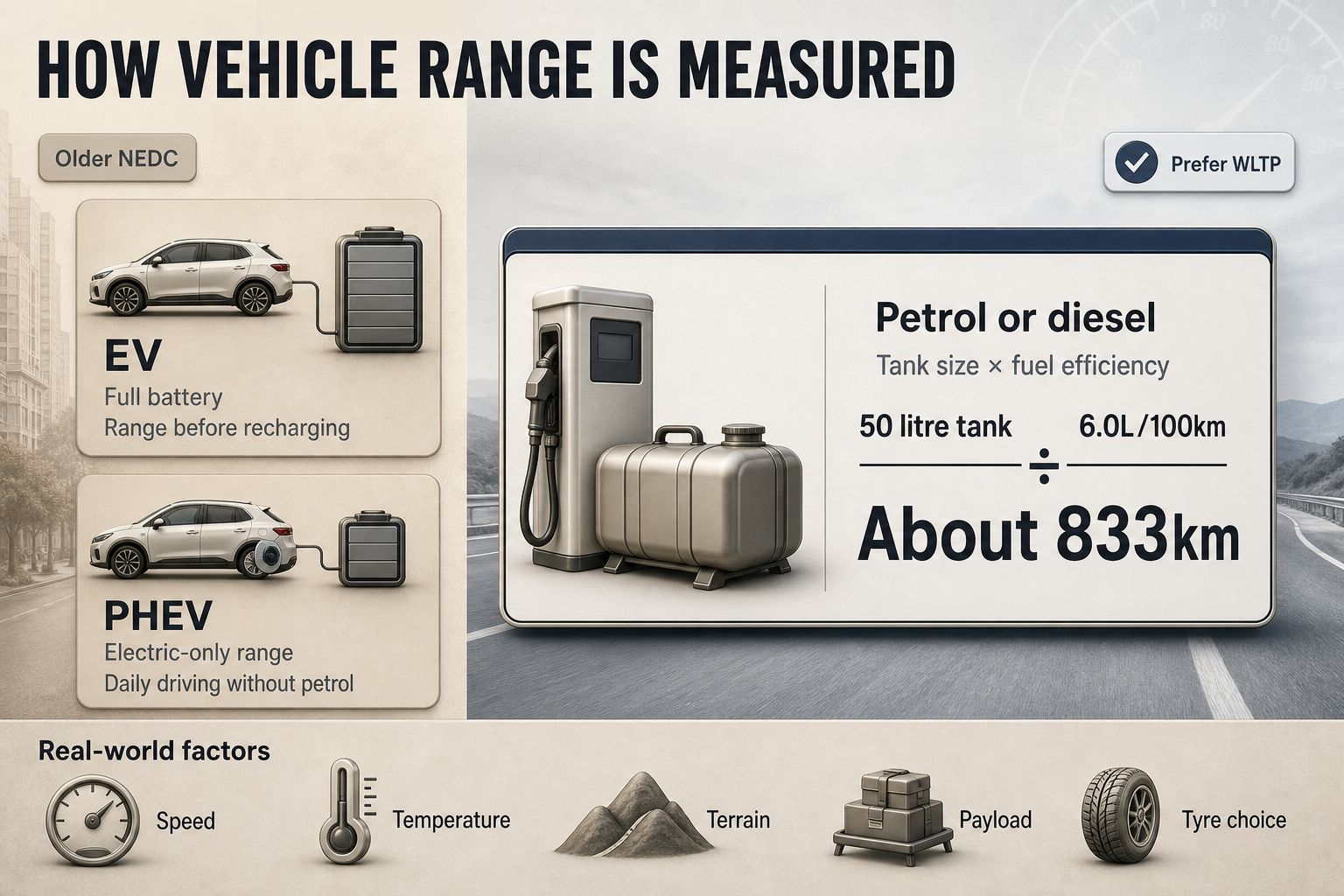
That “theoretical” part matters. Real-world range changes with speed, temperature, terrain, payload, and tyre choice. In New Zealand, hilly roads, strong winds, coarse-chip surfaces, and winter temperatures in inland South Island areas can all trim range. EECA specifically notes that EV range is affected by flat versus hilly roads and by heat or cold, and that reduced battery capacity over time means less distance per charge. (eeca.govt.nz)
Typical Ranges
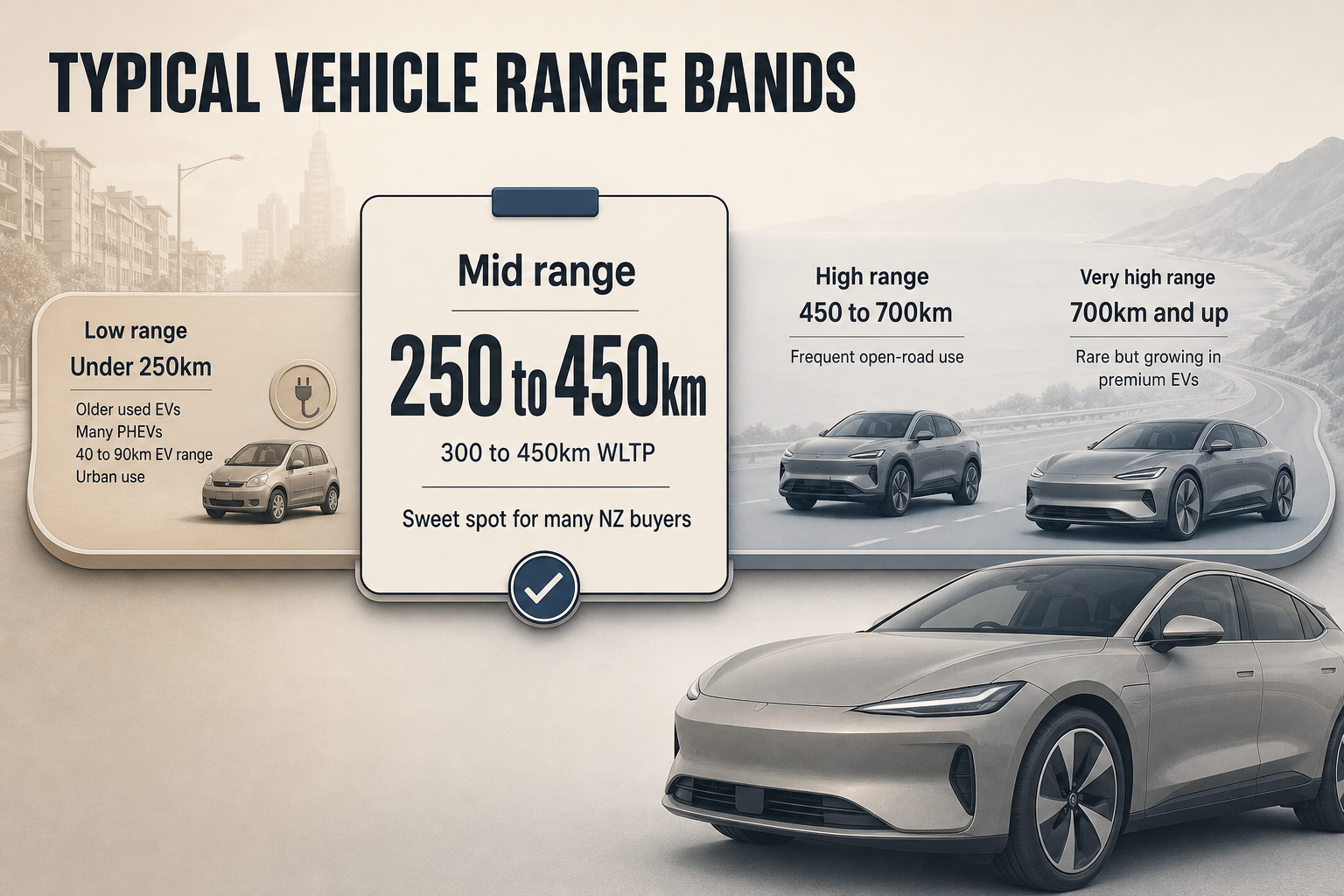
Low range: under 250km
Under 250km is short by modern EV standards, but it can still work well if your driving is predictable and you can charge at home. This bracket includes older used EVs and many plug-in hybrids on electric power alone. A PHEV with 40 to 90km of EV range can cover school runs, errands, and some commutes without starting the petrol engine, but only if you plug it in regularly. NZTA notes that PHEVs have smaller battery packs than BEVs because they have another energy source on board. (nzta.govt.nz)
For a full EV, less than 250km suits urban use best. Think central Auckland, Hamilton, Tauranga, or Christchurch driving where most trips are short and public charging is more backup than necessity. It is less ideal if you regularly head long distances between towns, tow a trailer, or live somewhere with sparse charging options.
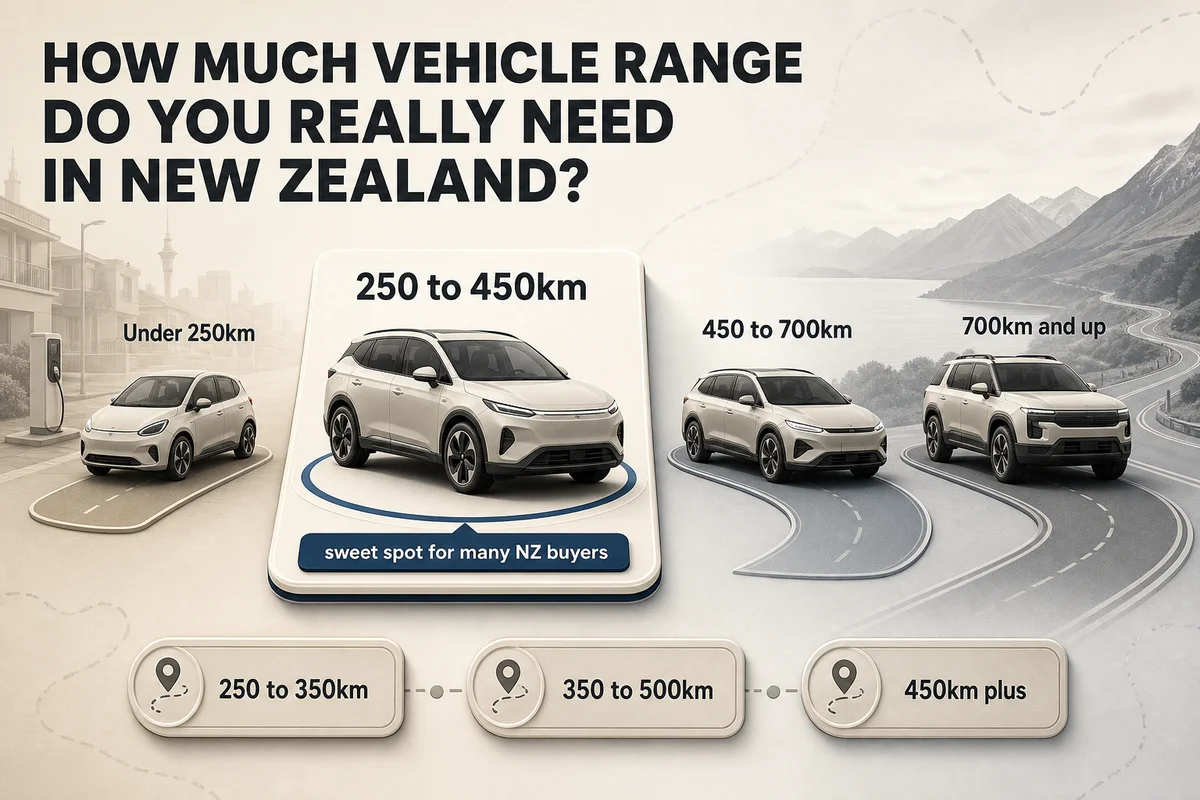
Mid range: 250 to 450km
This is the sweet spot for many NZ buyers. A modern EV with 300 to 450km of WLTP range is usually enough for daily driving plus regular inter-city trips with some planning. It also gives a useful buffer for winter, motorway speeds, and battery ageing.
This range band works well for buyers who commute during the week and do weekend travel to beaches, ski fields, or family around the region. It is also realistic for households with one car doing everything. Because most charging in New Zealand happens at home and overnight, a mid-range EV often feels easier to live with than buyers expect. NZTA says the majority of charging in New Zealand is carried out at home and at night, while EVRoam provides live information on public charger locations and availability for longer trips. (nzta.govt.nz)
High range: 450 to 700km
Once you get above about 450km, range anxiety drops away for most people. These vehicles are well suited to frequent open-road use, long South Island runs, or buyers who do not always have convenient charging at home. You still need to think about charging speed, not just total range, but the larger battery gives you more flexibility.
In petrol and diesel terms, this is also a common real-world touring range. Many diesel SUVs and utes, especially with larger tanks and efficient open-road consumption, can sit comfortably in this bracket. If you cover big weekly distances, high range can save you time even if fuel or electricity cost per kilometre is the bigger financial factor.
Very high range: 700km and up
This is common in some diesel vehicles and rare but growing in premium EVs. It sounds ideal, but you should ask whether you will actually use it. Carrying extra battery or extra fuel capacity often means more weight and higher purchase cost.
For most private buyers, very high range is more “nice to have” than necessary. It becomes more relevant if you drive remote routes often, tow regularly, or use the vehicle for commercial work where downtime matters. In those cases, range becomes a productivity issue rather than just a convenience feature.
Use-Case Guidance
If your life is mostly urban and suburban, you probably need less range than you think. The Ministry of Transport’s Household Travel Survey shows New Zealanders’ travel is dominated by everyday household trips rather than constant long-distance driving, so a car that comfortably covers two or three normal days is often enough. (transport.govt.nz) For a city EV, around 250 to 350km is usually a practical target. For a PHEV, even 50 to 80km of electric range can make a big difference if your round-trip commute fits inside it.
For mixed family use, 350 to 500km is a sensible comfort zone. That gives enough capacity for school runs, commuting, and regional road trips without needing to charge at every opportunity. If you live in a hillier area such as Wellington, or often drive loaded with kids and gear, aim toward the upper end of that band.
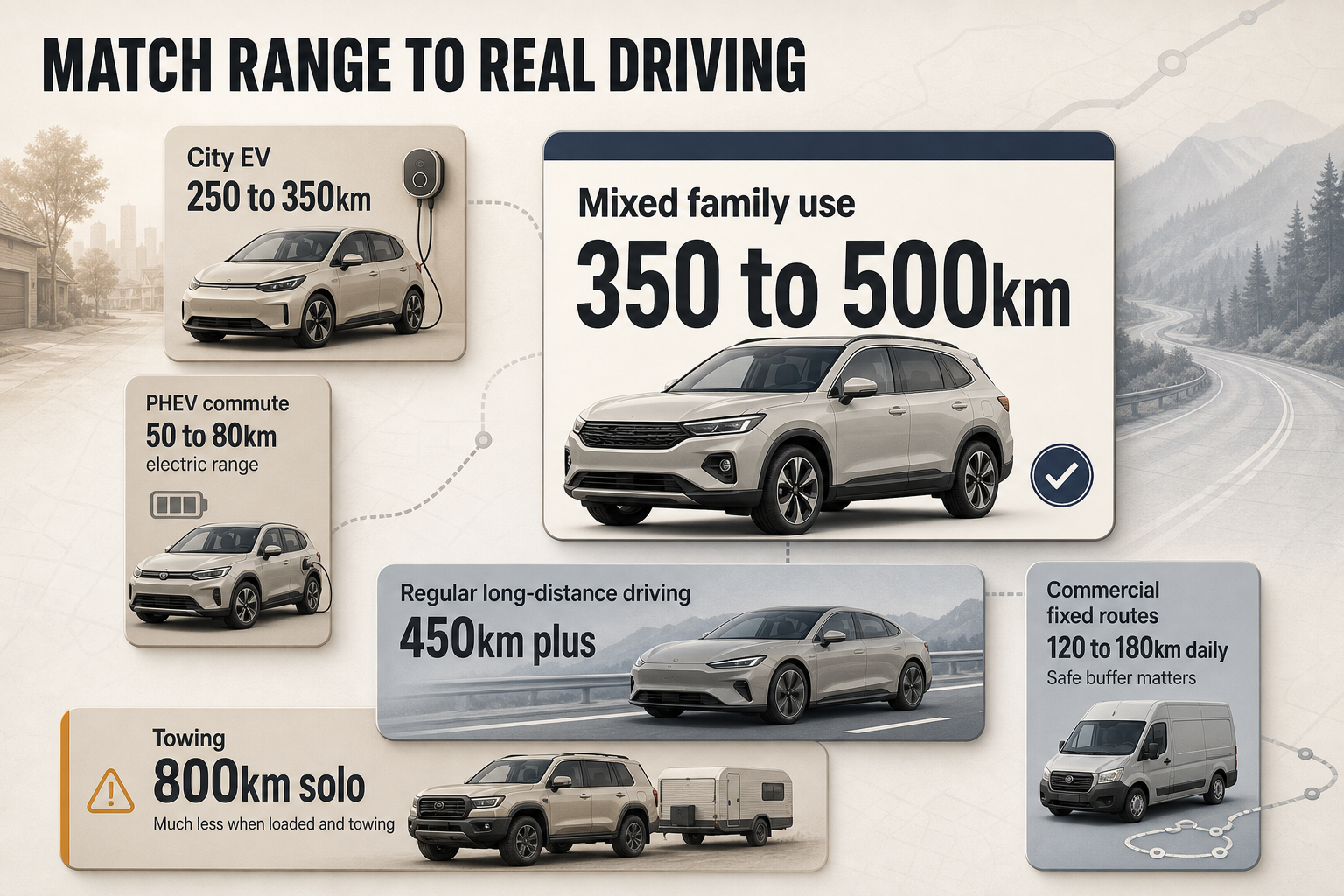
For regular long-distance driving, 450km plus starts to make more sense. That is especially true if you travel between centres where charger spacing, queueing, or weather can affect your plans. NZTA’s charging guidance and EVRoam support trip planning, but public infrastructure is still most helpful for longer journeys or for drivers who cannot charge at home. (nzta.govt.nz)
For towing, assume the brochure figure will shrink sharply. Whether the vehicle is electric or combustion-powered, towing a boat, horse float, or caravan increases energy use. If towing is a regular part of your life, buy more range than your day-to-day maths suggests you need. A ute or SUV that can theoretically do 800km solo may feel much less generous once loaded and towing on hilly roads.
Commercial users should think in terms of route certainty. If your van, ute, or truck has a fixed daily loop, a lower nominal range can still work well. EECA’s heavy vehicle examples show some urban electric trucks in New Zealand operate on daily distances around 120 to 180km and top up during breaks. (eeca.govt.nz) The key is not maximum range, but whether the vehicle can complete your real route with a safe buffer.
NZ-Specific Factors
Road user charges now matter when you compare range and running costs. NZTA says light electric vehicles must now buy RUC, and vehicles 3,500kg or less that are powered by diesel or electricity, including plug-in hybrids, also fall into the RUC system, while petrol-only vehicles and non-plug-in petrol hybrids do not. (nzta.govt.nz) That means an EV’s attractive energy cost per kilometre should be weighed alongside RUC, not looked at in isolation.
Charging access matters just as much as quoted range. NZTA says public charging should mainly support longer-distance travel or drivers without home charging, and EVRoam is the official live database for public charger locations and status. (nzta.govt.nz) If you have off-street parking and can charge overnight, a modest-range EV can be easy to own. If you live in an apartment or rely on street parking, you may want more range simply to reduce charging frequency.
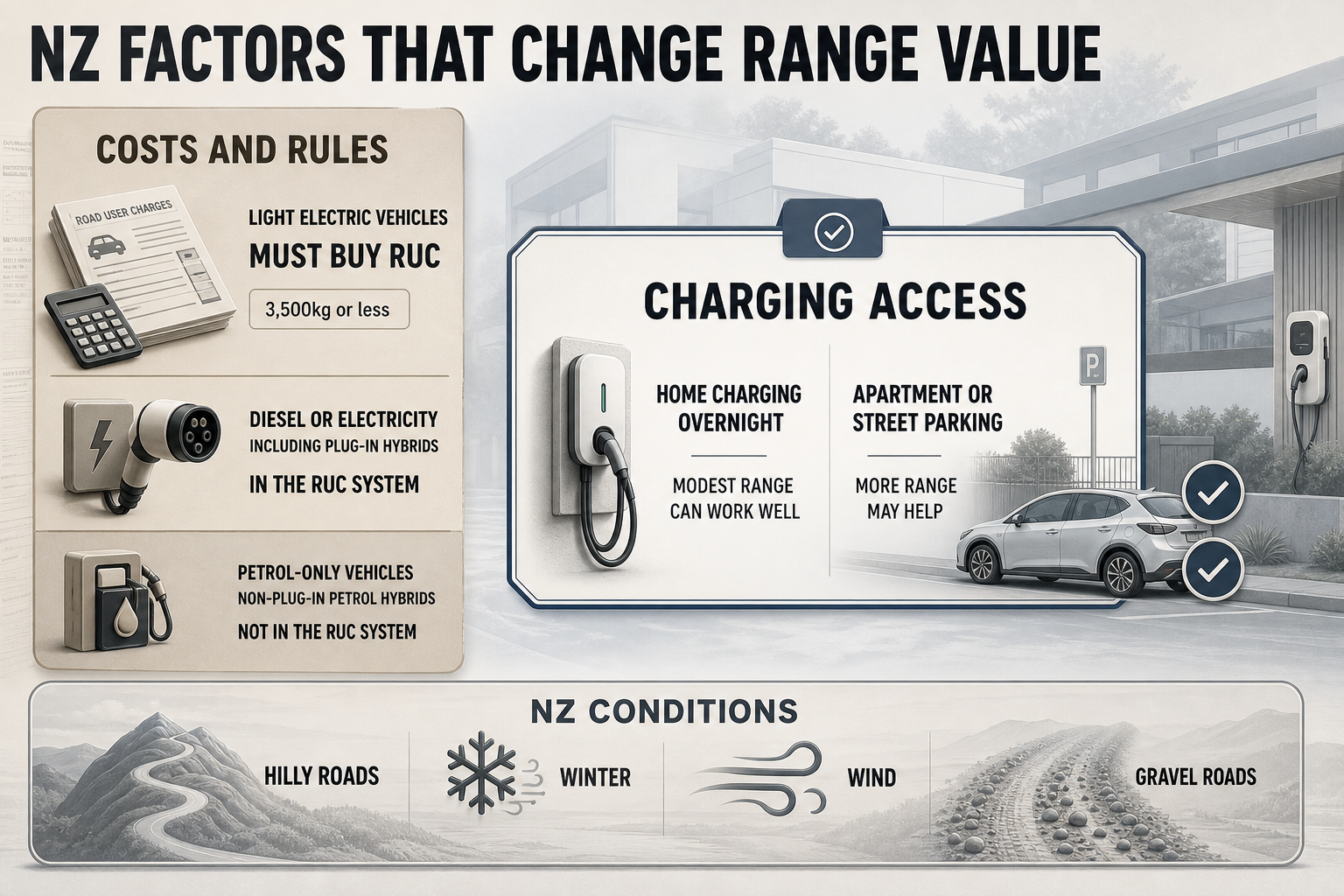
New Zealand conditions can also exaggerate the gap between official and real-world figures. The Desert Road in winter, alpine trips to the Central Otago ski fields, gravel roads in the Mackenzie Basin, and windy coastal highway driving all use more energy than flat urban commuting. That does not mean EVs are unsuitable here. It means you should treat range the way you treat fuel economy: as a comparison tool, not a promise.
The smartest way to choose range is to look at your longest normal week, not your biggest once-a-year holiday trip. If your regular life fits comfortably within the vehicle’s real-world ability, and the occasional longer journey is supported by charging or refuelling stops you can live with, you have enough range. If you are stretching the maths before you even buy the car, you probably do not.
You may also be interested in these independent articles
Sources
© 2026 pyfoi. All rights reserved.