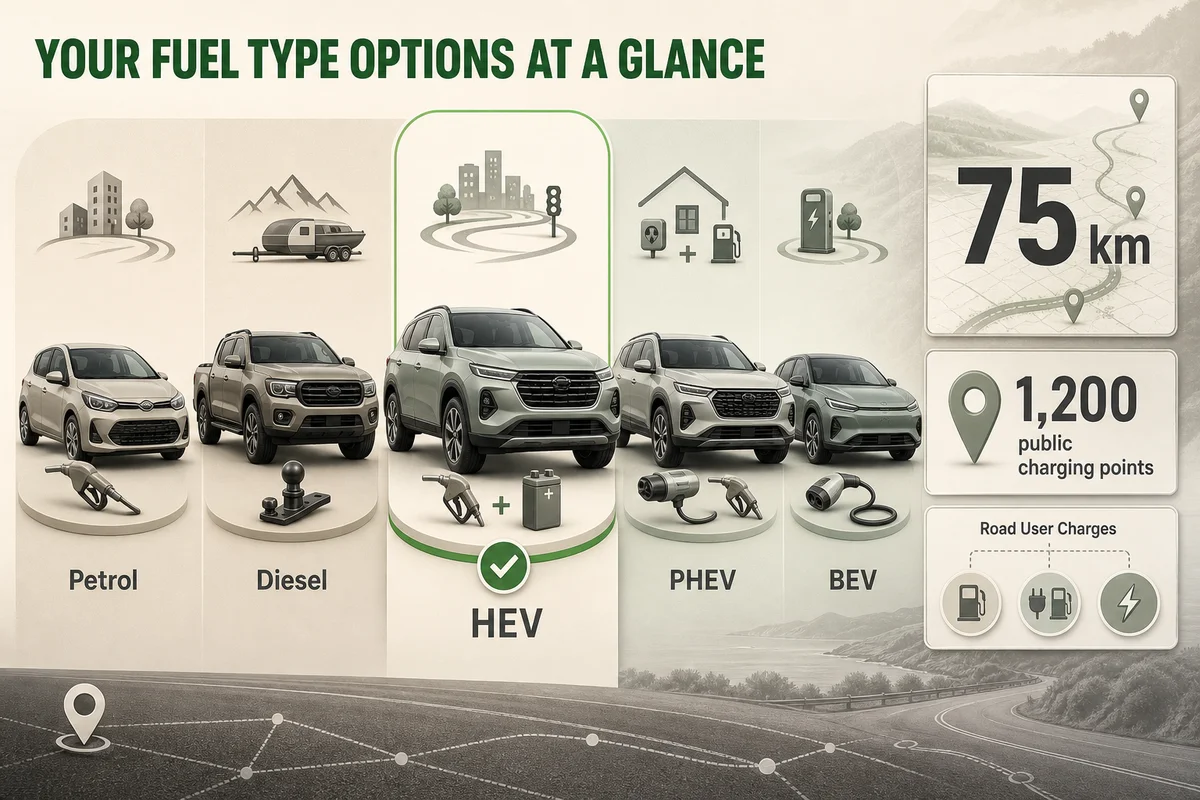

Fuel Type Guide for NZ Car Buyers
Compare petrol, diesel, hybrid, PHEV and EV options for NZ car buyers. Learn how RUC, charging access and driving habits can change the best pick.
Fuel type is one of the first specs you should check because it shapes how a car feels to drive, what it costs to run, and how well it suits your daily life in New Zealand. It affects everything from open-road range and towing manners to whether you will be stopping at a pump, plugging in at home, or paying Road User Charges.
A petrol hatchback, a diesel ute, a hybrid SUV and a battery EV can all look similar on a listing, but they behave very differently once you own them. If you understand the strengths and trade-offs of each fuel type, it becomes much easier to avoid buying the wrong car for your roads, your budget and your routine. (nzta.govt.nz)
The Options
Petrol
Petrol vehicles use a spark-ignition engine that burns unleaded fuel. This is still the most common setup across small cars, family SUVs and performance models, and it remains the default choice for many buyers because it is familiar, widely available and easy to live with anywhere in the country.
The big advantages are simplicity and flexibility. Petrol cars are usually cheaper to buy than an equivalent hybrid or EV, they refuel quickly, and they suit drivers who do mixed use without huge annual mileage. They also tend to be quieter and smoother than diesel cars around town. The downside is fuel consumption. If you do a lot of kilometres, especially in a heavier SUV or ute-based wagon, petrol costs can add up quickly compared with hybrid or electric alternatives. (mbie.govt.nz)
For New Zealand use, petrol makes the most sense if you want a straightforward car for city commuting, school runs, weekend trips and occasional longer drives without thinking about charging. It is also a sensible fit if you live in an apartment or park on-street and cannot easily install home charging. For Auckland, Hamilton, Tauranga or Christchurch suburban use, a modern small petrol car can still be a perfectly rational buy. You probably do not need anything more complex if your annual distance is modest.
Diesel
Diesel vehicles use compression ignition rather than spark plugs, and they are built to deliver strong low-speed pulling power. That is why diesel remains popular in utes, large SUVs, vans and some tow vehicles. If you regularly haul a boat, horse float, trailer or work gear, diesel’s torque can make a vehicle feel less strained.
The strengths are easy to understand. Diesel engines are typically more efficient than petrol on long motorway or open-road runs, and they often suit heavy vehicles better. A diesel ute doing big distances through Waikato, Canterbury or Southland can still make a lot of practical sense. The trade-offs are that diesel vehicles can be noisier, often cost more to service, and New Zealand diesel vehicles generally pay Road User Charges rather than covering road costs through fuel excise at the pump. That changes the running-cost picture, especially if you only drive short distances. (nzta.govt.nz)
Diesel is best for buyers who genuinely use the benefits. Think rural drivers, tradies, frequent towers, or families who spend long stretches on State Highway 1 with a loaded SUV. It is less convincing for short urban trips, where modern diesel emissions systems may not be operating in their ideal conditions and where the fuel-efficiency advantage can be smaller in real life.
HEV (Hybrid)
A conventional hybrid, usually called an HEV, combines a petrol engine with a small battery and electric motor, but you do not plug it in. The car charges its battery through braking and through the engine itself. In practice, that means the vehicle can run on electric power for short periods at low speeds, then blend petrol and electric power automatically.
For many New Zealand buyers, this is the sweet spot. Hybrids are especially efficient in stop-start traffic, so they shine in urban commuting and school-run duty. They are easy to own because you fill them with petrol as normal, but they use less of it than a comparable non-hybrid car. Toyota’s hybrid system is the best-known example, but plenty of other brands now offer similar setups. The drawbacks are higher purchase prices than plain petrol versions and less benefit if most of your driving is steady-speed open-road work. (eeca.govt.nz)
An HEV suits Auckland congestion, Wellington hills, Christchurch commuting and any buyer who wants lower fuel use without changing habits. If you cannot charge at home but still want better efficiency, this is often the smartest place to start. For many households, a hybrid SUV or hatchback gives you most of the day-to-day savings people want from electrification without the planning that comes with plugging in.
PHEV (Plug-in Hybrid)
A plug-in hybrid, or PHEV, is a halfway point between a hybrid and a full EV. It has a petrol engine and an electric motor, but with a much larger battery that you charge from an external power source. That allows meaningful electric-only driving for shorter trips, with the petrol engine there as backup for longer journeys.
The appeal is obvious. If your weekday driving is short, a PHEV can cover much of it on electricity, then head from Auckland to Taupō or Dunedin to Queenstown without relying entirely on the public charging network. That flexibility is why PHEVs appeal to buyers who are EV-curious but not ready to commit. The catch is that they only make sense if you actually plug them in. If you treat a PHEV like a normal petrol SUV, you are carrying extra weight and complexity without getting the savings. In New Zealand, light PHEVs also pay Road User Charges, which is an important ownership cost many buyers overlook. (nzta.govt.nz)
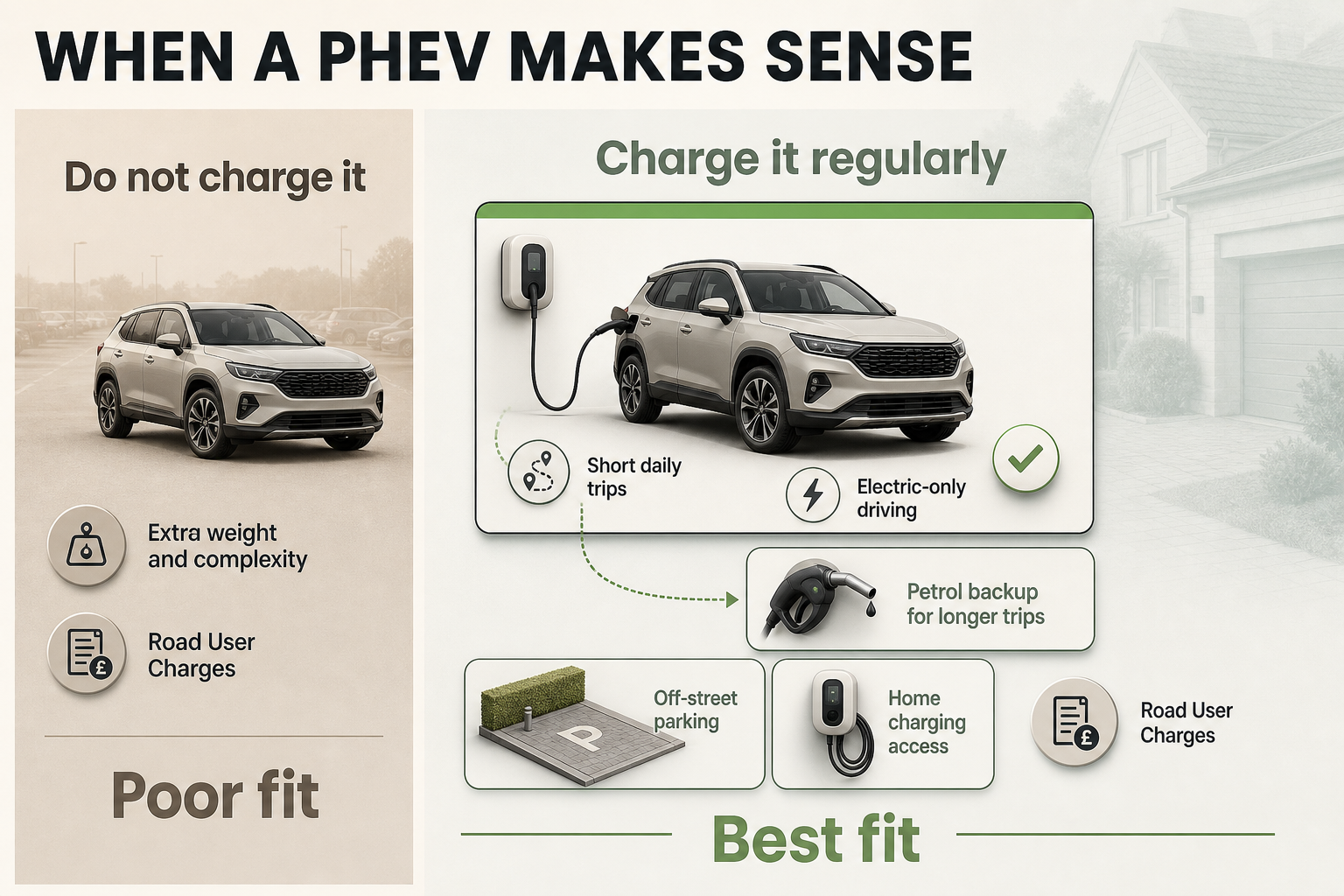
A PHEV fits households with off-street parking, home charging access and lots of short daily trips, but occasional longer drives into regions where charging still needs a bit of planning. It can work very well for a family SUV in places like Tauranga, Nelson or Palmerston North, where most weekday use is local but holidays involve bigger distances.
Full Electric (Battery EV)
A battery electric vehicle, or BEV, runs entirely on electricity stored in a battery. There is no petrol or diesel engine at all. You charge it at home, at work, or on public chargers, and the driving experience is usually smooth, quiet and very responsive.
The main benefits are low day-to-day energy costs, fewer routine maintenance items, and excellent refinement around town. EVs are especially good for commuters who can charge overnight at home. New Zealand’s public charging network has expanded significantly, with chargers available at least every 75 km along most state highways, and EECA says the country had more than 1,200 public charging points as of October 2024, with further growth continuing into 2026. That makes EV road trips much easier than they were a few years ago, although charger availability still varies by region and holiday peaks can require patience. Light EVs in New Zealand now also pay Road User Charges, so the running-cost advantage is no longer as dramatic as it once was, but electricity is still often cheaper per kilometre than liquid fuel. (eeca.govt.nz)
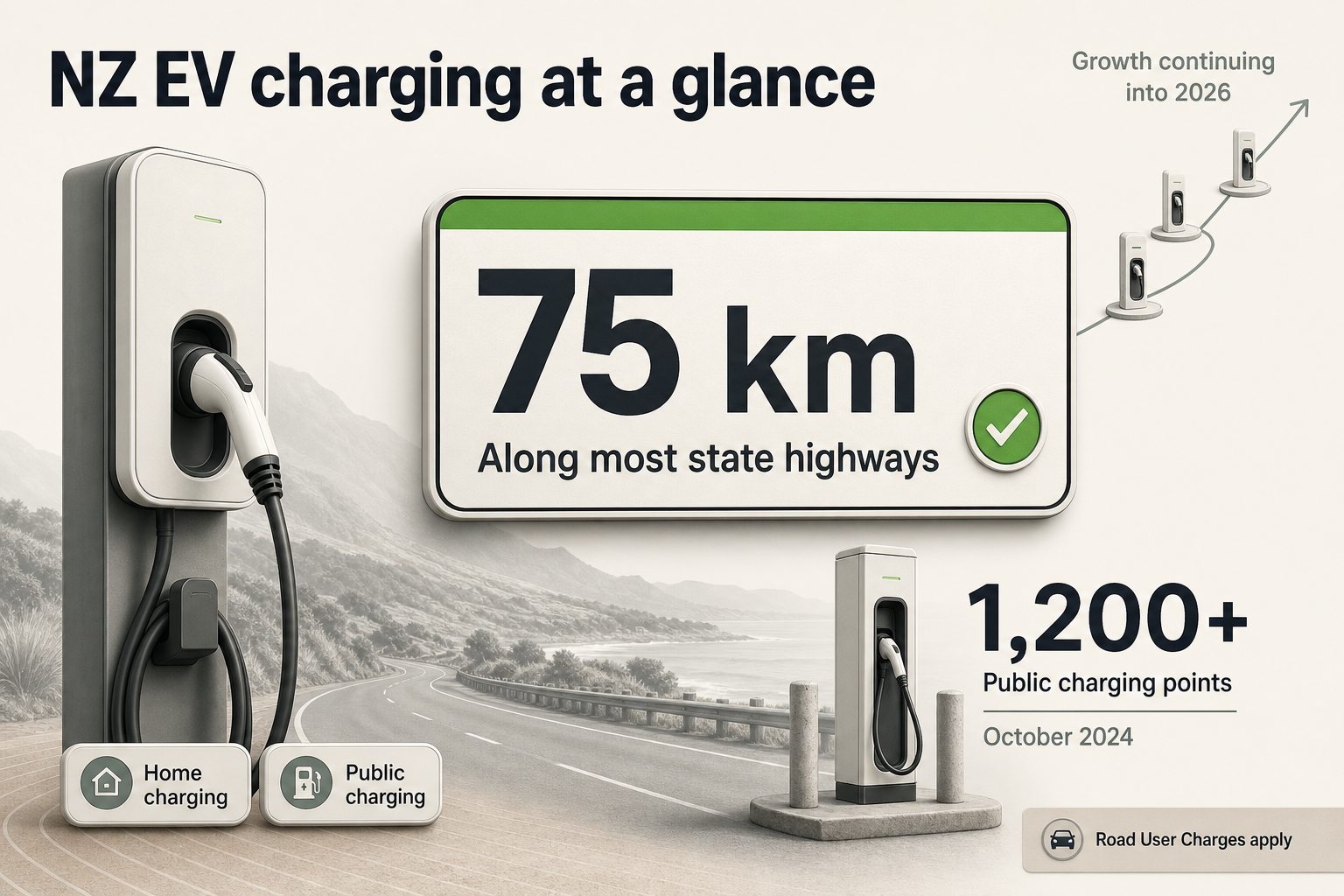
A BEV is ideal if you have reliable home charging and most of your driving is predictable. It suits urban and suburban use brilliantly, and it can suit inter-city travel too if you are happy to plan charging stops. For Wellington commuters, Auckland households with a driveway, or Christchurch families doing mostly local kilometres, a BEV can be very easy to live with. If you regularly tow heavy loads long distances or travel into remote areas with little charging backup, you need to be more selective.
Fuel Cell EV
A fuel cell EV, or FCEV, uses hydrogen to generate electricity on board, which then powers an electric motor. In theory, it offers EV-style driving with fast refuelling rather than long charging stops.
The problem in New Zealand is infrastructure. Hydrogen passenger vehicles are rare, and public refuelling options are extremely limited compared with petrol, diesel or electricity. That means an FCEV may look interesting on paper but is not yet a mainstream choice for ordinary private buyers here. The technology itself is impressive, but ownership practicality matters more than novelty.
Right now, an FCEV is mainly relevant as a niche or future-facing option rather than a realistic recommendation for most NZ households. Unless hydrogen supply becomes far more widespread, it is hard to justify over a BEV or PHEV for normal private use.
LPG
LPG, or liquefied petroleum gas, is an alternative fuel that has historically been used in some converted petrol vehicles. It burns differently from petrol and requires dedicated fuel-system hardware.
For most New Zealand buyers, LPG is now a fringe category. Public availability is far more limited than petrol or diesel, and factory-fresh LPG passenger cars are uncommon. You may still come across older vehicles with LPG conversions, but you should treat them as specialist buys and pay close attention to certification, servicing history and tank condition.
LPG can reduce fuel costs in the right circumstances, but the real-world convenience penalty is large if you do not live near reliable supply. For most buyers, it is no longer a mainstream path.
How to Choose
Start with your actual driving pattern, not the badge on the boot. If you mainly do short urban trips and want the least fuss, a hybrid is often the smartest answer. If you can charge at home and your daily distance is predictable, a BEV can be even cheaper to run and nicer to drive. If you want electric commuting without giving up petrol backup for holiday travel, a PHEV can work well, but only if you will plug it in regularly. (eeca.govt.nz)
If you do big annual mileage, tow often, or spend much of your time on open roads with a loaded vehicle, diesel still deserves a proper look. But be honest about whether you really need it. Plenty of NZ buyers choose diesel utes for image, then spend most of their time in suburban traffic where a petrol or hybrid SUV would be cheaper, quieter and easier to live with. (nzta.govt.nz)
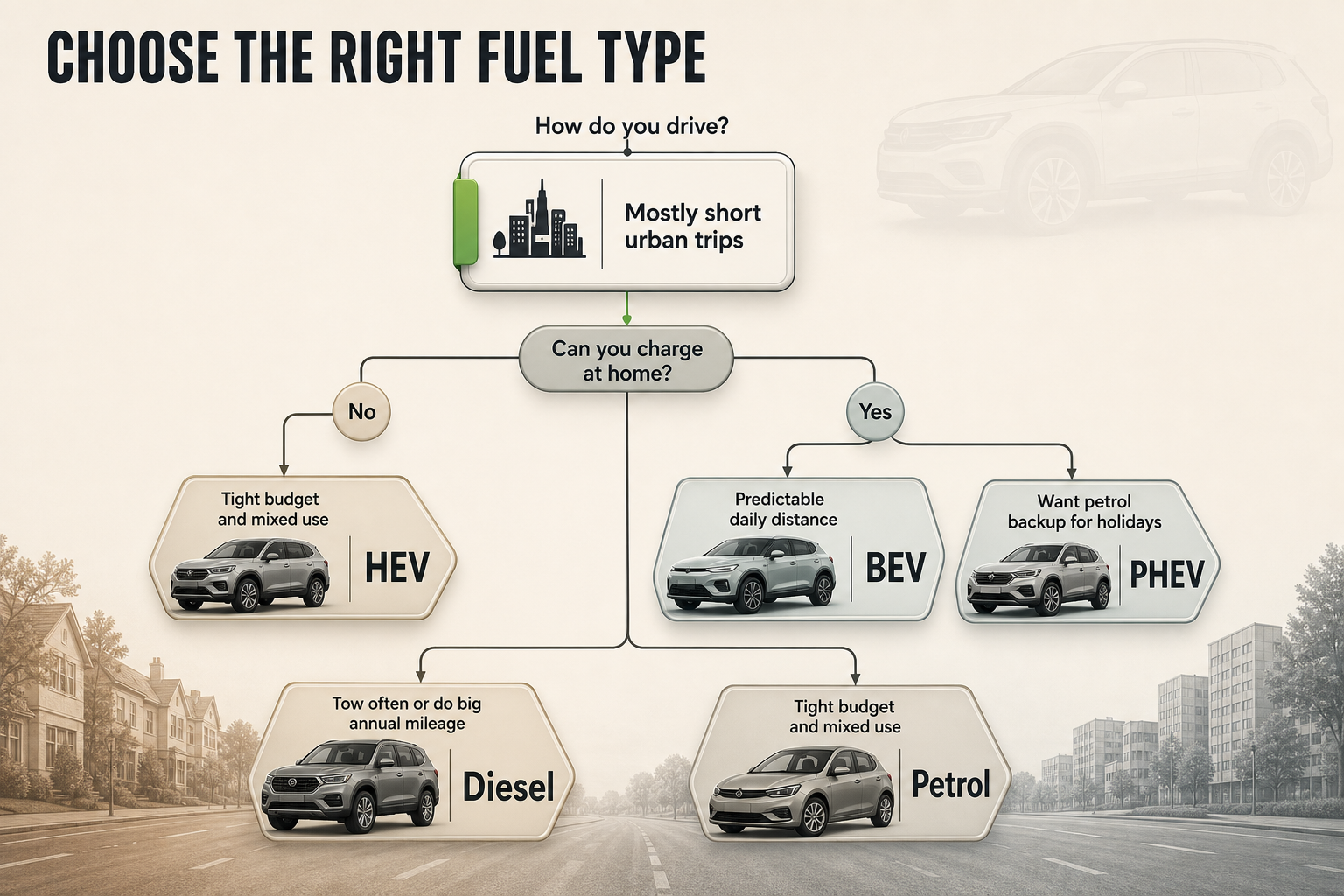
Petrol remains the safe all-rounder if your budget is tight, your use is mixed, and you want the broadest choice on the used market. It is not the most efficient option, but it is often the easiest to buy and understand. The best fuel type is the one that matches your kilometres, your parking situation and your willingness to change habits.
NZ Context
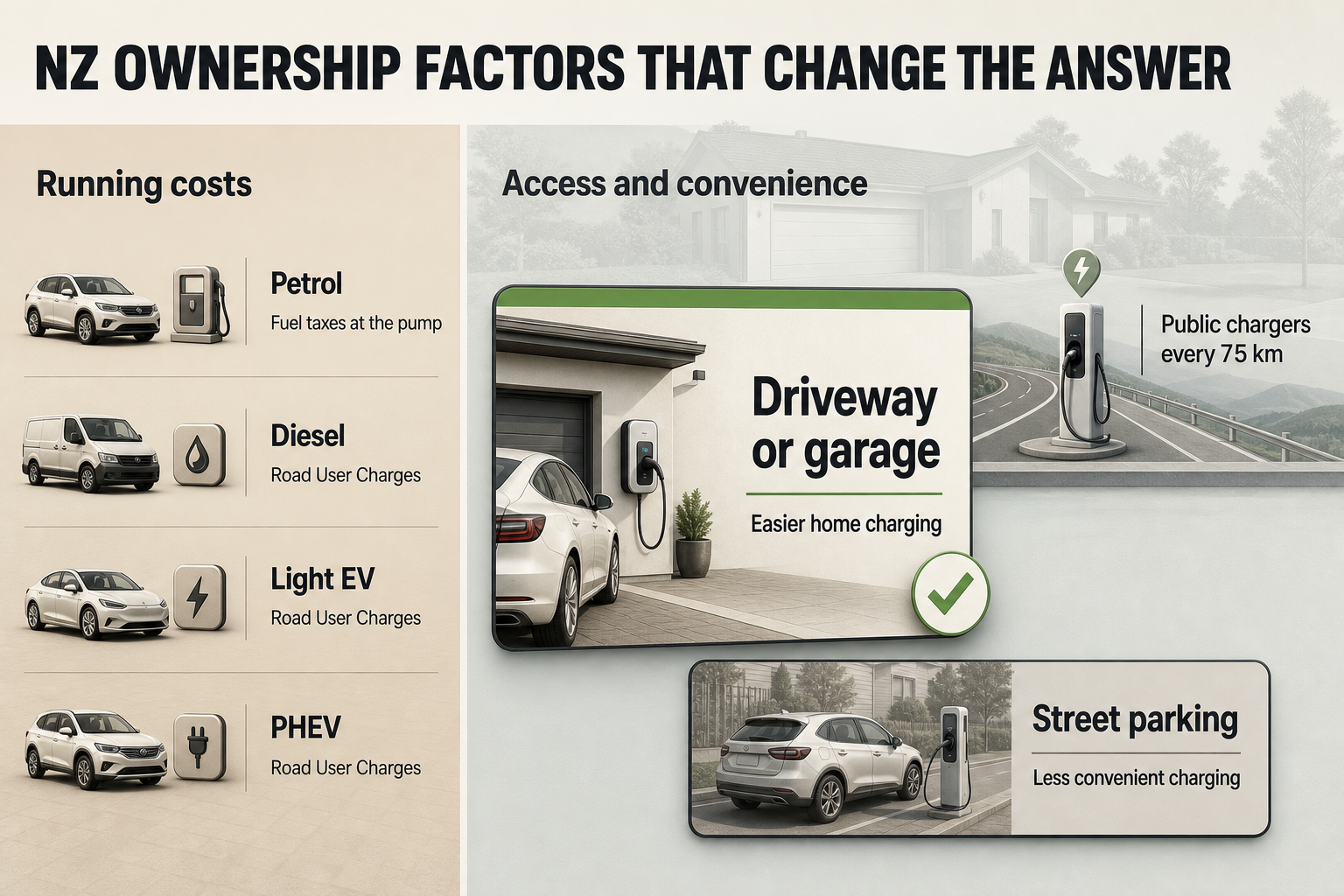
New Zealand ownership costs make fuel type more than a technical detail. Diesel vehicles pay Road User Charges, and so do light EVs and PHEVs, while petrol vehicles mostly contribute through fuel taxes built into what you pay at the pump. That means comparing only pump price or electricity price can give you the wrong answer. You need to look at the full running-cost picture. (nzta.govt.nz)
Charging access is the other big local factor. EECA advises that public chargers are available at least every 75 km along most state highways, and smart home charging can help you take advantage of cheaper off-peak electricity rates. That makes BEVs and PHEVs much easier to own if you have a driveway or garage, but less convenient if you rely on street parking. For many urban New Zealanders, home charging is the dividing line between an EV that feels effortless and one that feels like admin. (eeca.govt.nz)
Road conditions matter too. Gravel roads, ski-field trips, towing and long South Island distances do not automatically rule out electrified vehicles, but they do make range, tyre choice and charging or refuelling access more important. A Queenstown family that heads to the slopes every winter has different needs from a Ponsonby commuter. Fuel type should support the way you really use a vehicle in New Zealand, not the way you imagine you might use it once a year.
You may also be interested in these independent articles
Sources
- [1]NZ Transport Agency Waka Kotahi - RUC exemptions
- [2]NZ Transport Agency Waka Kotahi - Road user charges
- [3]EECA - How to charge your EV at home and on the road
- [4]EECA - Compare electric vehicle types and benefits
- [5]EECA - Public EV Charger Dashboard
- [6]Ministry of Business, Innovation & Employment - Weekly fuel price monitoring
- [7]EECA - Smart EV chargers: faster, safer, cheaper
© 2026 pyfoi. All rights reserved.