
Vehicle Length Guide for NZ Drivers
Learn how vehicle length affects parking, towing and fuel costs in New Zealand, with size ranges and tips to choose the right car, SUV or ute.
Vehicle length is the bumper-to-bumper measurement of a car, ute, SUV or van, usually listed in millimetres. It sounds simple, but it affects how easy a vehicle is to park, turn, load, tow with, and live with on New Zealand roads.
A few hundred millimetres can make a real difference. The right length for you depends less on image and more on where you drive, where you park, and how much space you genuinely need.
What the Numbers Mean
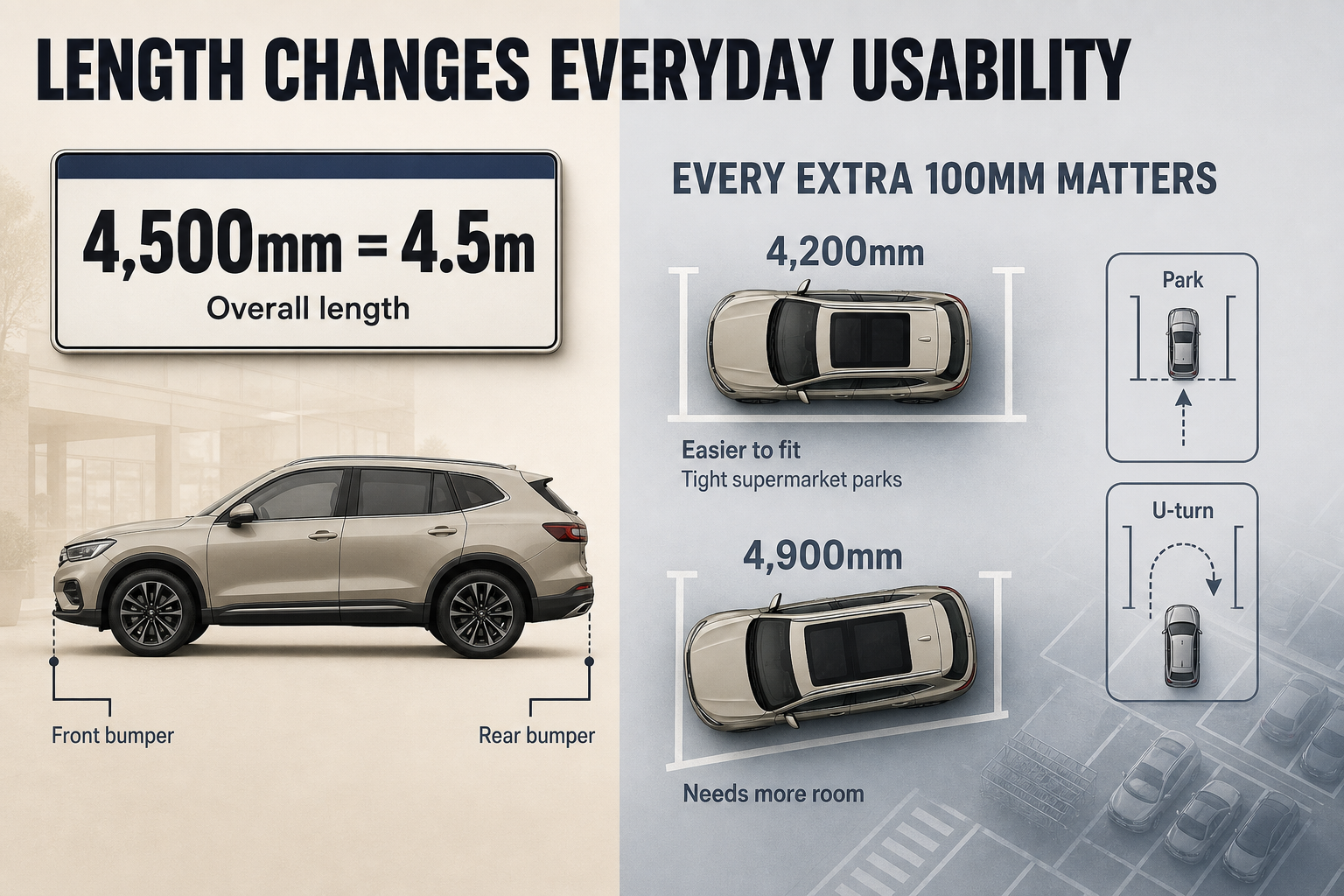
Length is the vehicle’s overall measurement from the very front bumper to the very back bumper. It is not the wheelbase, which is the distance between the front and rear axles, and it is not the cargo floor length inside the boot or tray. If a listing says a car is 4,500mm long, that means it takes up 4.5 metres of physical space before you even account for room to open the boot, walk around it, or clear a towbar.
In practical terms, every extra 100mm matters most in town. A car that is 4,200mm long will usually feel much easier to fit into tight supermarket parks than one that is 4,900mm long. Longer vehicles also tend to need more room to swing into a park or complete a U-turn, even if the difference on paper looks minor.
Length often brings benefits too. A longer car can have a bigger boot, more rear legroom, or a more stable feel on the open road. That is why size needs to be judged against use, not just convenience. EECA also notes that smaller vehicles generally need less energy to get moving, so choosing a vehicle that is no bigger than you need can help reduce running costs. (eeca.govt.nz)
Typical Ranges
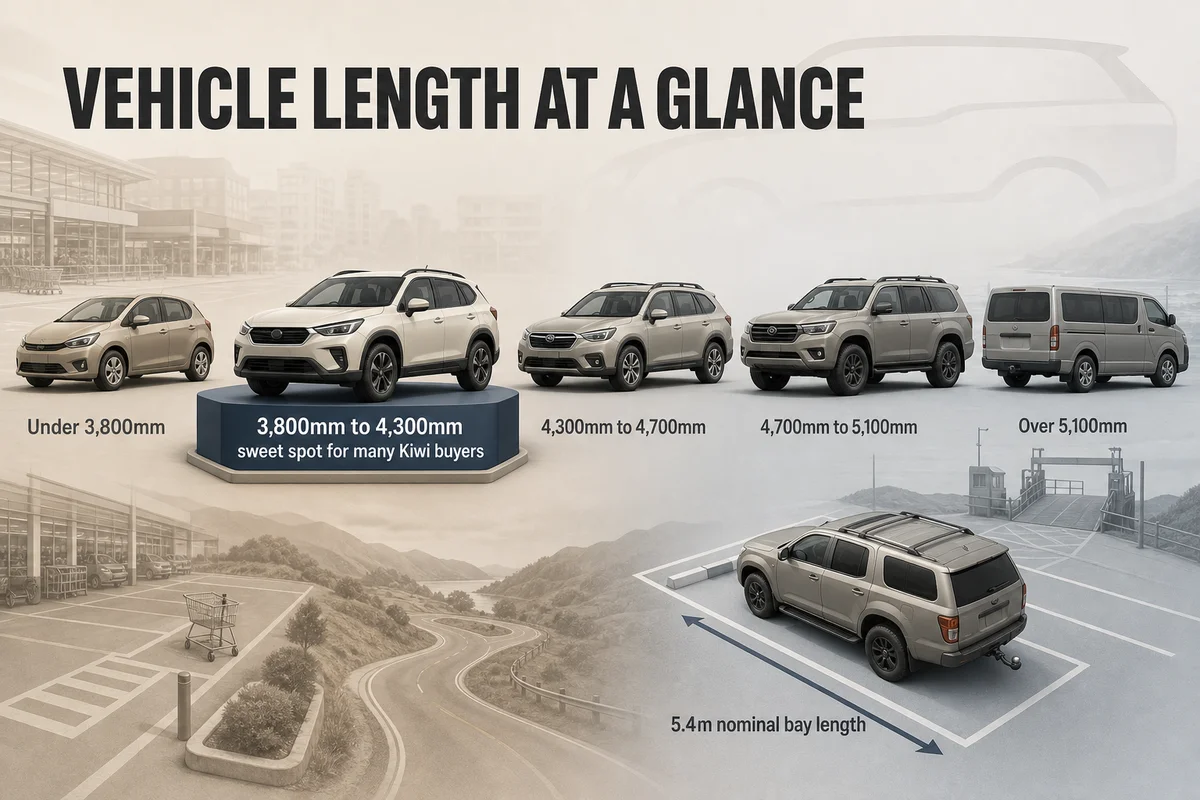
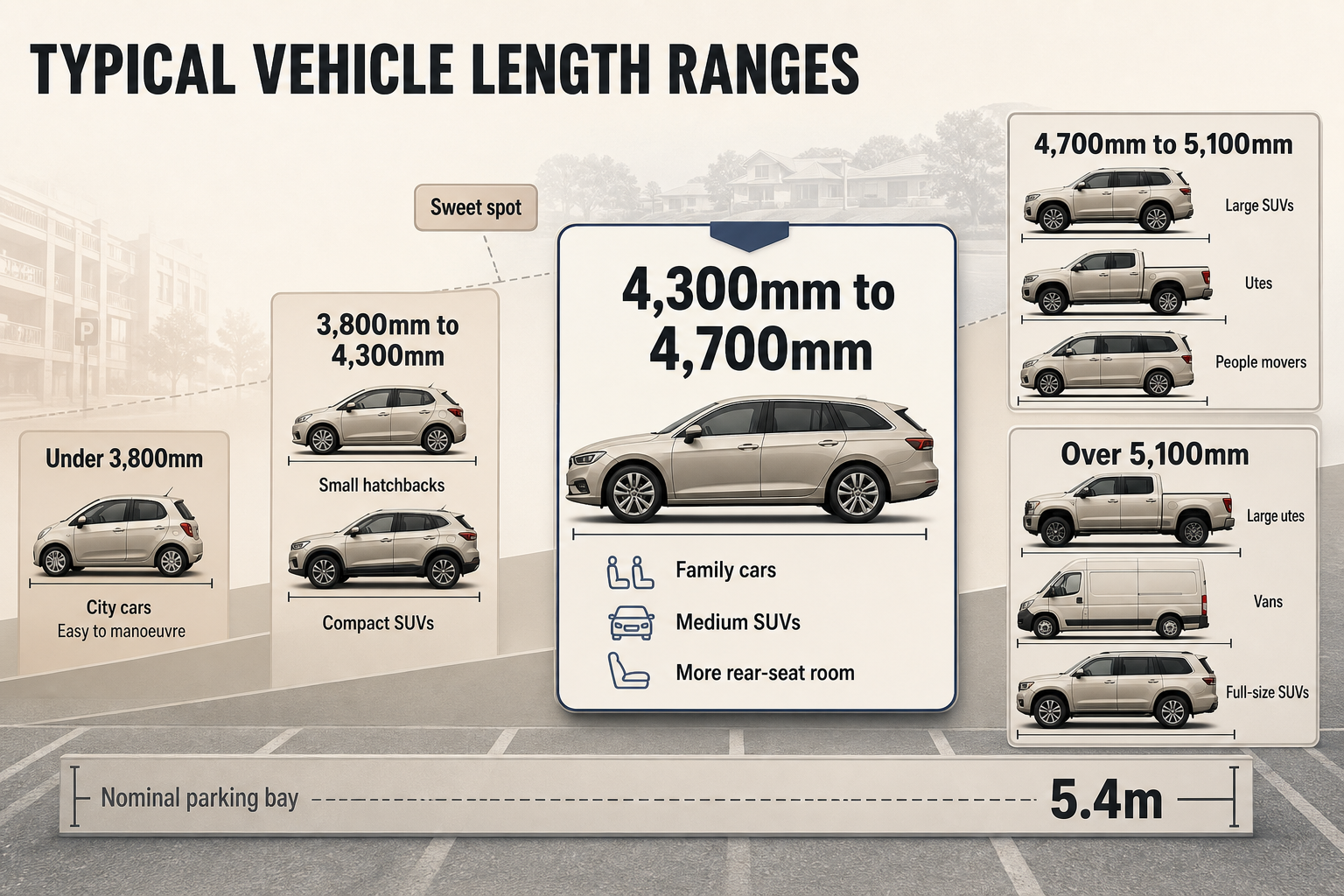
Under 3,800mm
This is city-car territory. Think compact hatchbacks and kei-style imports. These vehicles are easy to place on narrow urban streets, simple to manoeuvre into older parking buildings, and well suited to solo drivers or couples.
The trade-off is space. Rear seats are often tight, and boot capacity can be limited once you load a buggy, groceries, or sports gear. If you regularly carry adults in the back or head away for long weekends, this size can start to feel cramped.
3,800mm to 4,300mm
This is the sweet spot for many Kiwi buyers. Small hatchbacks, compact SUVs and some small sedans sit here. You get a vehicle that still works in Wellington or Auckland parking buildings, but with enough cabin and boot space for daily family duties.
For commuting, school runs and occasional road trips, this range is often the easiest to live with. It is long enough to feel like a proper all-rounder without becoming annoying in tight car parks.
4,300mm to 4,700mm
This is the mainstream family-car zone. Medium SUVs, wagons, larger hatchbacks and many sedans fall into this bracket. It usually gives you noticeably better rear-seat room and luggage space, which matters if you have growing kids, a pram, or holiday gear.
For many New Zealand households, this is the point where practicality overtakes compact convenience. It suits long intercity trips, airport runs, and weekends away, but you will notice the extra size when parallel parking or squeezing into older off-street parks.
4,700mm to 5,100mm
This covers large SUVs, large sedans, many utes, and some people movers. These vehicles can be excellent for families with teenagers, buyers towing boats or trailers, or tradies who need cabin and tray space together.
The downside is everyday bulk. A vehicle around 5,000mm long can overhang tight parking bays and feel cumbersome in older city centres or beach-town streets during summer. Standard off-street parking guidance commonly uses a nominal bay length around 5.4m, so once you add a towbar or bike rack, a big vehicle can become awkward fast. (nzta.govt.nz)
Over 5,100mm
This is large-ute, van and full-size SUV territory. These vehicles make sense if you need serious carrying ability, lots of cabin space, or commercial utility. They are less convincing if most of your driving is a solo commute and the school pick-up queue.
In New Zealand, vehicles of this size can become a hassle in suburban malls, ferry queues, older multi-storey parking buildings, and narrow rural gateways. They can still be the right tool, but only if your use case justifies the extra length.
Use-Case Guidance
City commuting
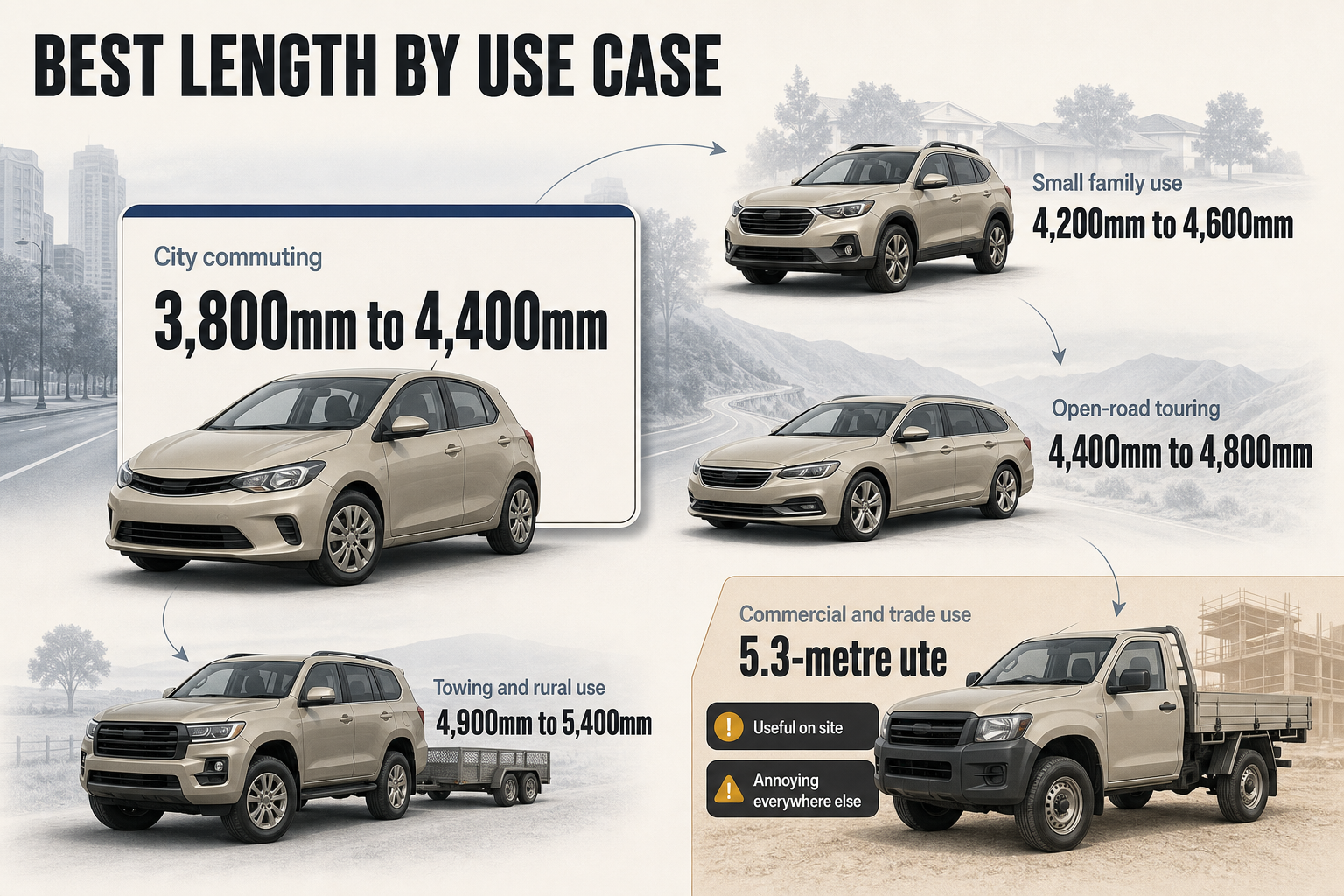
If most of your driving is in Auckland, Wellington, Christchurch or Hamilton, a length of about 3,800mm to 4,400mm is usually the easiest fit. That gives you decent cabin space without making every car park a calculation exercise. If you mostly drive alone or as a couple, staying closer to the lower end of that range makes life easier.
Small family use
For one or two children, a vehicle around 4,200mm to 4,600mm is often the best compromise. That is enough for child seats, groceries and weekend luggage, while still being manageable in normal parking spaces. If you have a large pram or often travel with grandparents, moving toward the upper end can be worthwhile.
Open-road touring
If you do frequent trips between regions, a longer vehicle can be more comfortable. Around 4,400mm to 4,800mm often gives a more settled ride, more luggage room and better rear-seat comfort. That suits family holidays, ski trips to the Central Plateau or South Island, and long drives where cabin space reduces fatigue.
Towing and rural use
If you tow a small boat, horse float or work trailer, or you live on rural roads, length can be helpful. A longer wheelbase vehicle often feels more stable under load, and many utes and large SUVs sit in the 4,900mm to 5,400mm range. But do not assume longer automatically means better. You still need to check the actual braked towing rating, payload and gross combined mass, not just the body size.
Commercial and trade use
Vans and dual-cab utes are often chosen for cargo or worksite practicality, not parking ease. If your vehicle is a mobile tool shed, extra length may pay for itself every day. If it is also the family car, think carefully about where it will spend most of its time. A 5.3-metre ute can be useful on site and annoying everywhere else.
NZ-Specific Factors
New Zealand roads reward sensible sizing. Many suburban streets are narrow, some rural roads are tight and winding, and holiday towns can be crowded with parked cars in summer. A vehicle that feels fine on a wide dealership forecourt can feel much larger on a Coromandel side street or a Dunedin hill suburb.
Parking is a key local issue. Waka Kotahi’s parking guidance refers to AS/NZS 2890.1 for off-street parking layouts, and current guidance still points to nominal parking-space lengths around 5.4m in standard layouts. That means large utes and SUVs can fit on paper, but with very little spare room, especially if they have towbars or accessories. (nzta.govt.nz)
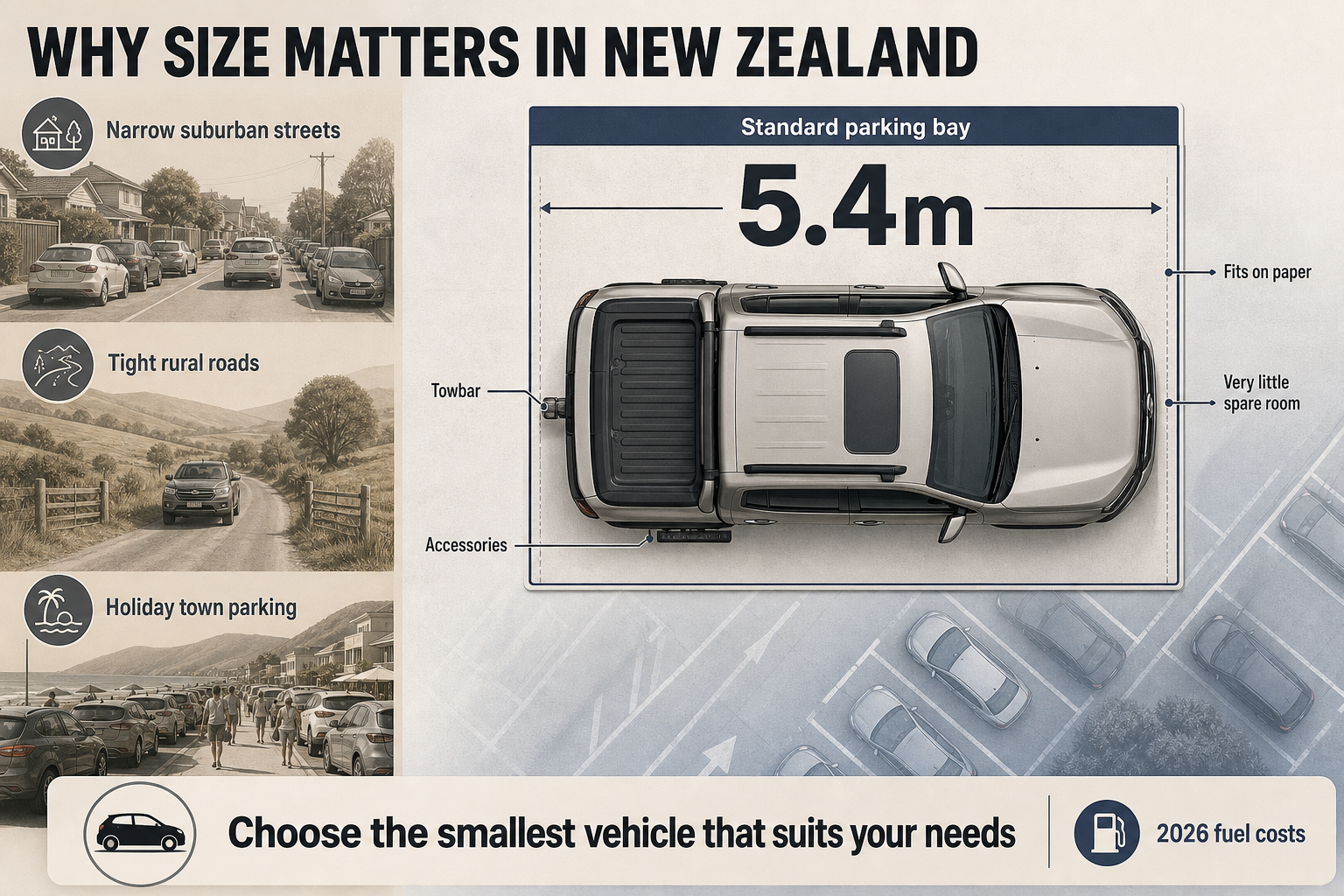
Length also matters if you are buying for efficiency. Bigger, longer vehicles are often heavier and less aerodynamic, which usually means higher fuel or energy use. EECA advises buyers to choose the smallest vehicle that suits their needs, and New Zealand’s mandatory emissions and energy economy labelling makes it easier to compare models before you buy. (eeca.govt.nz)
If you are looking at very large commercial vehicles or specialist rigs, legal dimensions matter as well. Waka Kotahi sets dimension limits for vehicles on New Zealand roads, and anything beyond standard limits can require specific permitting. That will not affect ordinary passenger cars, but it matters for large vans, trucks and specialist work vehicles. (nzta.govt.nz)
Fuel costs are another reason not to oversize. MBIE continues to publish weekly fuel price monitoring and national energy price data, and with petrol and diesel remaining a meaningful household expense in 2026, carrying extra vehicle you do not need can cost you every week. A longer vehicle is only better if you regularly use the extra space it gives you. (mbie.govt.nz)
You may also be interested in these independent articles
Sources
- [1]Waka Kotahi NZ Transport Agency: Vehicle dimensions and mass
- [2]Waka Kotahi NZ Transport Agency: Light rigid vehicles
- [3]Waka Kotahi NZ Transport Agency: Traffic control devices manual, Part 13 Parking control
- [4]EECA: Fuel saving tips
- [5]EECA: About the Vehicle Emissions and Energy Economy Labelling Programme
- [6]MBIE: Weekly fuel price monitoring
- [7]MBIE: Energy prices
- [8]Building Performance NZ: What does the D1 acceptable solution say?
© 2026 pyfoi. All rights reserved.