
Car Maintenance Cost in NZ: What to Budget
Learn typical car maintenance cost in NZ, from city cars to utes and EVs, and see which servicing bills can quietly turn cheap buys into costly ownership.
Maintenance cost is the money you spend to keep a car serviced and roadworthy over time. For New Zealand buyers, it matters because a cheap car to buy can turn into an expensive car to own if its annual servicing, wear items, and workshop bills are high.
A maintenance-cost figure is never the whole story, but it is one of the best clues to how painful ownership will feel after the honeymoon period. If you are comparing two similar cars, the one with lower routine servicing costs can save you hundreds of dollars a year, and sometimes much more once tyres, brakes, fluids and age-related repairs start stacking up. (toyota.co.nz)
What the Numbers Mean
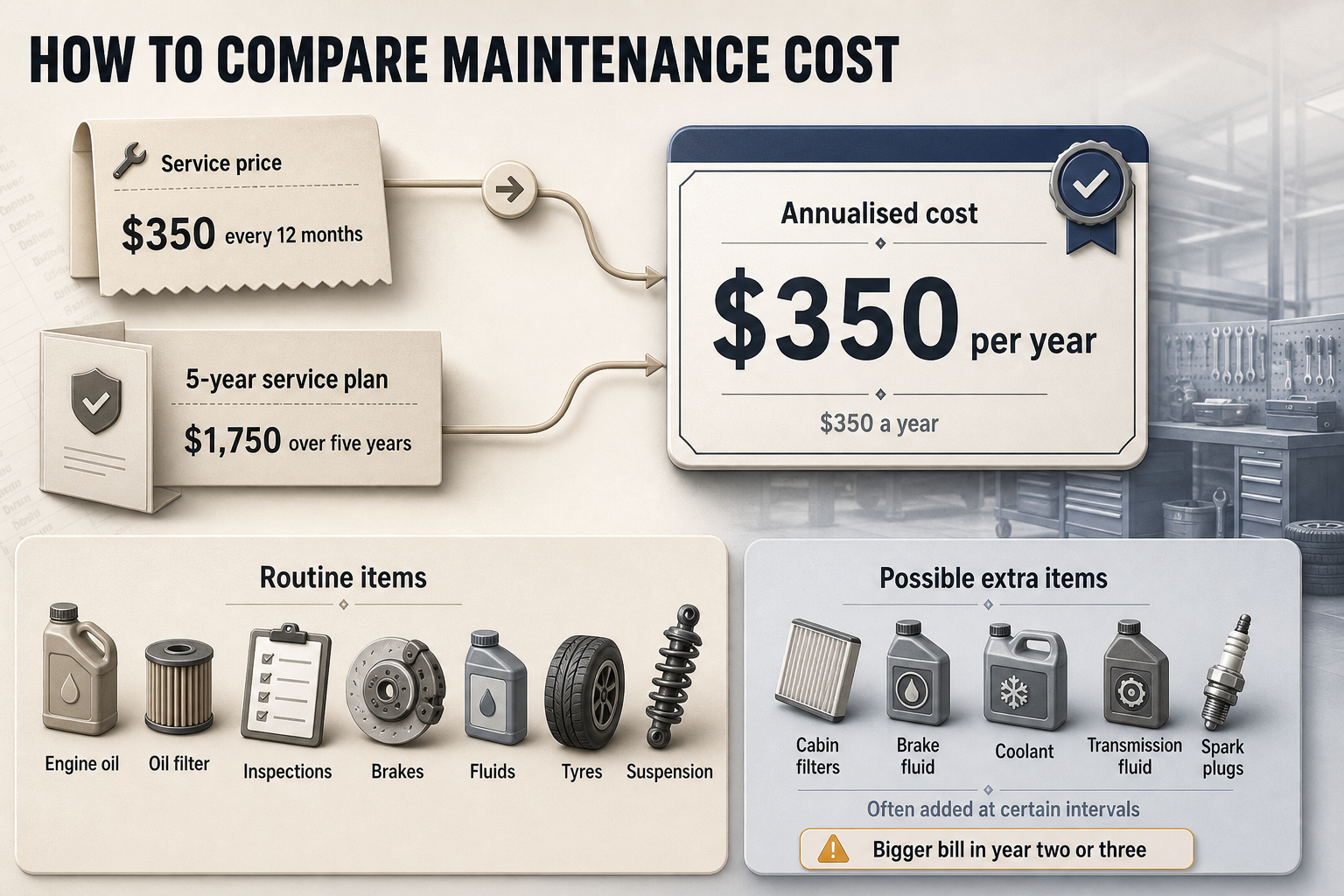
For this parameter, think of maintenance cost as an annualised NZ dollar figure for scheduled servicing. If a brand says servicing is $350 every 12 months, that is a $350 per-year maintenance cost. If it offers a five-year service plan for $1,750, that works out to $350 a year. That makes it easier to compare brands and vehicle types on the same basis. (hyundai.co.nz)
Routine maintenance usually includes items such as engine oil, an oil filter, inspections, and checks of brakes, fluids, tyres and suspension. Some services also include cabin filters, brake fluid, coolant, transmission fluid or spark plugs, but these often appear as extra items at certain intervals rather than every year. That is why one advertised “cheap service” can still lead to a bigger bill in year two or three. (toyota.co.nz)
It also helps to separate maintenance from other ownership costs. Maintenance is not the same as fuel, insurance, registration, road user charges, tyres, or a WoF fee, though all of those affect your budget. In New Zealand, you still need to keep the vehicle roadworthy and maintain a current WoF or CoF where required, but the maintenance-cost parameter is specifically about servicing and upkeep rather than every motoring expense. (nzta.govt.nz)
Typical Ranges
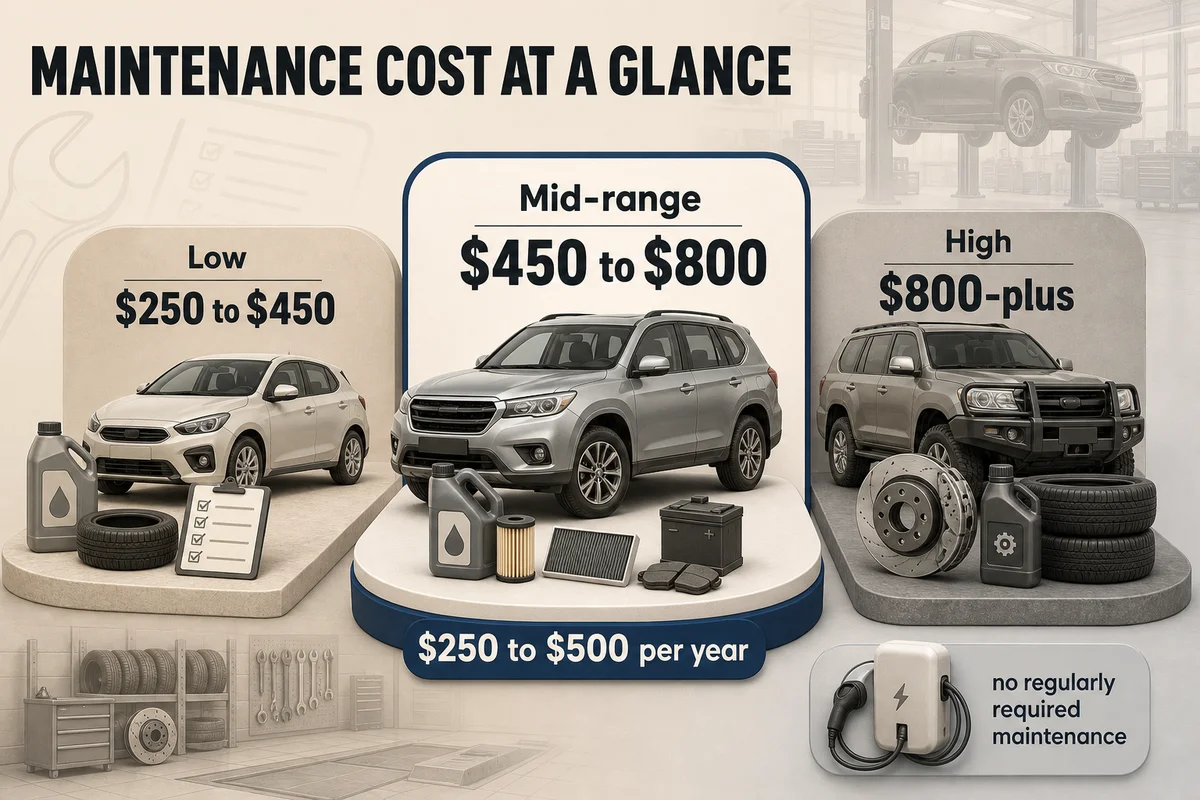
A low annual maintenance cost in New Zealand is usually around $250 to $450 for a mainstream small car, hybrid hatch, or simple petrol SUV under a capped-price or menu-pricing programme. Toyota, for example, publishes capped servicing with advertised maximum retail prices of $255 for petrol and $340 for diesel on some eligible vehicles, while its broader service menu shows many routine services for passenger models in roughly the $345 to $390 range before periodic add-ons. (toyota.co.nz)
A mid-range figure is roughly $450 to $800 per year. This is common for larger SUVs, utes, diesels, European cars, and vehicles with pricier oils, filters or longer lists of inspection items. Toyota’s menu pricing shows examples such as $420 for some 4-cylinder diesel/hybrid vehicles, $430 for some 6-cylinder commercial and sport models, and $490 for some diesel vehicles with a diesel particulate filter. (toyota.co.nz)
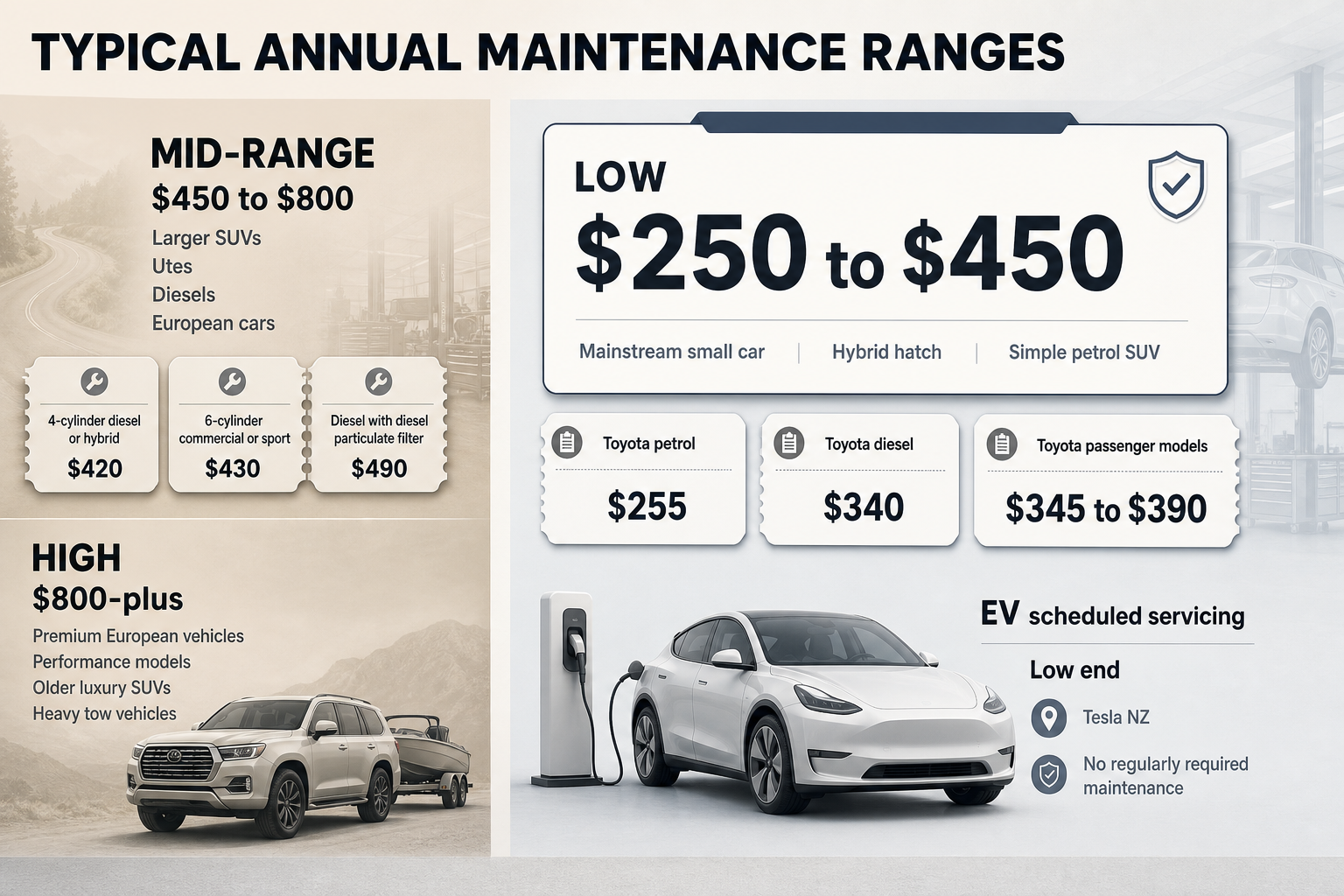
A high annual maintenance cost is generally $800-plus, though this often shows up less in the scheduled-service price and more in total workshop spending over a year. Premium European vehicles, performance models, older luxury SUVs, and heavy tow vehicles can easily land here once you include larger brake components, specialist fluids, extra labour time, and wear from towing or rough-road use. If you are looking at a used vehicle out of warranty, especially one with air suspension, complex turbocharging, or expensive electronics, “maintenance cost” can stop being a tidy annual figure and become a much bigger ownership risk. (aa.co.nz)
Battery electric vehicles often sit at the low end for scheduled servicing because they have fewer moving parts and no engine oil changes. Tesla New Zealand states its vehicles have no regularly required maintenance, which shows why EVs can look very cheap on this parameter, although tyres, brake fluid, cabin filters and repairs still exist in the real world. (tesla.com)
Use-Case Guidance
If you mainly drive around Auckland, Wellington or Christchurch in a small petrol car, hybrid, or EV, you should aim for a maintenance-cost figure of about $250 to $500 per year. That usually buys you predictable servicing without nasty surprises, especially if the car has a strong dealer or independent workshop network. For school runs, commuting and supermarket duty, you do not need to accept ute-level service costs just because an SUV looks appealing. (toyota.co.nz)
For family SUVs doing open-road trips, ski weekends, and holiday runs with a full load, a sensible allowance is $400 to $700 per year for scheduled maintenance. That covers the reality that bigger vehicles often need more oil, pricier filters, and more expensive brake and suspension consumables over time. If you are comparing a petrol midsize SUV with a diesel one, the diesel may save fuel on long trips but can carry higher servicing costs and, in New Zealand, diesel vehicles also face road user charges. (toyota.co.nz)
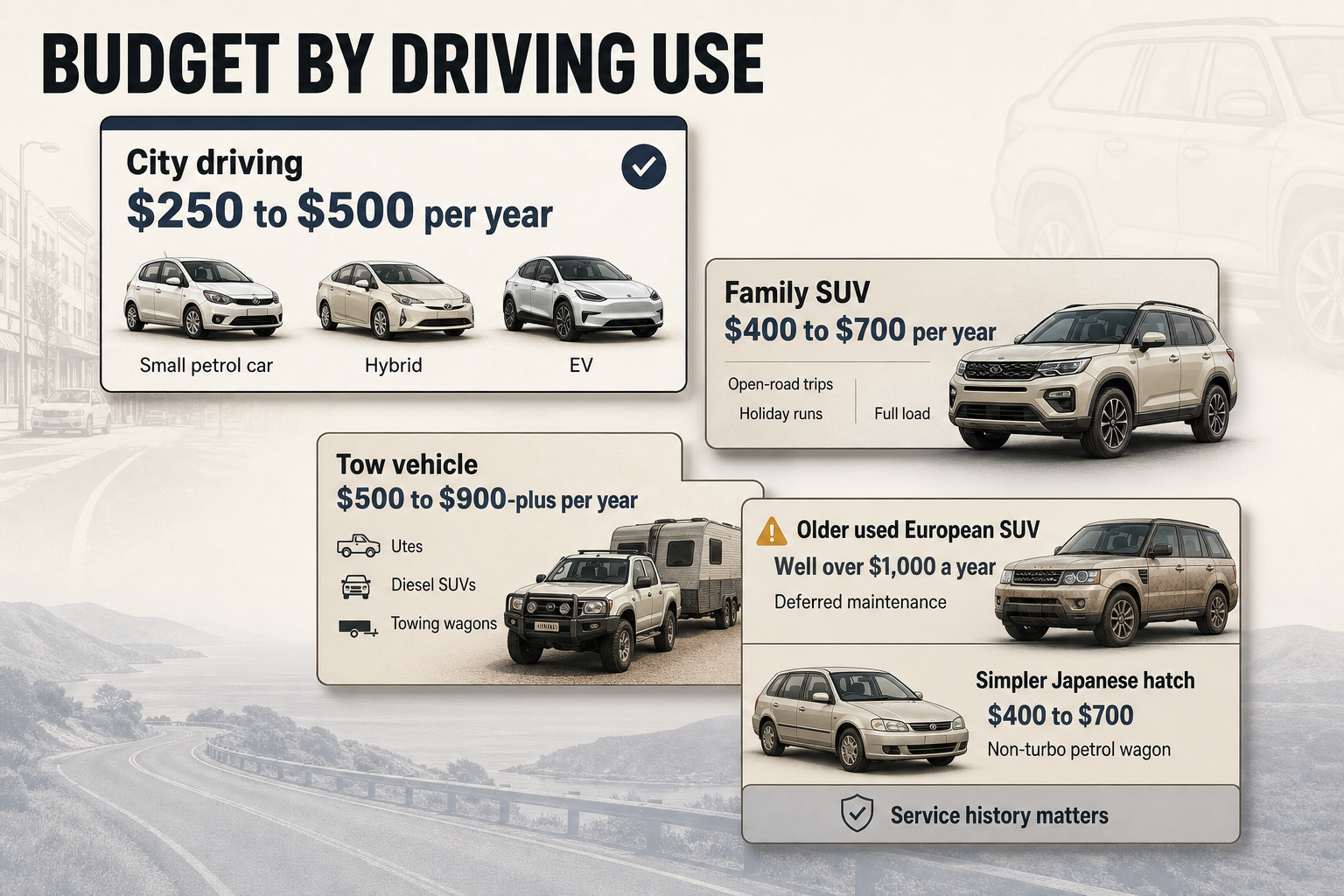
For utes, diesel SUVs, towing wagons and anything that regularly hauls a boat to the ramp or a trailer over the Kaimais, budget $500 to $900-plus per year. Towing and heavy loads increase wear on brakes, transmission fluid, tyres and cooling systems. A service menu price may look manageable, but the real cost of keeping a hard-worked tow vehicle healthy is usually higher than the advertised base service. (toyota.co.nz)
For older used cars, the number you should focus on is not the cheapest annual service quote. It is the likely average spend once deferred maintenance is caught up. A 10-year-old European SUV with a bargain purchase price can still need well over $1,000 a year in servicing and repairs once bushings, cooling parts, sensors, batteries and transmission work start appearing. By contrast, a simpler Japanese hatch or non-turbo petrol wagon may stay much closer to $400 to $700 if it has been serviced properly. This is where service history matters more than brochure pricing. (consumerprotection.govt.nz)
NZ-Specific Factors
New Zealand conditions can make maintenance costs rise faster than you expect. Short urban trips are hard on engines and batteries, gravel roads chip paint and stress suspension, coastal air can speed up corrosion, and hilly roads put more load on brakes and transmissions. A car that seems cheap to maintain in a flat urban market overseas may not feel so cheap after years of Northland humidity, Wellington hills, or corrugated rural roads in Canterbury and Otago.
Workshop access matters too. Mainstream Japanese and Korean brands usually have broader support and easier parts supply in New Zealand than niche European or grey-import models. Consumer Protection notes that manufacturers, importers and distributors must ensure spare parts and repair facilities are available for vehicles they assemble or import, but in practice some vehicles are still easier and cheaper to service here than others. (consumerprotection.govt.nz)
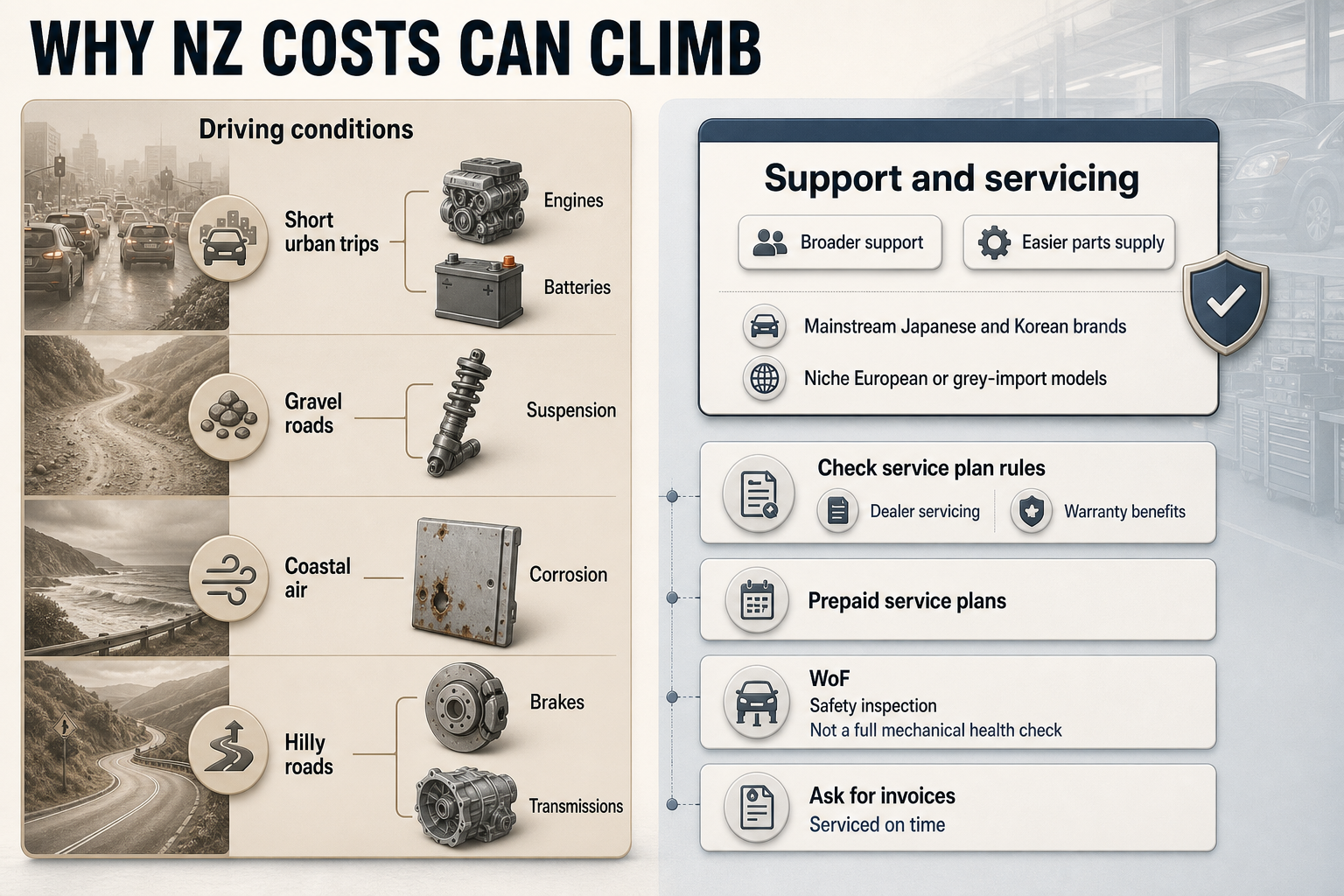
You should also check whether the car must be serviced at a franchise dealer to keep a service plan, roadside support, or warranty benefits active. Toyota’s servicing programmes tie in with added ownership benefits, and Hyundai promotes prepaid service plans that lock in scheduled servicing costs against future price rises. Those plans can make a higher purchase price easier to live with because your annual maintenance spend is more predictable. (hyundai.co.nz)
Finally, do not confuse a fresh WoF with proper maintenance. A WoF is a safety inspection, not a full mechanical health check, and NZTA says the registered person is responsible for keeping the vehicle compliant and roadworthy. A car can pass a WoF and still be overdue for oil, filters, transmission fluid or other scheduled work. If you are buying used, ask for invoices, not just a stamp in the handbook, and look for evidence that servicing was done on time rather than only when something failed. (nzta.govt.nz)
You may also be interested in these independent articles
Sources
- [1]Toyota NZ Servicing
- [2]Toyota NZ Service Menu Pricing PDF
- [3]Hyundai New Zealand Service Plans
- [4]Tesla New Zealand Service
- [5]AA New Zealand Vehicle Servicing Guide
- [6]Consumer Protection NZ: Fixing Your Car
- [7]Consumer Protection NZ: Solving Issues with Your Car Dealer
- [8]NZ Transport Agency Waka Kotahi: Warrant of Fitness
- [9]NZ Transport Agency Waka Kotahi: Registered Person’s Responsibilities
- [10]NZ Transport Agency Waka Kotahi: Road User Charges
© 2026 pyfoi. All rights reserved.