
How to Choose the Right Seating Capacity in NZ
Choosing vehicle seating capacity in NZ is about more than seat count. Compare 5-seater and 7-seater options, child-seat fit, boot space and costs.
Seating capacity sounds simple, but it affects far more than how many people you can carry. For New Zealand buyers, it shapes your day-to-day comfort, luggage space, child-seat fit, running costs, and even whether a vehicle suits school runs, ski trips, or towing the boat to the bach.
What the numbers mean
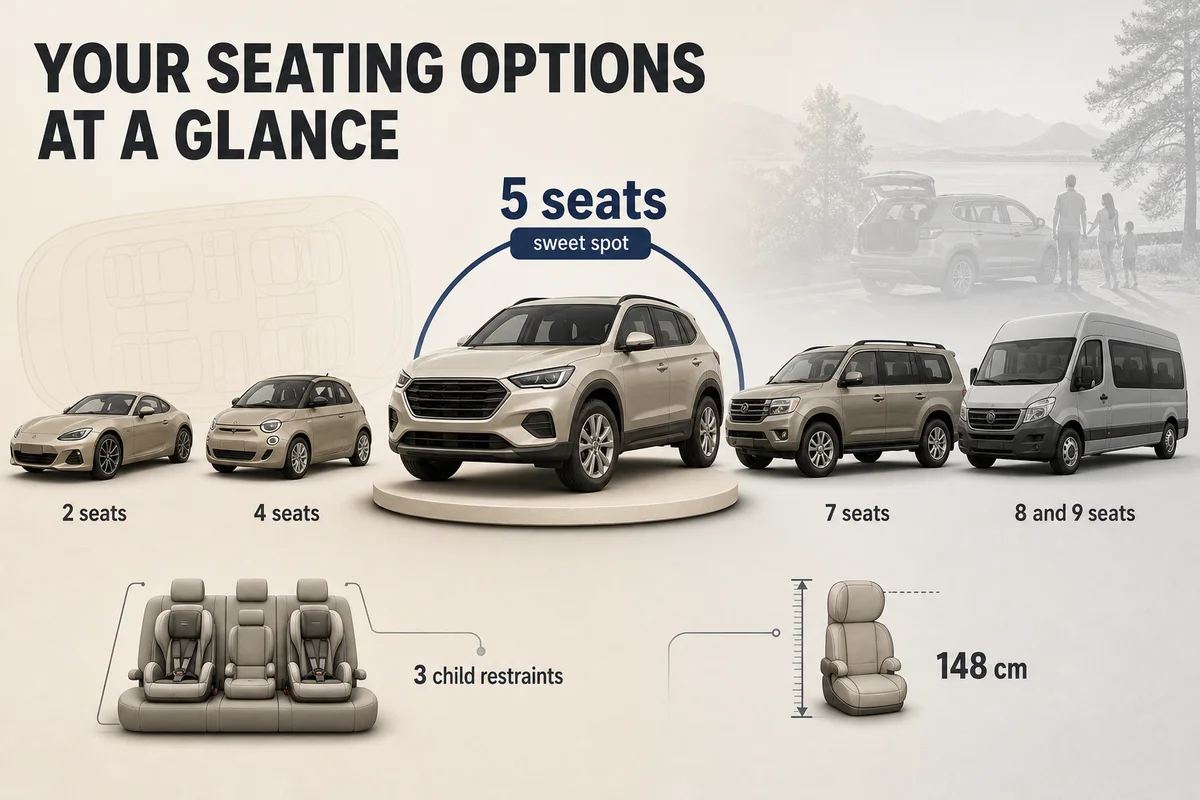
A vehicle’s seating capacity is the total number of passenger seats including the driver. So a five-seater means room for four passengers plus you, while a seven-seater means six passengers plus you. On paper that looks straightforward, but the real-world difference between seat counts can be huge.
The first thing to understand is that a higher seat count does not always mean a bigger or better family car. Some seven-seaters are really “5+2” layouts, where the third row is best for children or short trips. Others, such as larger SUVs and people movers, have adult-friendly rear seats and enough width for three across the middle row.
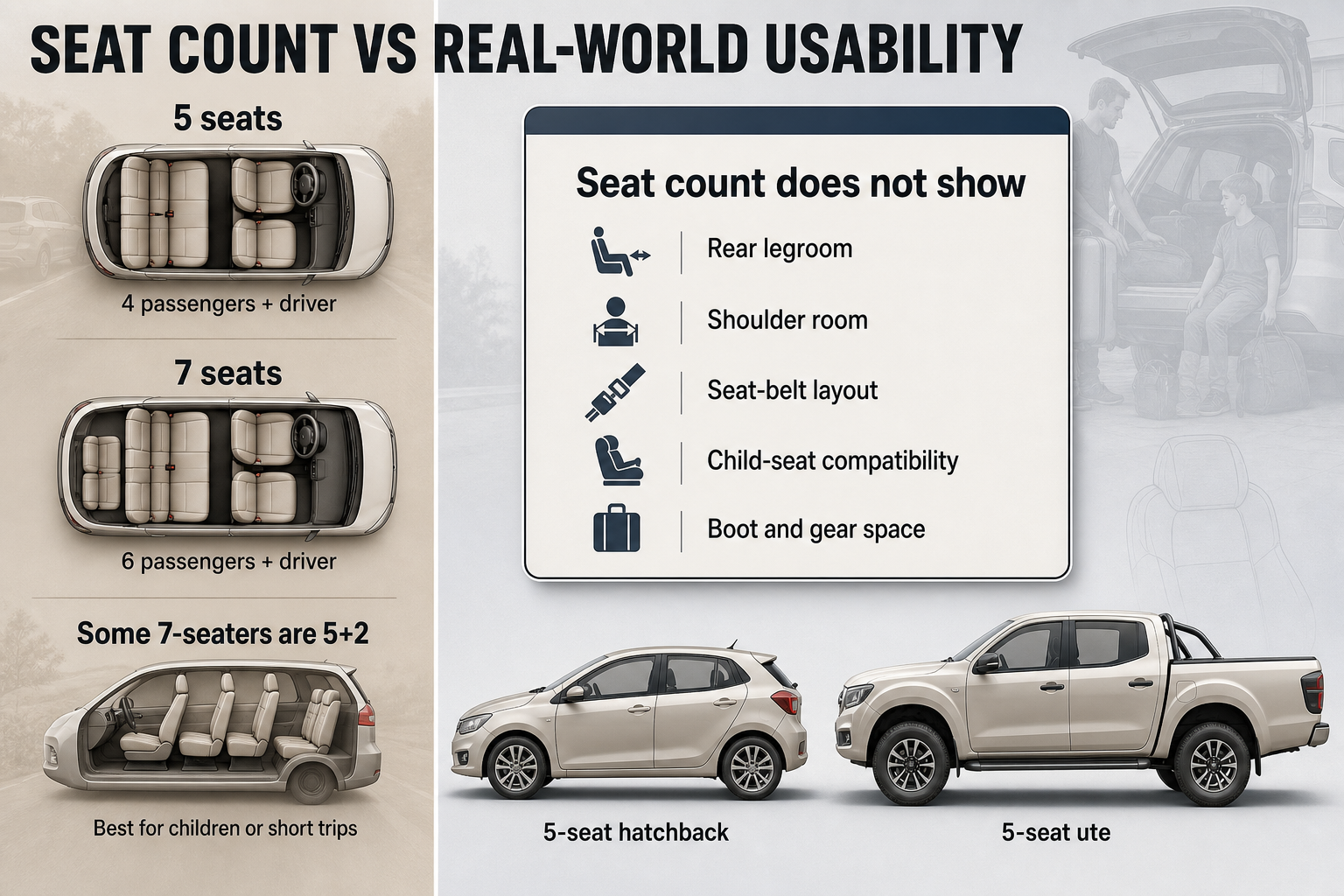
Seat count also does not tell you how usable the cabin is. A five-seater hatchback and a five-seater ute may both list the same capacity, but rear legroom, shoulder room, seat-belt layout, and child-seat compatibility can be very different. In New Zealand, where many families need to fit booster seats, sports gear, prams, or camping kit, the practical layout matters as much as the number itself.
Typical ranges
Two seats
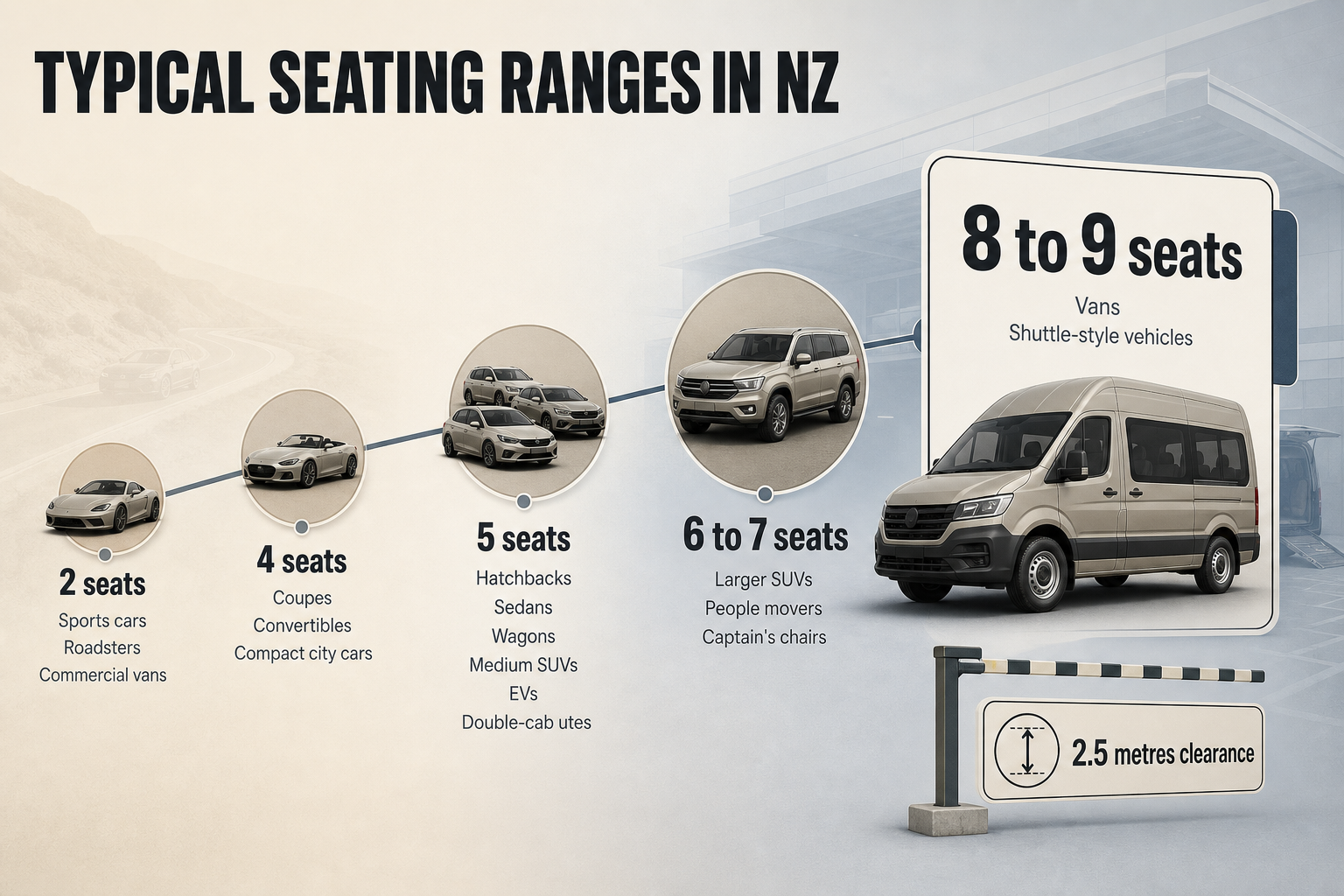
Two-seat vehicles are usually sports cars, roadsters, some coupes, and commercial vans with only a front bench or two front seats. These are niche choices in New Zealand. They suit buyers who rarely carry passengers and want either a focused driving experience or maximum load space behind the front seats.
The trade-off is obvious. You get no flexibility for children, friends, or carpooling. For most households, a two-seater works only as a second car.
Four seats
Four-seat vehicles are less common now, but you still see them in some coupes, convertibles, and a few compact city cars with a narrow rear bench shaped for two. In practice, a four-seater can work for a couple with occasional passengers, but it is not ideal if your household regularly carries three people in the back.
For New Zealand use, this format can be fine for urban driving in Wellington or Auckland where a smaller footprint helps with parking. It is much less useful for family duties or airport runs with luggage.
Five seats
Five seats is the default for most passenger vehicles sold in New Zealand. Small hatchbacks, sedans, wagons, medium SUVs, many EVs, and double-cab utes all sit here. For singles, couples, and many families with one or two children, five seats is the sweet spot.
A good five-seater gives you lower purchase and running costs than a larger seven-seater, and you usually keep more boot space because there is no folded third row taking up room. The catch is that “five seats” often means the middle rear seat is narrow and best used occasionally. If you need to fit three child restraints across the second row, many five-seaters will struggle.
Six and seven seats
Six-seat layouts usually appear in larger SUVs or vans with second-row captain’s chairs. Seven-seat layouts are common in medium and large SUVs such as the Mitsubishi Outlander, Hyundai Santa Fe, Kia Sorento, Toyota Highlander, and various people movers.
This is where many Kiwi buyers aim when family life gets busier. A seven-seater gives you flexibility for grandparents, team sport drop-offs, or taking extra kids to school. It can also be useful for South Island holiday trips where you need people space one weekend and folded seats for gear the next.
The compromise is that many medium SUVs with seven seats have a tight third row and a very small boot when all seats are in use. If you regularly carry seven people and their bags, you may need a larger SUV or van rather than assuming any seven-seater will do the job.
Eight and nine seats
Eight- and nine-seat vehicles are usually vans, people movers, or shuttle-style vehicles. These are the most practical choice if you genuinely carry big groups, have a large family, or need maximum passenger flexibility for work and home.
In New Zealand, these vehicles make sense for school holiday travel, sports teams, airport transfers, and larger households. The downside is size. They take more room in town, use more fuel in petrol or diesel form, and can feel cumbersome in older parking buildings or tight suburban streets. Accessible parking routes in parking buildings are designed for a vertical clearance of at least 2.5 metres under NZS 4121, but ordinary car parks can be tighter, so tall vans need extra care. (building.govt.nz)
Use-case guidance
If you mostly commute alone or as a couple, a four- or five-seater is usually the sensible choice. A small hatch or compact SUV is easier to park, cheaper to fuel, and better suited to city life. You do not need a seven-seater for the once-a-year family reunion.
If you have one or two children, five seats often remains enough, but check the rear bench carefully. Bring your child seats to the test drive. New Zealand law requires children under seven to be secured in an approved child restraint, and children aged seven must use one if available. You should also keep using a booster until your child reaches 148 cm tall. (nzta.govt.nz)
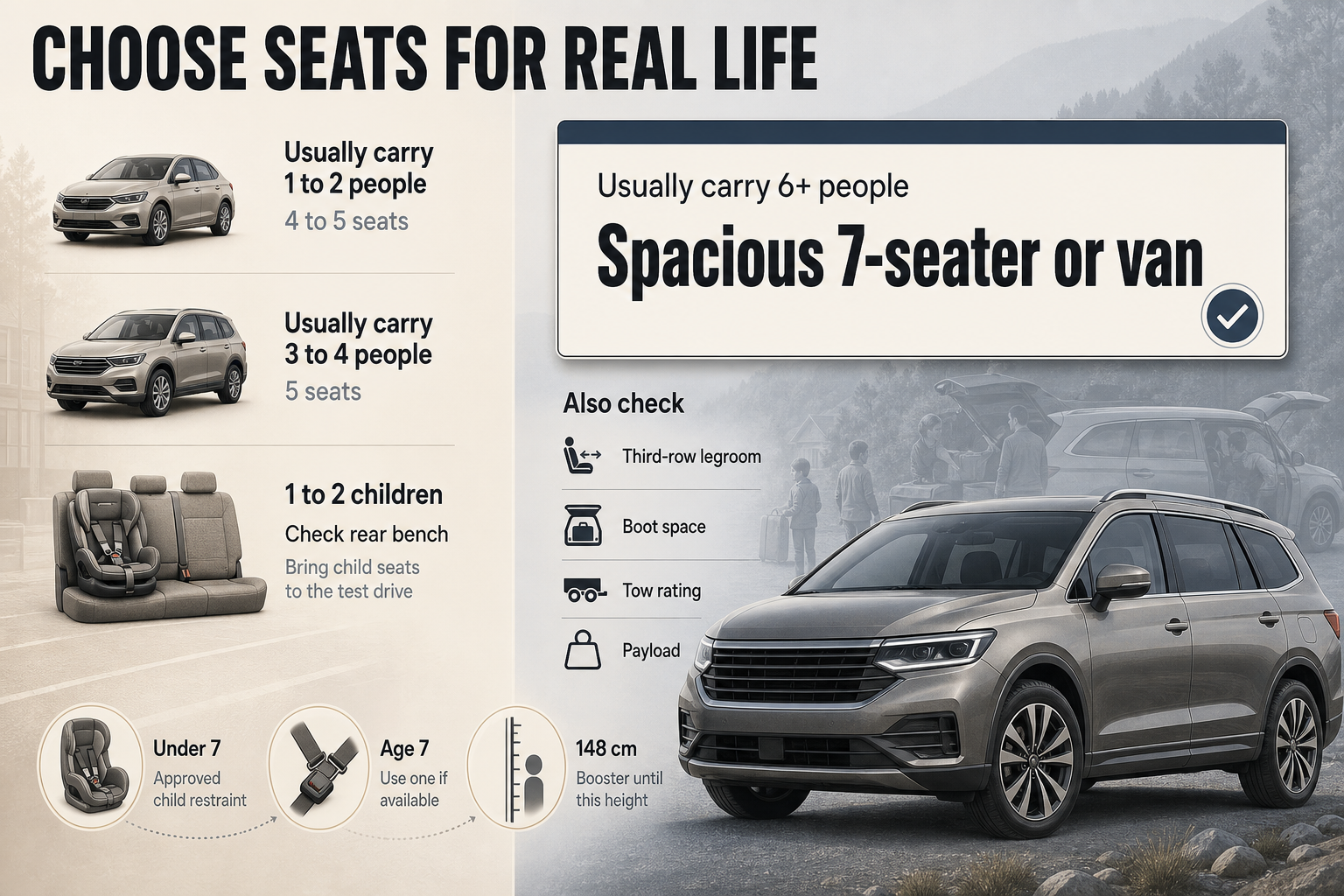
If you have three children, especially if some still use child restraints, seating capacity becomes more than a simple number. You need enough width across the second row, accessible ISOFIX or top tether points where fitted, and seat belts that work with your restraint setup. A nominal five-seater may be legal, but frustrating to live with every day if the centre rear seat is narrow or uses an awkward belt arrangement.
If you regularly carry six or seven people, look beyond the badge and brochure. Measure third-row legroom, check whether adults can get in easily, and see how much boot space remains with all seats up. For long New Zealand trips such as Auckland to Taupō or Christchurch to Queenstown, luggage space matters just as much as seat count.
If you tow a caravan, horse float, or boat, do not assume a bigger passenger count automatically means stronger towing ability. Some seven-seat SUVs tow well, others do not. You need to assess seating capacity alongside tow rating, payload, and how much weight the vehicle can carry when every seat is occupied.
For commercial or mixed family-work use, eight- or nine-seat vans can be excellent. They suit tradies who move staff during the week and family gear on weekends, but they are best if you genuinely use the seats. If most of the time you carry only two or three people, you may be paying for size you do not need.
NZ-specific factors
New Zealand’s restraint laws matter more as seat count rises. Every occupied seating position needs a usable seat belt, and if a seat has a belt, the occupant must wear it. Modern cars must have seat belts in front and back seats, and drivers are responsible for making sure passengers under 15 are correctly restrained. (nzta.govt.nz)
This becomes especially important in third rows. Some older imports and older large wagons may have lap-only belts in rear positions. Waka Kotahi notes that lap belts do not provide the extra support of a three-point lap-and-diagonal belt, and the safest option for children in those seats is a restraint designed to work with lap belts. (nzta.govt.nz)
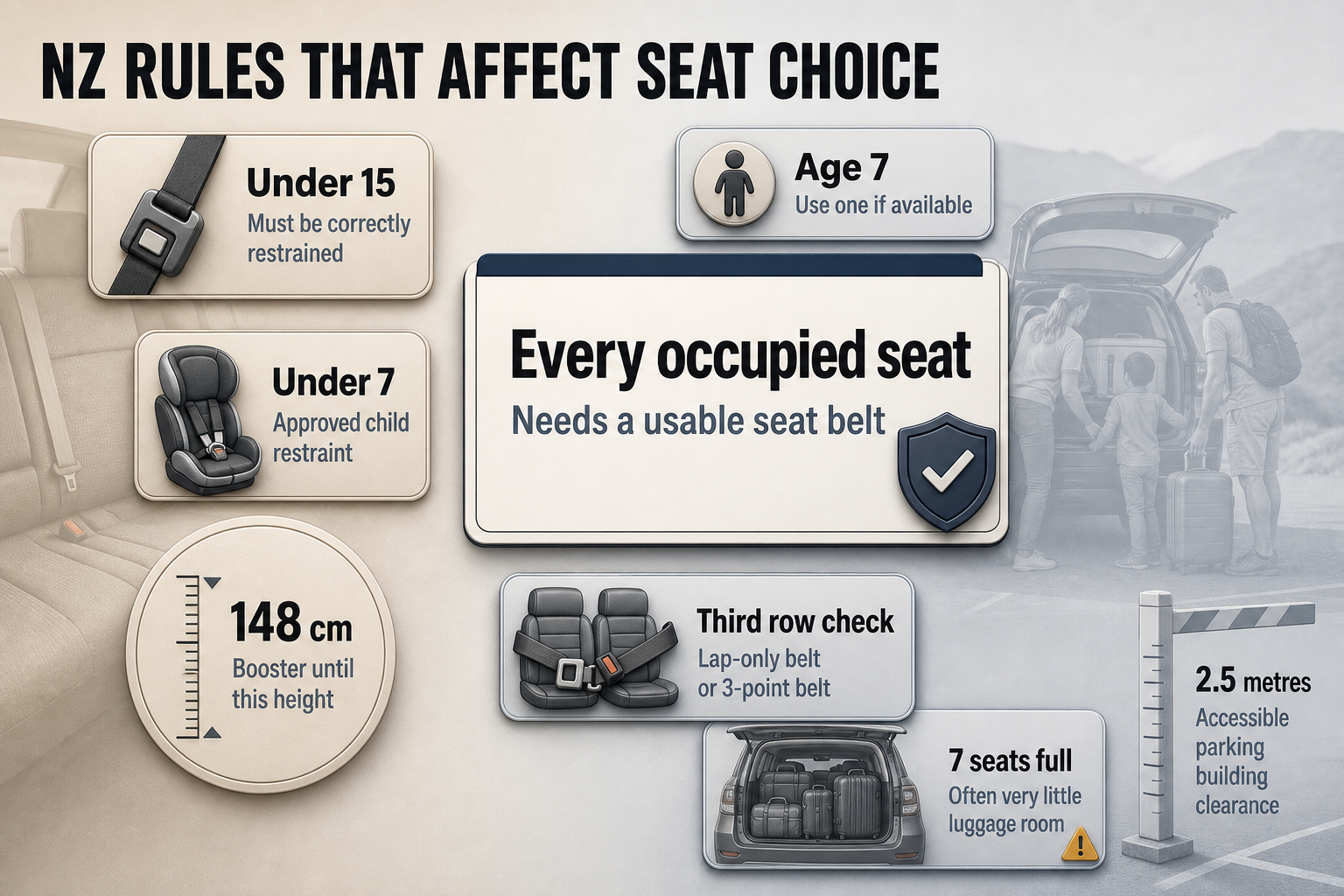
Road-trip culture also changes what “enough seats” means here. Kiwi families often combine passengers with bulky gear such as chilly bins, scooters, cricket bags, or ski equipment. A seven-seater with all seats occupied may leave almost no luggage room, which can push bags into the cabin and make travel less safe and less comfortable.
Running costs matter too. More seats usually mean a larger, heavier vehicle. That tends to mean higher fuel use for petrol and diesel models, and often higher tyre and servicing costs. If you only need extra seats a few times a year, it can be cheaper to own a good five-seater and hire something larger for holidays.
The smart way to choose seating capacity is to buy for your real weekly life, not your most crowded day of the year. If you usually carry one to four people, a well-packaged five-seater is often the best buy. If you often carry six or more, move straight to a genuinely spacious seven-seater or van and check every rear seat for comfort, belt type, child-seat fit, and boot space before you sign.
You may also be interested in these independent articles
Sources
© 2026 pyfoi. All rights reserved.