
What a Fridge Icemaker Rating Really Means
Fridge icemaker ratings can mislead NZ buyers. Learn what they really measure, how they affect space, noise, repairs, and running costs.
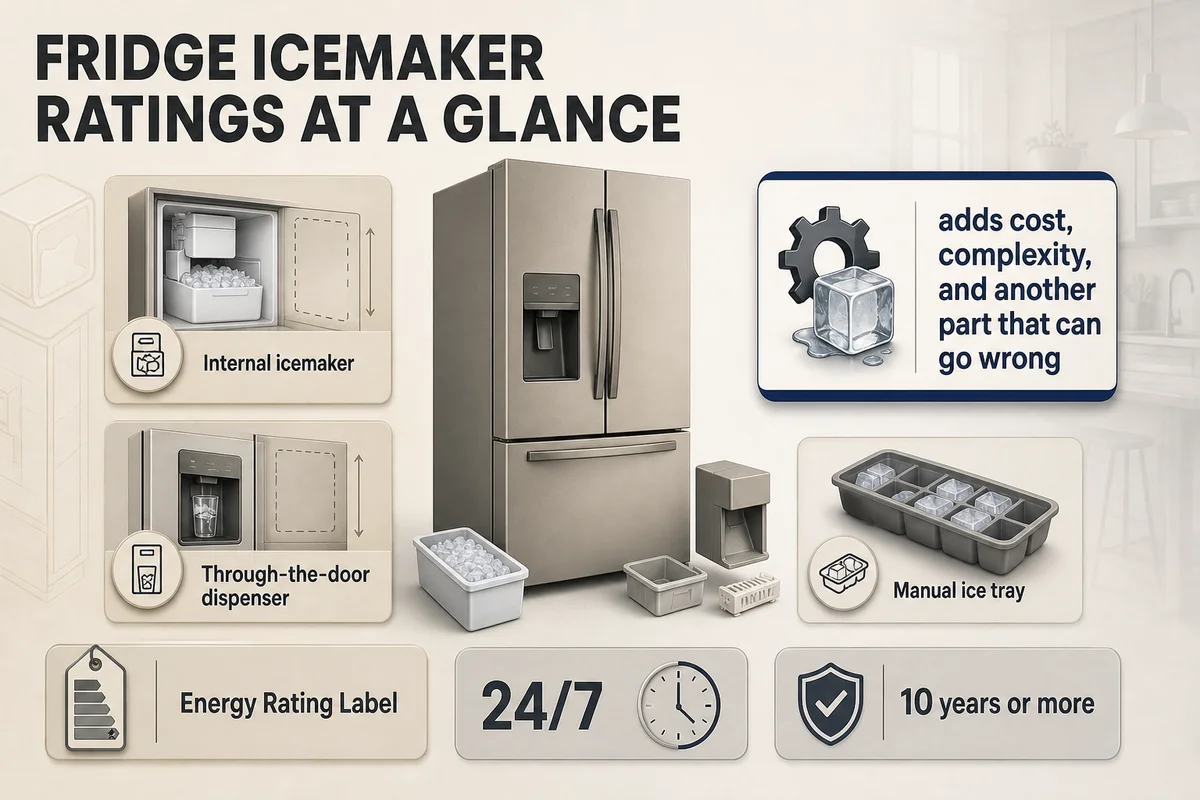
A fridge icemaker rating is a simple way of describing how well the ice-making system performs. It matters because an icemaker can be handy in summer, for entertaining, or for a busy family, but it also adds cost, complexity, and another part that can go wrong.
What Goes Into the Rating
An icemaker rating is not a formal New Zealand government label in the way an Energy Rating Label is. NZ energy labels are regulated and show appliance efficiency, but they do not give a separate official star score for ice-making performance. (consumer.org.nz) In practice, an icemaker rating is usually a retailer, review-site, or internal catalogue score that tries to summarise how good the icemaker is.
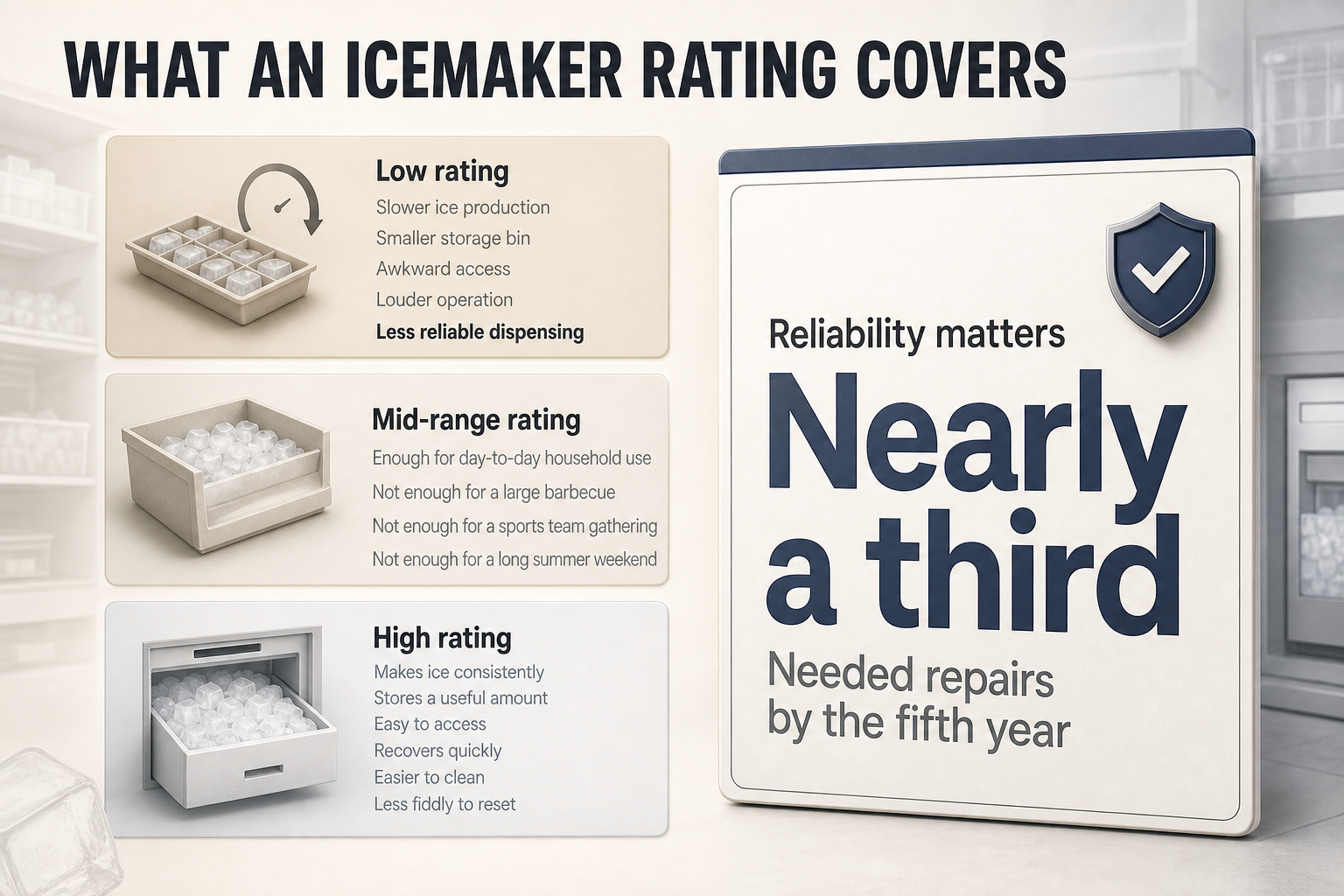
A low rating usually points to basic performance. That can mean slower ice production, a smaller storage bin, awkward access, louder operation, or less reliable dispensing. It may also reflect the fact that the fridge needs more time to recover after heavy use, especially if the freezer section is opened often on a hot day.
A mid-range rating generally suggests the icemaker does the job without standing out. You can expect enough ice for day-to-day household use, but not necessarily enough for a large barbecue, a kids' sports team gathering, or a long summer weekend at the bach without some planning ahead.
A high rating usually means the system makes ice consistently, stores a useful amount, is easy to access, and recovers reasonably quickly after the bin is emptied. Better-rated systems also tend to be easier to clean and less fiddly to reset after a power cut or filter change, though that varies by brand and design.
Reliability should form part of any sensible icemaker rating, because icemakers and dispensers are a common trouble spot in refrigerators. Consumer Reports says icemakers and dispensers are among the most commonly reported fridge problems in owner surveys, and nearly a third of refrigerators in its survey sample needed repairs by the fifth year. (consumerreports.org) That does not mean you should avoid every fridge with an icemaker, but it does mean the rating should never be read as a pure convenience score.
What to Look For
Start by checking whether the fridge has an internal icemaker or a through-the-door dispenser. Through-the-door systems are convenient, but they take up space in the door and add more hardware. Consumer NZ notes that some fridges with through-the-door icemakers and water dispensers need plumbing during installation, which adds cost and limits where you can place the appliance. (consumer.org.nz)
Next, look at usable storage space. An icemaker can reduce freezer room because the ice box, motor, ducting, and dispenser hardware all occupy space that could otherwise hold food. Consumer Reports specifically notes that usable capacity measurements subtract the volume taken up by icemakers and related components. (consumerreports.org) If you buy in bulk from Pak'nSave or Costco-style outlets, or you freeze a lot of meat, bread, and leftovers, this matters more than the brochure might suggest.
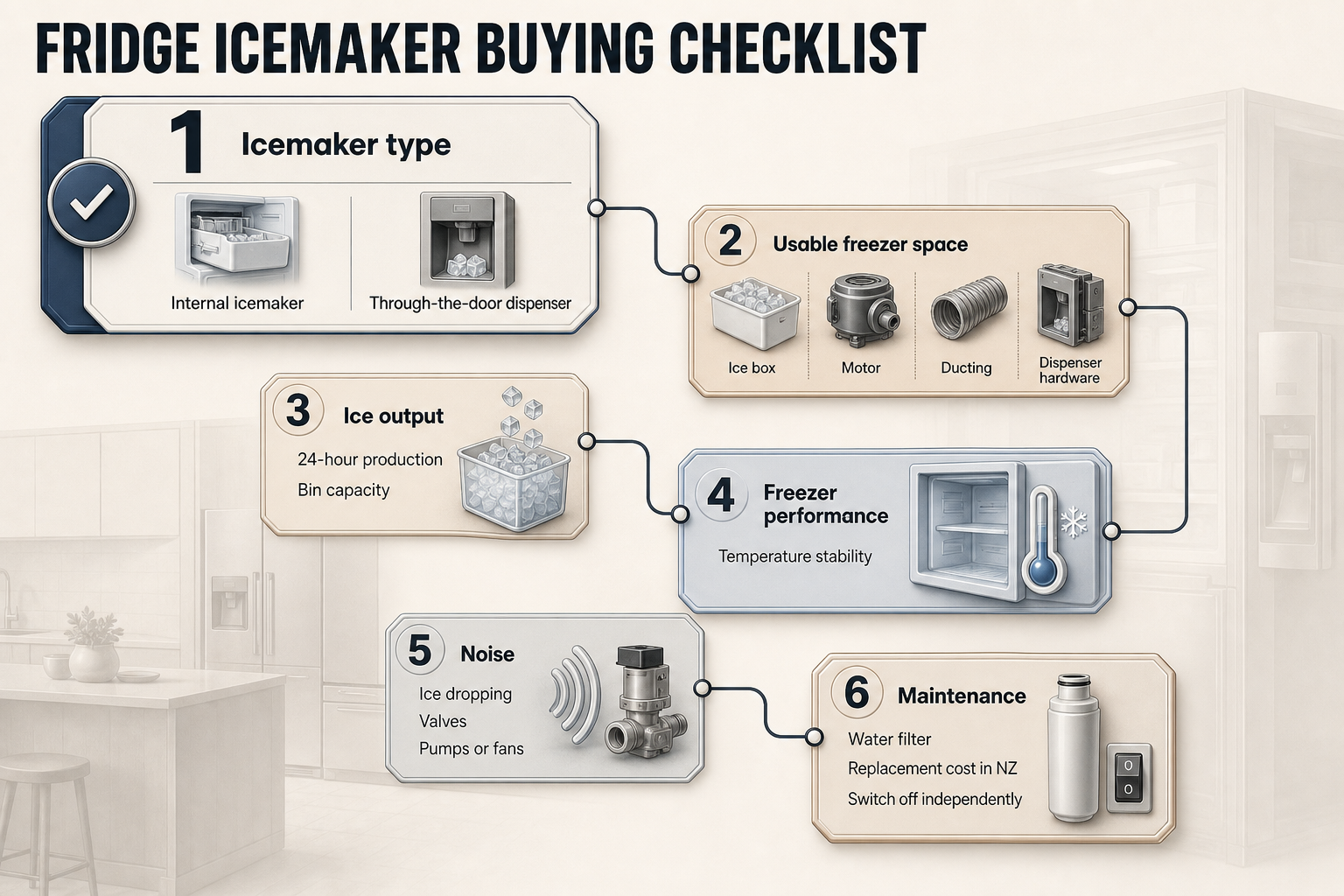
You should also ask how much ice the unit can actually make in 24 hours and how much it can store at once. Brands do not always present these numbers clearly, and some NZ retailers focus more on total fridge litres than on ice output. If the seller cannot tell you the daily ice production or bin capacity, treat any star rating with caution.
Temperature stability matters too. Consumer NZ testing has shown that some fridges struggle with temperature fluctuations, and poor temperature control can affect frozen food quality. (consumer.org.nz) While that is not the same as an icemaker test, it is relevant because an icemaker depends on a freezer maintaining steady cold conditions. A fridge with weak freezer performance may still have an icemaker, but not a very satisfying one.
Noise is another thing buyers often miss. Ice dropping into the bin, valves opening, and pumps or fans cycling can be surprisingly noticeable in an open-plan Auckland apartment or a smaller townhouse kitchen. Independent test programmes such as Consumer Reports include noise as part of fridge assessment, which is useful context if the icemaker rating does not mention sound levels. (consumerreports.org)
Documentation matters. Check the product sheet, user manual, and warranty terms. If the model has a water filter, ask how often it needs replacing and what that costs in New Zealand. Also ask whether the icemaker can be switched off independently, because many households only use it part of the year and would rather free up space or reduce maintenance.
NZ Context
For New Zealand buyers, the first thing to keep straight is that stars on an Energy Rating Label are about electricity efficiency, not ice quality. Consumer NZ explains that the label compares energy efficiency between appliances of similar type and capacity, and fridge energy labels are based on the Australian and New Zealand standard. (consumer.org.nz) So if you see a fridge with a good energy star result, that tells you about running cost, not whether the icemaker is excellent.
That distinction matters because fridges run all day, every day, and power costs add up. Consumer NZ notes that refrigeration is a significant household running cost because fridges and freezers operate 24/7. (consumer.org.nz) An icemaker can add convenience, but it may also add energy use, reduce freezer space, and increase the chance of repairs. For many homes, especially if you only want ice occasionally, a simple manual ice tray may be the smarter buy.
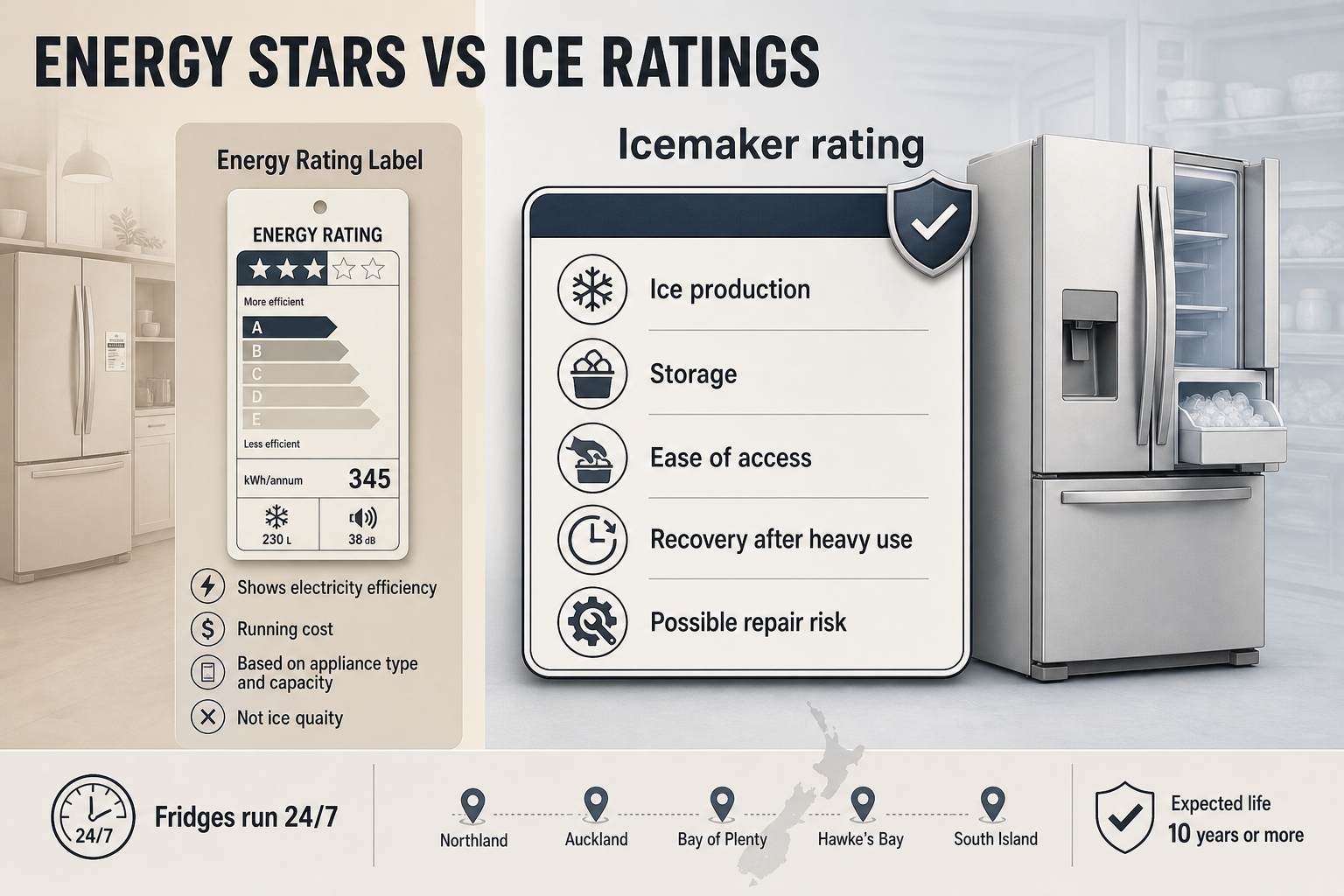
New Zealand conditions also change how useful an icemaker really is. In warmer northern areas such as Northland, Auckland, Bay of Plenty, and Hawke's Bay, an automatic icemaker may get plenty of use over summer. In cooler parts of the South Island, it may be more of a nice-to-have than a must-have, unless you entertain often or have a large family.
Service support is a practical local issue. A clever dispenser system is less appealing if replacement filters, valves, or door parts are slow to source in NZ. Consumer NZ also reminds buyers that the Consumer Guarantees Act applies, and products must be of acceptable quality and fit for purpose. (consumer.org.nz) If an icemaker fails early or repeatedly, your rights may go beyond the written warranty.
You should also think about installation in the kind of home you have. Many NZ kitchens are not huge, and large French-door or side-by-side fridges with icemakers can be harder to fit through doors, into cabinetry gaps, or beside islands. If the model needs plumbing, that can be straightforward in a new build but more annoying in an older villa or unit where the fridge space was never designed for a water connection.
The best way to read an icemaker rating is as one small part of the buying decision. If you use lots of ice, entertain often, and want convenience, a high-rated icemaker may be worth paying for. If you mainly want dependable cooling, lower running costs, and fewer things to break, you may be better off prioritising energy efficiency, temperature performance, and brand reliability over any flashy ice score. Consumer NZ says a new fridge should last 10 years or more, which is a useful reminder that the whole appliance matters more than a single feature. (consumer.org.nz)
You may also be interested in these independent articles
Sources
© 2026 pyfoi. All rights reserved.