
Fridge Ice Capacity Explained for NZ Buyers
Fridge ice capacity affects freezer space, running costs and daily use. Learn what litres mean, compare NZ fridge options, and avoid costly mistakes.
Fridge ice capacity is the volume of the ice-maker section, measured in litres. It sounds like a small spec, but it affects how much ice your fridge can store, how much freezer space is given over to the ice system, and whether the appliance suits the way your household actually uses cold drinks and entertaining space.
For New Zealand buyers, this matters more than it first appears. A family in Auckland that fills chilly bins for beach trips has different needs from a couple in a Wellington apartment, and a big American-style fridge with a generous ice bin can cost more to buy and run than a simpler model with no dedicated ice storage at all. (eeca.govt.nz)
What the numbers mean
Ice capacity in litres is the usable volume of the ice-maker compartment or ice bin. In plain terms, it tells you how much space is available to hold ready-made ice inside the fridge or freezer. A 1 litre ice bin is small, while a 5 litre or 6 litre bin is much more substantial and can cope better with several people using ice over a short period.
This figure is not the same as total fridge capacity or freezer capacity. A fridge might be advertised as 500 litres overall, but only a small slice of that may be reserved for ice storage. If the model has an automatic ice maker, some of the freezer’s usable space is often sacrificed to the ice mechanism and storage bin, so a bigger ice capacity can mean less room for frozen food. That trade-off is worth checking if you bulk-buy meat, freeze school lunches, or keep a lot of frozen meals on hand. (eeca.govt.nz)
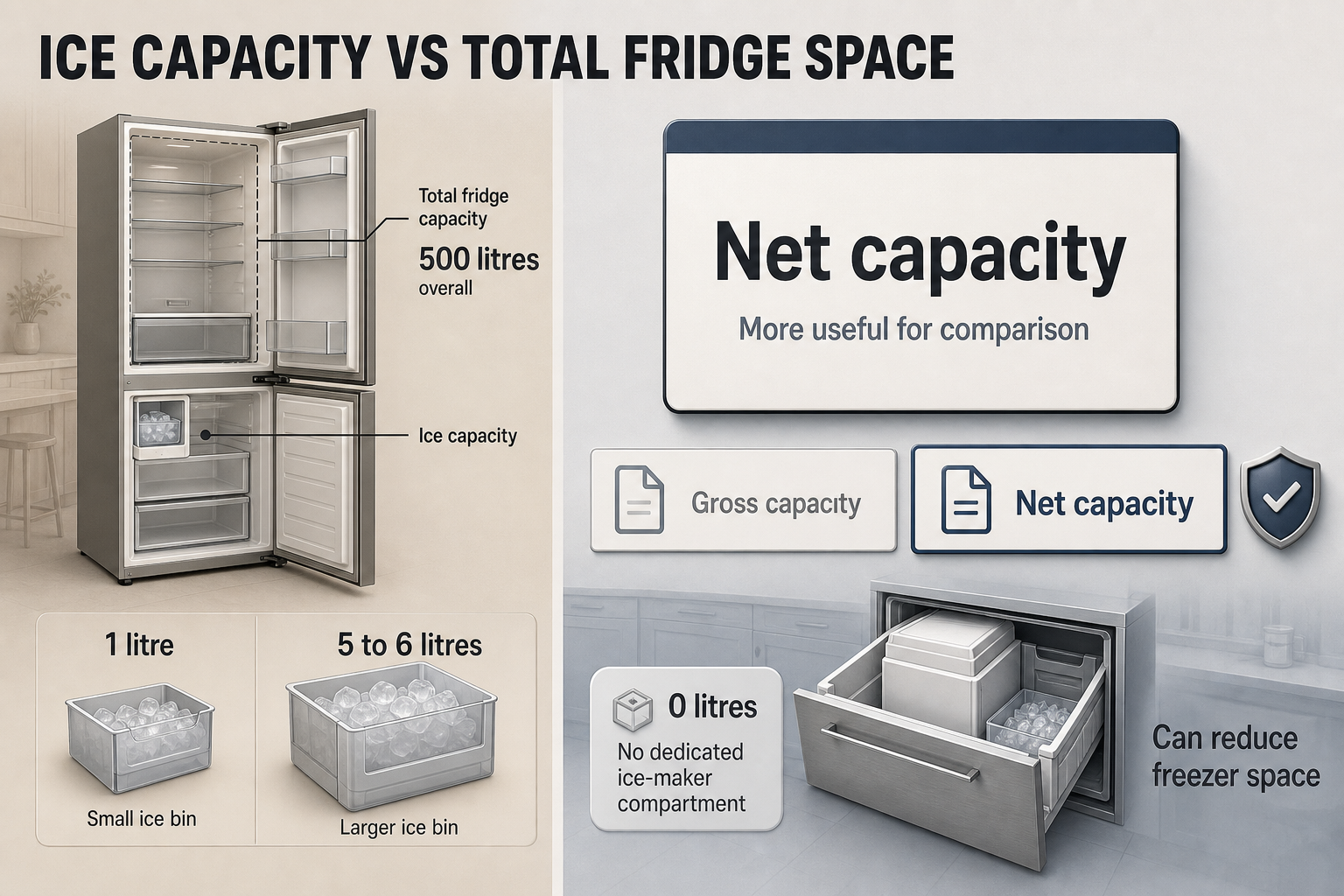
You will also see many fridges with an ice capacity of 0 litres. That does not mean the data is missing. It often simply means there is no dedicated ice-maker compartment, or the brand does not provide a separate rated ice-bin volume. For plenty of buyers, that is perfectly fine. Standard ice trays still do the job, and they do not permanently take up the same amount of built-in freezer hardware.
Where manufacturers publish more than one capacity figure, the most useful one is the standardised net capacity rather than gross capacity. Net figures are meant to reflect usable internal volume under recognised test methods, which is why they are better for comparing products side by side. In New Zealand, fridge and freezer energy labelling and testing are tied to regulated standards and test methods, so standardised figures matter more than marketing claims. (eeca.govt.nz)
Typical ranges
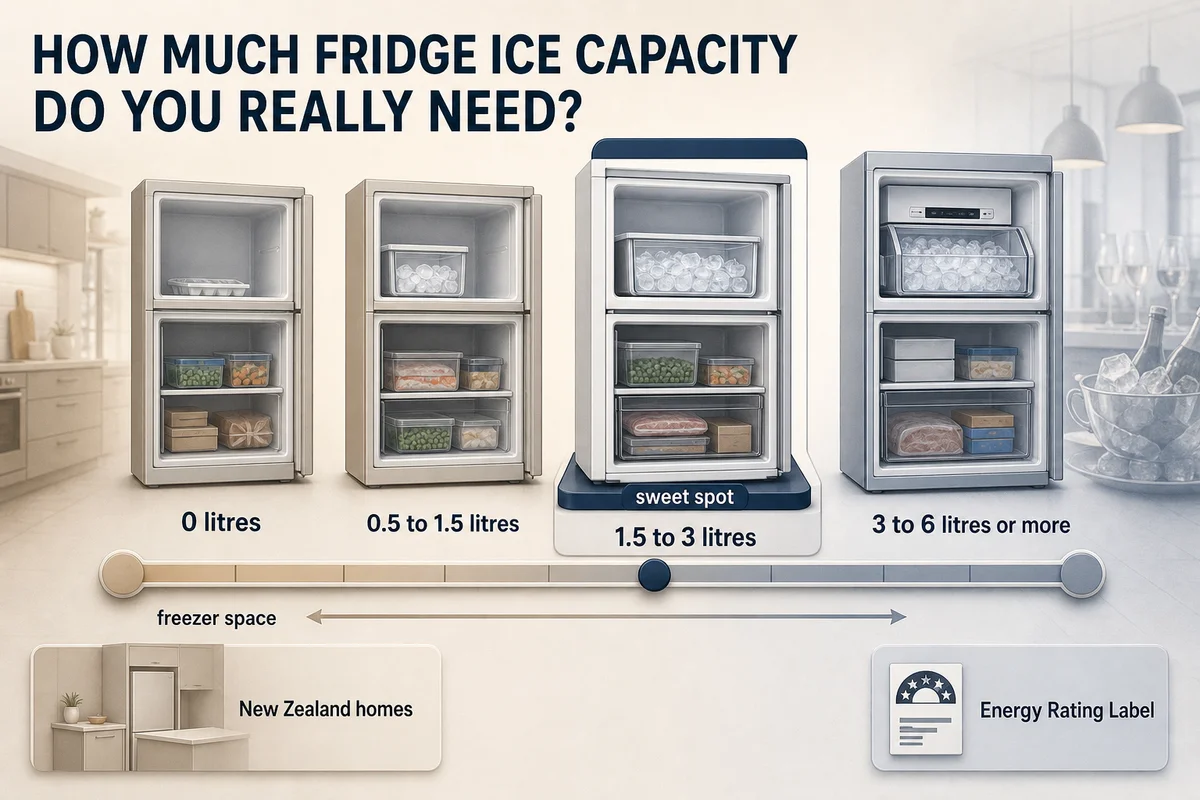
For this parameter, the practical range starts at 0 litres and rises into the low single digits for most household fridges. A 0 litre rating is common on compact fridges, many bottom-mount units, and plenty of traditional fridge-freezers that do not have a built-in ice maker.
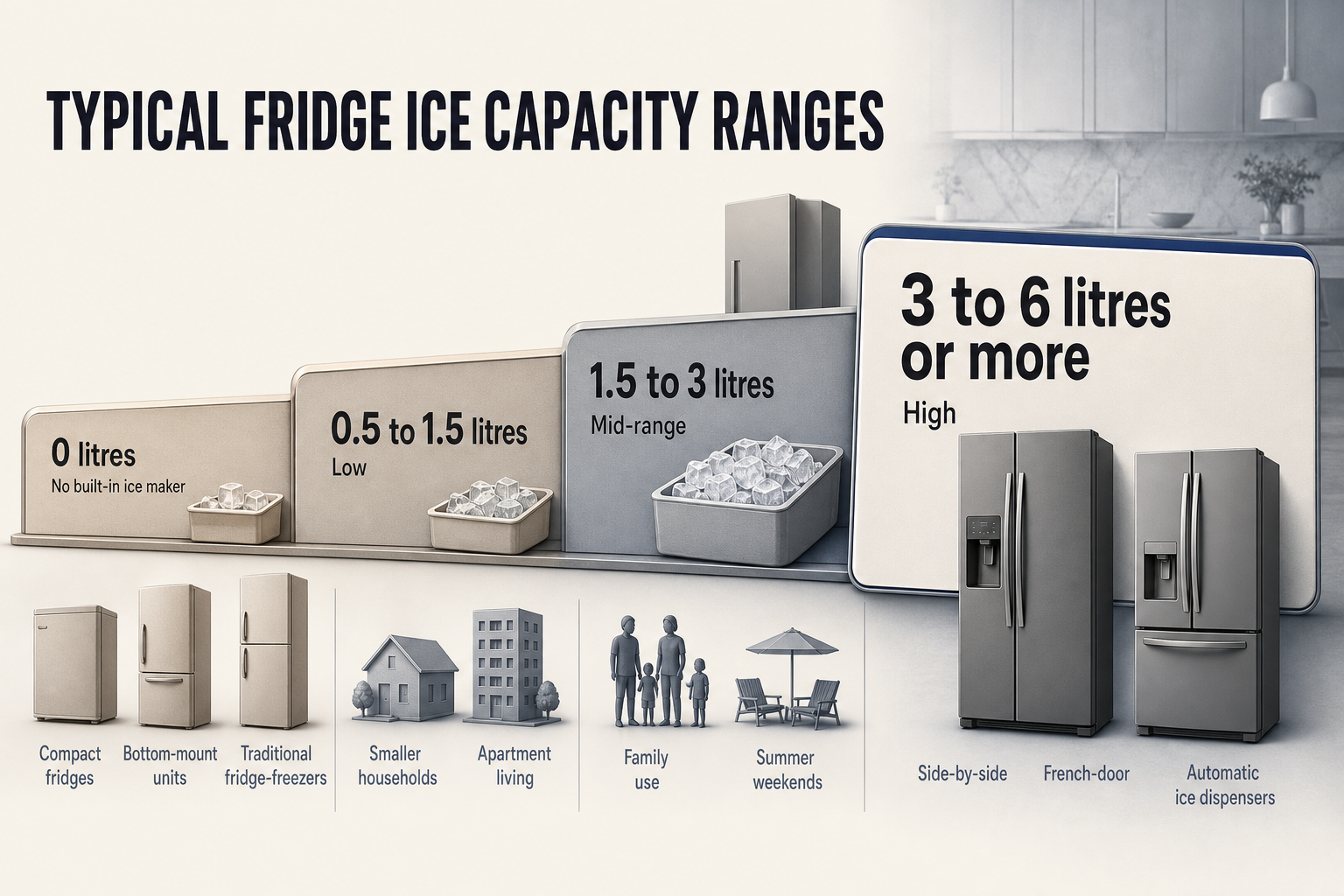
A low ice capacity is roughly 0.5 to 1.5 litres. This suits smaller households, apartment living, or buyers who only use ice occasionally for a Friday night gin and tonic or a bag for a picnic. In real use, this size can run out quickly if several people are filling glasses or if you are loading a chilly bin before heading to the bach.
A mid-range ice capacity is about 1.5 to 3 litres. This is often enough for a family that uses ice regularly but not heavily. It gives you a buffer for summer weekends, barbecues, and school sports days without taking an oversized chunk out of freezer storage.
A high ice capacity is around 3 to 6 litres or more, usually found in larger side-by-side or French-door fridges with plumbed water and automatic ice dispensers. This suits households that entertain often, drink a lot of chilled beverages, or want ready access to cubed or crushed ice. Above that, you are into niche territory where the fridge is prioritising convenience and features over simplicity and, in some cases, over efficiency. Because refrigerators run all day, every day, feature-heavy models can bring higher running costs, so it pays to compare the Energy Rating Label rather than assuming bigger is better. (eeca.govt.nz)
Use-case guidance
If you live in a flat or apartment in central Auckland, Wellington, or Christchurch, 0 to 1 litre is often enough. You are likely working with a smaller kitchen, and freezer space is usually more valuable than a dedicated ice bin. In that situation, you are better off choosing a fridge with a sensible overall layout and strong energy performance, then using trays or a small removable ice box when needed.
For a couple or small family in a standard suburban home, around 1 to 2.5 litres is the sweet spot. That is enough for everyday use without giving away too much freezer volume. It also tends to match the kind of mid-sized fridge-freezers many New Zealand homes can accommodate comfortably.
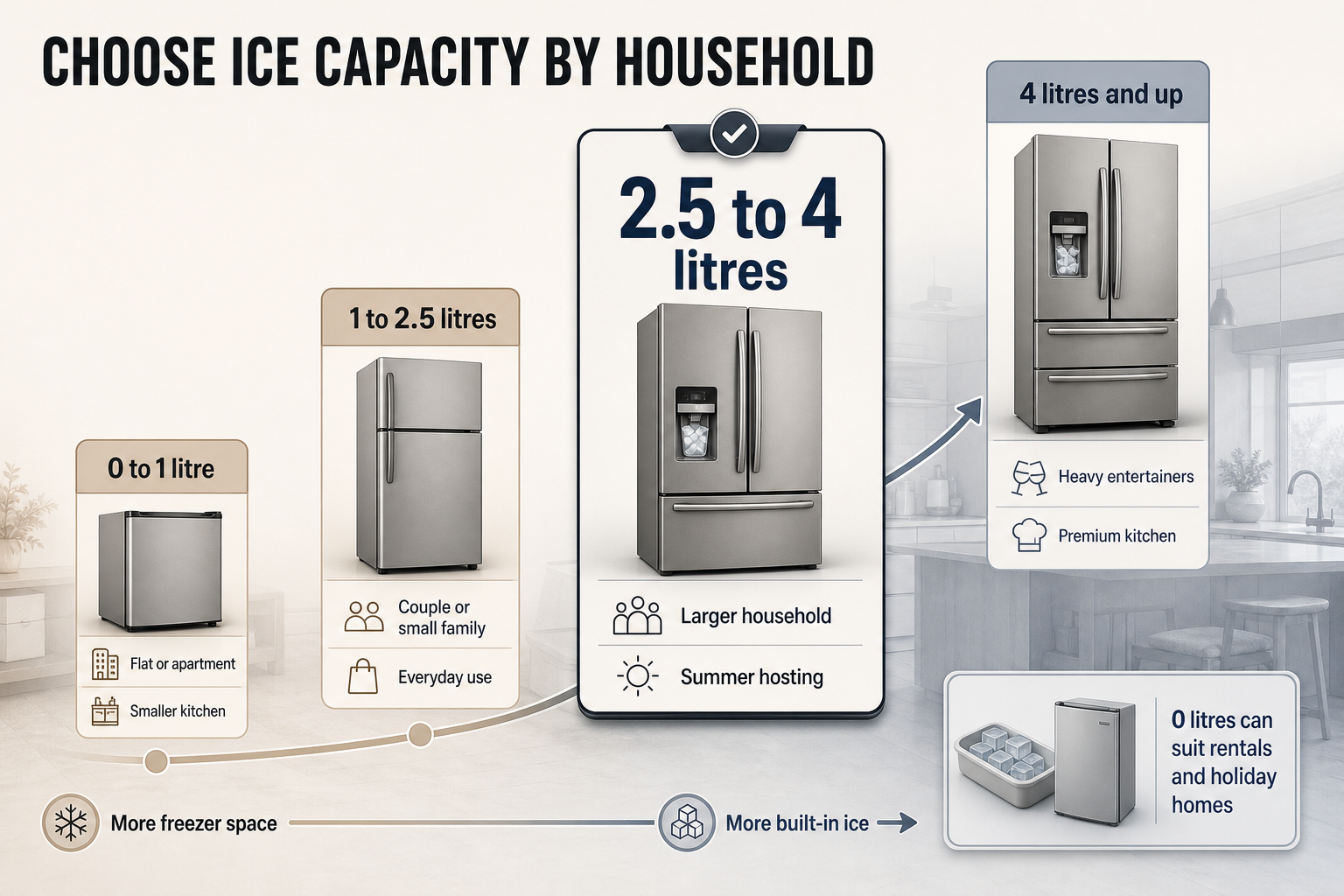
If your household is larger, or you host a lot over summer, look closer to 2.5 to 4 litres. Think about how you actually use ice. If you regularly fill water bottles, iced coffees, cocktail glasses, and chilly bins before a trip to the beach or lake, a bigger built-in reserve is genuinely useful.
For heavy entertainers, large families, or buyers fitting out a premium kitchen, 4 litres and up can make sense. This is where side-by-side and French-door models start to appeal. But be honest with yourself. If your main aim is storing frozen food for a busy family, a large ice system may be stealing space you would rather use for bags of veg, leftovers, or bulk packs from the supermarket.
There is also a reliability angle. Simpler fridges with no ice maker or a very basic one tend to have fewer moving parts, no water line in many cases, and less to go wrong over time. If you are buying for a rental, holiday home, or a household that values low fuss over premium features, 0 litres can be the smartest number on the spec sheet.
NZ-specific factors
New Zealand conditions make balance important. Our electricity prices are high enough that running costs deserve attention, and EECA notes that fridges and freezers are always on and are a major part of household energy use. That means a bigger, feature-rich fridge should be judged not just on convenience, but on its Energy Rating Label and annual kWh figure as well. Since 1 May 2026, household refrigerating appliances imported into New Zealand must use the new Energy Rating Label under updated requirements, and the annual energy figure and star rating are based on standardised testing. (eeca.govt.nz)
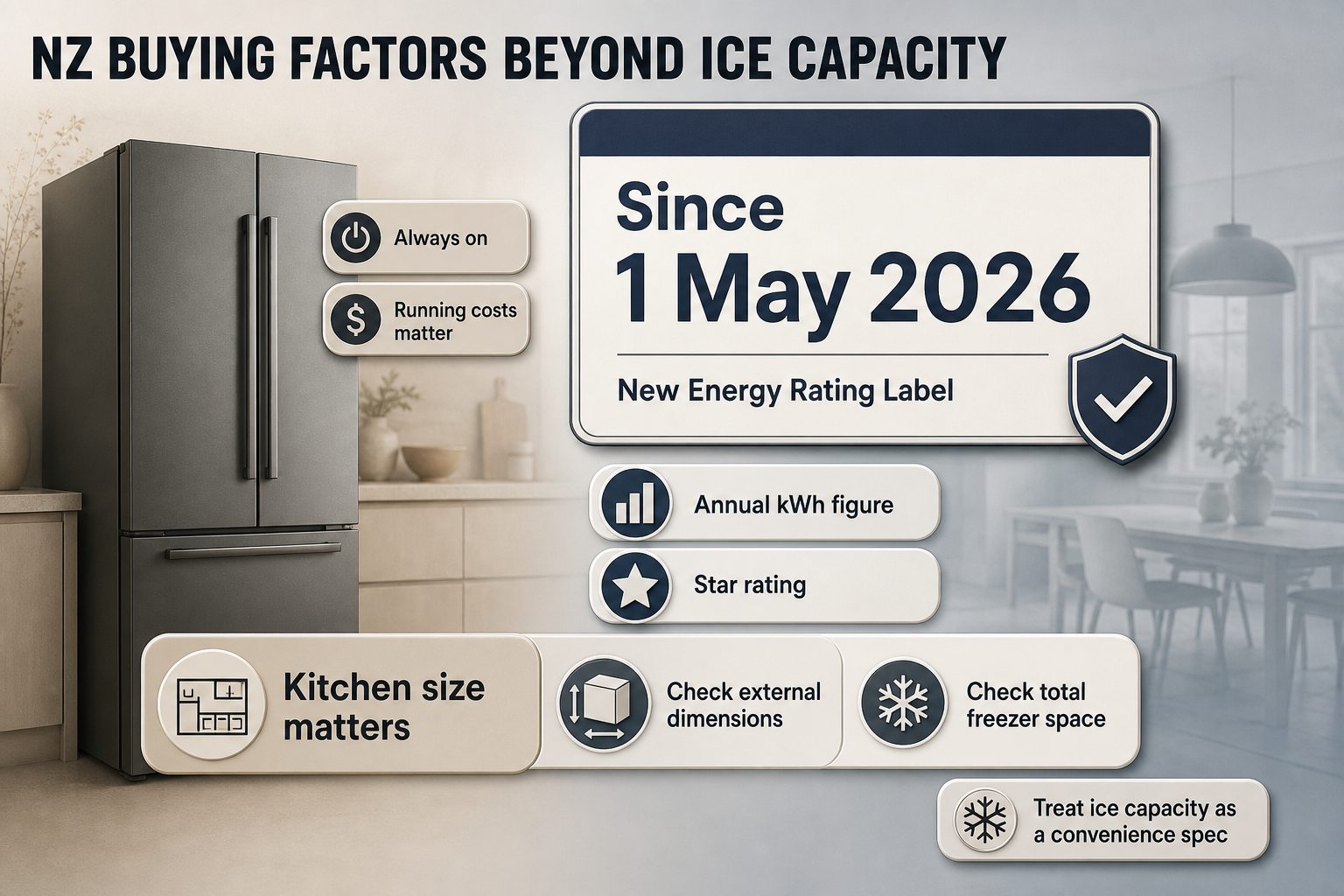
Kitchen size matters too. Many New Zealand homes, especially older villas, units, and apartments, do not have the generous fridge cavities common in American kitchens. Large fridges with substantial ice bins are often physically wider and deeper, so the ice capacity figure should be read alongside external dimensions and total freezer space.
Climate and lifestyle play a part. In warmer northern regions and during summer entertaining, a larger ice reserve is more useful. In colder parts of the South Island, or in households that simply do not use much ice, paying extra for a large automatic system may bring little benefit. If you head away to the bach, go boating, or spend weekends at sports grounds, you may value fast access to stored ice more than someone whose fridge use is mostly weekday meal prep.
The best buying approach is simple. Treat ice capacity as a convenience spec, not a quality score. A 0 litre fridge is not worse than a 4 litre one. It is just aimed at a different kind of household. Start with your real habits, check the trade-off in freezer room, and use the standardised capacity and Energy Rating Label to compare models fairly in the New Zealand market. (eeca.govt.nz)
You may also be interested in these independent articles
Sources
- [1]EECA: Requirements under E3 - Fridges and freezers
- [2]EECA: Fridges and Freezers Energy Rating Labels
- [3]EECA: How to use Energy Rating Labels and star ratings
- [4]EECA: Choose an efficient fridge or freezer to cut costs
- [5]Energy Rating: Fridges and freezers
- [6]Energy Rating: Household refrigerators and freezers
© 2026 pyfoi. All rights reserved.