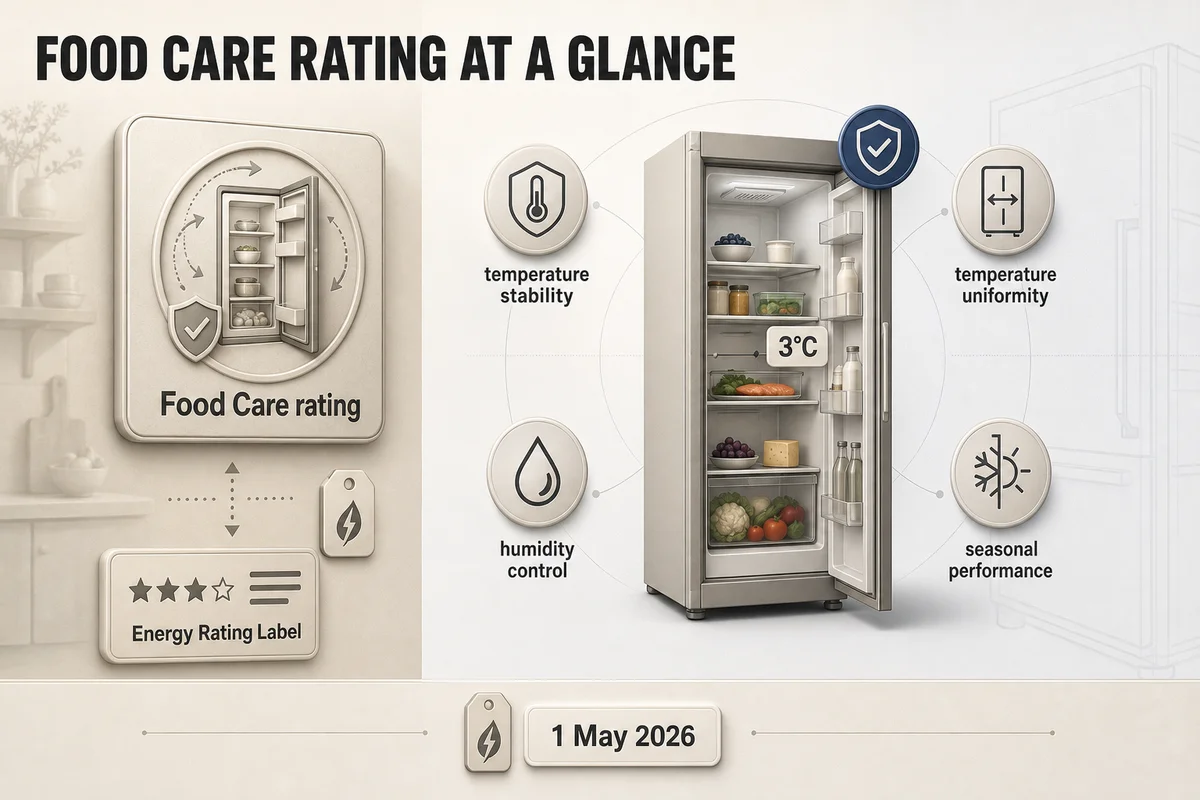

What a Fridge Food Care Rating Really Means
Fridge Food Care ratings can reveal temperature stability, cooling and food preservation. Learn what NZ buyers should check before buying in 2026.
A fridge can look impressive on the shop floor and still do a poor job of protecting your groceries. An appliance Food Care rating is meant to reflect how well a fridge or freezer keeps food in the right conditions, not just how stylish it looks or how big it is.
For New Zealand buyers, that matters because groceries are expensive, power prices are not cheap, and many homes deal with changing room temperatures through the year. A good Food Care rating should point you towards a model that keeps temperatures stable, protects fresh produce, and helps reduce food waste.
What Goes Into the Rating
Unlike the official Energy Rating Label, which is regulated and must be displayed on new fridges and freezers sold in New Zealand, a Food Care rating is usually a product-performance score rather than a government label. Energy labels show annual electricity use in kWh and a star rating for efficiency, while food-care style ratings are about how well the appliance preserves food. In other words, one tells you what it costs to run, and the other tries to tell you how well it does the actual cooling job. (eeca.govt.nz)
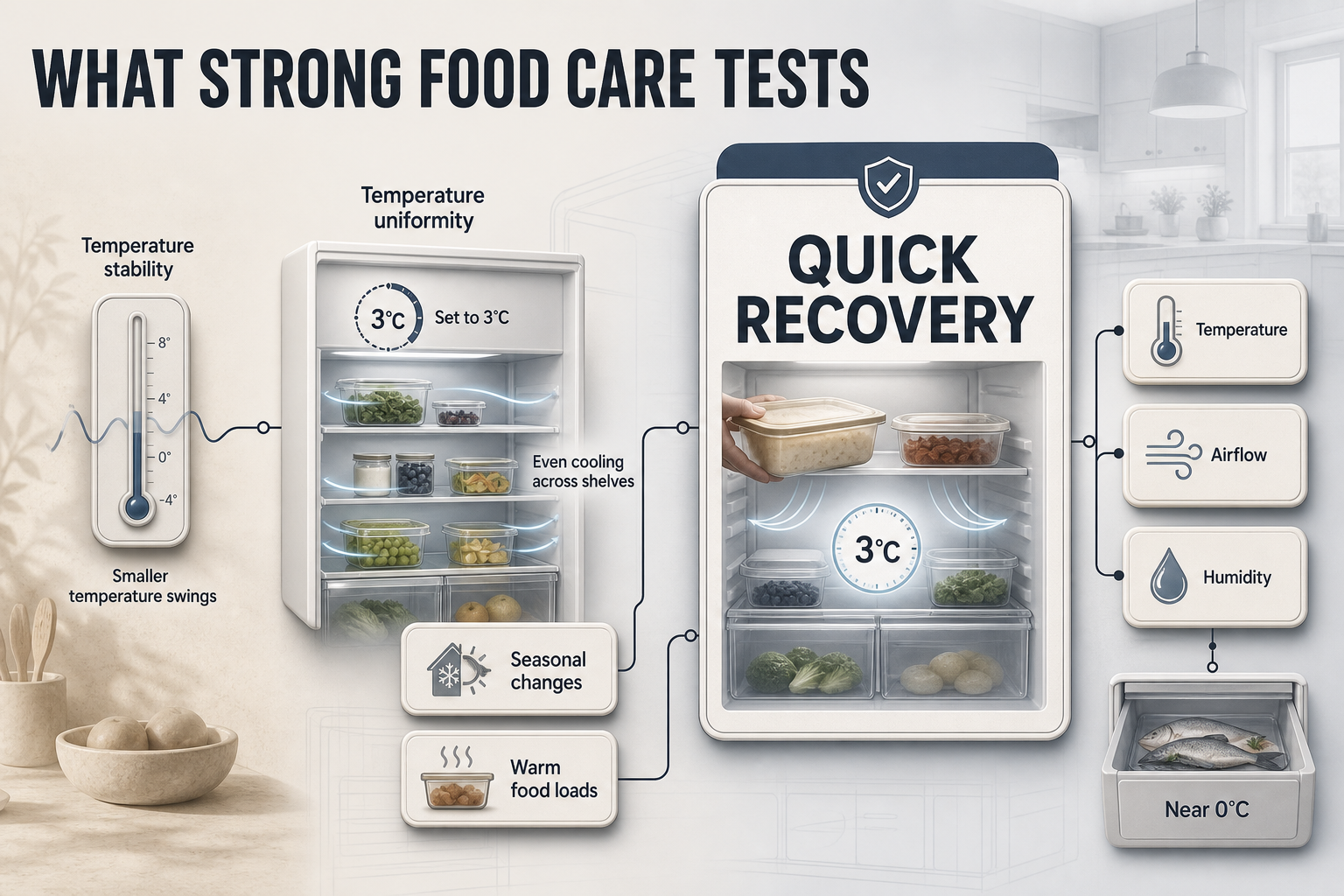
In practical terms, a strong Food Care rating is usually linked to several things. The first is temperature stability. Consumer NZ’s fridge testing looks at how much the internal temperature swings as the compressor cycles on and off, because smaller swings mean safer, more consistent storage conditions for food. (consumer.org.nz)
The second is temperature uniformity. A fridge might say it is set to 3°C, but that does not mean every shelf is actually sitting at 3°C. Better-performing models keep temperatures more even from top to bottom and across different compartments, which helps stop milk freezing at the back while leftovers sit too warm near the door. Consumer NZ specifically tests this uniformity in both fridge and freezer sections. (consumer.org.nz)
The third is how well the appliance copes with seasonal changes and warm food loads. New Zealand kitchens can vary a lot between winter and summer, and garages or utility rooms can be even more extreme. Consumer NZ tests how fridges respond when surrounding temperatures change, and EECA notes that fridge energy calculations also account for door openings and the cooling of warm food under standardised conditions. A better food-care result generally means the appliance can recover quickly and keep conditions controlled when real life happens. (consumer.org.nz)
Some brands also use “Foodcare” as a feature name rather than an independent rating. Fisher & Paykel’s ActiveSmart Foodcare, for example, is described as technology that monitors temperature, airflow and humidity and adjusts operation to keep food fresher for longer. That is useful to know, but you should treat brand language as a feature claim, not proof by itself that one fridge is better than another. (appliancesonline.com.au)
So what separates a low score from a high one? A lower-rated model is more likely to have bigger temperature swings, less even cooling, weaker humidity control, and poorer performance when the room gets hotter or the door is opened often. A higher-rated model should hold steadier temperatures, spread cold air more evenly, and keep produce, dairy and meat in better condition for longer. That can mean fewer wilted greens, less freezer burn, and less food thrown out at the end of the week. This last point is partly an inference based on how food-safety and temperature-control tests work. (consumer.org.nz)
What to Look For
Start by asking who created the rating. If the seller shows a Food Care score, check whether it comes from an independent testing body, the retailer’s own scoring system, or the manufacturer. That matters because not all stars mean the same thing. An official Energy Rating Label is governed by regulations and standardised tests, but a retailer or brand-specific Food Care rating may use its own criteria. (eeca.govt.nz)
Next, look past the headline star score and check the appliance’s actual food-preservation features. Useful signs include separate cooling circuits, adjustable humidity drawers, stable crisper temperatures, fast-cooling modes, and compartments with variable temperature settings for meat, deli items or produce. These do not guarantee a perfect result, but they are the kinds of features that support better food care in day-to-day use. Fisher & Paykel, for instance, ties its Foodcare system to active control of temperature, airflow and humidity, which are exactly the factors that matter most. (appliancesonline.com.au)
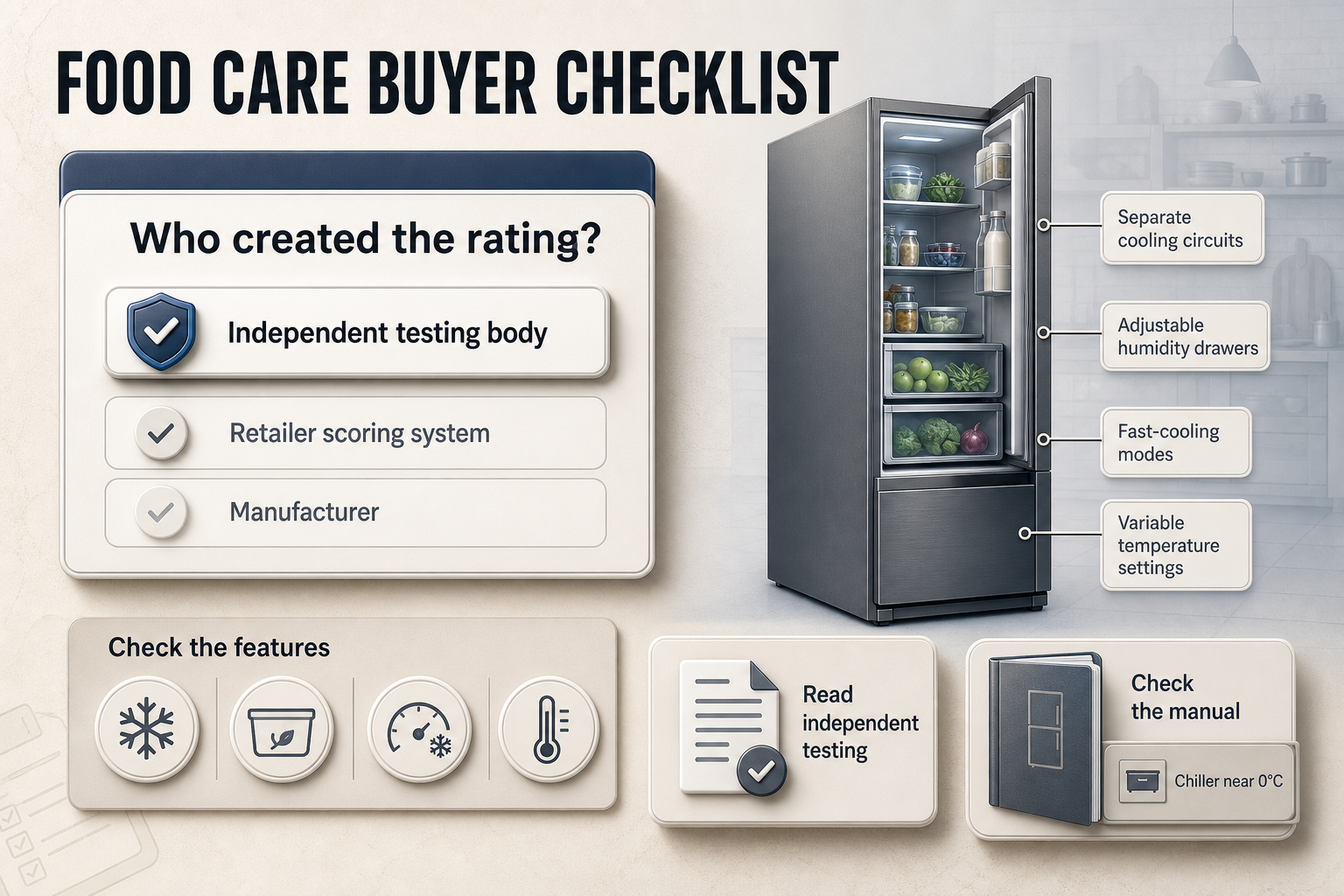
You should also read independent testing where possible. Consumer NZ’s fridge methodology is especially useful because it focuses on food safety, temperature fluctuations, uniformity, and seasonal performance rather than marketing language. If a retailer says a fridge has excellent food care but independent testing shows poor temperature control, trust the independent test. (consumer.org.nz)
Check the manual or specification sheet for the target temperature ranges and any special compartments. A “chiller” drawer that sits close to 0°C can be genuinely useful for fish, meat and lunchbox prep, while a simple vegetable bin with no humidity control may do much less. Also pay attention to layout. A technically good fridge can still be frustrating if the shelves force you to block vents or over-pack the crisper, which hurts real-world performance. (appliancesonline.com.au)
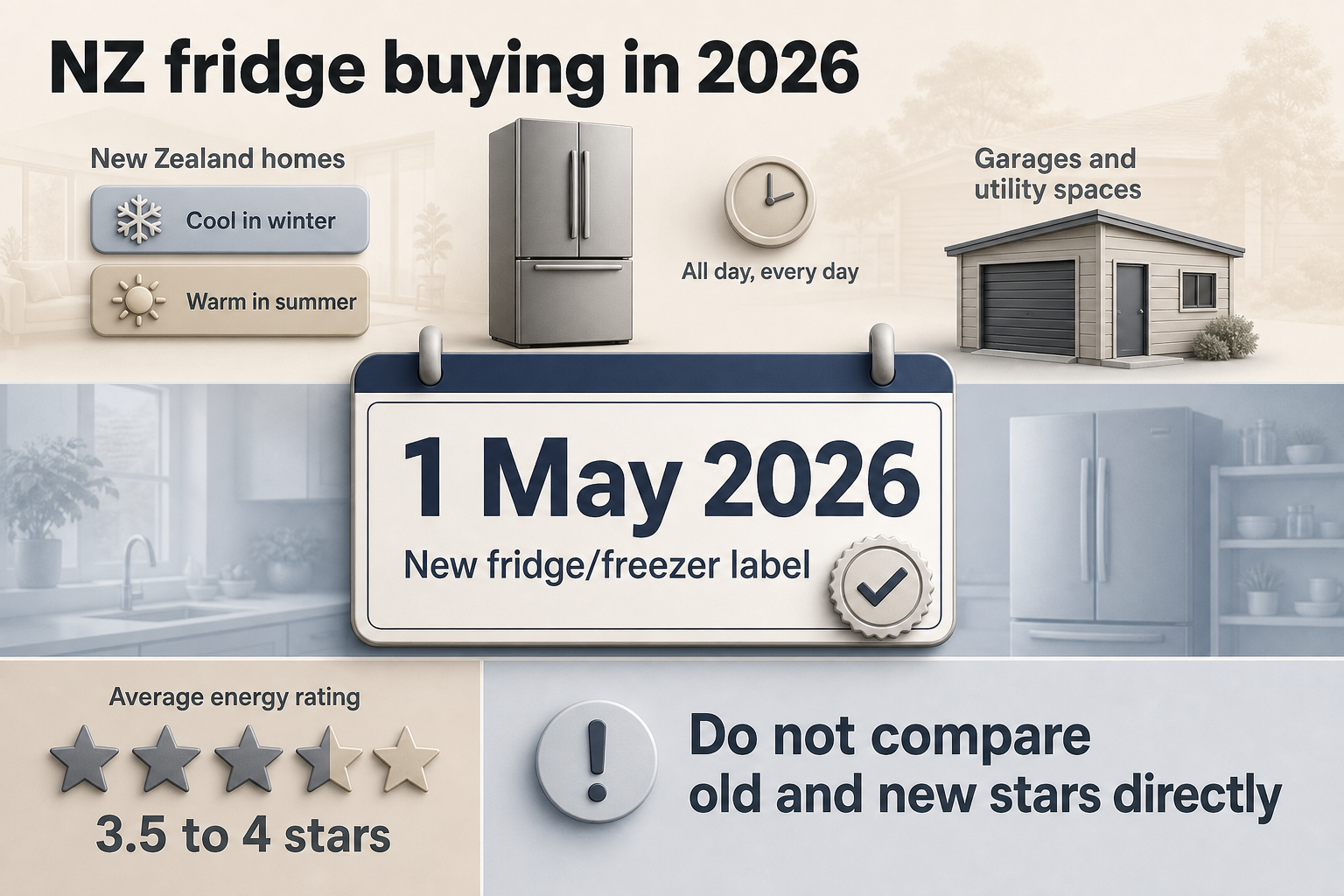
Do not confuse food care with energy efficiency. A fridge can have a good energy label and only average food-preservation performance, or the other way around. EECA says the Energy Rating Label is there to compare efficiency and annual electricity use, and Consumer NZ notes you should compare star ratings only among similar types and sizes. For fridges and fridge-freezers, the average energy rating sits around 3.5 to 4 stars, so a high energy score is helpful, but it does not replace good temperature control. (eeca.govt.nz)
A useful buyer question is this: what food do you actually buy? If your household stores a lot of fresh produce, dairy, school lunches and meal-prep containers, food care matters more than having an ice maker or a fancy finish. If you bulk-freeze meat, bread and home-grown produce, then freezer temperature consistency and recovery after door openings become more important.
NZ Context
Food care matters a bit more in New Zealand than many buyers assume. Our homes are not all centrally heated, kitchens can run cool in winter and warm in summer, and some people still put second fridges or chest freezers in garages, sleepouts or utility spaces. Consumer NZ specifically warns that room conditions affect fridge performance, and its testing includes seasonal change effects for that reason. (consumer.org.nz)
Running cost is the other local factor. Fridges and freezers are on all day, every day, so you should weigh food-care performance alongside energy use. EECA says new fridges and freezers sold in New Zealand must carry an Energy Rating Label, and from 1 May 2026 products imported or manufactured here must use the new fridge/freezer label under the updated regulations. That means NZ buyers in 2026 may see newer labels and should avoid comparing old and new label star ratings directly, because EECA says the testing and calculations changed. (eeca.govt.nz)
Consumer rights matter too. Under the Consumer Guarantees Act, goods must be of acceptable quality, including being durable and fit for purpose. If a fridge cannot maintain safe temperatures, develops uneven cooling, or fails to perform as a reasonable buyer would expect, your rights do not depend only on the written warranty. That is worth remembering before paying extra for an extended warranty at the checkout. (consumer.org.nz)
For many NZ households, the smartest approach is simple. Use the Energy Rating Label to compare running costs, then use independent reviews and the appliance’s temperature-control features to judge food care. If you are choosing between a flashy large fridge and a slightly plainer model with better temperature stability and humidity control, the second one is often the better buy for your groceries, your power bill, and the amount of food you throw away each week. (eeca.govt.nz)
You may also be interested in these independent articles
Sources
- [1]Consumer NZ: How we test fridges
- [2]EECA: Fridges and Freezers Energy Rating Labels
- [3]EECA: How to use Energy Rating Labels and star ratings
- [4]Consumer NZ: Energy Rating Labels explained
- [5]Consumer NZ: Can fridges be more energy efficient?
- [6]Consumer NZ: Consumer Guarantees Act
- [7]EECA: Requirements under E3 for fridges and freezers
- [8]Appliances Online: Fisher & Paykel ActiveSmart Foodcare example
© 2026 pyfoi. All rights reserved.