
Which Fridge Configuration Suits NZ Homes Best?
Compare fridge configurations in NZ, from top freezer to French door, and see which layout saves space, suits your routine, and cuts power bills.
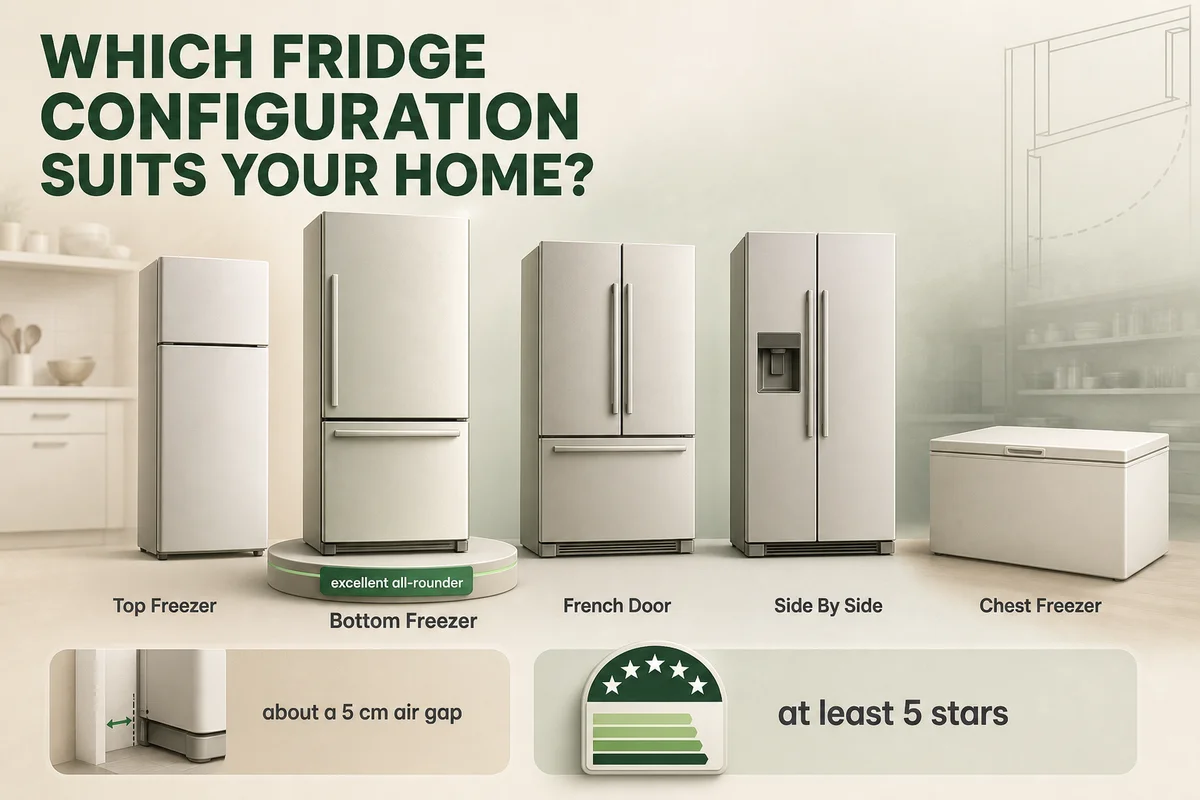
A refrigerator’s configuration is its basic layout: where the fridge and freezer sections sit, how the doors open, and what kind of storage the appliance is built around. That matters more than many buyers expect, because the right layout changes how easy the fridge is to live with, how much floor space it needs, and often how much electricity it uses over time in a New Zealand home. (eeca.govt.nz)
The Options
French Door
A French door fridge usually has two doors opening from the centre for the fresh-food section, with a freezer drawer underneath. Some versions add extra drawers or flexible compartments, but the core idea is wide fridge access at eye level. (consumer.org.nz)
The big advantage is convenience. You get the most-used fridge shelves up high, and the wide opening makes it easier to fit platters, pizza boxes, and large supermarket shops. That suits family kitchens, entertainers, and households that buy in bulk from Pak’nSave or Costco-style outlets. The downside is price, plus higher energy use on some larger models compared with simpler top-freezer or bottom-freezer designs. EECA says fridge configuration affects efficiency, and Consumer NZ notes French-door models are typically among the larger, more feature-heavy options. (eeca.govt.nz)
For New Zealand buyers, French door works best if you have a full-size kitchen and enough clearance for both doors and the lower freezer drawer. It is a strong fit for busy family homes in places like Christchurch, Hamilton, or Tauranga where one appliance often needs to handle a full weekly shop.
Multi Door
Multi-door fridges are broad-category models with more than two doors, but not in a standard French-door or quad-door format. They often include separate pantry-style sections, convertible compartments, or split cooling zones. These are designed for buyers who want more control over food organisation.
The benefit is flexibility. You can separate meat, drinks, produce, and frozen food more neatly, and some compartments may run at different temperatures. The trade-off is complexity. More doors, seals, and cooling zones can mean a higher purchase price and more things to learn or maintain.
In NZ, a multi-door layout can make sense for large households, shared flats, or homes where people store very different kinds of food. It is less appealing in compact Auckland apartments or older villas with tighter kitchen footprints, where door swing and appliance width matter more than compartment variety.
Quad Door
A quad-door fridge has four main doors, usually with two upper fridge doors and two lower freezer or multi-temperature doors. Some models split the lower section into left and right compartments rather than using a pull-out drawer.
Its strongest point is access. You can open only one section at a time, which helps reduce cold-air loss and makes organisation easier. It also suits homes where different people use different compartments. The downside is cost and size. These models are usually premium appliances, and they often need generous kitchen width.
For NZ households, quad-door fridges suit larger new-build kitchens and buyers who want a more tailored storage setup for school lunches, meal prep, and entertaining. They are usually overkill for a couple in a small unit or townhouse.
Single Door (Freezer)
A single-door freezer is a standalone upright freezer. It is separate from your main fridge and is built for frozen storage only.
The main advantage is capacity without the footprint of a chest freezer. It is easier to organise than a deep chest because shelves and drawers keep food visible. The downside is that upright freezers can lose more cold air when opened, and they may cost more to run than the most efficient chest freezers of similar capacity. EECA recommends comparing the Energy Rating Label and annual kWh figure before buying. (eeca.govt.nz)
This type suits NZ households that freeze meat, fish, bread, or batch-cooked meals, especially in rural areas where people shop less often. It is also handy for hunting, fishing, or storing produce from a home garden.
Drawer
A drawer refrigerator or freezer is a drawer-only appliance, often built under a bench or into a scullery, bar area, or outdoor kitchen. It is not just a fridge with drawers inside. It is an appliance where the storage is accessed by pulling out drawers.
The attraction is placement and convenience. A drawer unit can fit under a bench and keep drinks, snacks, or fresh ingredients close to where you use them. The compromise is value. These units usually offer less volume for the money than a standard upright fridge, and they are generally a secondary appliance rather than your only one.
In NZ homes, drawer units suit premium renovations, entertainers, and homes with a scullery. They are a luxury choice, not the practical default.
Wine
A wine fridge is designed to store wine at stable temperatures, often with low vibration and shelving shaped for bottles. It is not a substitute for a normal food fridge.
Its advantage is specialised storage. If you keep wine long term, serve different styles at different temperatures, or want to protect bottles from heat and light, a wine cabinet does that better than a kitchen fridge. The downside is obvious: it stores wine well, but not much else.
For NZ buyers, wine storage makes the most sense if you already have your main refrigeration sorted and you regularly keep a collection. In warmer north-facing homes, stable temperature control can be useful, especially over summer.
Single Door (Fridge)
A single-door fridge is a standalone refrigerator with no separate freezer section, or only a very limited internal compartment that is not the main focus. These are straightforward fresh-food appliances.
The benefit is simplicity and usable fridge space. If you already have a separate freezer, a single-door fridge can be a very efficient and practical setup. The downside is that it is less flexible for households wanting one all-in-one appliance.
This works well in NZ for couples, small households, offices, sleepouts, or homes where a separate upright or chest freezer handles bulk frozen food. It also suits buyers who want better fresh-food access than a combined fridge-freezer often gives.
Single Door (Variable Temp)
A single multi-temp unit is a single-door appliance with a compartment that can switch between fridge and freezer operation. Think of it as a flexible box rather than a fixed-purpose one.
That flexibility is the main selling point. It can adapt to seasonal needs, extra drinks space at Christmas, or overflow freezer storage when you buy half a lamb. The drawback is that you need to manage it actively, and it may not match the convenience of having dedicated fridge and freezer spaces available all the time.
For NZ homes, this can be a smart second appliance in a garage, laundry, or utility room. It is especially useful for households whose storage needs change through the year.
Chest Freezer
A chest freezer opens from the top and is built purely for frozen storage. It is deep, wide, and usually offers a lot of capacity for the price.
Its strengths are efficiency and storage volume. Because cold air stays low when you open the lid, chest freezers are often very effective for long-term frozen storage. The weaknesses are access and space. Food can disappear to the bottom, and the lid needs overhead clearance. EECA encourages buyers to compare annual energy use and choose efficient models, because freezers run constantly. (eeca.govt.nz)
In New Zealand, chest freezers are common in garages, sheds, and rural homes. They suit bulk buying, homekill, fishing catches, and large family meal prep. If you live in a small city apartment, they are usually impractical.
Top Freezer
A top-freezer fridge has the freezer compartment above the main fridge. This is one of the oldest and simplest combined layouts.
The biggest advantage is value. Top-freezer models are often cheaper to buy and can perform well for energy use. EECA says a top or bottom split is a practical mainstream option, and notes configuration affects efficiency and running costs. (eeca.govt.nz) The downside is ergonomics. You use the fridge section more often, so bending down to reach fresh food can become annoying.
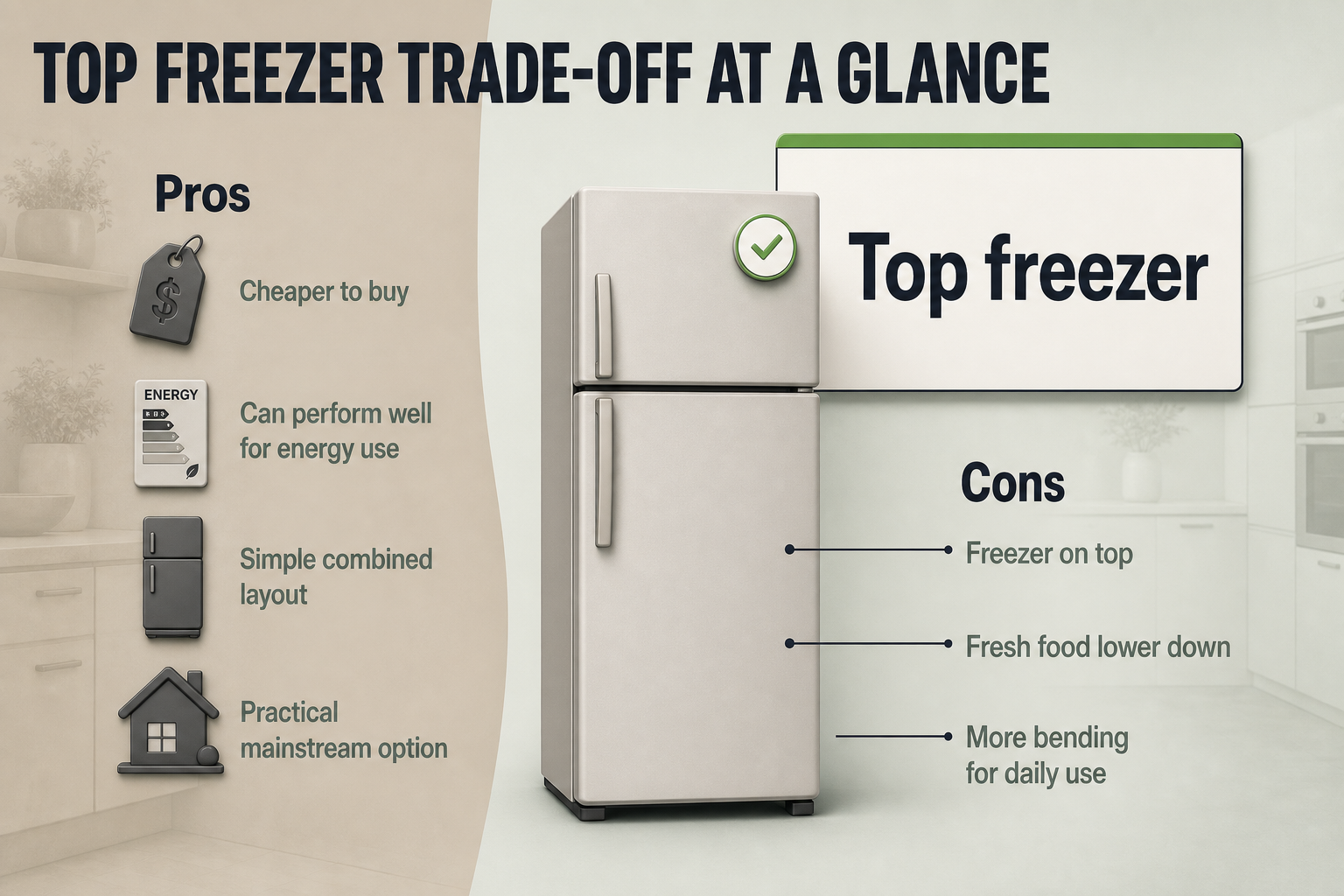
This layout suits first-home buyers, rentals, small families, and anyone who wants a straightforward fridge-freezer without paying for premium styling. It is a sensible choice for many NZ homes where budget matters more than showroom appeal.
Bottom Freezer
A bottom-freezer fridge flips that layout, putting the fridge at eye level and the freezer below, often in a drawer. This is now one of the most popular formats.
The main benefit is daily comfort. Consumer NZ points out that having the fridge at the top is generally more convenient because that is the section you access most often. (consumer.org.nz) The downside is that freezer drawers can be less tidy than shelves, and some models cost more than equivalent top-freezer units.
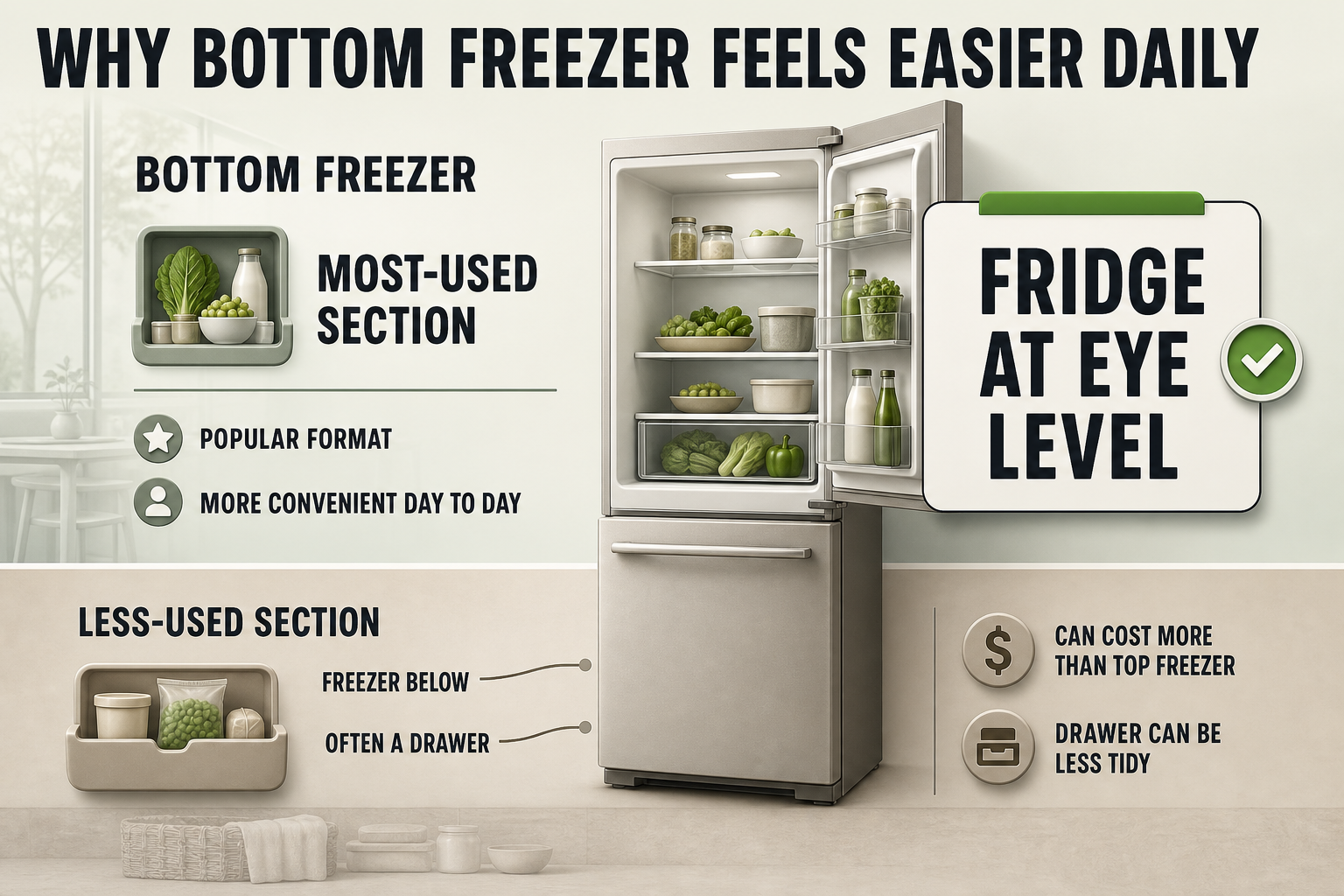
For NZ buyers, bottom-freezer models are an excellent all-rounder. They suit family kitchens, regular supermarket shops, and homes where convenience matters but a French-door unit would be too wide or too expensive.
Bar
A bar fridge is a compact refrigerator intended for drinks, snacks, or light-use storage. It is much smaller than a full household fridge.
The upside is size. It fits in offices, bedrooms, sleepouts, student flats, and home bars. The downside is efficiency per litre and limited usefulness. A bar fridge is rarely the best choice as the main fridge for a household.
In New Zealand, bar fridges make sense as a second appliance in a rumpus room or for short-stay accommodation. For a main kitchen, most households outgrow one quickly.
Side By Side
A side-by-side fridge places the fridge on one side and the freezer on the other, each running full height. These often include through-door water or ice.
The attraction is easy freezer access and a premium feel. You do not need to bend for frozen food, and the vertical split keeps both sections visible. The compromise is narrower shelves. Consumer NZ notes that side-by-side compartments are narrower and deeper than vertically stacked models, which can make large platters or wide trays harder to fit. (consumer.org.nz) EECA also notes side-by-side models often have different efficiency expectations from other fridge-freezers, and ice and water dispensers can use more electricity and may need plumbing. (eeca.govt.nz)
For NZ homes, side-by-side suits buyers who use the freezer heavily and want frequent access to both compartments. It is less ideal in tighter kitchens or for people who often store wide dishes.
How to Choose
Start with your kitchen, not the brochure. Measure width, depth, height, and the space needed for doors to open properly. EECA advises allowing about a 5 cm air gap around the appliance, which is easy to overlook in older NZ kitchens and apartment cabinetry. (eeca.govt.nz)
Then think about what you open most. If you mostly reach for milk, leftovers, fruit, and lunch items, bottom-freezer and French-door layouts usually feel better day to day than top-freezer or side-by-side designs. If frozen food is a major part of your household routine, a side-by-side, upright freezer, or chest freezer may suit better.
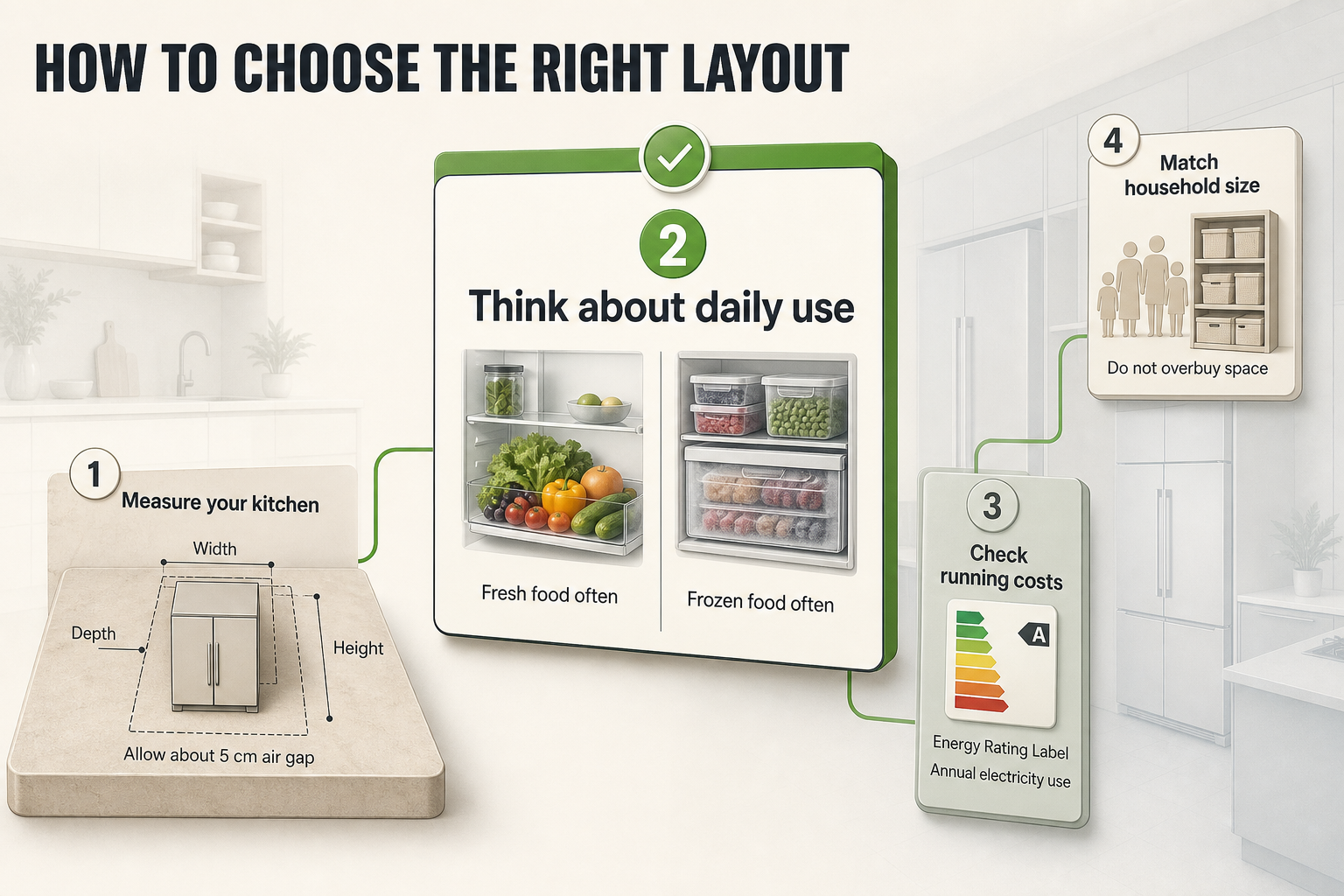
Be honest about scale. Many people buy a very large French-door or quad-door fridge because it looks premium, then pay more upfront and more on the power bill for space they do not use. EECA says energy labels let you compare annual electricity use, and that is especially important for large multi-door models that run all year. (eeca.govt.nz)
You probably do not need a huge multi-door fridge for a two-person household in Wellington or Auckland. A bottom-freezer or top-freezer model is often the smarter buy. On the other hand, if you have teenagers, entertain often, or store bulk groceries, paying more for a French-door or quad-door layout can make daily life noticeably easier.
NZ Context
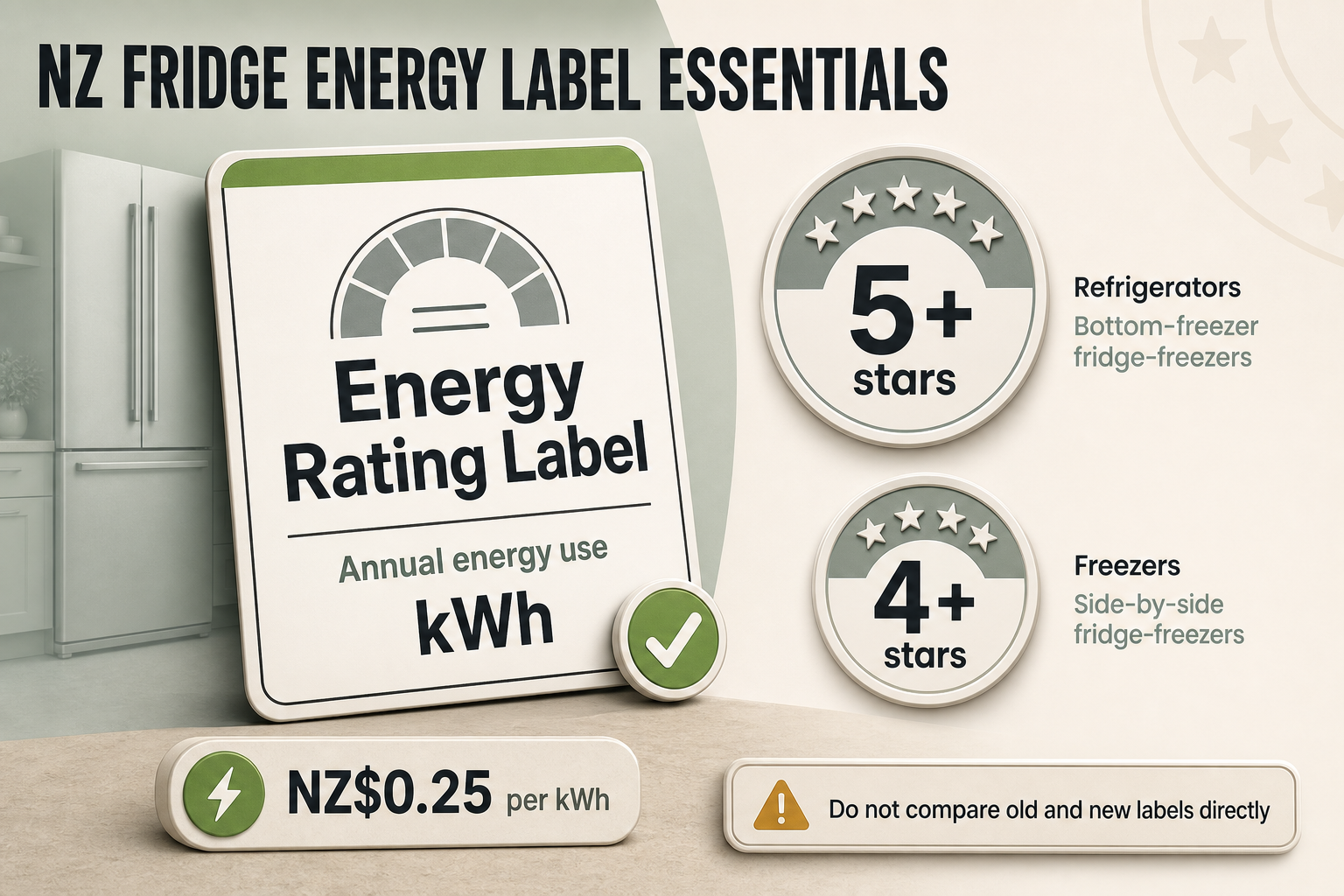
In New Zealand, energy efficiency should be part of the configuration decision, not a separate thought. Residential fridges and freezers sold here must display an Energy Rating Label, showing annual energy consumption in kWh and a star rating so you can compare similar appliances. EECA says the current label is based on updated test standards, and old and new labels should not be compared directly. (eeca.govt.nz)
EECA’s current buying advice is to aim for at least 5 stars for refrigerators and bottom-freezer fridge-freezers, and at least 4 stars for freezers and side-by-side fridge-freezers. It also notes that a more efficient fridge and freezer can save meaningful money over its life, using an electricity price assumption of NZ$0.25 per kWh in its examples. (eeca.govt.nz)
Your rights matter too. Consumer Protection says the Consumer Guarantees Act applies to household appliances bought in New Zealand, and those rights can last beyond a manufacturer’s written warranty. That is useful if you are weighing a premium configuration with more electronics, dispensers, or moving parts. (consumerprotection.govt.nz)
You may also be interested in these independent articles
Sources
© 2026 pyfoi. All rights reserved.