
Fridge Compartment Capacity Guide for NZ Homes
Find the right fridge compartment capacity for your NZ home. Compare fridge litres, household size and running costs before you buy too big.
Fridge compartment capacity tells you how much usable chilled storage a refrigerator gives you in its fresh-food section, measured in litres. It sounds simple, but this number has a big effect on how well a fridge suits your household, how often you shop, and how much space bulky items like milk, leftovers, lunchboxes and platters actually take up.
For New Zealand buyers, capacity matters because our shopping habits vary a lot. A couple in an Auckland apartment may be fine with a compact fridge section, while a family in Hamilton or Invercargill doing one big weekly shop will usually want far more fresh-food space. It also links to running costs, because larger fridges tend to use more electricity overall, even though newer models are much more efficient per litre than older ones. (eeca.govt.nz)
What the Numbers Mean
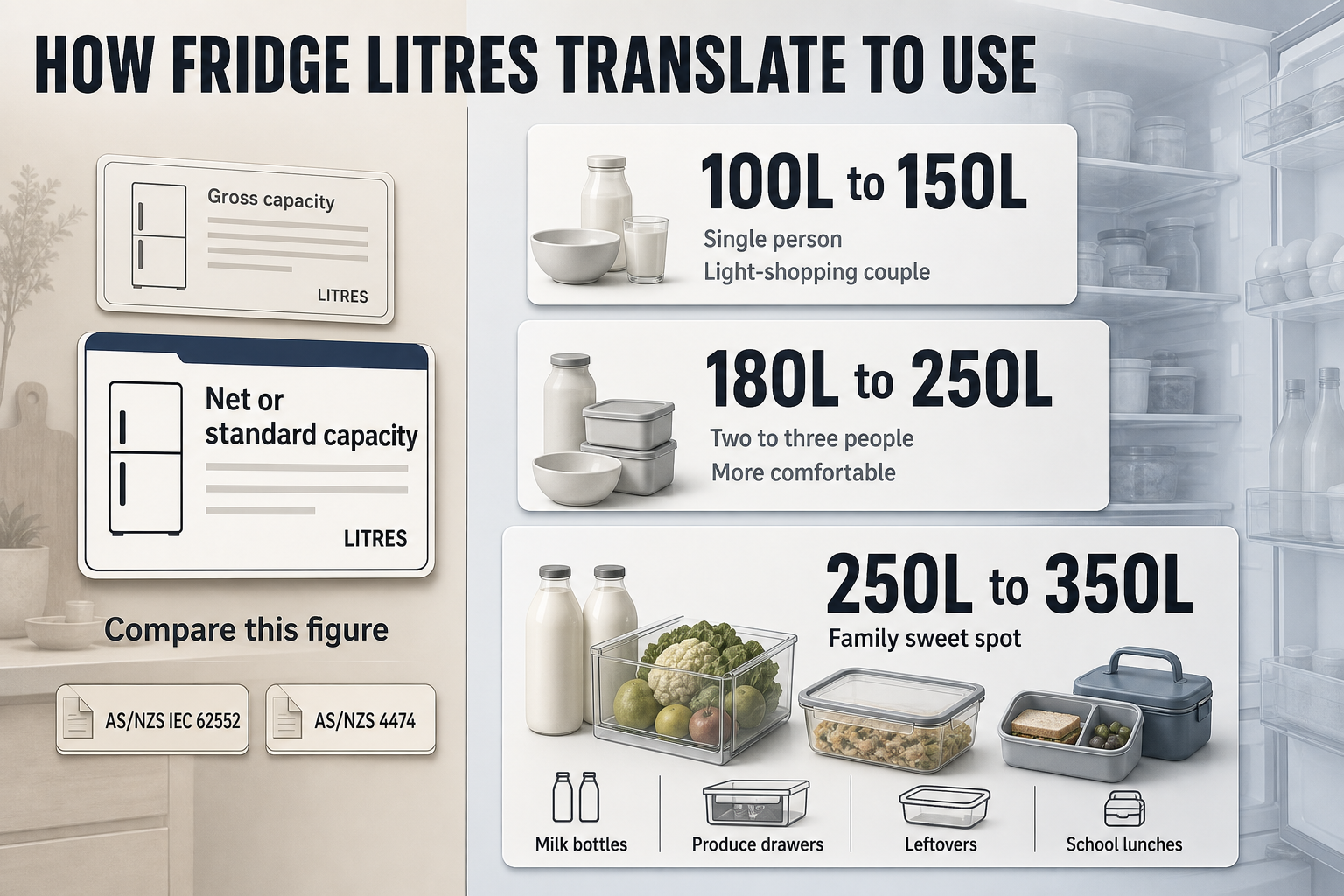
A fridge capacity figure in litres refers to volume, not shelf area. In practice, it is the space available in the chilled compartment for everyday foods such as vegetables, dairy, drinks, sauces and cooked meals. If the product lists both gross and net or standard capacity, the net or standard figure is the one that matters most because it better reflects usable internal space under recognised test standards such as AS/NZS IEC 62552 and AS/NZS 4474. (eeca.govt.nz)
A useful way to think about litres is in shopping-basket terms. Around 100L to 150L of fridge space is enough for a single person or a very light-shopping couple if you buy often and do not store many large platters or meal-prep containers. Around 180L to 250L starts to feel more comfortable for two to three people. Once you move into 250L to 350L of fridge capacity, you are usually in the sweet spot for many family fridge-freezers, where there is enough room for milk bottles, produce drawers, leftovers and a week’s worth of school lunches.
Do not assume two fridges with the same litre figure will feel identical to use. Shelf layout, door bin size, vegetable drawer depth and whether the cabinet is wide and shallow or narrow and deep all change how practical that volume feels. Consumer NZ notes that side-by-side models often have narrower, deeper compartments, which can make large items harder to fit and food at the back easier to forget. (consumer.org.nz)
Typical Ranges
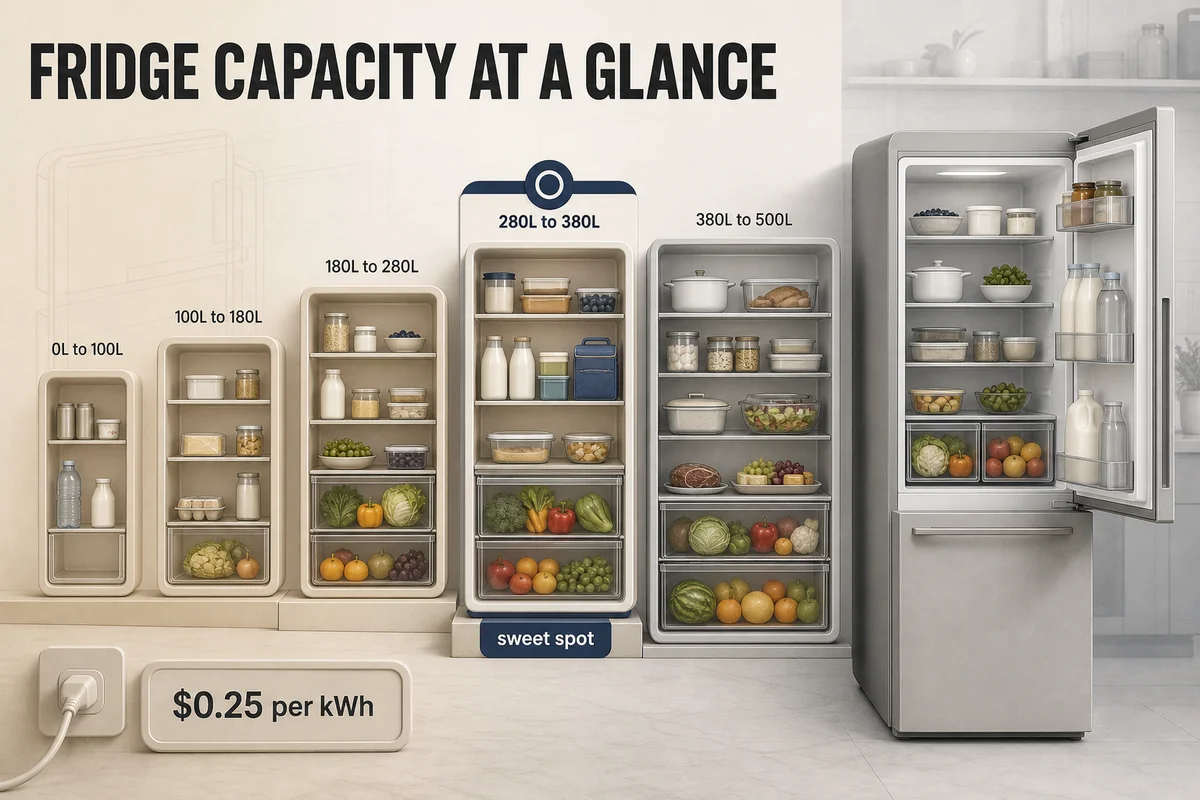
At the low end, 0L to 100L covers specialist cases rather than mainstream household use. A freezer-only appliance can legitimately have 0L fridge capacity, and a wine or beverage fridge may also have a smaller chilled section by normal kitchen standards. These can suit a garage drinks fridge, office kitchenette or a home where a separate full-size fridge already does the main work.
A small household fridge section usually sits around 100L to 180L. This is common in compact top-freezer units, bar fridges and smaller apartment-friendly models. That size can work for one person, students, a sleepout, or a holiday home where you shop every couple of days rather than once a week.
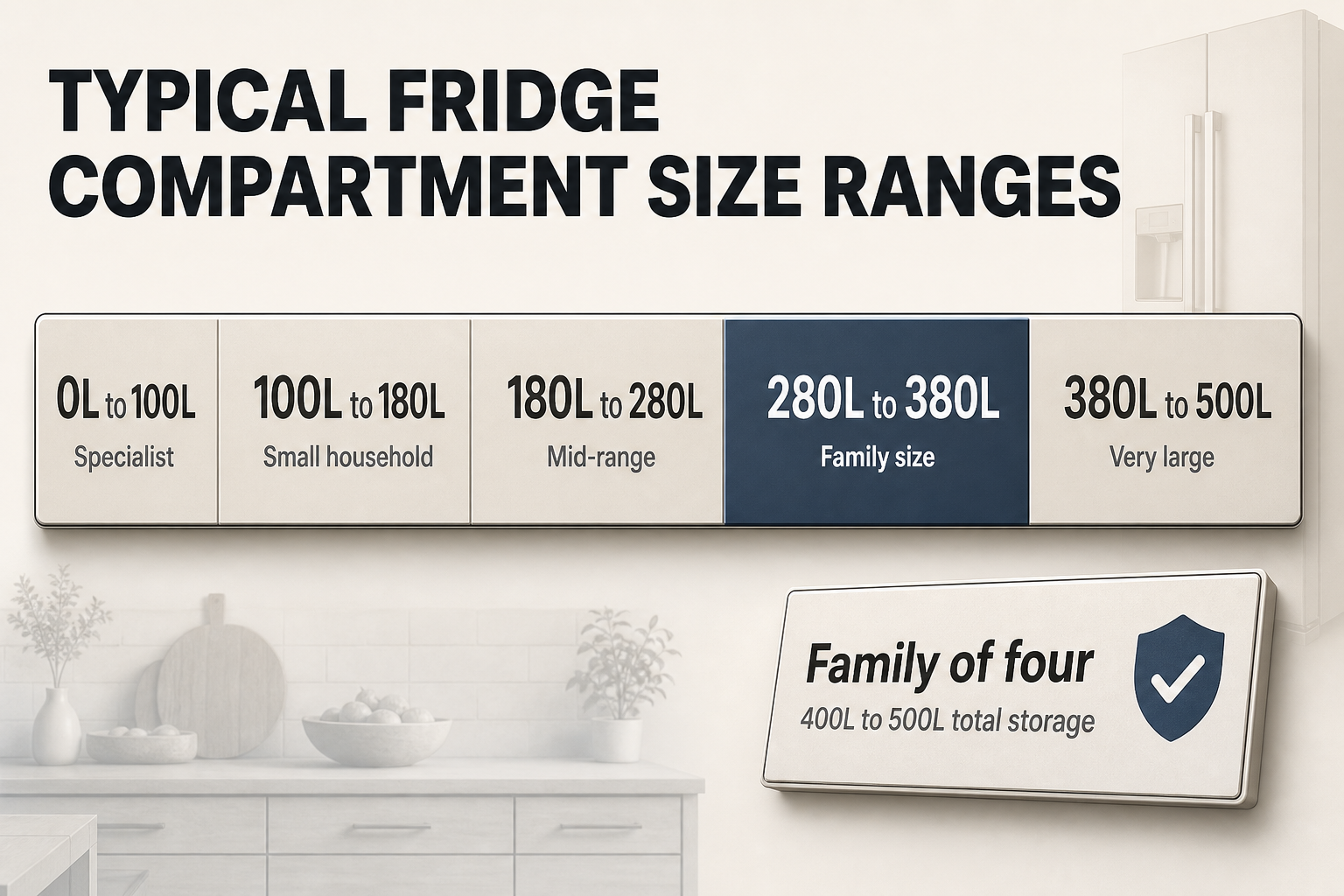
A mid-range fridge compartment is roughly 180L to 280L. This is a common zone for smaller bottom-mounts and conventional fridge-freezers aimed at couples and small families. It gives enough room for normal groceries without the appliance becoming oversized for a townhouse kitchen.
A larger family-oriented fridge section is usually about 280L to 380L. This is where many mainstream family fridges sit, especially wider bottom-freezer and French-door models. Consumer NZ estimates a typical family of four doing its main shop once a week will need about 400L to 500L of total storage across fridge and freezer combined, so the fridge portion of that often lands somewhere in this bracket depending on freezer size. (consumer.org.nz)
At the top end, 380L to 500L of fridge capacity is very large. You will usually find this in broad French-door units and some large side-by-side models. This suits big households, keen cooks, entertainers, or buyers who regularly store platters, bulk produce and multiple large containers. It can also suit rural households that shop less often and want more fresh-food room between trips.
Use-Case Guidance
If you live alone in a flat or apartment and buy food every few days, about 100L to 160L of fridge capacity is often enough. That gives room for basics without paying for a large cabinet you will never fill. In Wellington or central Auckland, where kitchen footprints can be tight, a compact model may be the smarter fit than chasing maximum litres.
For a couple, around 150L to 220L is often a good starting point. If you cook at home most nights, pack lunches, or like to keep a lot of fresh produce on hand, look closer to 200L to 250L. If you mostly eat out or shop frequently, you can go smaller.
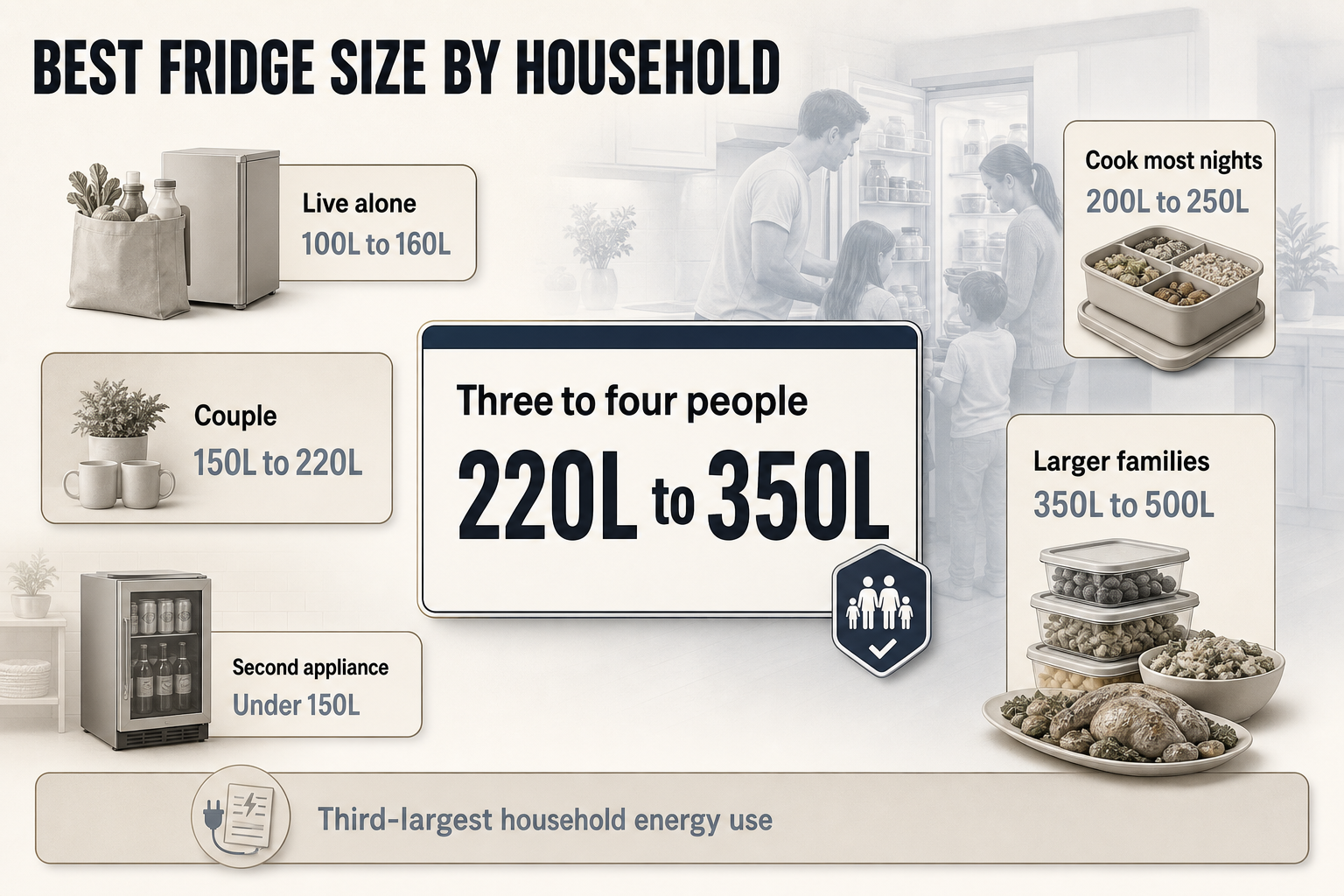
For a household of three to four people, roughly 220L to 350L of fridge space is usually the practical zone. At this size, you can fit larger milk bottles, leftovers, school lunch items and a decent fruit and veg shop without shelves becoming a daily puzzle. If your family does one major supermarket run each week, aim toward the upper half of that range.
For larger families, shared houses, or anyone who entertains often, 350L to 500L of fridge capacity can make life much easier. This is especially true if you host summer barbecues, keep several lunchboxes on the go, or need room for trays and platters around Christmas. Just remember that a very large fridge only makes sense if your kitchen, household size and food habits actually justify it.
For a bach, office, sleepout or second appliance, under 150L is often enough. A drinks fridge or overflow unit does not need family-sized fresh-food storage. In fact, a smaller efficient model may be the better buy because fridges run all day, every day. EECA says fridges and freezers are the third-largest use of household energy after heating and hot water, so oversizing has a real running-cost effect over time. (eeca.govt.nz)
NZ-Specific Factors
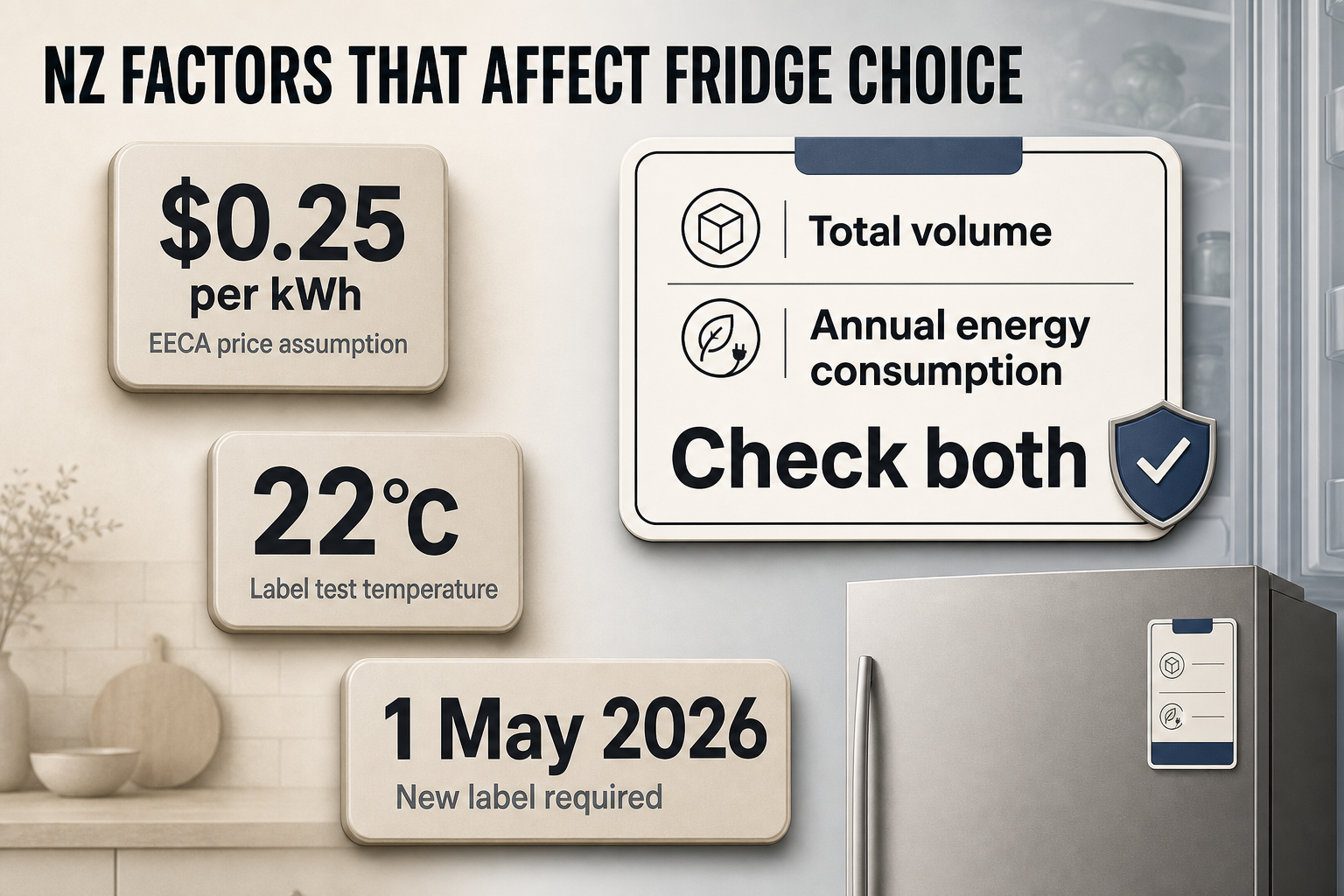
In New Zealand, electricity cost matters because a fridge never gets a day off. EECA uses an electricity price assumption of $0.25 per kWh in its fridge and freezer savings examples, while MBIE tracks residential electricity prices nationally and shows ongoing movement in household power costs. That means capacity should always be weighed alongside the Energy Rating Label’s annual kWh figure, not looked at in isolation. A bigger fridge with a strong efficiency rating can still be a sensible choice, but only if you genuinely need the space. (eeca.govt.nz)
The Energy Rating Label is especially useful here because New Zealand requires residential fridges and freezers to display it, and newer labels now include total volume as well as annual energy consumption. EECA says the new label for fridges and freezers is based on updated testing that better reflects real use, including door openings and cooling warm food, with calculations assuming an ambient temperature of 22°C. From 1 May 2026, imported household refrigerating appliances in New Zealand must be supplied with the new label. (eeca.govt.nz)
Climate and placement also matter in NZ homes. A fridge in a cool, shaded kitchen in Dunedin may have an easier life than one in a warm, sunny room in Northland. If your kitchen gets hot afternoon sun, or you plan to place the appliance in a garage or enclosed scullery, check the manufacturer’s climate-class guidance and ventilation clearances. Real-world energy use can rise if the fridge has to work harder than the test conditions assume.
The last point is practical rather than technical: buy for your real shopping pattern, not your aspirational one. Many households think they need the biggest fridge that fits the cavity, but a sensible target is enough fresh-food space for your busiest normal week. If you are constantly buying takeaway, a 450L fridge compartment is wasted money and floor space. If you cook most meals, host family often, or live a long way from the supermarket, going larger can be the better call.
You may also be interested in these independent articles
Sources
© 2026 pyfoi. All rights reserved.