
Fridge Hinge Direction Guide for NZ Buyers
Choosing the right fridge hinge direction can save space, improve kitchen flow, and avoid costly mistakes. See which fridge door setup suits your home.
A fridge’s hinge direction sounds minor until the door opens the wrong way and blocks your kitchen, wall, or pantry. For New Zealand buyers, the right hinge setup affects daily convenience, usable space, and even whether drawers and crisper bins can open properly in a tight kitchen.
Hinge direction matters just as much in a compact Auckland apartment as it does in a family kitchen in Christchurch or a garage setup in Southland. Before you compare litres, finishes, or ice makers, make sure the door will actually work in your space.
The Options
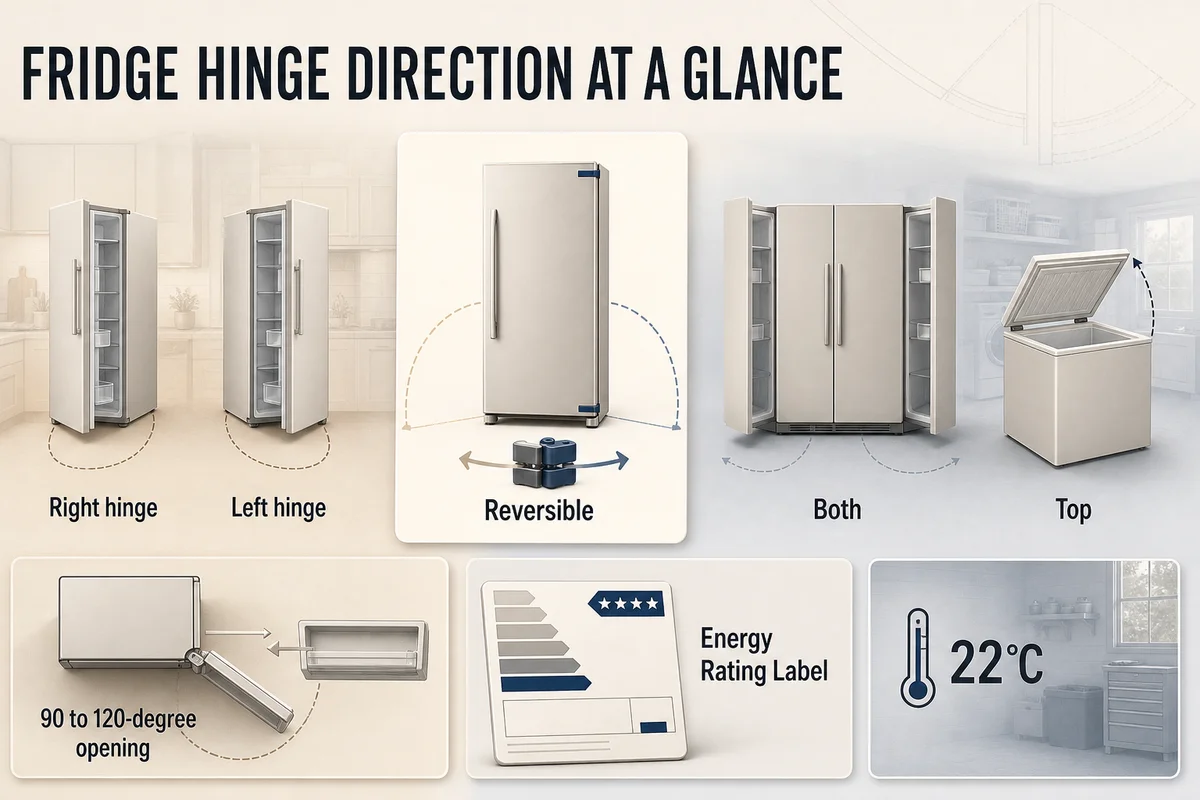
Right hinge
A right-hinged fridge has its hinge on the right-hand side, so the door swings open from left to right. This is a very common default on single-door fridges and many upright freezers, and some product data will assume right hinge if nothing else is specified.
The main advantage is simplicity. If your fridge sits with clear space on its left side, a right hinge can give you easy access with your left hand while you reach in with your right. In many standard kitchen layouts, especially where the fridge is placed at the end of a cabinet run, this works perfectly well.
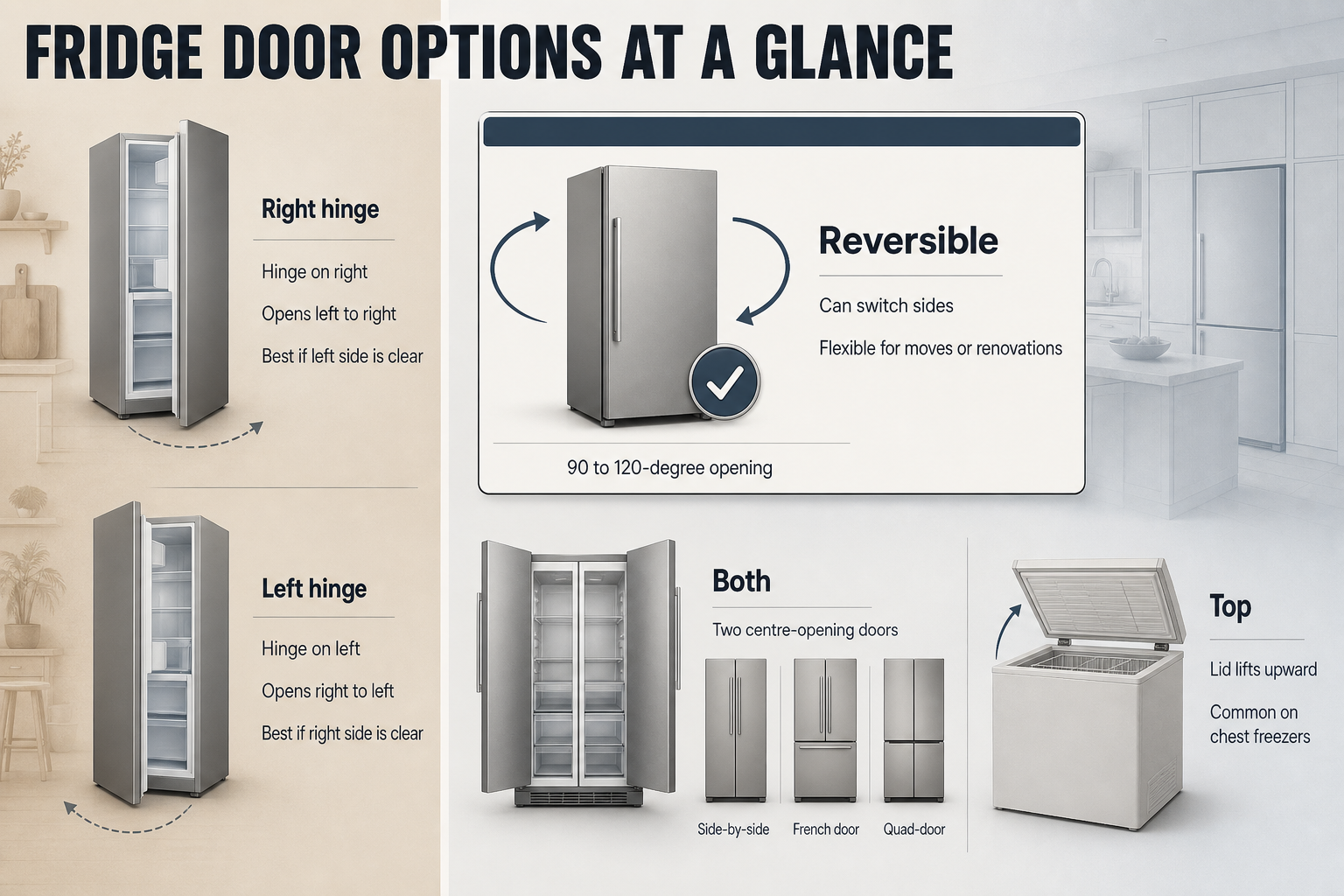
The downside appears when the fridge is hard against a wall or tall cabinetry on the left side. In that case, the door may not open wide enough for shelves, bins, or freezer drawers to slide out fully. Consumer NZ advises buyers to check whether the door is hinged on the correct side for the kitchen, and whether it may be reversible if it is not. (consumer.org.nz)
A right hinge suits homes where the fridge is positioned so the door opens away from the main walkway. That can work well in open-plan homes, rental properties with standard appliance bays, or utility rooms where layout matters more than symmetry.
Left hinge
A left-hinged fridge is the mirror image, with the hinge on the left and the handle side on the right. The door swings open from right to left. This can be the better option if your kitchen flow naturally approaches the fridge from the right-hand side.
Its biggest benefit is ergonomic. If your bench, prep area, or pantry sits to the right of the fridge, a left hinge can make loading groceries and grabbing ingredients feel more natural. In a narrow galley kitchen, that can be the difference between smooth use and constant annoyance.
The drawback is availability. Left-hinged models are often less common as factory-standard stock, so your choices may be narrower unless the unit has a reversible door. You also need to check whether changing the hinge affects door seals, handle placement, or warranty conditions, especially on integrated or premium models.
For NZ buyers, a left hinge often makes sense in older homes where the appliance space was not designed around modern wide fridges. Villas and bungalows can have awkward corners, and a left-opening door may simply be the only way to avoid hitting a wall or blocking a passage.
Reversible
A reversible fridge has a door that can be re-hung to open from either side. For many buyers, this is the safest option because it gives you flexibility if you move house, renovate, or discover the original plan does not work as expected.
The biggest advantage is obvious: you are not locked into one layout. If you are fitting out a new kitchen, buying for a rental, or replacing an old fridge in a tight cavity, reversible hinges reduce the risk of getting it wrong. Consumer NZ specifically points buyers to check whether a model is reversible if the standard hinge side does not suit. (consumer.org.nz)
There are a few catches. Some reversible models still need clearance on one side for a full 90 to 120-degree opening, and the hinge swap may require tools, extra parts, or a service technician. On some models, the process is easy; on others, it is fiddly enough that you will want the retailer or installer to do it.
This option is ideal for first-home buyers, landlords, and anyone furnishing a flat or townhouse where the next layout is uncertain. In New Zealand, where people often shift between rentals and owner-occupied homes, flexibility can be more valuable than a fixed left or right setup.
Both
The “both” category covers fridges with doors opening from the centre outward, such as side-by-side, French-door, and quad-door designs. In practical terms, this means you get access from both left and right rather than relying on one large swing door. EECA notes that side-by-side models split the unit down the middle, typically with the freezer on the left and the fridge on the right. (eeca.govt.nz)
The advantage is access and width management. Because each door is narrower than a full-width single door, they can be easier to use in kitchens where a large single door would swing too far into the room. French-door layouts also tend to put fresh food at eye level, which many families prefer.
The compromise is that these models are usually larger and often use more energy than simpler top-mount or bottom-mount fridges, especially if they include through-the-door ice or water. Building Performance says water and ice dispensers use more energy and cost more to run, while EECA also notes these features can increase electricity use and may need plumbing. (building.govt.nz)
This setup suits larger households, entertainers, and buyers who want wide fridge shelves for platters, pizza boxes, or bulk shopping. In NZ terms, it works well for busy family homes, but you need to measure carefully because these units can dominate a smaller kitchen.
French door
Your selector list includes “French Door” as a separate value, but the scraper guidance groups French-door models under “both”, which is how buyers should think about them in practice. A French-door fridge has two upper doors opening from the centre, usually with a lower freezer drawer or lower compartment arrangement.
The main benefit is convenience. You open only one side when you need milk or condiments, but you still get a wide opening when loading platters or supermarket trays. They also tend to feel more premium and can suit modern NZ kitchen renovations where the fridge is a visual focal point.
The downside is cost, size, and sometimes running cost. Consumer NZ notes you should compare energy labels only between similar appliances, not across very different formats such as a large French-door fridge and a small bottom-mount model. EECA requires fridges and freezers sold in New Zealand to display an Energy Rating Label, showing annual energy use in kWh and a star rating, so you can compare similar models properly. (consumer.org.nz)
French-door models suit larger homes, family kitchens, and buyers who shop in bulk. They are less suited to narrow apartments or older kitchens where doorway width, turning space, and cabinet clearance are tight.
Top
A top-opening appliance is usually a chest freezer rather than a conventional fridge. Instead of swinging sideways, the lid lifts upward. That changes the space planning completely.
The advantage is simple access in a garage, laundry, or utility room where side clearance is limited. You do not need room for a door to swing left or right, and chest freezers are often excellent for bulk storage. Haier’s current NZ chest freezer range shows this format is still common, including hybrid models that can switch between fridge and freezer modes. (haier.co.nz)
The downside is overhead clearance and usability. You need enough room above the lid to open it fully, and chest freezers are less convenient for day-to-day fridge-style access because food stacks vertically. In a crowded garage, that upward-opening lid can clash with shelving or low storage.
This setup suits households storing meat, fish, frozen meals, or garden produce in bulk. It is also practical for rural properties, large families, and anyone who buys in volume to reduce shopping trips.
How to Choose
Start with your kitchen, not the brochure. Stand where the fridge will go and picture the full door swing, not just whether the appliance physically fits the gap. You need space for the handle, the door arc, and enough opening angle to remove shelves and bins. Fisher & Paykel planning documents for integrated refrigeration specifically show door swing clearance requirements, which is a reminder that hinge direction is about usable space, not just width on paper. (fisherpaykel.com)
If the fridge sits against a wall on one side, choose the hinge so the door opens away from that wall. If you are unsure, reversible is usually the smart buy. You probably do not need to overthink left versus right if the fridge sits at the end of an open bench with plenty of clearance, but you absolutely should care if it is boxed in by cabinetry.
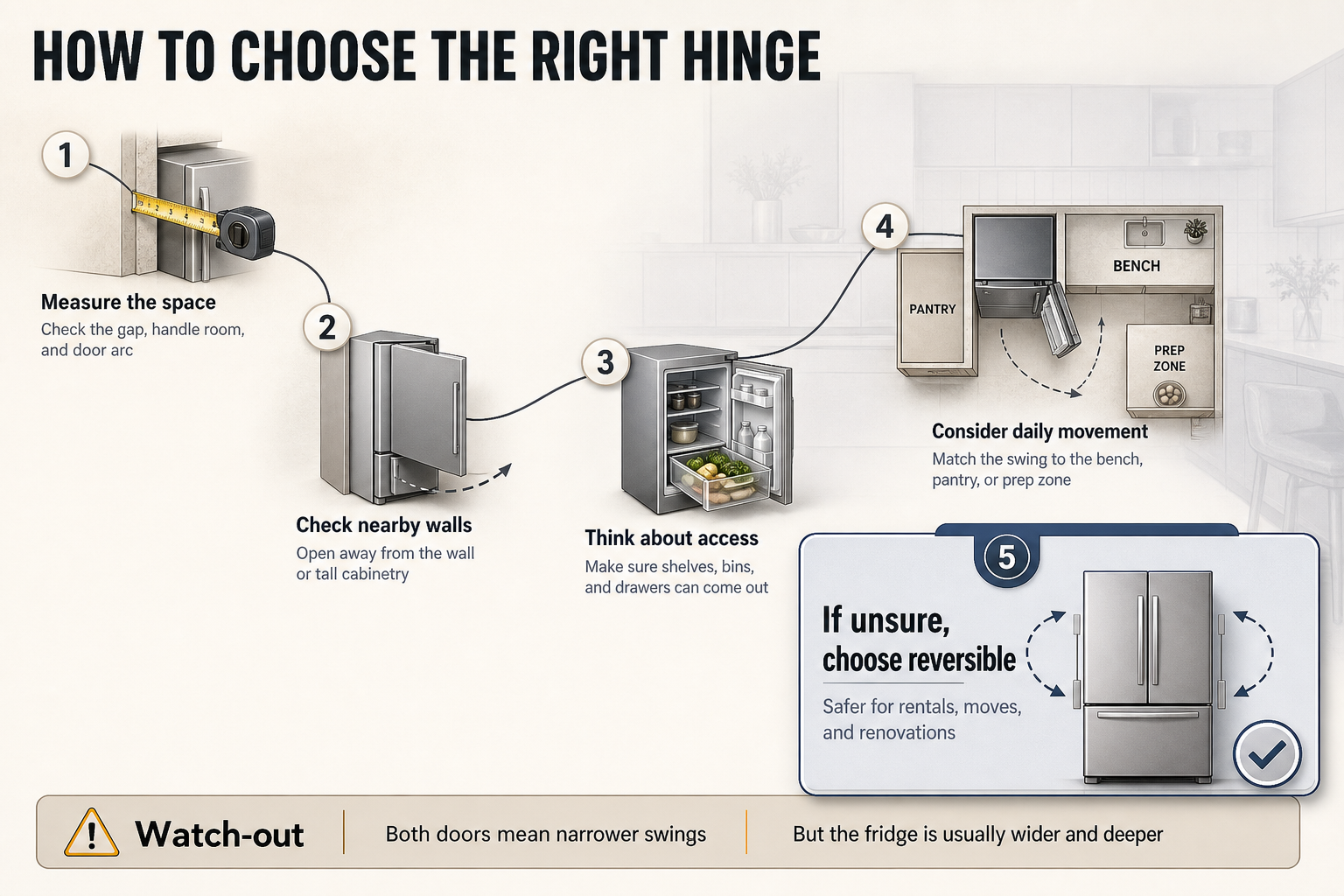
Do not assume bigger multi-door fridges solve every layout problem. “Both” door setups reduce the width of each door swing, but the appliance itself is usually wider and deeper. In many NZ kitchens, especially older homes, that can create pinch points near islands, pantry doors, or dining areas.
Think about your daily movement. If you unload groceries straight from the garage entry to the kitchen, choose the hinge that lets the door open toward the bench or prep zone. If children regularly grab lunch items before school, a layout that avoids the open door blocking the main walkway will feel much better over time.
NZ Context
New Zealand buyers should pay attention to energy labels as well as door direction. EECA says residential fridges and freezers sold here must display an Energy Rating Label, and that annual energy consumption is calculated using standardised testing that includes the effect of door openings. That means door design and usage patterns are part of real efficiency, even if hinge direction itself is mostly a layout issue. (eeca.govt.nz)
Our housing stock also makes hinge choice more important than many people expect. Apartments and townhouses often have tighter kitchen footprints, while older homes can have uneven walls, narrow alcoves, and less predictable appliance spaces. A reversible hinge is especially useful if you are buying for a rental or planning to move.
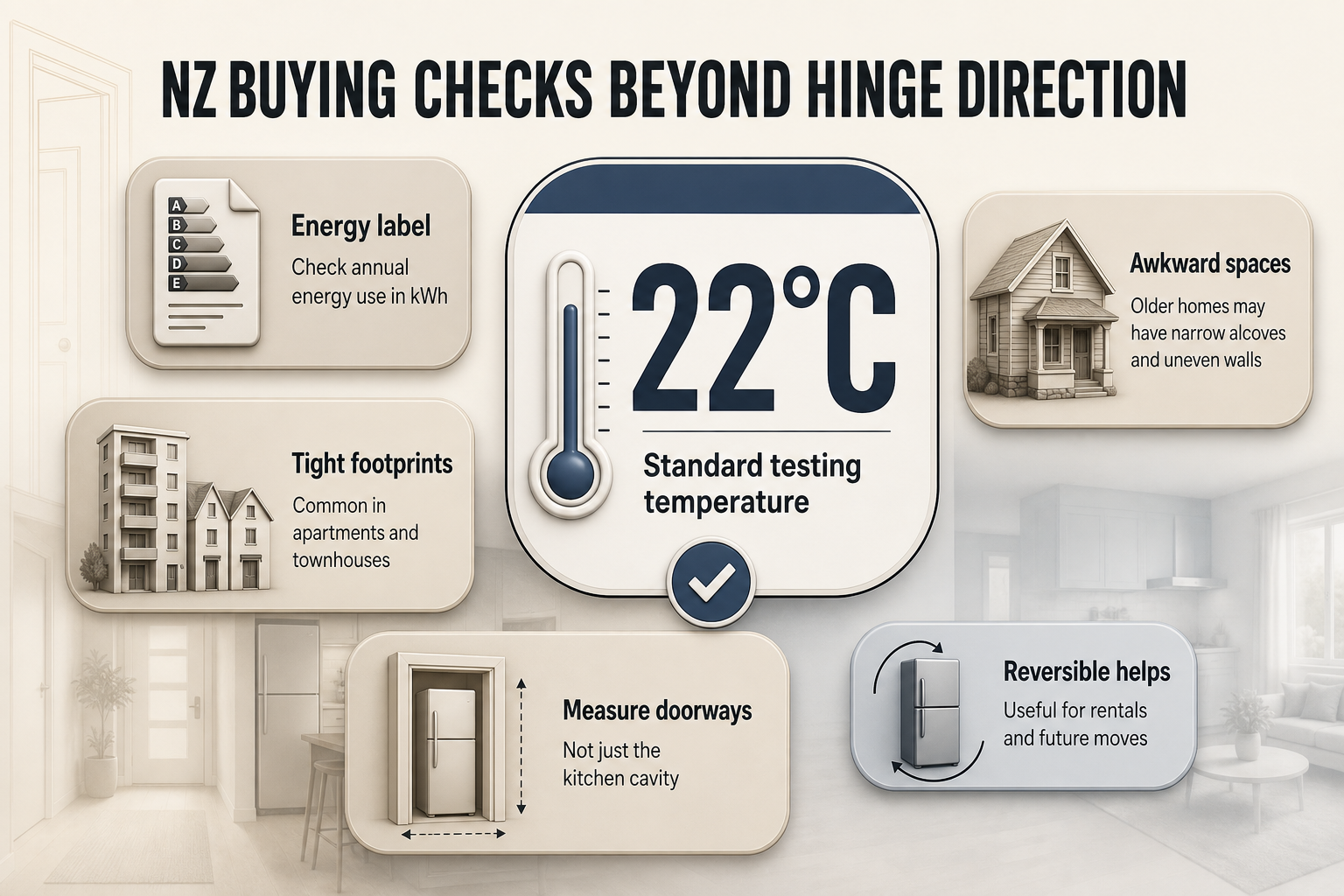
For chest freezers in garages or sheds, check the manufacturer’s installation guidance and ambient temperature recommendations before buying. Energy label testing for fridges and freezers assumes a surrounding temperature of 22°C, according to EECA, which may differ from a very cold Central Otago winter garage or a hot Northland utility room. (eeca.govt.nz)
Finally, measure your doorways, not just the kitchen cavity. A French-door or side-by-side model with “both” opening doors may suit family life beautifully, but it still has to get through the front door, around the hallway, and into place without a drama.
You may also be interested in these independent articles
Sources
- [1]EECA: Fridges and Freezers Energy Rating Labels
- [2]Consumer NZ: Energy Rating Labels explained
- [3]Consumer NZ: How to buy the best fridge
- [4]Consumer NZ: How to buy the best freezer
- [5]EECA: Choose an efficient fridge or freezer to cut costs
- [6]Building Performance: Fridges and freezers
- [7]Fisher & Paykel Planning Guide: Integrated Refrigeration
- [8]Haier New Zealand: 137L 300 Series Hybrid Chest Freezer
© 2026 pyfoi. All rights reserved.