
Refrigerator Warranty Length in New Zealand
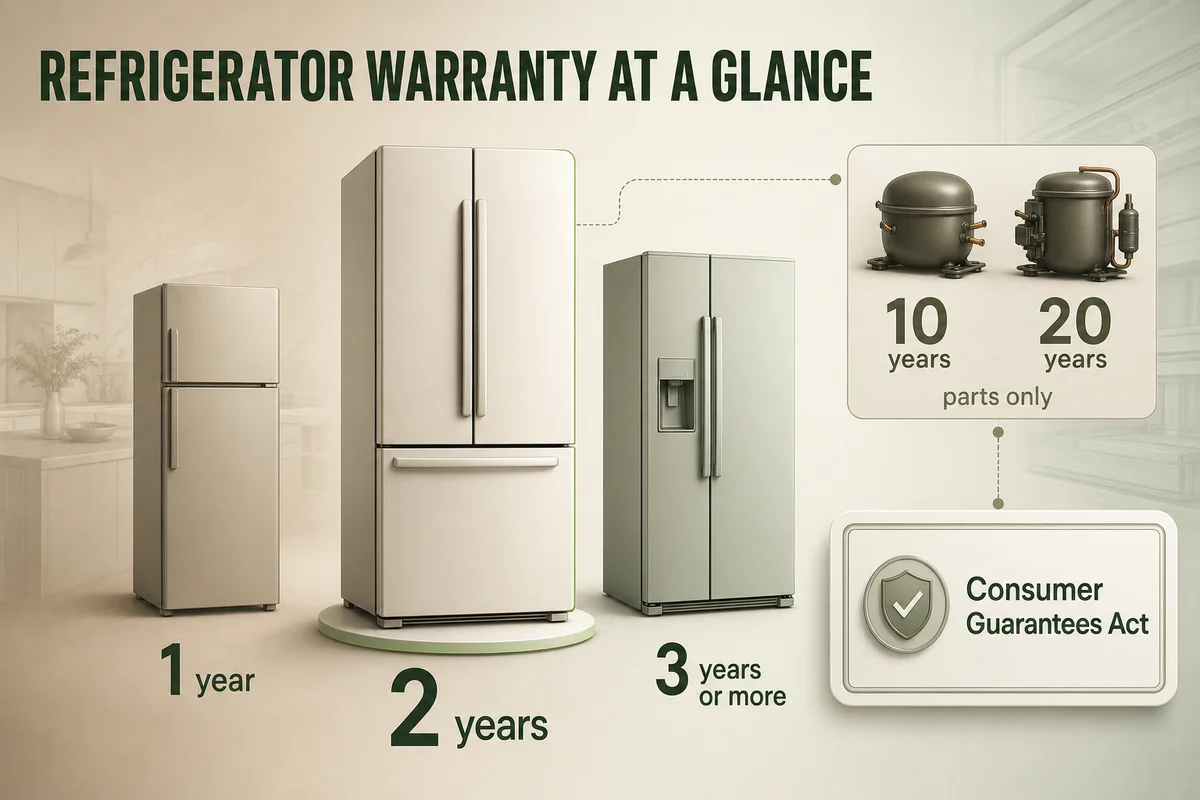
Most NZ refrigerators come with a 2-year warranty, but CGA rights can last longer. Learn what full cover really means before you buy.
A refrigerator warranty looks simple on the spec sheet, but the number of years only tells part of the story. For New Zealand buyers, warranty length matters because a fridge is a long-term appliance that runs all day, every day, and a short written warranty does not cancel your rights under the Consumer Guarantees Act.
What the Numbers Mean
For refrigerators, the primary warranty is usually the standard manufacturer cover on the whole appliance, including parts and labour for faults caused by manufacturing defects. In New Zealand, that primary warranty is commonly 2 years for mainstream brands sold through local retailers and official channels. Haier states a two-year manufacturer’s warranty on new products, and Samsung’s New Zealand support information says its refrigerators have a two-year manufacturer’s warranty from the original purchase date. Fisher & Paykel’s service and warranty guide for refrigeration also shows a 2-year manufacturer’s warranty. Source 1 Source 2 Source 3
That matters because the headline number on a retailer page can be misleading if you do not check whether it is the primary warranty or a separate cover for a specific part. Many refrigerator brands promote long compressor warranties, but those are often additional, limited warranties that start after the main cover ends and may be parts only, not labour. Haier advertises a 12-year compressor warranty on eligible models, but that is made up of the standard 2-year manufacturer’s warranty plus an additional 10-year parts-only compressor warranty. LG also lists 2 years parts and labour on refrigerators, with further sealed-system cover that is parts only in the extra period. Source 1 Source 4
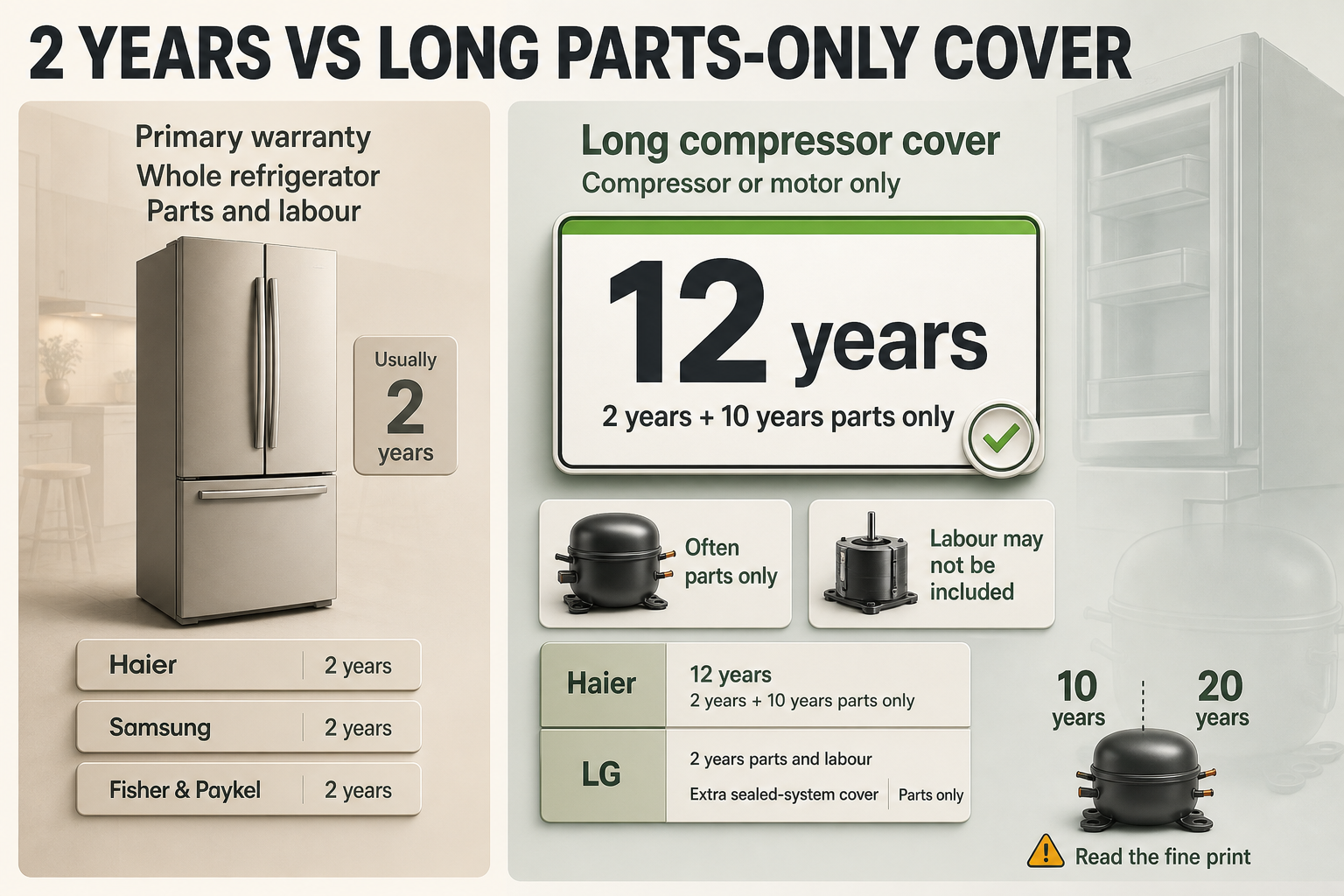
So if you see 2 years on the spec sheet, that is normal. If you see 10 years or 20 years, read the fine print carefully because it may refer only to the compressor or motor, not the full refrigerator.
Typical Ranges
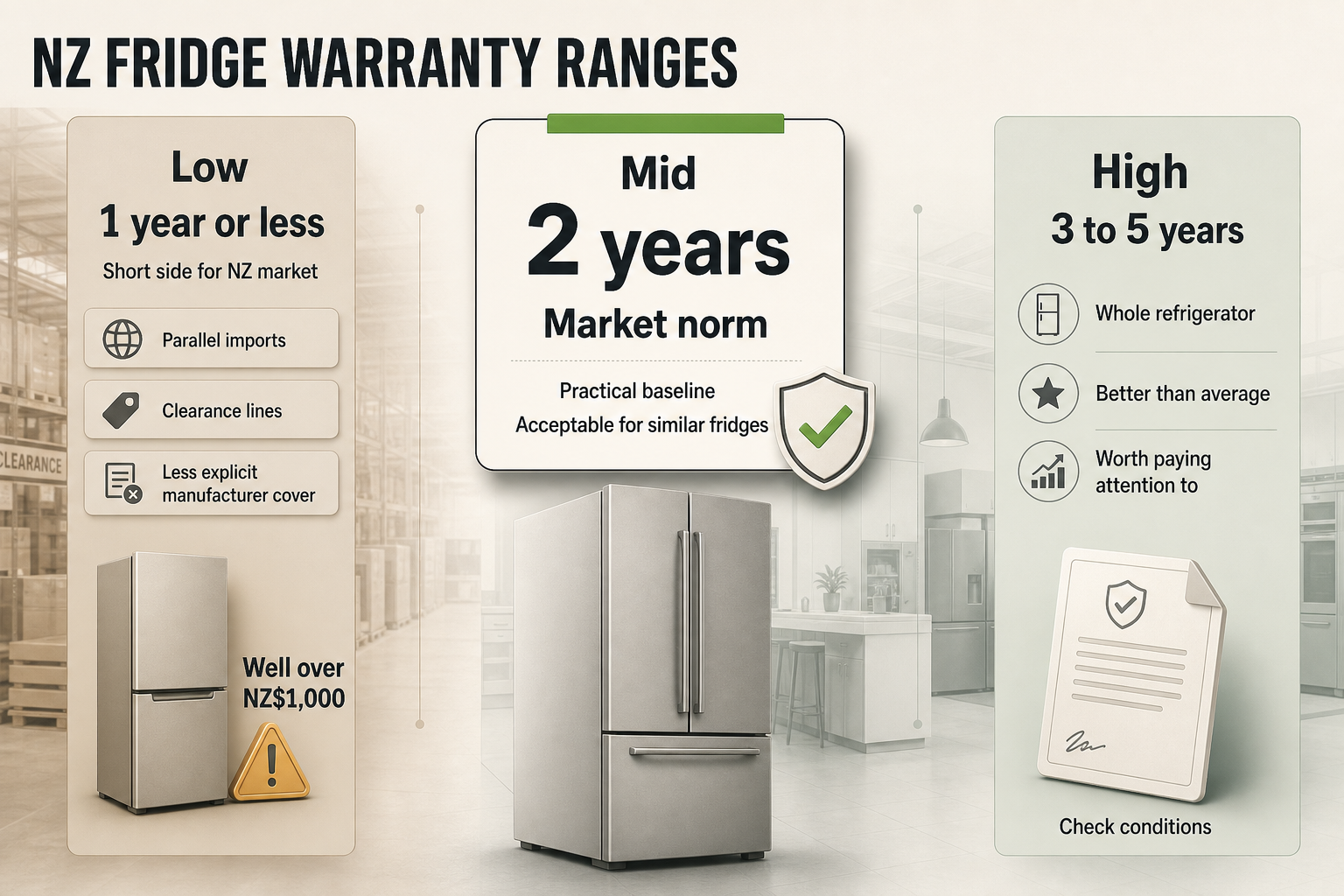
Low: 1 year or less
A primary refrigerator warranty of 1 year is now on the short side for the NZ market. You may still see it on parallel-imported stock, clearance lines, or products sold outside the usual authorised retail network. A one-year written warranty is not automatically a deal-breaker, but it gives you less explicit manufacturer cover and may signal a weaker local support setup.
For a fridge-freezer that costs well over NZ$1,000, one year feels lean. Refrigerators are expected to last well beyond that, and any buyer should look closely at who handles service in New Zealand, how parts are supplied, and whether the seller is established enough to support claims.
Mid: 2 years
This is the market norm for many refrigerators in New Zealand. It is long enough to cover early-life faults, installation-related issues that show up later, and some failures in electronics, fans, sensors, or door seals that appear after the first summer.
For most households, 2 years is the practical baseline. If you are comparing two otherwise similar fridges, a 2-year primary warranty is acceptable, but you should still compare the service network, response times, and any exclusions. A fridge in a busy family kitchen in Auckland or Northland may work harder through warm, humid months than one in a cooler South Island home, so support quality matters as much as the number itself.
High: 3 years or more
A true 3-year to 5-year primary warranty on the whole refrigerator is better than average and worth paying attention to, especially on premium models or promotional offers. It can reduce your risk if you are buying a feature-heavy fridge with ice makers, water dispensers, Wi-Fi controls, convertible compartments, or more complex inverter systems.
That said, a longer written warranty should not be treated as proof that the fridge is better built. Sometimes a brand with a standard 2-year warranty still has excellent reliability and strong local after-sales support. Sometimes a longer warranty comes with more conditions, such as registration requirements, limited labour cover, or exclusions for commercial use.
Use-Case Guidance
If you are buying a basic top-mount or bottom-mount refrigerator for a smaller household, a 2-year primary warranty is usually enough as a starting point. In this segment, reliability, energy use, shelf layout, and service access often matter more than chasing a headline warranty number.
If you are spending more on a French-door or quad-door model, especially one with plumbed water or automatic ice, it is sensible to look for at least 2 years of full-appliance cover and then read the terms for the sealed system and compressor. More features mean more components that can fail, and not all of them are covered in the same way after the primary period ends.
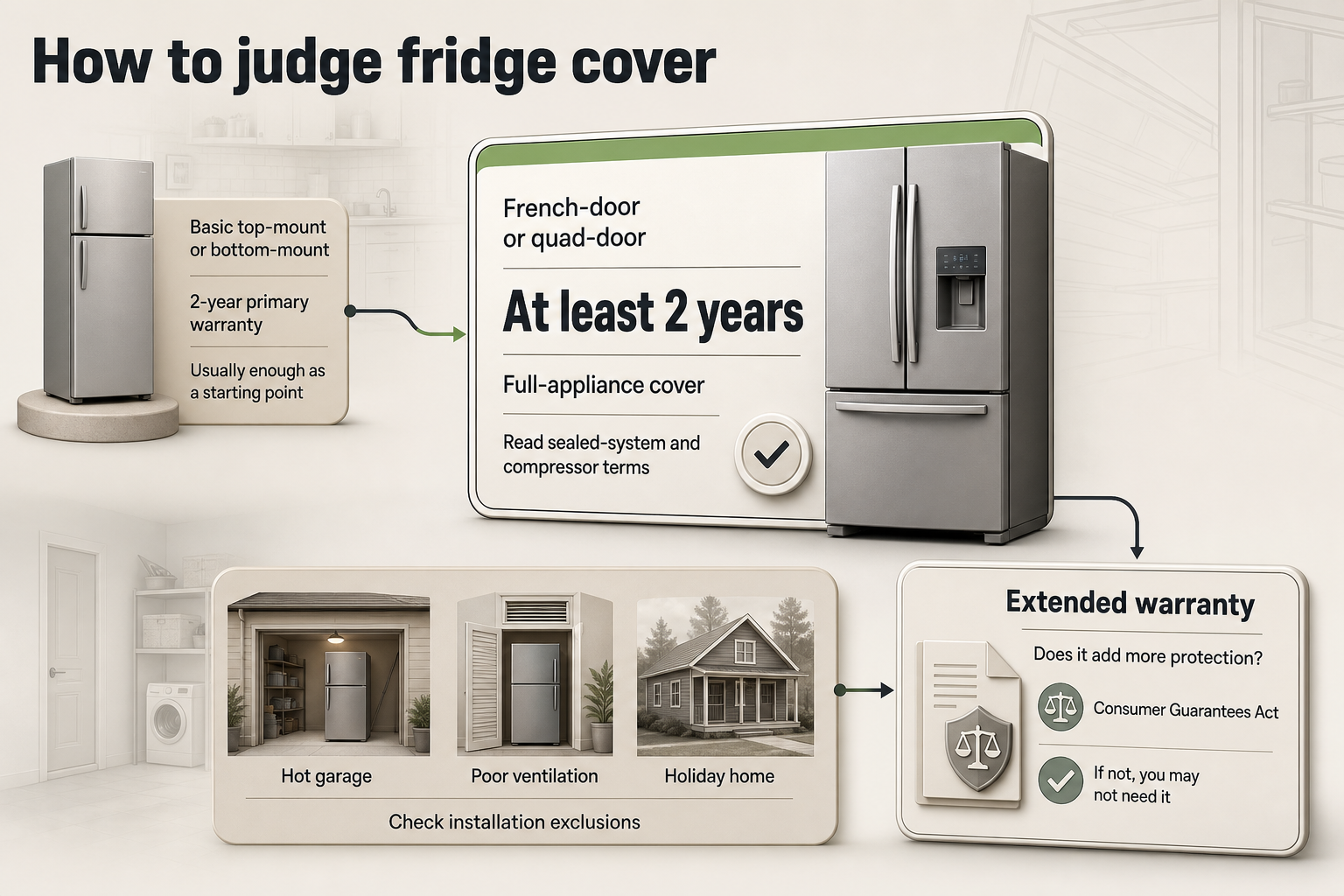
If your fridge will live in a tougher spot, such as a hot garage, a scullery with poor ventilation, or a holiday home that sits unused for stretches, warranty wording becomes more important. Some failures caused by incorrect installation, unsuitable ambient conditions, or poor clearance around the cabinet may be excluded. In those cases, a longer warranty is helpful, but only if you have followed the installation requirements.
If you are choosing between paying extra for an extended warranty or keeping that money in reserve, New Zealand law changes the calculation. Consumer Protection says you do not usually need an extended or manufacturer’s warranty unless it gives you more protection than you already have by law, because your rights under the Consumer Guarantees Act continue even after a manufacturer warranty expires. Source 5 Source 6
NZ-Specific Factors
The biggest New Zealand factor is the Consumer Guarantees Act. A written refrigerator warranty is an extra promise from the manufacturer, but it does not replace your legal rights. Consumer Protection states that businesses cannot limit their obligations to the terms of a store or manufacturer’s warranty, and your CGA rights can continue after the written warranty ends. Source 5 Source 6
That is especially relevant for refrigerators because they are major household appliances with an expected life well beyond 2 years. If a fridge develops a serious fault after the written warranty has expired, you may still have a remedy under the CGA if it has not lasted a reasonable time. Consumer Protection also notes that your legal right to a repair, refund, or replacement can last longer than the manufacturer’s warranty. Source 7 Source 8
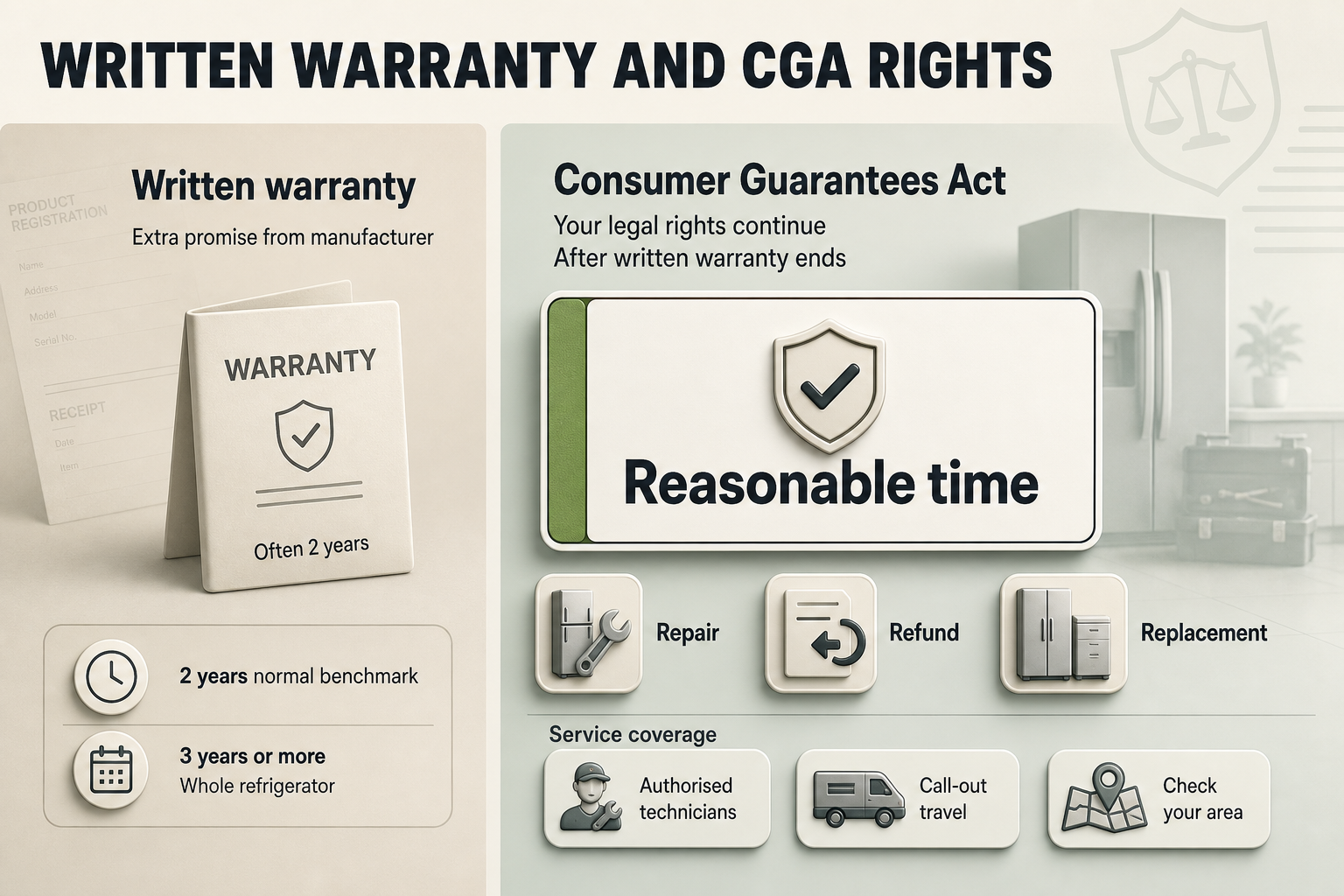
The other NZ-specific issue is service coverage. A fridge is not a small appliance you can easily post away. If you live outside the main centres, check whether the brand has authorised technicians in your area and whether call-out travel is covered. Consumer Protection advises checking warranty terms carefully, including who pays freight or return costs. Source 5
For most New Zealand buyers, the smart approach is to treat 2 years as the normal benchmark, view 3 years or more as a genuine plus if it covers the whole refrigerator, and be sceptical of very long warranty claims unless they clearly state what is covered, who pays labour, and whether the promise applies to the full appliance or only the compressor.
What the brands say
These brands have chosen to respond directly to this independent research. We publish brand responses unedited because we believe transparency builds trust - and that brands willing to engage openly with independent analysis deserve to be heard.
You may also be interested in these independent articles
Sources
- [1]Haier New Zealand Warranty Information
- [2]Samsung New Zealand Refrigerator Warranty FAQ
- [3]Fisher & Paykel Service & Warranty Guide
- [4]LG New Zealand Warranty Terms
- [5]Consumer Protection NZ: Warranties
- [6]Consumer Protection NZ: Consumer Guarantees Act
- [7]Consumer Protection NZ: Your Rights Compared
- [8]Consumer Protection NZ: Product Life, Maintenance and Care
© 2026 pyfoi. All rights reserved.