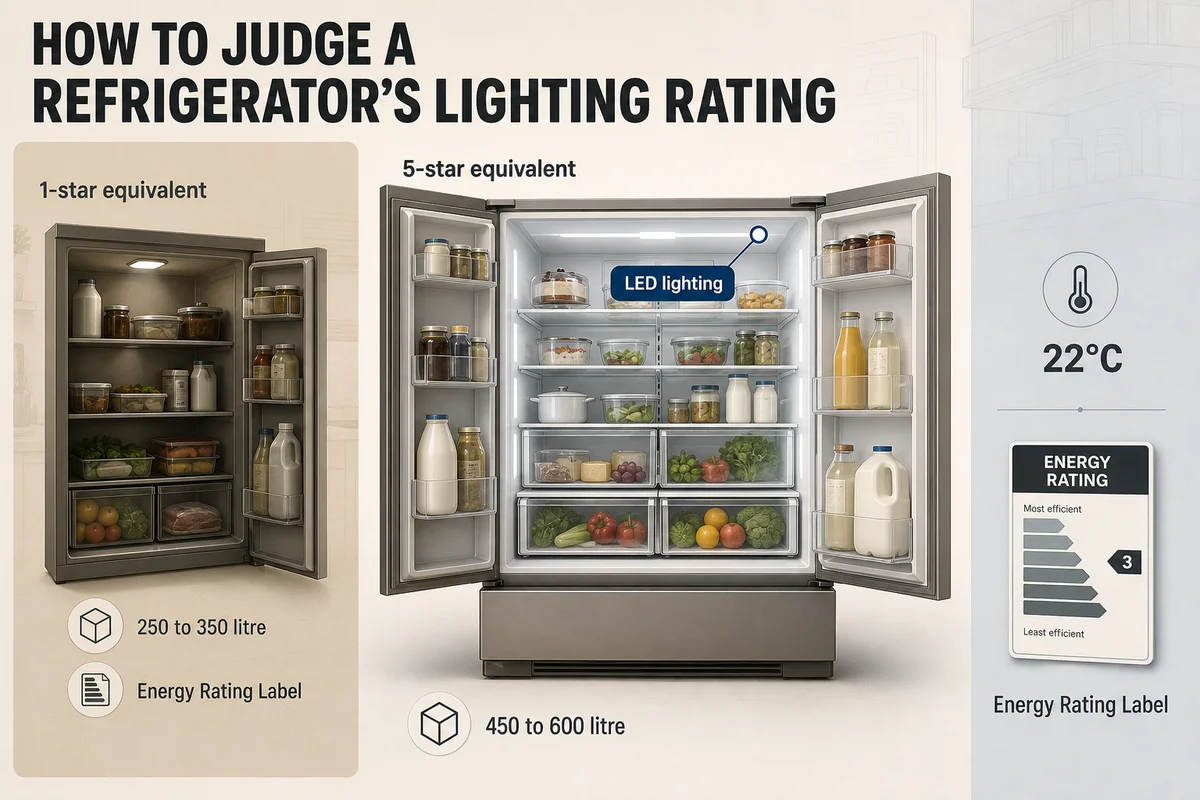

What a Refrigerator Lighting Rating Really Means
Refrigerator lighting rating explained for NZ buyers: learn how LED placement, freezer lighting and the Energy Rating Label affect real fridge usability.
A refrigerator’s lighting rating is a quick way of describing how usable and well-designed the interior lighting is. It does not matter much on a spec sheet if the fridge looks bright in a showroom but leaves the back corners dim once it is full of milk, leftovers, and produce.
For New Zealand buyers, this matters more than it first seems. Good lighting helps you find food faster, wastes less cold air while the door is open, and makes a big fridge feel genuinely practical rather than just large.
What Goes Into the Rating
A lighting rating for a refrigerator is usually about quality of illumination, not the fridge’s official energy label. In New Zealand, the mandatory Energy Rating Label for fridges and freezers covers overall energy efficiency and annual electricity use, not a separate star score for interior lighting. Residential fridges sold here must display that energy label, and the published kWh per year figure is based on standardised testing at an ambient temperature of 22°C under the AS/NZS test framework. (eeca.govt.nz)
So if you see a retailer or brand listing “Lighting” as a star-style feature rating, treat it as a convenience and design score rather than a regulated NZ performance label. A higher score generally means the light is brighter, more even, better positioned, and less likely to be blocked by shelves or tall items. It may also reflect whether both the fridge and freezer compartments are lit, and whether the lighting is modern LED rather than an older bulb design. This is an inference from how brands describe refrigerator lighting features and how buying guides suggest checking illumination in person. (bosch-home.com)
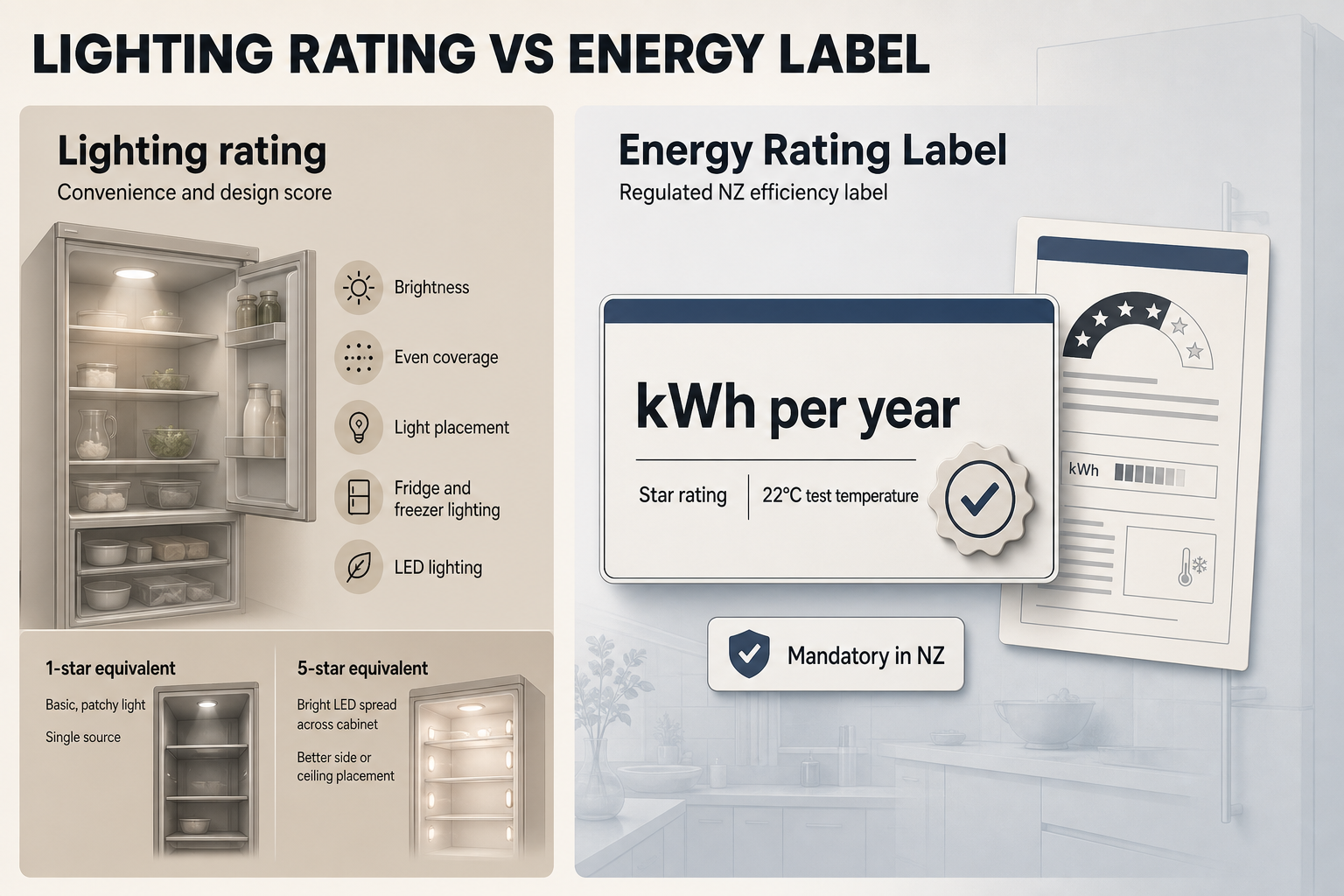
The gap between a low and high rating is usually not about raw brightness alone. A 1-star equivalent would mean basic, patchy light from a single source, often fine in a small top-mount fridge but frustrating in a wider French door model. A 5-star equivalent would usually mean bright LED lighting spread across the cabinet, with better side or ceiling placement so you can still see into drawers and rear shelves when the fridge is busy. Brands commonly promote LED interior lighting because it takes less space and gives a clearer view of the contents. (samsung.com)
What to Look For
The first thing to check is whether the fridge uses LED lighting. In modern refrigerators, LED is the better option for almost everyone. It runs cooler than old incandescent bulbs, uses less power, takes up less internal space, and tends to give a whiter, cleaner light. Manufacturers including Samsung, Bosch, LG, Haier and Westinghouse all highlight LED interior lighting as a feature in current refrigerator ranges. (samsung.com)
Next, look at light placement, not just the word “LED” in the spec list. One roof-mounted light can be enough in a compact 250 to 350 litre fridge, but in a 450 to 600 litre French door or side-by-side model, a single light can leave the lower shelves and vegetable bins in shadow. Side-mounted or multi-point lighting usually works better because food is less likely to block it. Samsung has described side-positioned interior lighting as helping produce brighter, more natural light, while Bosch markets bright LED lighting across larger interiors. (images.samsung.com)
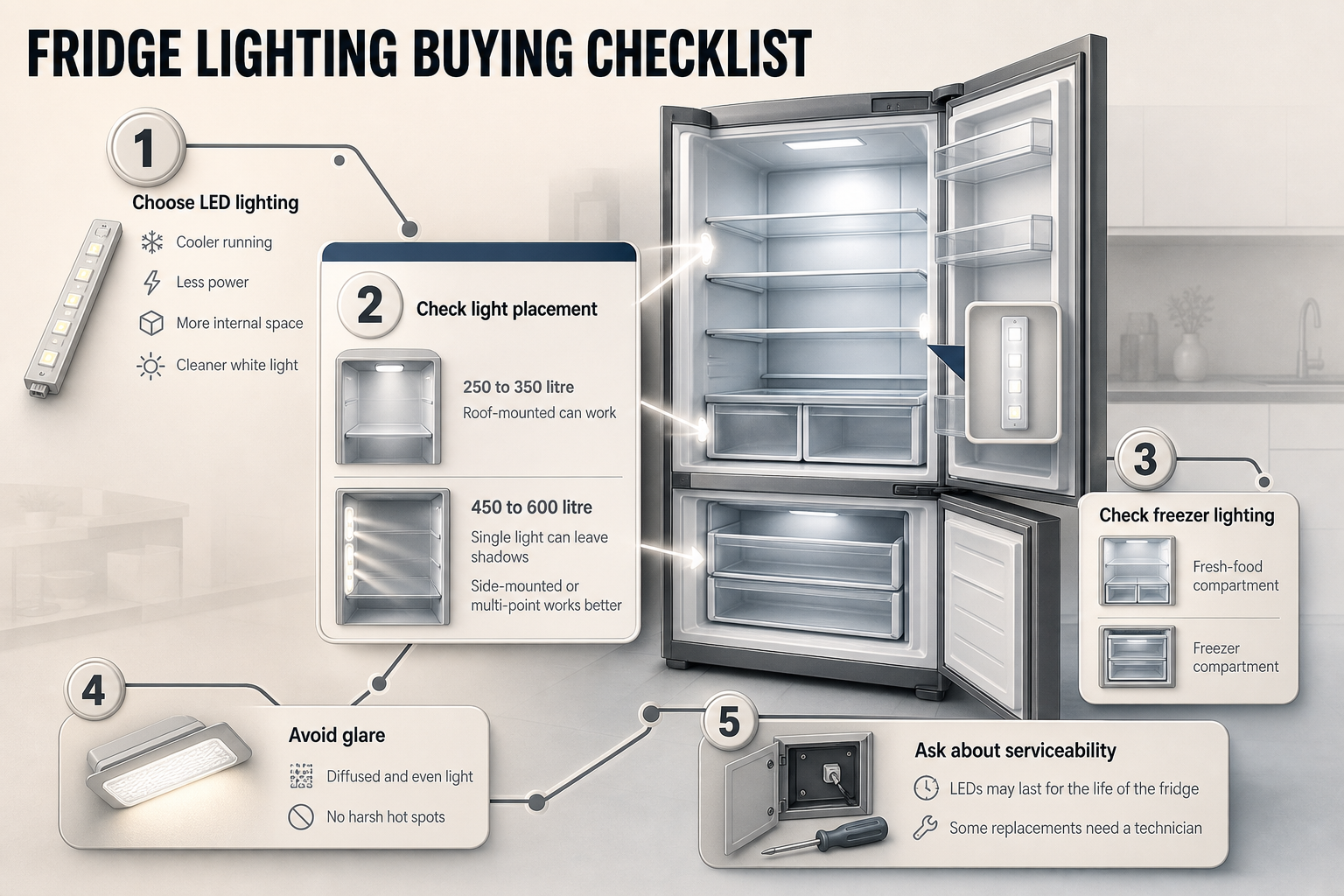
You should also check whether the freezer has its own light. This is easy to miss online. Some refrigerators light only the fresh-food compartment, while others include LED lighting in both sections. Consumer guidance for freezers specifically notes that you should check the light location and how far it illuminates, because stored food can block it. That is especially relevant if you bulk-buy meat, frozen veg, or meal-prep containers. (consumer.org.nz)
Another practical point is glare. A strong light is not automatically a good light if it shines directly in your eyes every time you open the door. Better refrigerator lighting is diffused and even, so labels, leftovers, and produce are easy to identify without harsh hot spots. Some Bosch materials explicitly describe LED refrigerator lighting as even and low-glare, which is the sort of wording worth noticing in product literature. (media3.bosch-home.com)
If you are shopping in-store, open the door and imagine the fridge half full, not empty. Look into the back corners, crisper drawers, door bins, and freezer cavity. Consumer NZ’s buying advice focuses heavily on interior usability and layout, and that same thinking applies to lighting: a fridge that looks good empty can be much less usable once food blocks the light path. (consumer.org.nz)
It is also worth asking how serviceable the lighting system is. Many modern LED modules are designed to last a long time, sometimes for the life of the refrigerator, but they are not always simple DIY replacements. Haier notes that LED lights are designed for the life of the fridge, while Samsung support material says LED replacement may require a technician on some models. That does not make LEDs a bad choice, but it is sensible to ask the retailer what happens if a light fails after a few years. (haierappliances.com)
NZ Context
The main NZ-specific point is that refrigerator lighting is separate from the official energy star label. If you are comparing two fridges, do not assume the one with the better interior light has the better running cost. In New Zealand, the regulated comparison tool for efficiency is the Energy Rating Label, which shows the star rating and annual electricity consumption in kWh. That label is mandatory for residential fridges and freezers sold here. (eeca.govt.nz)
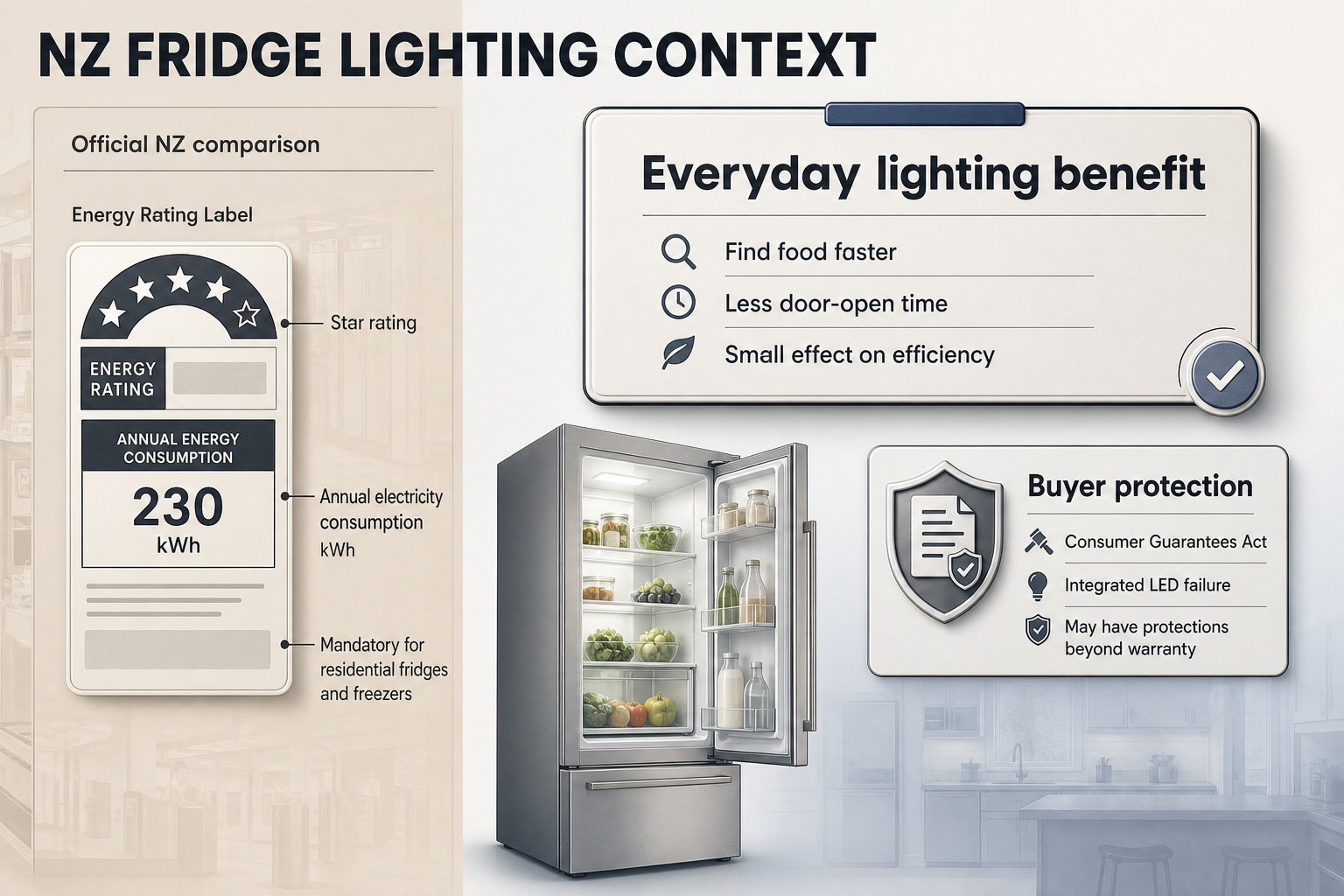
That said, lighting still affects day-to-day efficiency in a small way. If you can see what you need quickly, the door stays open for less time, which reduces warm air entering the cabinet. The direct electricity use of an LED light is small compared with the compressor, but the practical benefit of quicker access is real in busy households. This is an inference based on how refrigerator energy use rises with avoidable heat gain and how brands position LED lighting as a visibility feature. (consumer.org.nz)
NZ homes also vary a lot in kitchen size and natural light. In compact city kitchens, apartment galley kitchens, or older villas with awkward layouts, you may open the fridge in a dim corner, especially during winter evenings. In that setting, a high lighting rating is more useful than it might be in a bright open-plan kitchen. It is particularly helpful on deeper bottom-mount, French door, and side-by-side refrigerators, where food can disappear at the back. Consumer NZ and major NZ retailer guides both stress how much interior layout affects real usability, and lighting is part of that. (consumer.org.nz)
Finally, remember your rights under the Consumer Guarantees Act. If a refrigerator’s lighting system fails unreasonably early, especially as part of a broader product fault, you may have protections beyond the written manufacturer warranty. For a premium fridge, you should expect the interior light system to remain functional for a reasonable period, even if the brand’s express warranty is shorter. That matters more on models where the LEDs are integrated rather than a simple replaceable bulb. Consumer NZ regularly points buyers back to the CGA when assessing appliance durability and after-sales support. (consumer.org.nz)
You may also be interested in these independent articles
Sources
- [1]EECA: Fridges and Freezers
- [2]EECA: How to use Energy Rating Labels and star ratings
- [3]EECA: Requirements under E3 - Fridges and freezers
- [4]Consumer NZ: How to buy the best fridge
- [5]Consumer NZ: How to buy the best freezer
- [6]Samsung US: 4-Door French Door Refrigerator
- [7]Bosch US: B36CD30ENS French Door Bottom Mount Refrigerator
- [8]Haier NZ Quick Reference Guide HRF454TW3
© 2026 pyfoi. All rights reserved.