
Fridge Width Guide for New Zealand Buyers
Choosing the right fridge width in NZ affects fit, capacity and delivery access. Learn which fridge size suits your kitchen before you buy.
Width sounds simple, but it has a big effect on how well an appliance fits your kitchen, how much it holds, and how easy it is to live with every day. For New Zealand buyers, getting the width right matters just as much as price or energy rating, because many homes have tight kitchen layouts, standard cabinetry modules, and doorways that can catch you out on delivery.
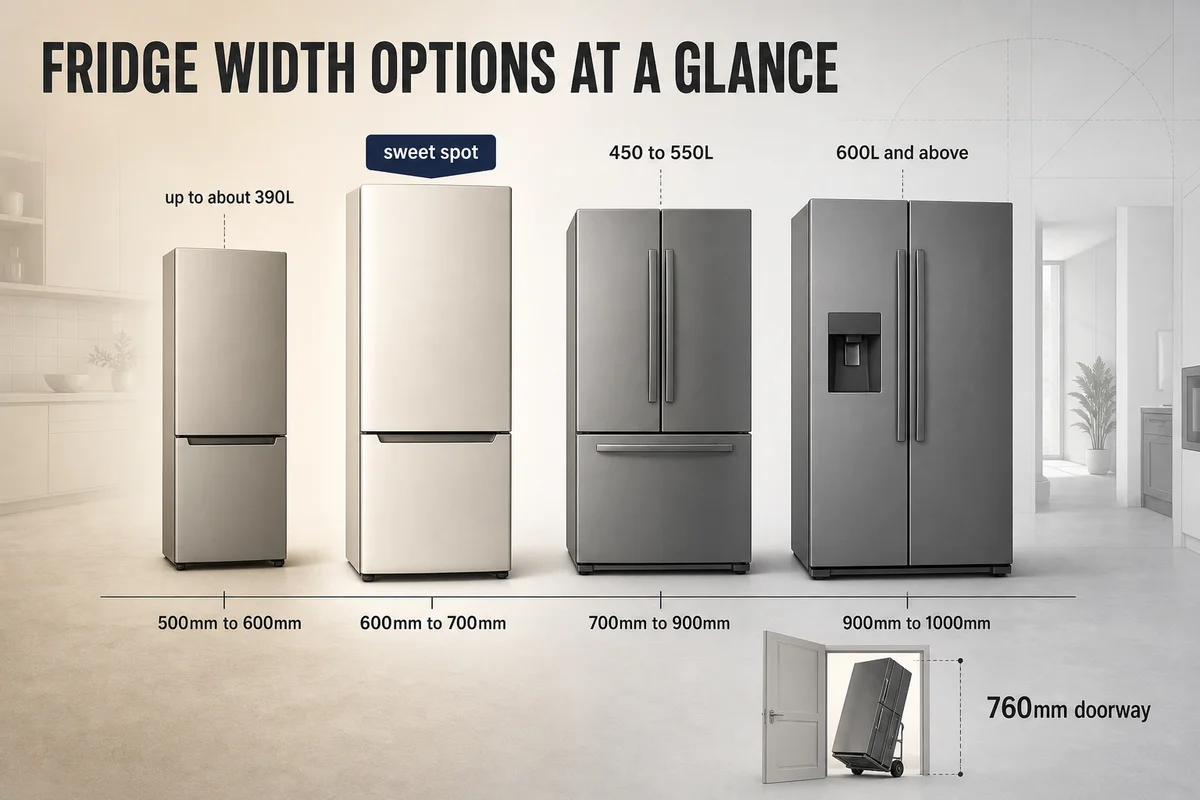
For most refrigeration appliances sold in New Zealand, width sits in a few familiar bands. Fisher & Paykel commonly groups fridges by widths under 600mm, 600 to 699mm, 700 to 899mm, and 900mm plus, while Samsung’s NZ buying guide links those widths to household size and storage needs. (fisherpaykel.com)
What the Numbers Mean
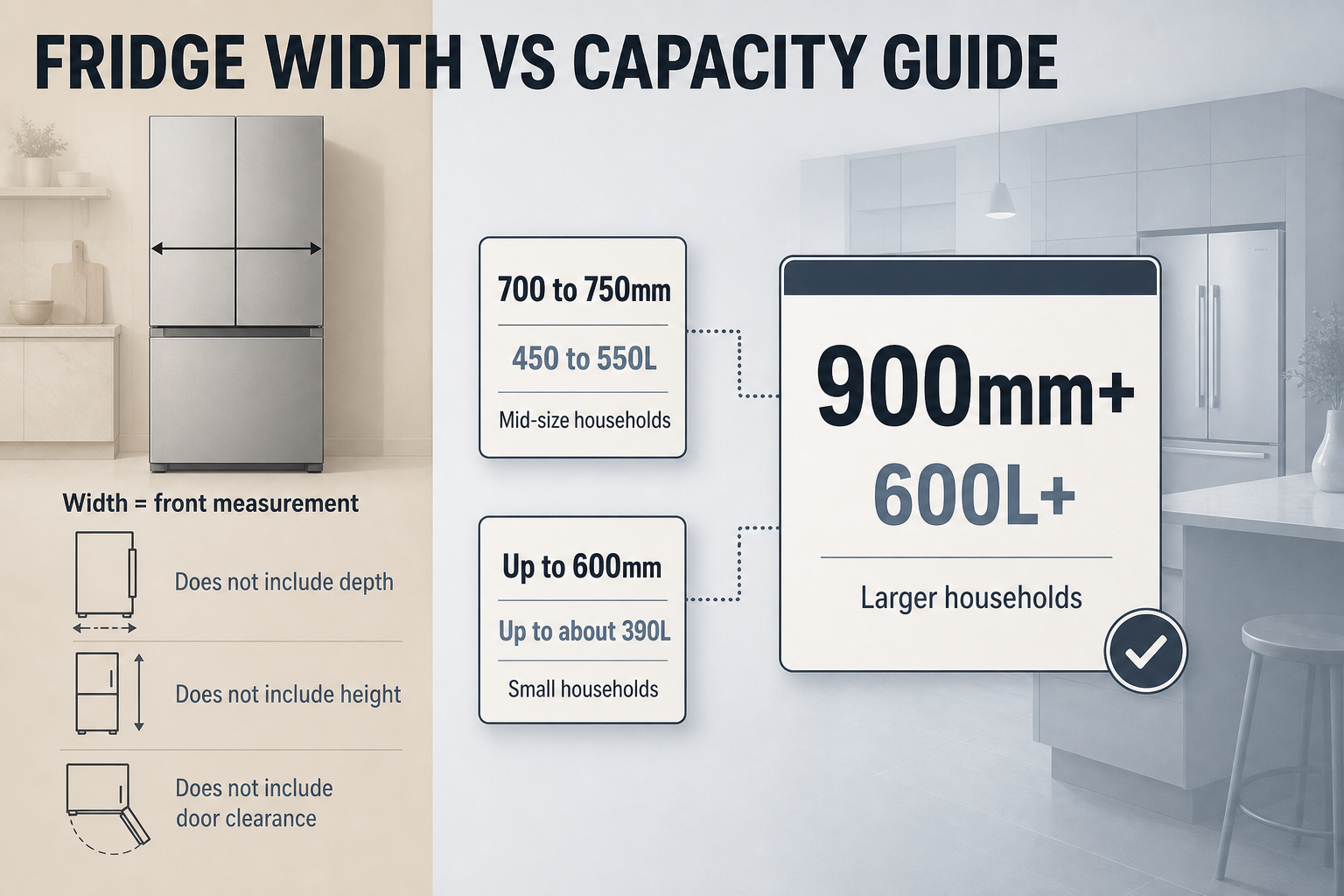
Width is the measurement across the front of the appliance, usually shown in millimetres. If a product is listed as 635mm wide, that means the front face spans 635mm from left to right. It does not tell you how deep it is, how tall it is, or how much clearance you need for doors to open properly.
In practical terms, width is closely tied to usable storage volume. A wider fridge usually gives you more shelf area, wider crisper bins, and more room for platters, pizza boxes, and bulk grocery shops. Samsung’s NZ guide says fridges up to 600mm wide are generally suited to small households with capacity up to about 390L, 700 to 750mm widths often match 450 to 550L, and 900mm wide models are commonly 600L and above. (samsung.com)
Width also affects installation. A 900mm fridge may physically fit the gap on paper, but still be a poor choice if cabinetry, wall returns, or an island bench restrict door swing. Fisher & Paykel’s planning guides note that installation dimensions can vary by model and that door clearance needs to be considered, especially for integrated units. (fisherpaykel.com)
Typical Ranges
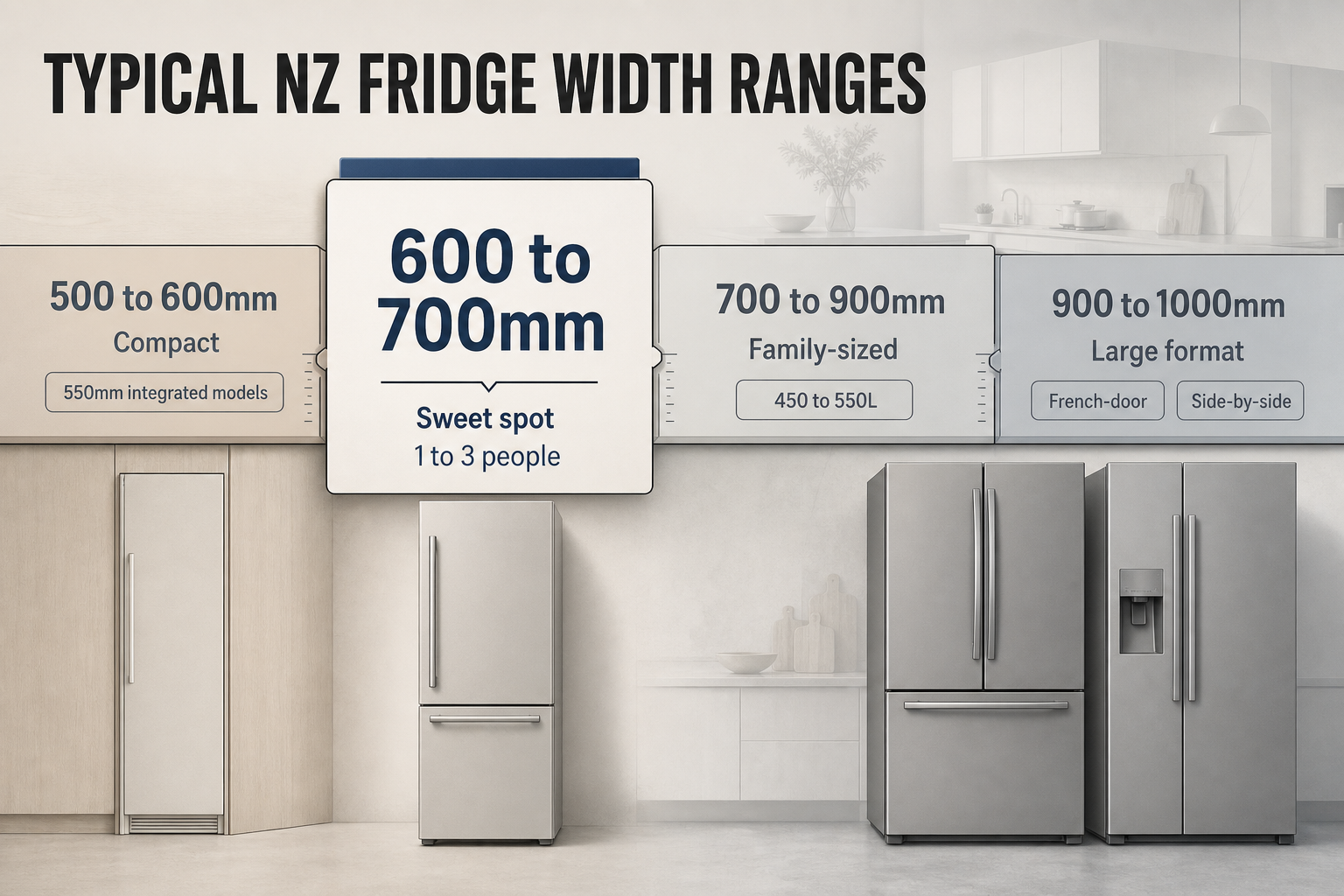
500mm to 600mm
This is the compact end of the range. Think slim single-door fridges, smaller top-mount units, apartment models, and some integrated appliances. Fisher & Paykel sells integrated models as narrow as 550mm wide, designed to sit within standard joinery. (fisherpaykel.com)
This width suits a couple in a flat, a small townhouse kitchen, a sleepout, or a bach where space matters more than total capacity. It can also make sense in older villas and units where kitchen footprints are tight and every millimetre counts. The trade-off is straightforward: less shelf width, less freezer space, and less flexibility for a big weekly supermarket run.
600mm to 700mm
For many NZ homes, this is the sweet spot. It lines up well with standard kitchen planning, because 600mm cabinetry modules are common in modular kitchen systems such as kaboodle’s NZ range. (kaboodle.co.nz)
A fridge in this band often works well for one to three people. You get enough room for normal grocery shopping without the appliance dominating the room. If your kitchen has a standard fridge recess or sits in a galley layout, this range is often the safest choice.
700mm to 900mm
This is where family-sized fridges start to feel generous. Samsung’s NZ guide places 700 to 750mm wide fridges in the mid-size household bracket, usually around 450 to 550L. (samsung.com)
These widths suit households that cook often, buy in bulk, or need room for lunchboxes, leftovers, and larger fresh-food compartments. In NZ terms, this can be a good match for a family in Hamilton, Christchurch or Tauranga with a modern kitchen but without the space for a full American-style unit.
900mm to 1000mm
This is the large-format end of the scale. French-door, quad-door, and side-by-side fridges often live here. Fisher & Paykel and Samsung both show 900mm-plus widths as a distinct category for higher-capacity models. (fisherpaykel.com)
This width suits bigger households, entertainers, and buyers who want wide shelving and freezer drawers rather than just extra height. It is especially useful if you shop at Costco-style bulk quantities, freeze meals ahead, or need space for platters over summer. The downside is that these units need more floor space, more side clearance, and more care during delivery.
Use-Case Guidance
If you live in an apartment or a compact Auckland terrace, stay realistic. A fridge around 550mm to 650mm wide is often easier to install, easier to move through hallways, and less likely to overwhelm the kitchen. You may lose some capacity, but the kitchen will work better day to day.
For a couple or small family, 600mm to 750mm is usually the practical zone. It gives you enough room for a proper weekly shop, meal prep containers, and a usable freezer without forcing a full kitchen redesign. If your current fridge feels cramped, moving from 600mm to 700mm can make a noticeable difference in shelf width and door bin space.
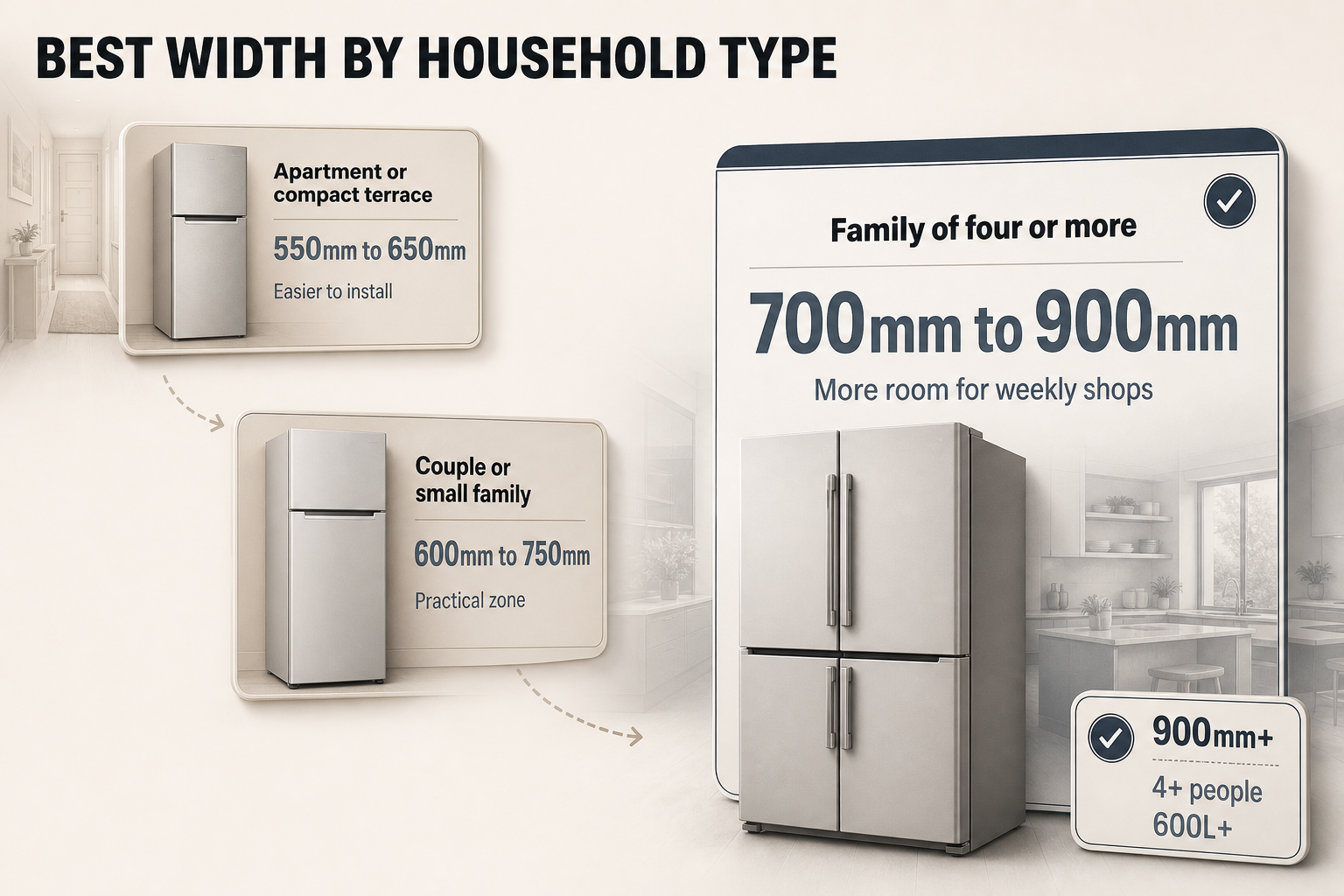
For a family of four or more, widths from 700mm to 900mm make sense if you have the room. That is especially true if you pack school lunches, buy milk in larger bottles, or prefer one big weekly shop instead of several smaller trips. Samsung specifically links 900mm-plus fridges with households of four or more and capacities above 600L. (samsung.com)
If you are building or renovating, do not choose width in isolation. Match the appliance to the cabinet plan, benchtop overhang, and adjacent walls. Integrated refrigeration is a separate case again, because the visible front, cavity width, and door panel setup can differ from a freestanding model. Fisher & Paykel’s planning documentation shows how exact those cavity dimensions can be. (fisherpaykel.com)
NZ-Specific Factors
The first NZ-specific issue is delivery access. A fridge that fits the kitchen can still fail at the front door, hallway turn, or laundry passage. New Zealand standards material states a minimum doorway clear width of 760mm in some cases, and common internal door slab sizes sold locally include 760mm and 810mm. That means a wide appliance may need doors removed from the fridge, doors removed from the house, or a completely different delivery path. (standards.govt.nz)
The second issue is kitchen module sizing. Many NZ kitchens are designed around 600mm increments, and modular cabinet systems commonly offer 600mm and 900mm cabinet widths. That does not mean your fridge should exactly match those numbers, but it does mean these widths often integrate more neatly into the room. (kaboodle.co.nz)
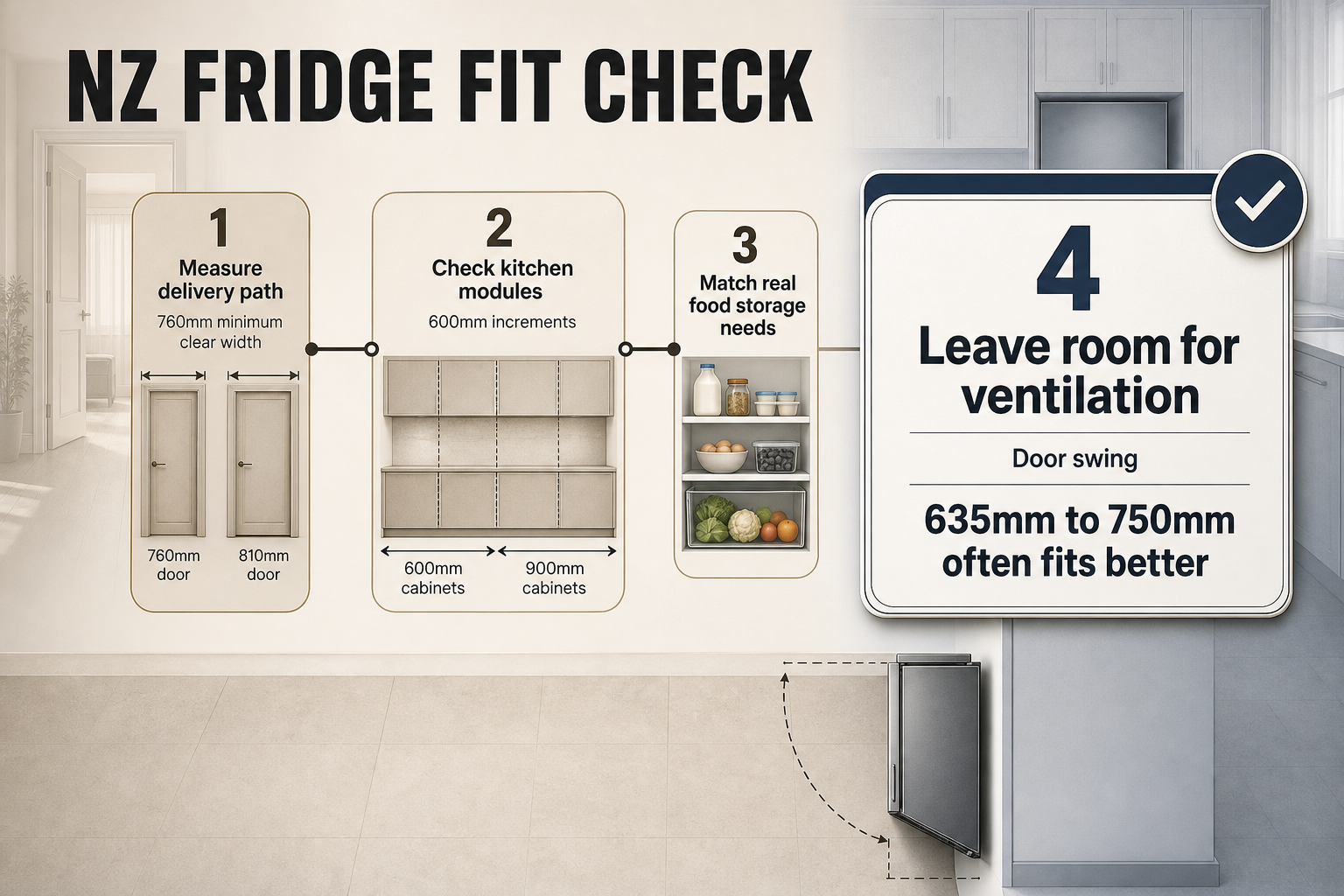
The third issue is how we shop and store food. If you live rurally, or you do one large weekly shop instead of popping to the supermarket every day, a wider fridge can be genuinely useful. The same applies if you keep extra chilled food for long weekends, fishing trips, or a full household over summer. In contrast, if you live close to shops and cook simply, you may be paying for width you do not need.
Finally, remember that wider is not always better. A 900mm fridge can look impressive, but in many NZ kitchens a well-chosen 635mm to 750mm model will fit better, waste less space, and still cover your real needs. Measure the opening, measure the delivery path, and leave room for ventilation and door swing before you fall in love with the biggest unit on the showroom floor.
You may also be interested in these independent articles
Sources
- [1]Samsung New Zealand Refrigerator Buying Guide
- [2]Fisher & Paykel NZ Refrigeration Range
- [3]Fisher & Paykel NZ Freestanding Refrigeration
- [4]Fisher & Paykel 60cm Integrated Refrigerator Freezer
- [5]Fisher & Paykel Integrated Refrigeration Planning Guide
- [6]kaboodle NZ 600mm Pantry Cabinet
- [7]kaboodle NZ Fridge Cabinet
- [8]Standards New Zealand NZS 4121:2001
- [9]Bunnings New Zealand 810mm Interior Door
- [10]Bunnings New Zealand 760mm Interior Door
© 2026 pyfoi. All rights reserved.